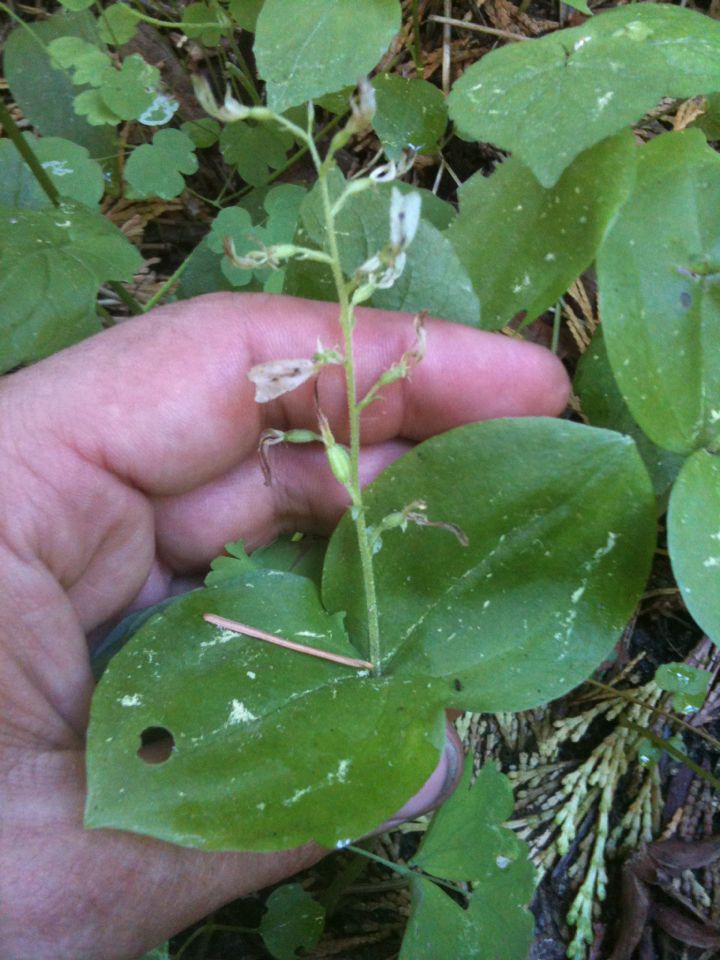
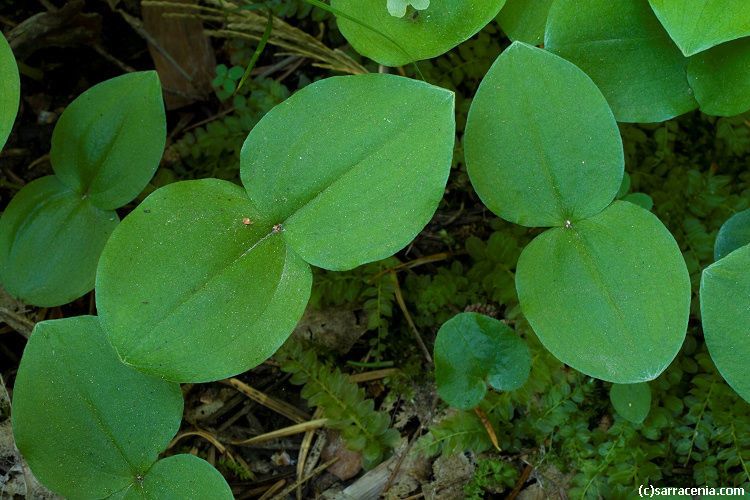
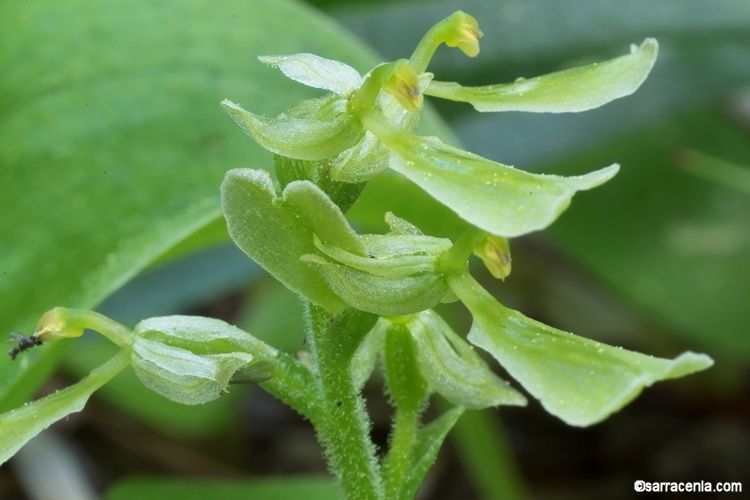
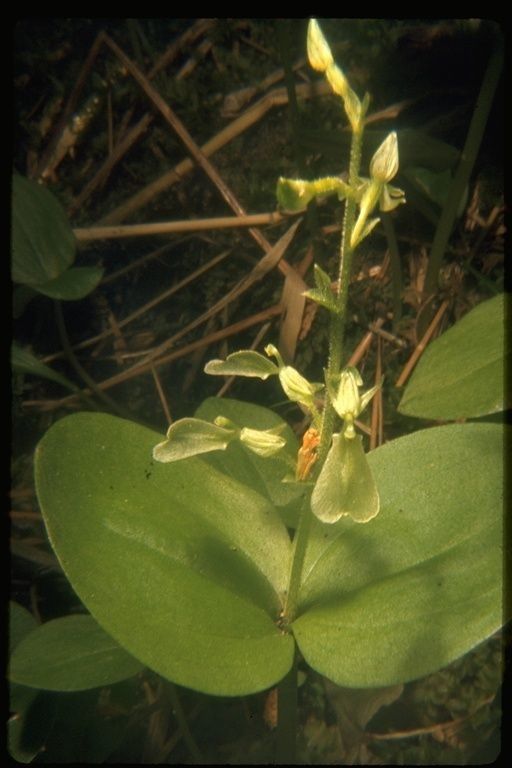
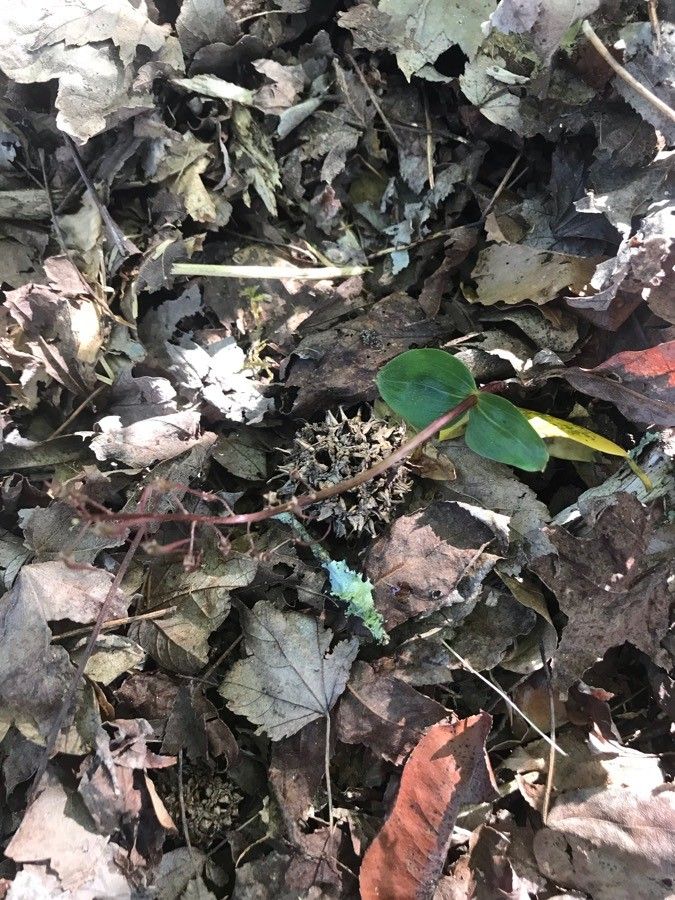
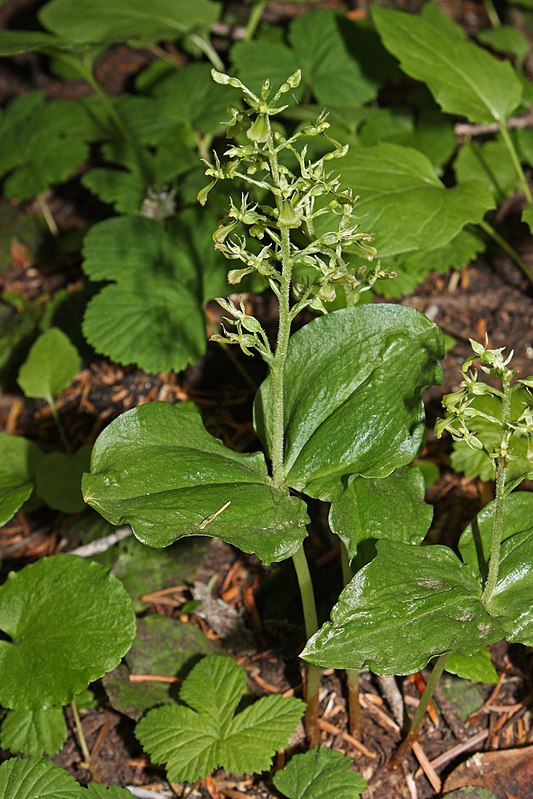
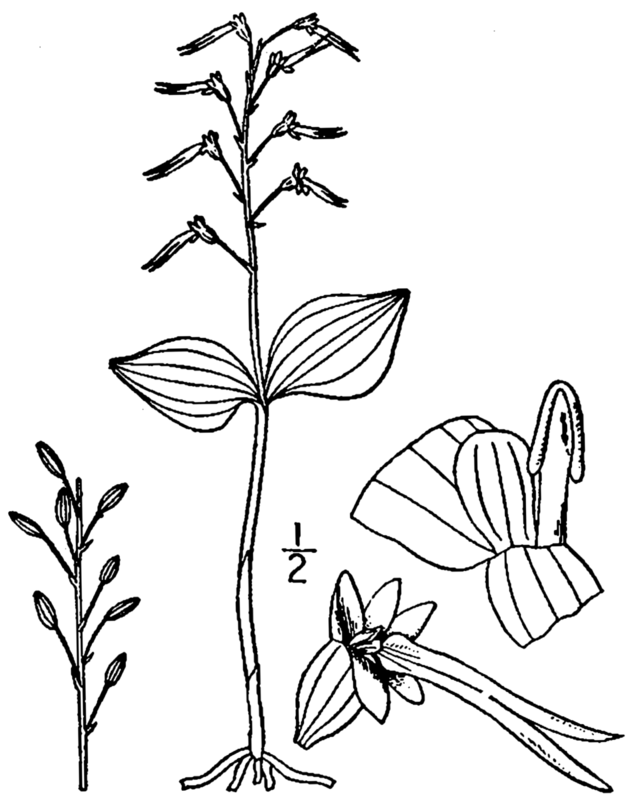
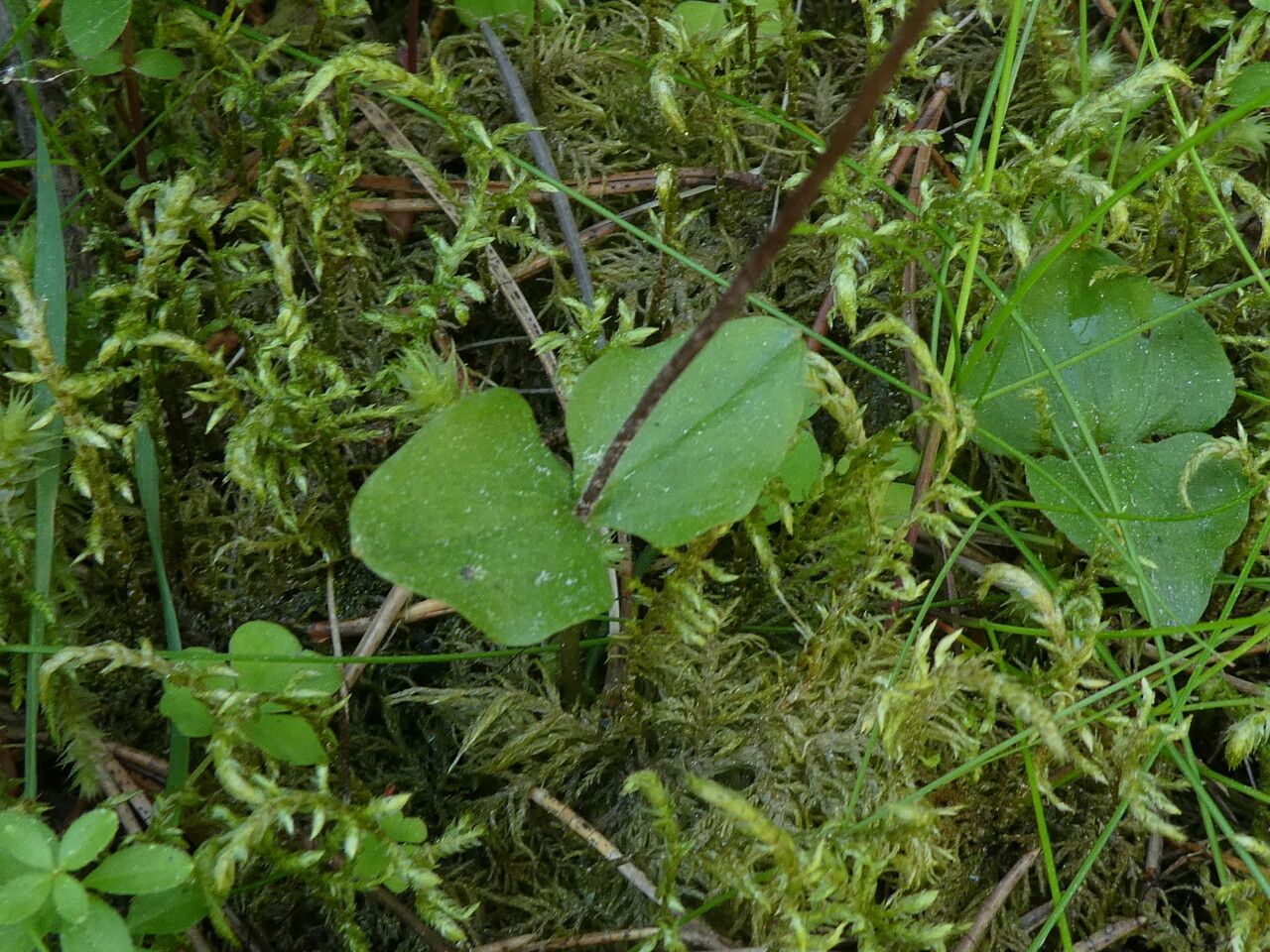
Neottia convallarioides is a species of orchid known by the common names broad-lipped twayblade and broad-leaved twayblade. It was formerly placed in the genus Listera, but molecular phylogenetic studies have shown that Neottia nidus-avis, the bird's-nest orchid, evolved within the same group, and all species of Listera have been moved to Neottia.Neottia convallarioides is native to much of Canada and in parts of the United States (Alaska, the Great Lakes Region, New England, and the mountains of the West: Rockies, Cascades, Sierra Nevada, etc.). I also reportedly occurs in St. Pierre & Miquelon and on the Komandor Islands in the Bering Sea, part of the Russian Far East.Neottia convallarioides is a plant of cool, moist, dim habitat, such as woods and forest, as well as swamps and streambanks. It is a rhizomatous perennial herb growing erect 10 to 35 centimeters tall. It has one pair of green oval leaves each up to 7 centimeters long near the base of the stem. The inflorescence is a small raceme of green or yellow-green flowers, sometimes slightly purple-tinged. Each has usually 3 reflexed lance-shaped sepals, 2 similar petals, and one petal known as the lip, which is longer, wedge-shaped, and notched at the tip. The plant sometimes forms large colonies, creating a groundcover. It is known to hybridize with Neottia auriculata.
Broad-lipped twayblade typically has strong resistance to disease and is affected by relatively few insect pests. Its care is considered difficult because it needs high humidity together with good ventilation and a low presence of harmful pathogens. Too much watering can cause root rot. Although anyone can grow Broad-lipped twayblade, keeping it healthy and getting it to bloom again requires more growing experience.
How to keep Neottia Convallarioides.
Water
The broad-lipped twayblade thrives in moist conditions but can tolerate periods of drought. During the summer, water it weekly. In the fall and winter, water every 10 days. Keep the humidity levels up by misting the plant and use water with a neutral pH. To neutralize tap or rainwater, let it sit for a while to allow dissolved CO2 and other substances to dissipate.
Fertilizer
Broad-lipped twayblade typically only requires a fertilizer application once during the spring, although growth can be optimized with multiple feedings. Provide nourishment every 30 to 45 days. The act of fertilizing improves the look and functionality of the leaves, encouraging regular coloring and robust texture. Additionally, it incentivizes root development and the uptake of nutrients, which is beneficial for the plant's health in the long run.
Pruning
The broad-lipped twayblade benefits from light pruning from early to late spring, especially targeting dead or damaged leaves. This practice promotes healthy growth, prevents diseases, and helps maintain the plant's natural shape. Regularly checking for overgrowth ensures good air circulation, following horticultural guidelines for optimal plant health.
Botanical profile.
- Plant Type
- Herb
- Life Cycle
- Perennial
- Genus
- Neottia
- Family
- Orchidaceae
- Hardiness Zone
- 9-11
- Leaf Type
- Deciduous
- Flower Color
- White, Yellow, Green
Other names.
Reader questions.
What is the common name of Neottia convallarioides?
The common name of Neottia convallarioides is Broad-lipped twayblade.
What are the essential information and symptoms related to the Broad-lipped twayblade?
For the Broad-lipped twayblade, or Neottia convallarioides, there were no specific details provided regarding its essential information or symptoms.