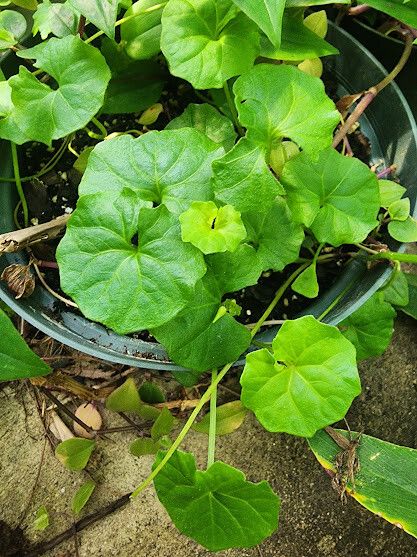
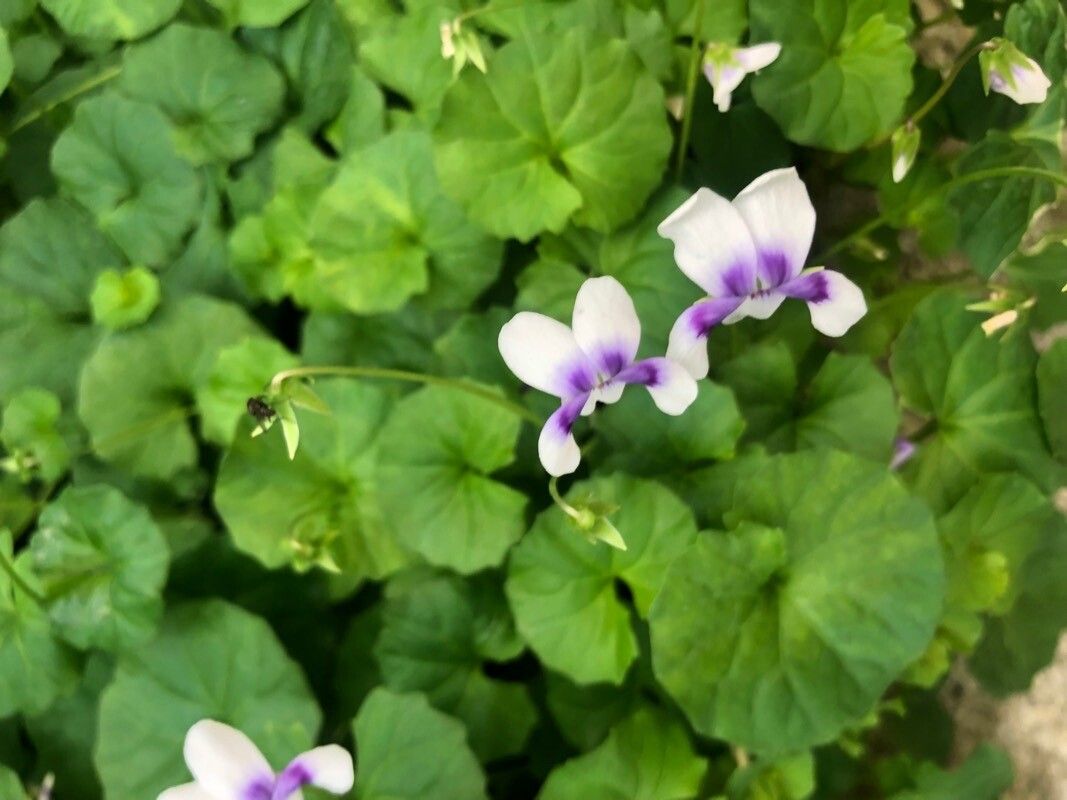
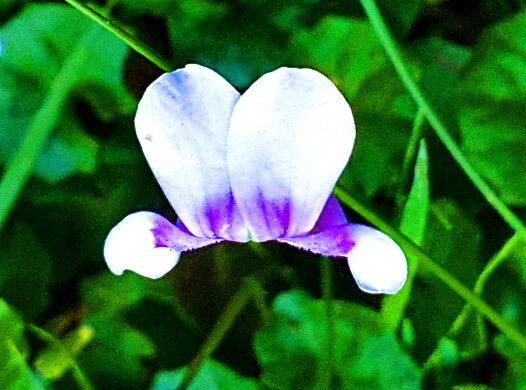
Viola banksii, commonly known as native violet, is sold and grown throughout garden nurseries and grown and loved in gardens around Australia, especially in the east. For many years it was known as Viola hederacea, however, the species complex was revised in 2004 by Kevin Thiele, with the name Viola banksii being published in 2003 by Kevin Thiele and Suzanne Prober. Although the Native Violet was initially collected by Banks and Solander, the type specimen was either lost or not provided until a collection by Jacques Labillardière in Tasmania. Thiele discovered that the original type specimen of V. hederacea collected by Labillardière was not the same as the hardier and showier plant later collected, cultivated and widely sold. This second form, native to the east coast from near Brisbane to Batemans Bay, he named Viola banksii. This species is distinguished by its striking purple and white flowers. As well, the fully developed leaves are almost circular in outline with a deep, narrow, v-shaped sinus at the base, and are usually rather bright, fresh green.
Native violet has strong resistance to disease and is generally unlikely to suffer from illnesses. Still, it can be vulnerable to pests and diseases found in its environment. Such infections are typically mild. Regarding care, this plant needs a moderate amount of upkeep. It should be pruned on a regular basis to preserve its appearance and encourage healthy growth. Applying fertilizer can also help stimulate blooming. Native violet is well suited for anyone with outdoor space, like a garden or patio, and does not demand extensive plant-care experience. It may need more attention if grown indoors.
How to keep Viola Banksii.
Light
The native violet occurs naturally in habitats like forest understories or rocky sites, where it lives under natural shade. It prefers partial sun but can tolerate full sun or full shade, showing its hardy and adaptable nature.
Water
Native violet flourishes in humid environments similar to tropical rainforests, requiring regular weekly watering to keep its growth lush and healthy. As an evergreen plant, it needs consistent watering, even during the cooler months, which makes it an excellent choice for indoor gardening.
Temperature
Native violet can adjust to a wide range of temperature conditions, but its distribution may still be restricted by different mixes of moisture and heat. It does best in warm summer climates with adequate rainfall or watering. Long periods of cloudy, rainy weather or persistent high temperatures can heighten the chance of Native violet dying. In winter, proper protection from the cold can increase the plant's survival prospects.
Fertilizer
The ideal time to fertilize a Native violet is in early spring, when it is coming out of dormancy and beginning active growth. Fertilization supplies essential nutrients for healthy development. Although the Native violet has relatively low fertilization needs, applying fertilizer annually can enhance its survival and promote better, longer-lasting flowers.
Pruning
Native violets are known for their vibrant flowers and their ability to cover the ground effectively. Performing light pruning from early to late spring can encourage new growth by removing spent blooms and damaged stems. This practice improves air circulation, helps prevent disease, and enhances the plant's vigor. To ensure precise cuts, use clean, sharp tools.
Botanical profile.
- Plant Type
- Herb
- Life Cycle
- Perennial
- Genus
- Viola
- Family
- Violaceae
- Hardiness Zone
- 4-9
- Mature Height
- 0 cm to 6 cm
- Mature Spread
- 10 cm to 30 cm
- Leaf Color
- Green, Dark Green
- Leaf Type
- Evergreen
- Flower Color
- White, Violet
- Flower Size
- 1.02 cm to 2.03 cm
- Bloom Time
- All year round
- Planting Time
- Spring, Summer, Autumn
- Harvest Time
- All year round