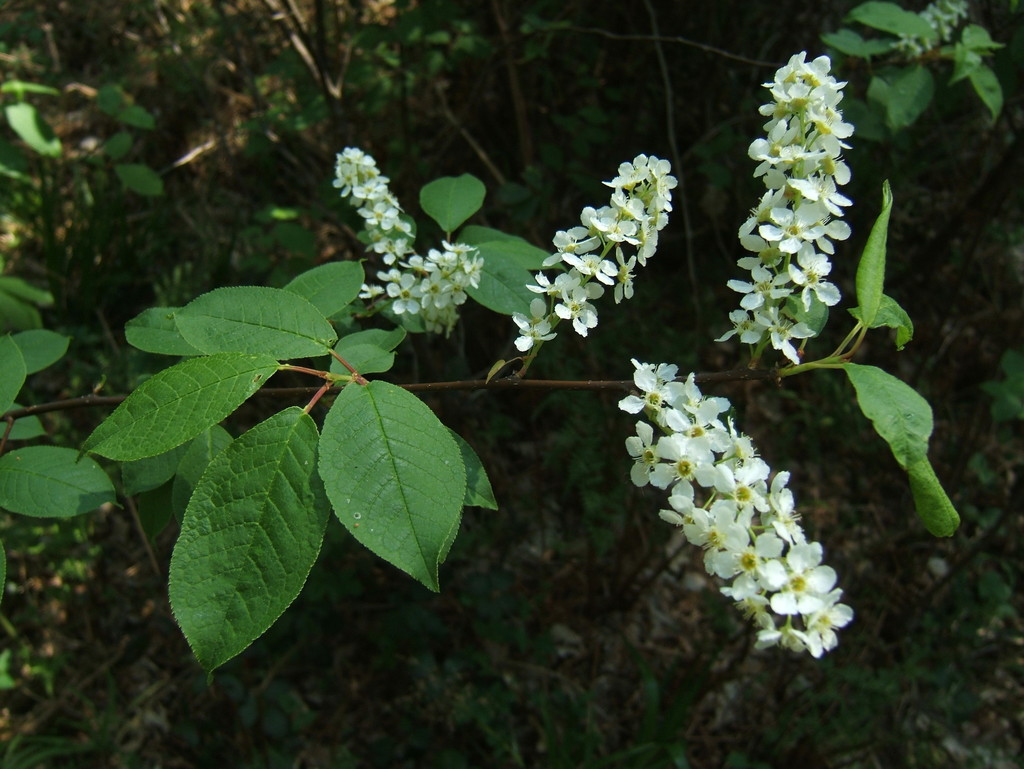
Prunus padus, commonly known as bird cherry, is a deciduous tree or shrub in the Rosaceae family. Native to Europe and Asia, it can reach heights of 10 to 15 meters. The tree features a slender trunk with smooth gray bark and dark green leaves that turn yellow in autumn.
In early spring, bird cherry produces fragrant white flowers. These blossoms are followed by small black cherries, which are popular with birds. While the fruit is edible, it has a bitter taste due to the presence of cyanogenic glycosides.
This plant thrives in moist soils and can endure both full sun and partial shade. Its attractive flowers and foliage make it a popular choice for ornamental use in gardens.
Although birds are quite fond of the berries from the Prunus padus, these berries are rarely eaten by humans due to their bitterness, which is caused by their tannin content. The bird cherry serves as a host plant for the bird cherry-oat aphid (Rhopalosiphum padi) and the bird cherry ermine moth (Yponomeuta evonymella). However, these species do not cause significant damage to the trees. FUN FACT · FROM THE LIBRARY
In traditional medicine, various parts of the bird cherry have been utilized for their medicinal properties, including treating coughs, colds, fever, and respiratory tract inflammation, among other ailments.
Overall, the Prunus padus is valuable both for its aesthetic appeal and its medicinal properties, making it an important species within the ecosystem.
Bird Cherry, also known as European Bird Cherry, Hagberry, or Hackberry, is a plant whose fruit is a popular food source for birds. While these birds can pose a challenge for horticulturists by consuming the cherries, they also play a crucial role in the plant's reproduction. As birds feed on the cherries, they help disperse the seeds of Prunus padus, facilitating its spread and growth. In English, the fruit of Prunus padus is sometimes called hackberry or hugberry.
Bird cherry exhibits strong disease resistance and is typically not susceptible to illnesses. With regard to care, this species is fairly low-maintenance. When grown outdoors it needs only light watering, and larger plants usually do not require pruning. Smaller plants, however, should be pruned after they finish blooming. Bird cherry is appropriate for anyone who has an outdoor area, like a garden or a deck, and it does not demand extensive gardening experience.
How to keep Prunus Padus.
Light
Bird cherry does best when it gets plenty of sunlight during the day. It can also tolerate conditions where the sun’s rays are partially diffused or dappled. Both an excess and a shortage of sunlight can adversely affect its growth, mirroring the conditions of its native habitat.
Water
The bird cherry prefers moderate moisture and should be watered every three weeks. Although it is resilient and can withstand periods of drought, its growth cycle, when grown outdoors, adapts to local rainfall patterns. This adaptation influences both its water intake and overall health.
Humidity
This plant will thrive in moderate humidity, which is probably the level in your home. However, misting it a few times a week can be very beneficial. Make sure the room has good ventilation.
Temperature
Bird cherry originates from climates with temperatures ranging from 41 to 95°F (5 to 35℃). It favors areas that are neither overly hot nor excessively cold. Across seasons, you may need to make adjustments to replicate this temperature range.
Fertilizer
Timing is important for fertilizing bird cherry. Apply fertilizer in early spring and continue monthly until early summer. Fertilizer encourages attractive blooms and supplies energy during both dormant and active growth periods.
Pruning
The bird cherry is a deciduous tree known for its fragrant white blossoms. To promote growth and flowering, it's best to prune the tree in late winter while it's dormant. During pruning, remove any dead or crossed branches to improve the tree's structure and airflow, which helps reduce pests and diseases. Regular pruning not only enhances the tree's health but also encourages vigorous growth and more abundant blooms.
Botanical profile.
- Plant Type
- Tree, Shrub
- Life Cycle
- Perennial
- Genus
- Prunus
- Family
- Rosaceae
- Hardiness Zone
- 5-9
- Mature Height
- 4.88 m to 15.85 m
- Mature Spread
- 14.94 m
- Leaf Color
- Green, Yellow, Red
- Leaf Type
- Deciduous
- Flower Color
- White
- Flower Size
- 0.51 cm to 1.02 cm
- Bloom Time
- Late spring, Early summer
- Planting Time
- Spring, Autumn
- Harvest Time
- Mid summer
- Native Area
- Ireland
Other names.
Reader questions.
How should I water my Bird cherry tree in the best way?
To promote excellent root development, place a garden hose at the base of the plant. Avoid spraying the leaves directly, as they may need more watering if exposed to direct sunlight. Additionally, you can use bubblers or soaker hoses to moisten the roots of each plant or cover the entire garden bed. When adding or removing plants, use soaker hoses to help push the roots deeper. Make sure to drain any excess water and wait for the soil to dry before watering again. Water at ground level to prevent diseases. On sunny days, consider spraying the entire bush with water. Whether the plant is in a pot or in the ground, it is important to remember that Bird cherry prefers deep watering rather than light sprinkling.
Why should I put fertilizer on my Bird cherry?
Fertilizing a Bird cherry is crucial for several reasons. Firstly, it helps the tree produce beautiful blooms. The best time to fertilize is early spring, ensuring excellent flower growth. Secondly, fertilizer provides the tree with ample energy that it can store in the ground during dormant phases. By giving the tree extra nutrients during fall planting or late spring, it can conserve more energy to use when it starts growing again.
What are the sunlight requirements for Bird Cherry?
Bird cherry plants thrive best when exposed to full sunlight, which means they should receive above 6 hours of direct sunlight each day. They can also cope with partial sun, getting about 3-6 hours of sunlight. It's crucial to observe how sunlight moves through your garden, seeking spots that provide a perfect balance of light and shade. This careful placement ensures the plants' happiness by mimicking their native habitat conditions, where the balance of sunlight plays a significant role in their growth.
What is the native climate for Bird cherry?
Bird cherry is native to climates where temperatures vary from 41 to 95°F (5 to 35°C), preferring regions that are neither too hot nor too cold. To maintain its health throughout different seasons, adjustments might need to be made to accurately simulate this temperature range. Bird cherry exhibits strong cold resistance, making special frost protection measures usually unnecessary during winter. Still, for temperatures expected to drop below -25°C, it's important to provide cold protection by wrapping the trunk and branches with non-woven fabric or cloth. An abundant watering before the first freeze of autumn is recommended to keep the soil moist, helping to prevent drought and water scarcity during winter and early spring.
What do I do if I give Bird cherry too much or too little water?
When a Bird cherry is overwatered, its leaves can turn yellow, drop off, and wilt. The plant may also appear dull and unhealthy, with mushy stems. It's important to adjust your watering schedule when these signs begin to show. Conversely, wilting can also indicate under watering, in which case the leaves may become crispy and dry. When the soil is dry and simply watering is not enough, give the plant a thorough soak. While this will help the Bird cherry recover, it may still have dry, yellow leaves for a few days due to damage to the root system. Once the plant returns to normal, the yellowing of leaves will stop. For indoor Bird cherries, always check the moisture levels in the pot and be cautious not to overwater. Look out for black spots, and if present, allow the soil to dry by refraining from watering for a few days. Overwatering can lead to root rot, so if you observe discolored and slimy roots, consider transferring the plant to a different pot and take steps to prevent future root rot by avoiding excessively soggy soil. When planting Bird cherries outdoors, ensure you dig deep enough. If the soil feels too dry when you check with your fingers, it may indicate under watering, requiring adequate watering to assist the plant in recovering.
When should I fertilize my Bird cherry for the best results?
To effectively fertilize Bird cherry, it is important to time it correctly. Fertilizing too early, when the tree is still dormant and inactive, would result in ineffective use of the fertilizer, as it would be washed away by rainwater. To prevent waste and pollution, the first application of fertilizer should be applied in early spring. After that, continue fertilizing once a month until early summer.
How does artificial lighting benefit Bird Cherry plants?
For Bird cherry plants situated indoors or in areas with insufficient natural sunlight, particularly during winter or in less sunny spaces, artificial lighting serves as an essential growth promoter. Opting for LED lights, which can be customized to provide specific wavelengths of light, helps fulfill the plant's light requirements. These artificial lights should range from 30-50W/sq ft for full sun plants to 20-30W/sq ft for partial sun plants, and 10-20W/sq ft for full shade plants. Positioning the light source 12-36 inches above the plant simulates natural sunlight conditions. Ensuring the plants receive 8-12 hours of artificial light per day is key to emulating the natural daylight hours and promoting healthier, more robust growth.
How does Bird cherry respond to low temperatures, and what are the solutions?
Bird cherry is highly cold-tolerant, thriving best when the temperature is above 5°C and should ideally be kept above -20°C during winter. If temperatures fall below -25°C, the branches might become brittle and dry by spring, potentially resulting in no new shoots emerging. A viable solution in spring involves pruning away any dead branches that have failed to produce new leaves, promoting healthier growth and recovery from the cold damages.
How often do I need to water my Bird cherry plant?
The Bird cherry prefers deep and infrequent watering. When planted in pots, it is important to soak them in a gallon of water each time because the soil in pots dries out faster. In cold regions, watering is needed every 3 to 5 days. Watering should be done early in the morning when the soil is dry, whether the plant is indoors or outdoors. Checking the soil is also a good way to determine if watering is necessary. When the top 2-3 inches of soil is dry, it is time to give the plant a full watering. During hot days, it is recommended to check the moisture daily as the soil in pots can dry out quickly due to the heat. For garden plants, irrigation is necessary in hot climates and watering once a week is sufficient. Only water when about 2 to 3 inches of soil becomes too dry, and make sure not to add water if there has been a lot of rainfall to prevent root rot. Bird cherry plants generally grow in spring and fall. When grown outdoors, adding mulch about 3 to 4 inches deep can help conserve water. Sandy soil requires more frequent watering compared to clay soil, which can go for 2-3 days without water. Keeping track of watering dates on a calendar can help ensure timely watering, and if the leaves start drooping, it may be an indication that watering is needed soon.
When is it not a good idea to fertilize my Bird cherry?
To ensure the optimal growth and blossoming of Bird cherry, it is important to carefully consider its fertilizer needs. Avoid using a fertilizer high in nitrogen, as this can cause excessive leaf growth but limited blooming. Instead, select a fertilizer with a lower nitrogen content in comparison to other nutrients. It is advisable to avoid fertilizing Bird cherry after early autumn, as this can result in excessive growth just before winter. Additionally, refrain from fertilizing during hot and dry periods, as dry soil does not effectively deliver nutrients like moist soil does. Fertilizing at this time can also stimulate growth, requiring additional water that may not be readily available. Optimal fertilization should occur earlier in the season when temperatures are cooler. Lastly, keep in mind that Bird cherry can absorb fertilizer applied to nearby plants or lawns, so exercise caution to avoid inadvertently over-fertilizing the tree or shrub.
What are some common symptoms of inadequate sunlight in Bird Cherry plants?
Bird Cherry plants manifest several symptoms when experiencing insufficient sunlight, including new leaves growing smaller than previous ones, a leggy or sparse appearance due to elongated spaces between leaves or stems, premature leaf drop to conserve resources, halted growth as the plant enters survival mode, and the development of lighter-colored or irregularly patterned new leaves indicating a lack of chlorophyll. Additionally, excessive sunlight can lead to chlorosis (leaves turning yellow), sunscald, leaf curling as a defense mechanism against overexposure, wilting due to increased water loss, and leaf scorching characterized by brown, dry edges on leaves. These symptoms highlight the plant's sensitivity to both inadequate and excessive sunlight.
How should Bird cherry be cared for in high temperatures?
During summer, Bird cherry should be maintained in conditions where the temperature stays below 35°C. Temperatures exceeding 38°C can cause the leaves to lighten in color, tips to become dry and withered, and increase susceptibility to sunburn. To mitigate these effects, sunburned and dried-up parts should be trimmed away. The plant should be moved to a location that offers shade from the midday and afternoon sun or be covered with a shade cloth. Additionally, watering the plant in the morning and evening can help keep the soil moist and reduce stress from high temperatures.