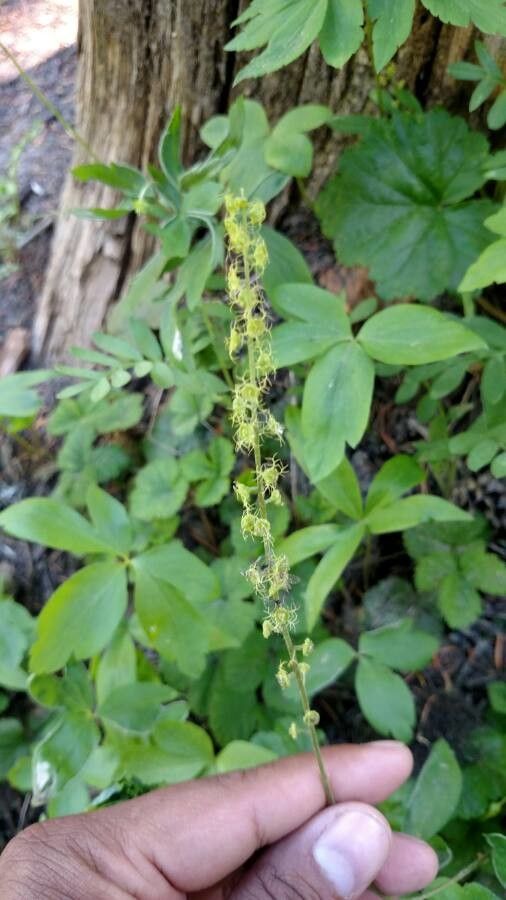
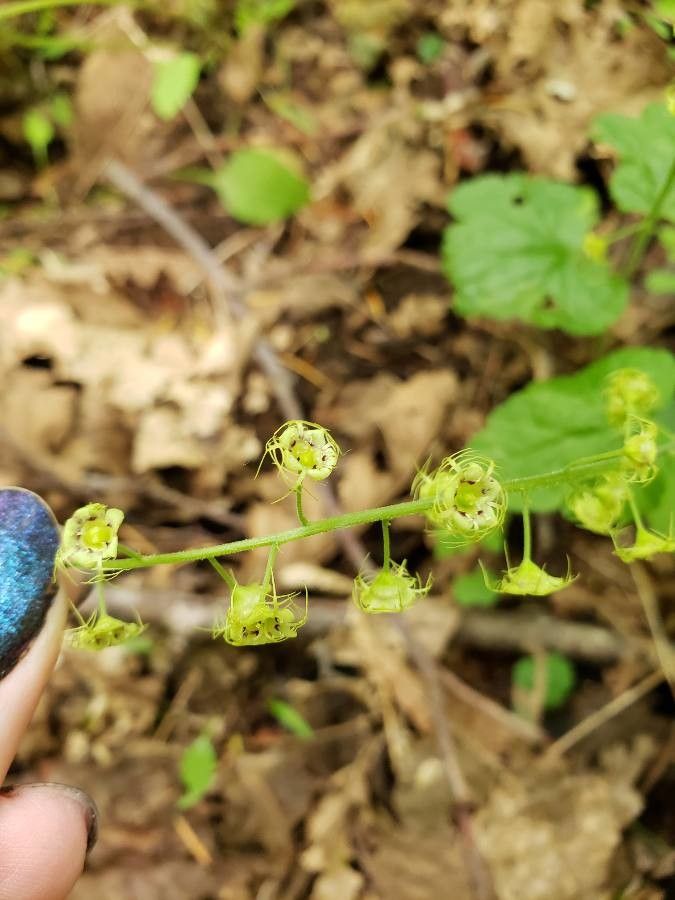
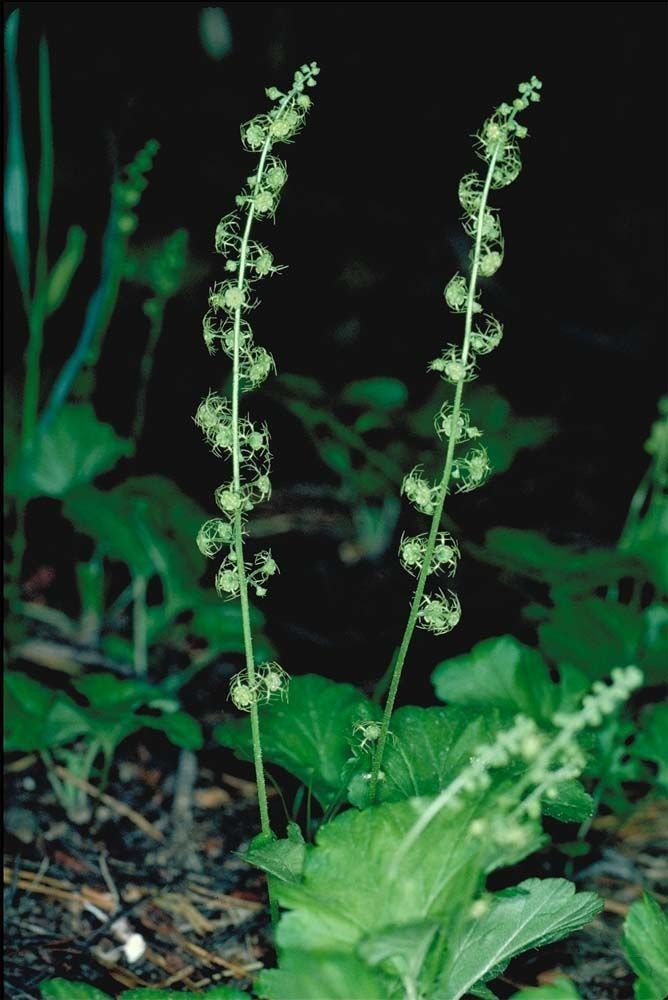
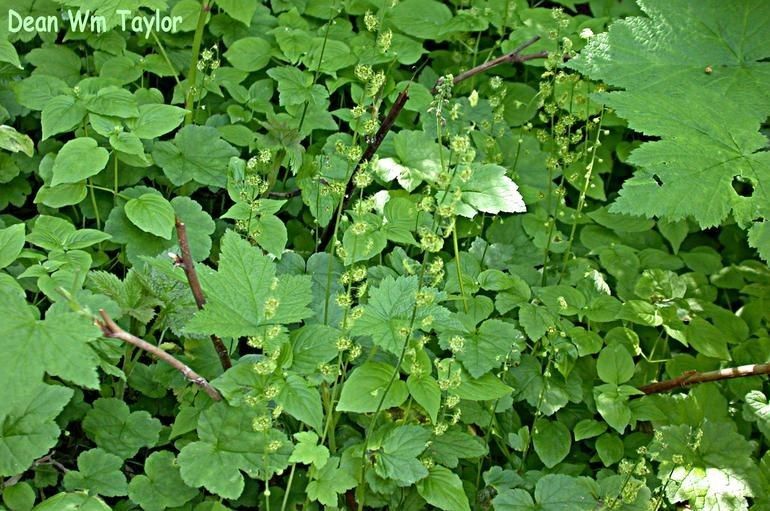
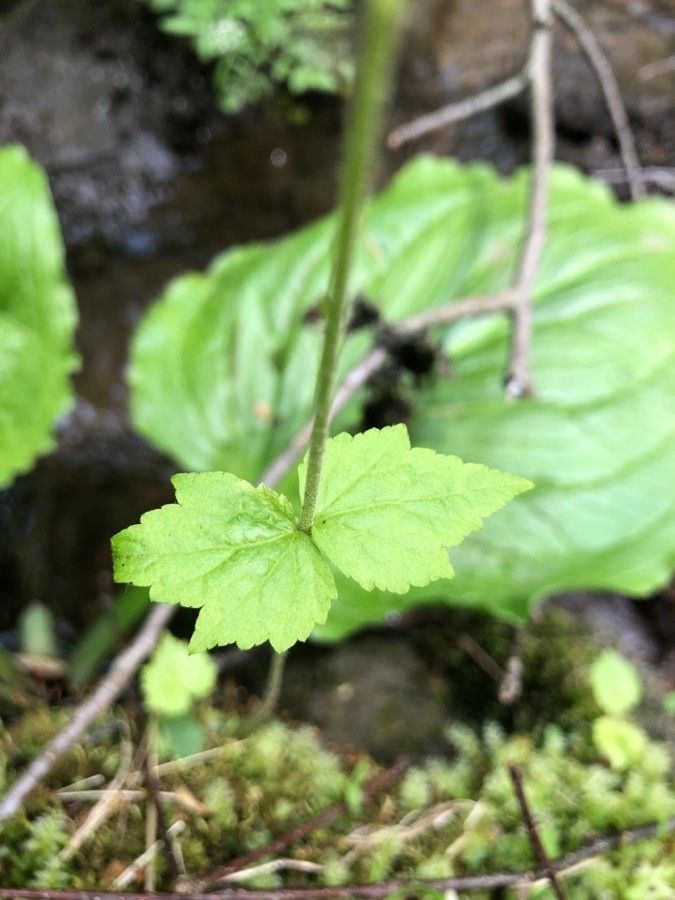
Mitella breweri is a species of flowering plant in the saxifrage family known by the common names Brewer's mitrewort and Brewer's bishop's cap. It is native to western North America from British Columbia to central California (Sierra Nevada range) and Nevada, where it grows in moist meadows, woods, and mountain forests. It is a rhizomatous perennial herb growing up to about 30 or 40 centimeters tall. Most of the leaves occur around the base of the stem. They have rounded blades several centimeters wide and edges divided into dull toothed lobes. The erect inflorescence bears several flowers, sometimes over 50, usually along one side of the stem. The distinctive flower is saucer-shaped with five greenish petals which are divided into narrow, whiskerlike lobes. This plant is listed as Pectiantia breweri by Calflora.
Brewer's miterwort is fairly resistant to disease and generally not prone to illness. However, it can be susceptible to pests and diseases present in its surroundings. These infections are typically minor. Regarding care, this plant has moderate maintenance needs. It should be pruned regularly to maintain a neat appearance and healthy growth. Fertilizing can also help encourage flowering. Brewer's miterwort is suitable for anyone with an outdoor area, such as a garden or patio, and does not demand extensive care experience. It may require additional attention when grown indoors.
How to keep Mitella Breweri.
Light
The Brewer's miterwort plant exhibits a distinct preference for low-light environments and tends to flourish in such conditions. Overexposure to sunlight may pose a threat to this plant, while an absence of light does not present any notable difficulties. This preference can be traced back to the specific light conditions in its native habitat.
Water
Brewer's miterwort thrives in environments that mimic its natural forest habitat, which are moist and shaded. To maintain its health, it requires evenly moist soil, high humidity, and weekly watering. Although it is often cultivated indoors, regular watering helps enhance its seasonal foliage display.
Temperature
The Brewer's miterwort plant originates from regions with temperate climates that fall between 41 and 95 °F (5 to 35 ℃). This vegetation flourishes in consistent weather conditions, and any severe temperature variations ought to be managed to guarantee its robust expansion.
Fertilizer
Typically, a single fertilizer application in the spring should be adequate for Brewer's miterwort. However, to optimize growth, you could feed it multiple times. Apply the fertilizer every one to one and a half months. Fertilizing improves the look and functionality of the leaves, encouraging uniform color and a wholesome texture. Additionally, it boosts the growth of the roots and aids in absorbing nutrients, supporting the plant's health over time.
Pruning
Brewer's miterwort is a rhizomatous perennial that flourishes in shady areas and showcases delicate, star-shaped flowers. To maintain its health and appearance, prune the plant in early spring. This will remove dead stems, improve air circulation, and prevent it from self-seeding. Regular pruning encourages healthy growth and enhances the visual appeal of Brewer's miterwort.
Botanical profile.
- Plant Type
- Herb
- Life Cycle
- Perennial
- Genus
- Mitella
- Family
- Saxifragaceae
- Hardiness Zone
- 5-9
- Mature Height
- 15 cm to 40 cm
- Mature Spread
- 20 cm
- Leaf Color
- Green
- Leaf Type
- Evergreen
- Flower Color
- Green, Yellow
- Flower Size
- 0.25 cm to 0.51 cm
- Bloom Time
- Mid spring, Late spring
- Planting Time
- Spring, Summer, Autumn
- Harvest Time
- Early summer, Mid summer
Other names.
Reader questions.
What are the sunlight requirements for Brewer's miterwort?
Brewer's miterwort requires full shade, defined as less than 3 hours of sunlight per day. It thrives in environments with little to no light, mirroring its origin habitat's specific light conditions. Excessive sun exposure can harm the plant, but a lack of light does not present significant challenges. It's crucial to observe the movement of sunlight through your garden to ensure the plants are positioned in spots that provide the perfect balance of light and shade for their happiness.
What is the native temperature range for Brewer's miterwort?
Brewer's miterwort is native to environments with moderate temperatures, thriving in climates where temperatures range between 41 to 95 °F (5 to 35 °C). This plant prefers stable climates, and any sudden change in temperature should be carefully managed to promote its healthy development. Despite its strong resistance to cold, it's essential to guard against extreme cold conditions to maintain its well-being.
How does Brewer's miterwort respond to artificial lighting?
When natural sunlight is insufficient for Brewer's miterwort, particularly in winter or less sunny spaces, artificial lights offer a vital solution for optimal growth. LED lights are recommended, as they can be customized to provide the specific wavelengths of light that plants need. Full shade plants like Brewer's miterwort need 10-20W/sq ft of artificial light. The light source should be placed 12-36 inches above the plant, mimicking natural sunlight, and provided for 8-12 hours per day to promote healthier growth.
How can you protect Brewer's miterwort during extremely cold winters?
Brewer's miterwort is quite resilient to cold weather, and special frost protection measures aren't generally needed during winter. However, for temperatures expected to fall below -25°C, providing some form of cold protection is crucial. This can involve covering the plant with soil or straw to shield it from harsh winter conditions. Additionally, it's advisable to water the plant abundantly before the first autumn freeze, ensuring the soil is moist when it freezes. This tactic helps prevent the plant from experiencing drought and water scarcity during the colder months and early spring.
What symptoms indicate Brewer's miterwort is receiving insufficient light?
Symptoms of light deficiency in Brewer's miterwort include small leaves, leggy or sparse growth, faster leaf drop, slower or no new growth, lighter-colored new leaves, chlorosis, sunscald, leaf curling, wilting, and leaf scorching. These symptoms reflect the plant struggling with either too little or too much sunlight, affecting its overall health and growth.
What are the symptoms of Brewer's miterwort experiencing too low or too high temperatures, and what solutions are suggested?
For Brewer's miterwort, exposure to temperatures below -25°C might not show immediate damage during winter, but it can lead to reduced or no sprouting in spring. In such cases, removing parts that failed to sprout is recommended. On the other end of the spectrum, temperatures exceeding 38°C during summer can cause the plant's leaves to lighten in color, curl, suffer from sunburn, or in severe cases, lead to wilting and drying out of the whole plant. To mitigate these issues, you should trim away sunburned and dried sections, relocate the plant to a shaded area away from direct midday and afternoon sun, or use shade cloth to protect it. Proper irrigation in the morning and evening will also help maintain soil moisture.
How can I address Brewer's miterwort's light-related issues?
To address insufficient light for Brewer's miterwort, indoors, move plants to spots where they can receive ample filtered light, including brief periods of direct morning sunlight, ideally 1-2 meters away from a window. Use artificial light for at least 8 hours daily for plants that are large or not easily movable. Outdoors, gradually adapt plants to sunlight by moving them to sunnier locations each week, avoiding sudden changes. Reduce obstructions by pruning trees or moving the plant to sunnier locations with good drainage. Remember, parts of the plant affected by insufficient sunlight may not recover, but new growth will be healthy after adjusting light exposure.