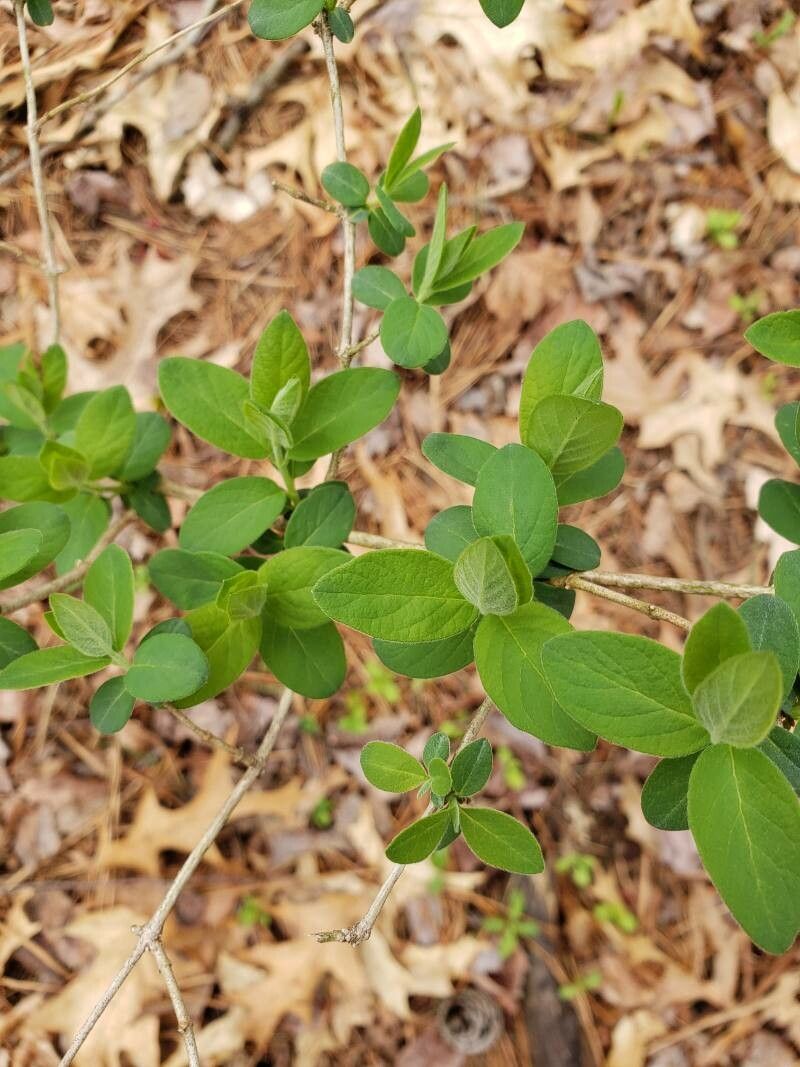
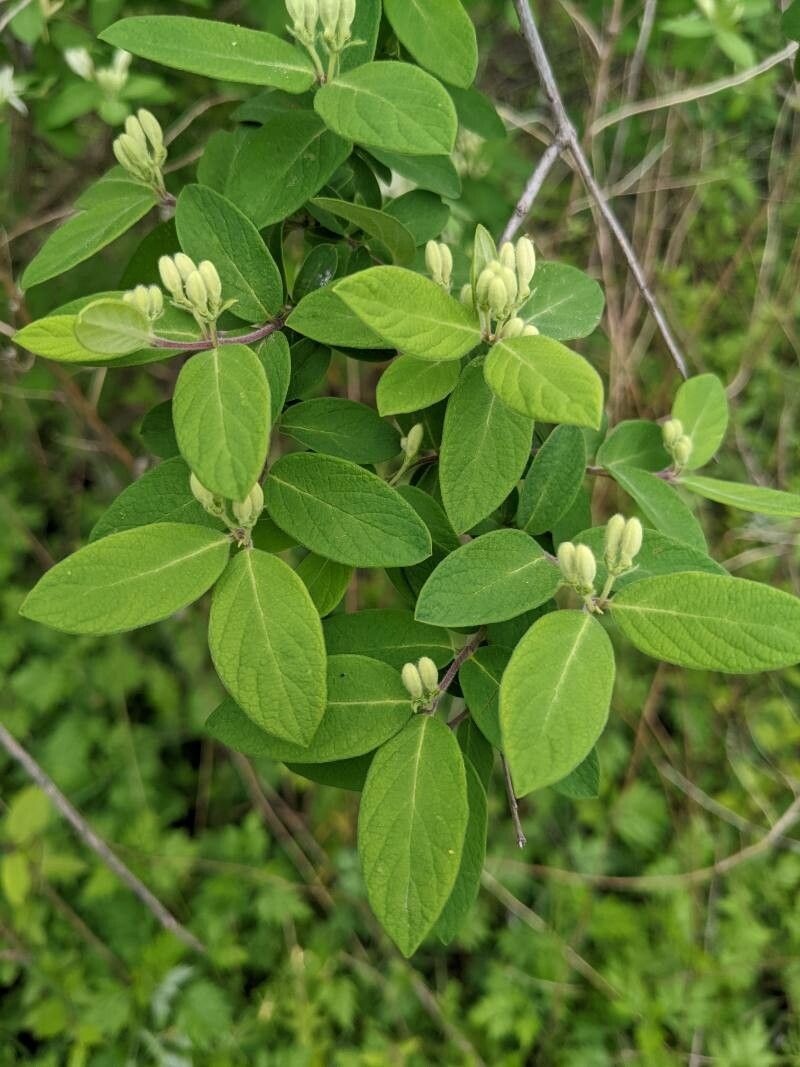
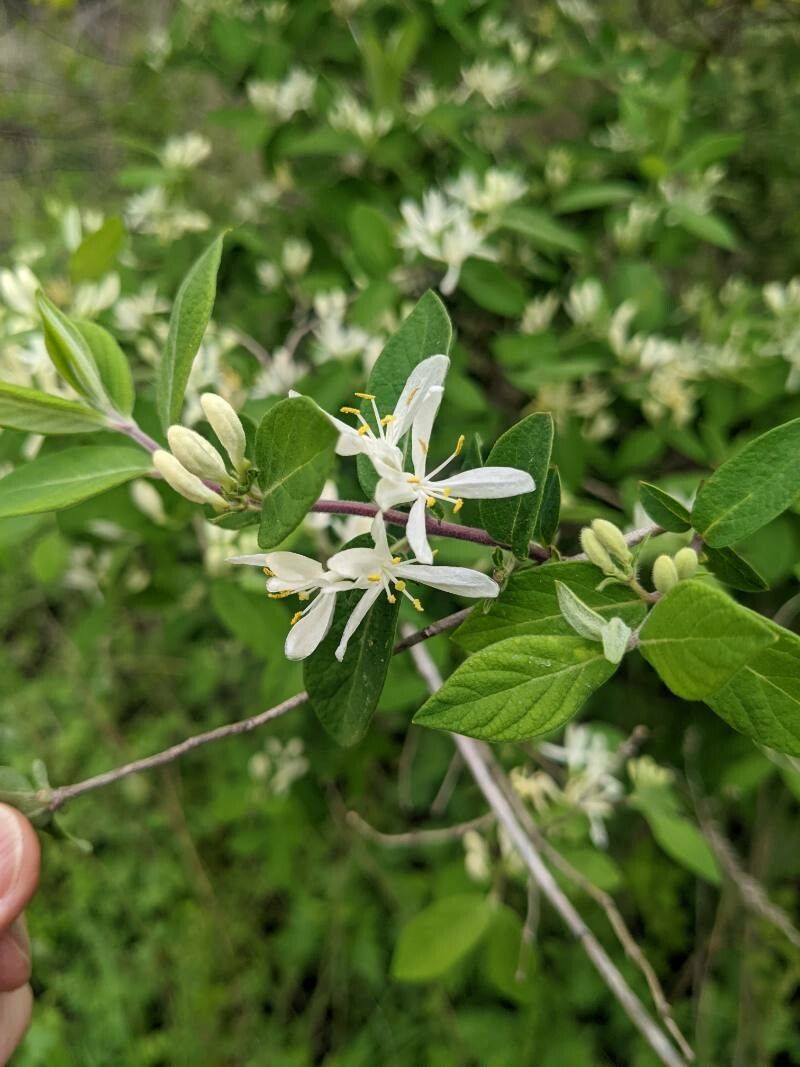
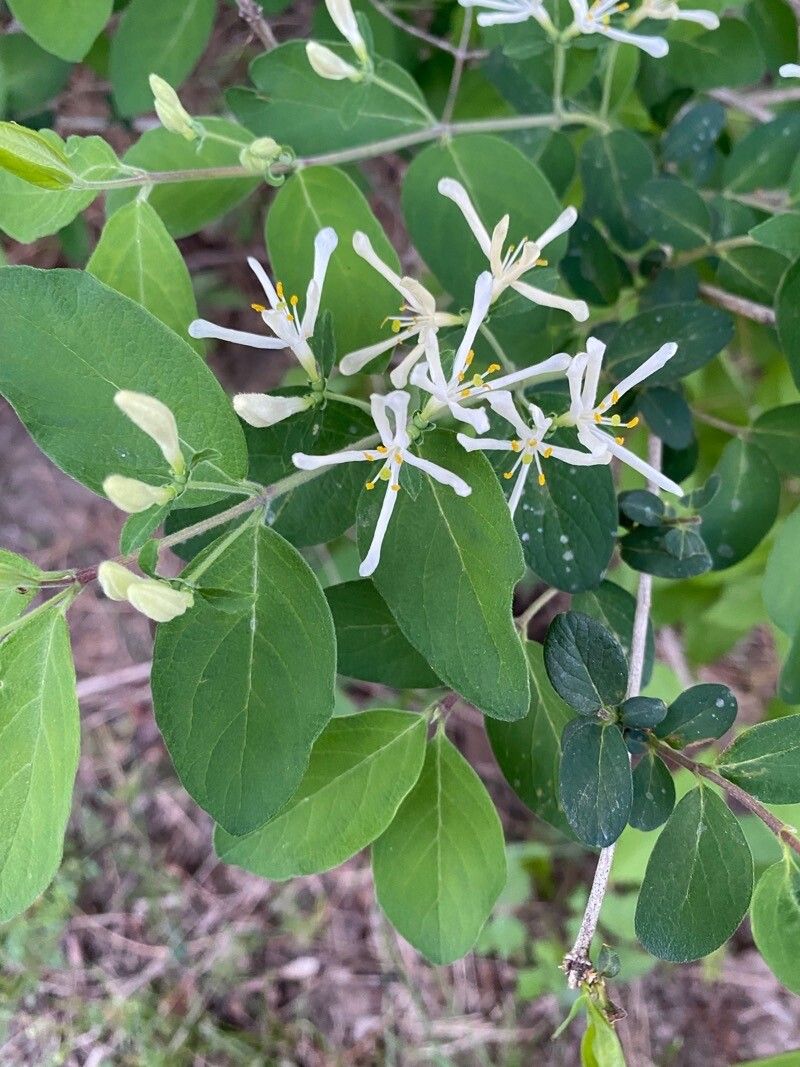
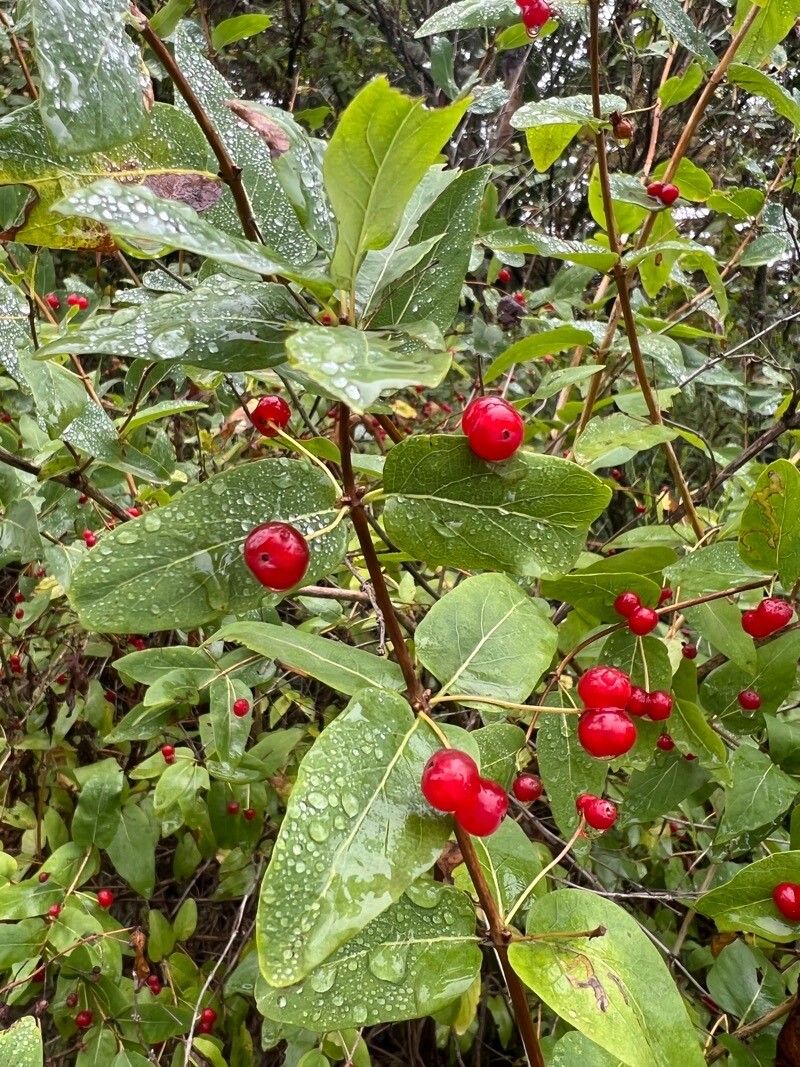
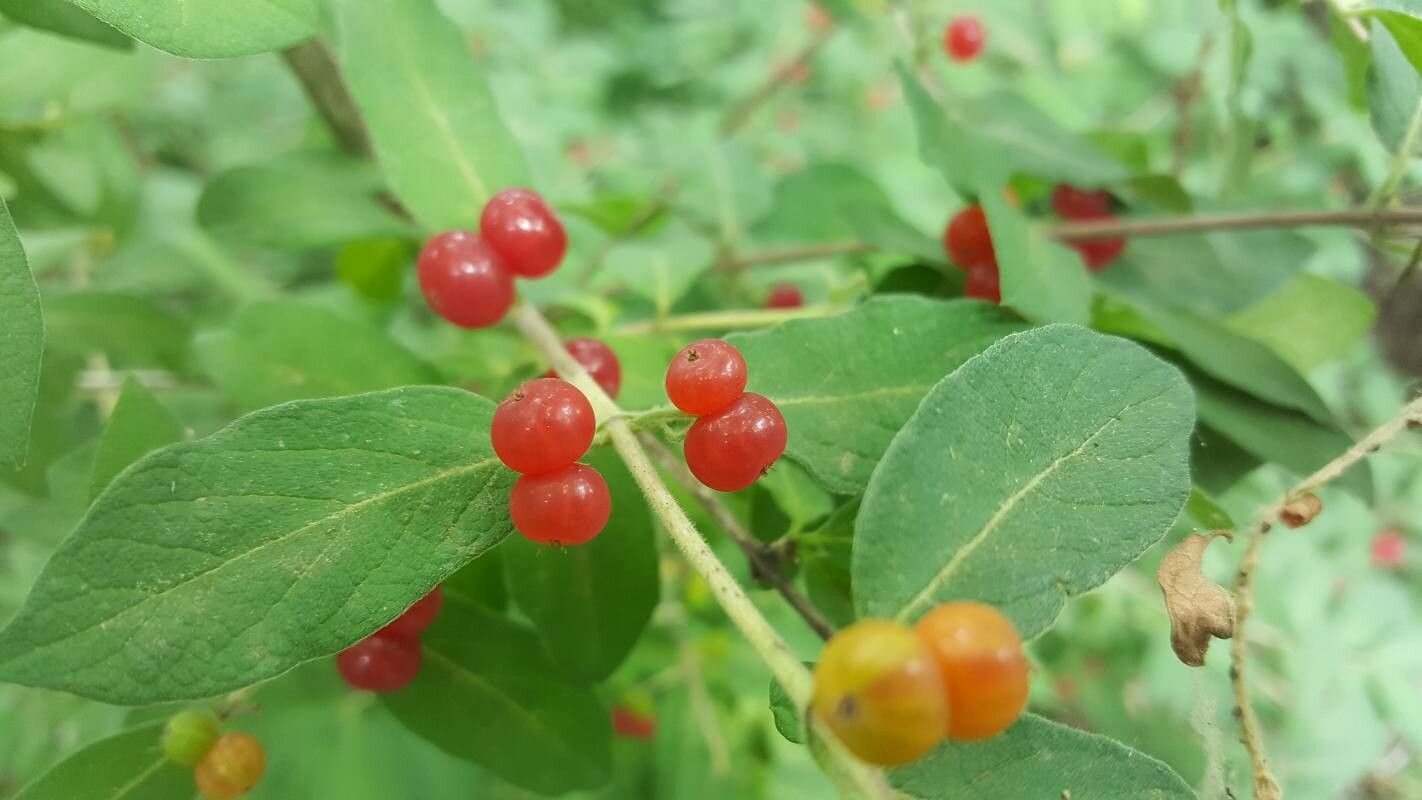
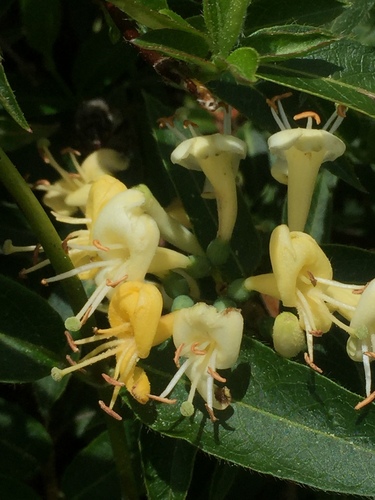
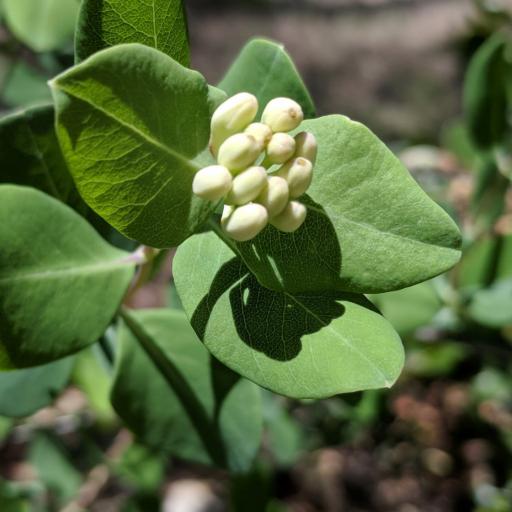
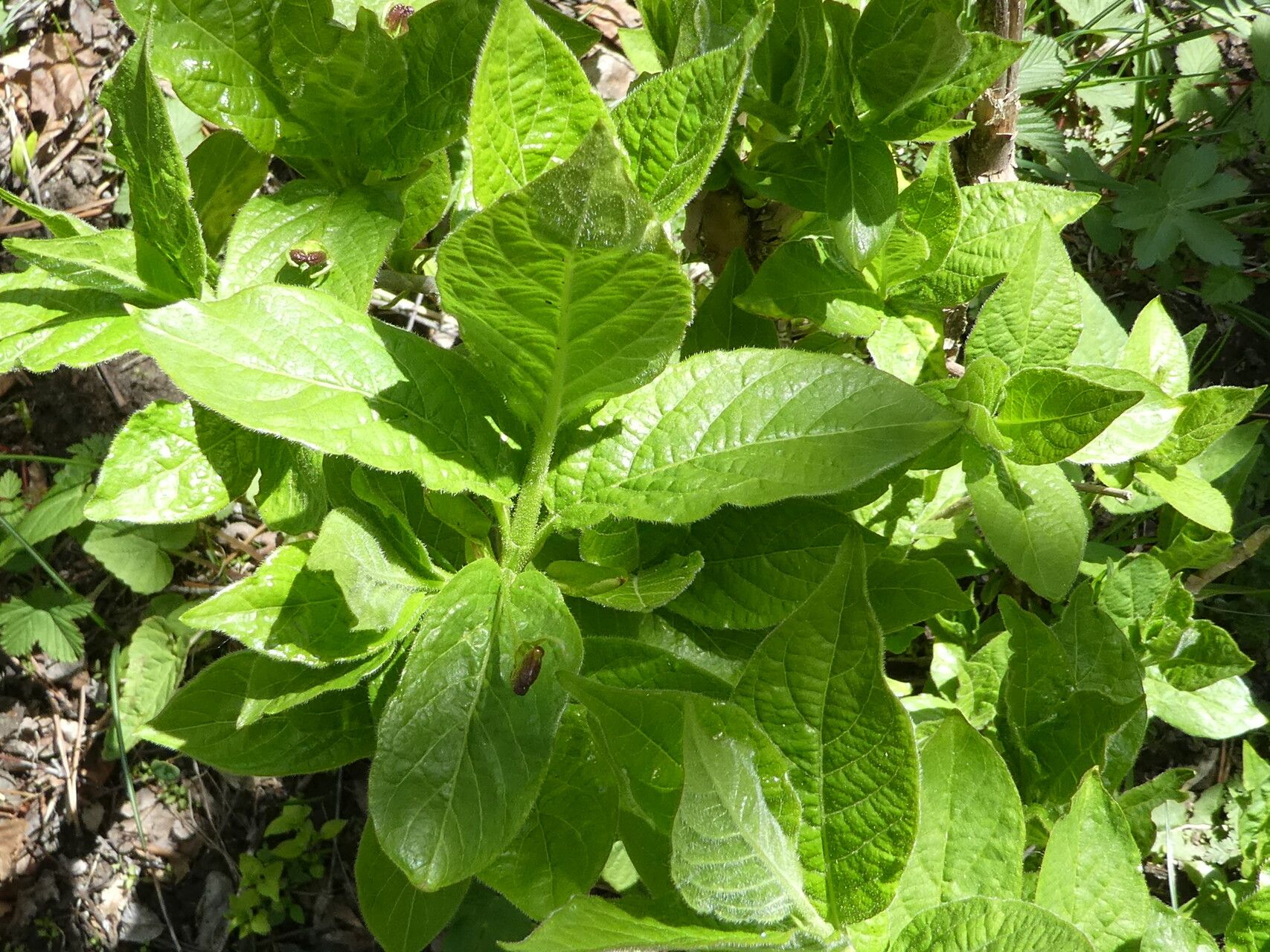
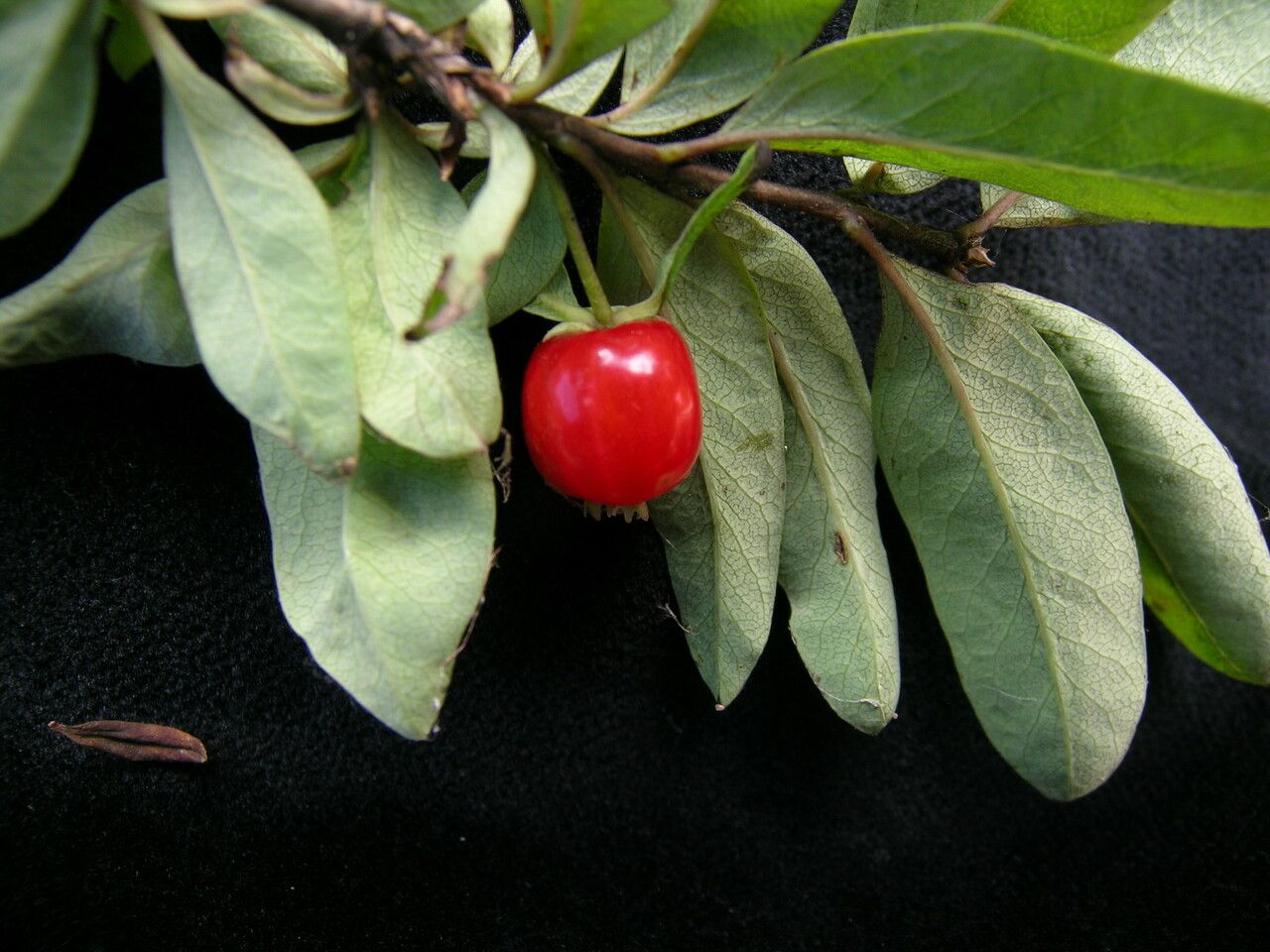
Lonicera morrowii, commonly known as Morrow's honeysuckle, is a deciduous shrub native to Japan and Korea. This plant is popular in gardens and landscaping due to its attractive foliage and fragrant flowers. It typically grows up to 6 feet tall with an equal spread, forming a dense thicket of branches covered in oval-shaped leaves with pointed tips. The flowers are tubular and range in color from white to pinkish-yellow, blooming from late spring through early summer. Morrow's honeysuckle produces small red berries that are edible, although their bitter taste makes them less commonly consumed. While the plant is easy to grow and maintain, it has become invasive in some areas of North America where it was introduced as an ornamental species.
Bush honeysuckle is a shrub that produces yellow and white flowers when it blooms. These beautiful blossoms emit a sweet fragrance and serve as a food source for many animals. Despite the plant's appealing appearance, it is an aggressively invasive species that can hinder the growth of other plants. Don't be deceived by its beauty; it poses a significant threat to local ecosystems.
Morrow's honeysuckle demonstrates strong resistance to disease and is generally unlikely to suffer from illnesses. Regarding maintenance, this plant is fairly low-maintenance. Planted outside, it needs only minimal watering, and larger specimens typically do not require pruning. Smaller specimens should be pruned after they finish blooming. Morrow's honeysucklet is appropriate for anyone with an outdoor area, such as a garden or deck, and does not demand much prior care experience.
How to keep Lonicera Morrowii.
Light
Morrow's honeysuckle prefers a spot with plenty of sunlight throughout the day, though it can tolerate areas where the sun is partially filtered. Coming from bright habitats, it performs best when light is plentiful. Too little light results in poor growth, while excessive exposure can be damaging.
Water
Bush honeysuckle thrives in moderately moist environments and typically needs watering every one to two weeks. It prefers well-drained soil and naturally adjusts its water intake according to seasonal changes. Being a deciduous plant, it conserves water by shedding its leaves when temperatures drop and light decreases in the autumn.
Temperature
In its native growth environment, Morrow's honeysuckle prefers temperatures between 41 and 95 ℉ (5 and 35 ℃). In spring, it may need some temperature adjustment if conditions drop below that range. In summer, the plant tolerates higher heat but can wilt if temperatures remain consistently above the preferred range. In fall, it may require slight temperature adjustments if temperatures fall below the preferred range.
Fertilizer
Fertilize your Morrow's honeysuckle in early spring to encourage healthy growth. Regular feeding boosts the plant's overall health, producing vigorous growth, increased resilience in difficult conditions, and improved resistance to diseases and pests. Follow a consistent fertilization schedule for your Morrow's honeysuckle to keep the foliage vibrant with deep color and a lush appearance.
Pruning
Bush honeysuckle is a rapidly growing, dense deciduous shrub known for its abundant yellow flowers. To keep it well-shaped, remove dead branches, and thin crowded stems for better air circulation, it's best to prune in early spring. Be sure to use sharp, sterilized tools for cutting to prevent disease and promote optimal health.
Pot & Repot
For a bush honeysuckle to thrive in a pot, it needs excellent drainage.
Botanical profile.
- Plant Type
- Shrub
- Life Cycle
- Perennial
- Genus
- Lonicera
- Family
- Caprifoliaceae
- Hardiness Zone
- 4-9
- Mature Height
- 2.13 m to 2.44 m
- Mature Spread
- 1.83 m to 3.05 m
- Leaf Color
- Green
- Leaf Type
- Deciduous
- Flower Color
- White
- Flower Size
- 2.54 cm
- Bloom Time
- Mid spring, Late spring, Early summer
- Planting Time
- Spring, Autumn
- Harvest Time
- Early summer, Mid summer
- Native Area
- Koppen, Japan, China, South Korea
Other names.
Reader questions.
When Should I Water My Bush Honeysuckle?
Watering your bush honeysuckle properly is crucial for its health and growth. Check the soil's moisture level by inserting a finger or a moisture meter 2-3 inches deep. If the soil feels dry, it's time to water. Wilting, limp leaves, or changes in leaf color to yellow or brown are indicators the plant needs water. Slow growth or stunted development also suggests a need for watering, especially during the pre-flowering stage to avoid bud drop. Bush honeysuckle needs more water during periods of warm temperatures and high sunlight exposure. Be cautious not to water too early if the soil is still moist, as this could cause root diseases, and avoid watering too late to prevent wilting or stunted growth.
What kind of plant food does my Bush honeysuckle need?
Bush honeysuckle plants require nitrogen as the most crucial nutrient, but this doesn't mean that phosphorus and potassium are insignificant. On the contrary, a balanced fertilizer with all three main nutrients, like a 10-10-10, is usually effective. However, a more precise nutrient ratio tends to promote optimal growth for Bush honeysuckle. Fertilizers with a slightly higher nitrogen content, such as 10-6-4, often yield better results. Both granular and liquid-based fertilizers can be used for fertilization.
What are the sunlight requirements for Bush Honeysuckle?
Bush Honeysuckle requires full sun, which means it should receive above 6 hours of sunlight daily, but it can also tolerate partial sun, about 3-6 hours of sunlight. It's important to observe your garden to find areas that offer a balance of light and shade, as the right amount of sunlight is crucial for the plant's health. Inadequate light can lead to poor growth, while too much direct sunlight could be harmful. Essentially, Bush Honeysuckle does best with abundant sun exposure but can adapt to somewhat filtered light.
What temperature range does Bush Honeysuckle prefer for growth?
Bush Honeysuckle, botanically known as Lonicera morrowii, thrives in a temperature range of 41 to 95°F (5 to 35°C). This range is optimal for its growth in its native environment. The plant has a strong resistance to cold, so it generally doesn't require special frost protection measures during winter. However, special attention might be needed during seasonal transitions. In spring, if temperatures fall below its preferred range, adjustments may be necessary. Similarly, during summer, the plant can tolerate high temperatures but may require interventions if temperatures consistently exceed its comfort zone. By fall, slight adjustments might again be needed for lower temperatures. To protect the plant in winter from temperatures below its tolerance range, wrapping the trunk and branches with non-woven fabric or cloth is advised. It’s also recommended to water the plant abundantly before the first freeze to ensure the soil remains moist, aiding in drought prevention through the colder months.
How Should I Water My Bush Honeysuckle?
Bush honeysuckle benefits from deep watering, which reaches its root zone, rather than just surface watering. Use a watering can with a long spout to target the water directly to the base of the plant, and consider a rose attachment for a gentle flow that prevents soil erosion. A moisture meter can help determine when it's time to water, aiming to keep the soil moist but not waterlogged. Avoid wetting the foliage directly to prevent fungal diseases. During hot, dry periods, misting the foliage can increase humidity and provide temporary relief, although it should not replace watering at the base. If growing bush honeysuckle in pots, consider bottom-watering by placing the pot in water, allowing roots to absorb moisture evenly. Adjust watering frequency based on soil moisture, climate, and plant size, ideally using rainwater when possible for its natural benefits and water conservation.
Why is it important to fertilize my Bush honeysuckle?
No matter the type of Bush honeysuckle you have, consistent fertilization is essential to promote overall plant health. Proper nutrient supply encourages robust growth and increases resistance to challenging growing conditions, as well as enhances the ability to combat diseases and pests. The foliage of your Bush honeysuckle is an appealing aspect, so it is important to maintain it. To achieve this, follow a regular fertilization schedule specific to your Bush honeysuckle. This will stimulate the development of vibrant leaves with a deep color, resulting in a lush appearance.
Can artificial lighting be used for Bush Honeysuckle if it doesn't get enough natural light?
Yes, artificial lighting can be an effective solution for Bush Honeysuckle when natural sunlight is insufficient, especially during winter or in spaces that don't receive much sunlight. LED lights are recommended because they can be tailored to provide specific light wavelengths needed by plants. For optimal growth under artificial light, full sun plants need 30-50W/sq ft, partial sun plants 20-30W/sq ft, and full shade plants 10-20W/sq ft. The light source should be placed 12-36 inches above the plant, and it's important to mimic natural daylight hours, meaning most plants will need 8-12 hours of light per day.
How should you care for Bush Honeysuckle in low temperatures?
Bush Honeysuckle is notably cold-tolerant and fares best when the temperature remains above its minimum growth threshold. However, if winter temperatures are expected to drop below this minimum, the plant can still survive without noticeable changes during the winter itself. The real challenge appears in spring, when branches might become brittle, dry, and devoid of new shoots due to the previous cold. In such cases, it's advised to prune away the dead branches to encourage the growth of new leaves. Ensuring the plant is properly protected and cared for during cold spells is crucial for its recovery and growth in the warmer months.
How Much Water Does Bush Honeysuckle Really Need?
Bush honeysuckle requires a consistent and moderate amount of water, given its relatively shallow root system (8-12 inches deep). Green, healthy leaves, upright and sturdy stems, and plentiful flowers and fruits are signs of adequate hydration. However, both overwatering and underwatering can pose risks, leading to root rot or a weakened plant, respectively. To promote proper health, ensure well-draining soil, consider adding organic matter for improved moisture retention, and apply mulch to preserve soil moisture. Regular monitoring of the soil's top few inches for dryness can guide the watering schedule more effectively than adhering to a rigid calendar.
When should I fertilize my Bush honeysuckle?
To ensure healthy growth, it's best to fertilize your Bush honeysuckle for the first time in late winter or early spring. This provides the necessary nutrients for the plant to thrive when the weather warms up. If you live in a warm climate region, it can be beneficial to give your Bush honeysuckle an additional fertilizer feeding in early fall. This helps the plant acquire extra nutrients for the following growing season and increases its ability to withstand the winter cold without sustaining foliage damage. Fertilizing earlier in the fall will also allow the new branches to grow sufficiently to endure the colder months.
What symptoms indicate Bush Honeysuckle is getting too much or too little sunlight?
Bush Honeysuckle may show various symptoms in response to inappropriate light levels. For too little sunlight, signs include smaller new leaves, leggy or sparse growth, faster leaf drop, slower or no new growth, and lighter-colored new leaves, indicating a lack of essential nutrients and chlorophyll. Excessive sunlight can lead to chlorosis (yellowing leaves due to chlorophyll breakdown), sunscald (pale or damaged leaves/stems), leaf curling (as a defense mechanism to reduce water loss), wilting (due to increased water loss), and leaf scorching (brown, dry, and crispy leaf edges). These symptoms suggest the plant is struggling to maintain its health under current lighting conditions.
What steps should be taken if Bush Honeysuckle experiences high temperatures?
When Bush Honeysuckle is exposed to temperatures that exceed its maximum comfortable range during the summer, several symptoms may occur. The leaves might turn lighter, tips can become dry and withered, and the plant becomes prone to sunburn. To mitigate these effects, it’s advisable to trim away the sunburned and dried parts to prevent further damage. Relocating the plant to a shaded area or using a shade cloth to protect it from the intense midday and afternoon sun can be beneficial. Additionally, watering the plant in the morning and evening helps keep the soil moist, aiding in the plant’s overall health and resilience against high temperatures.