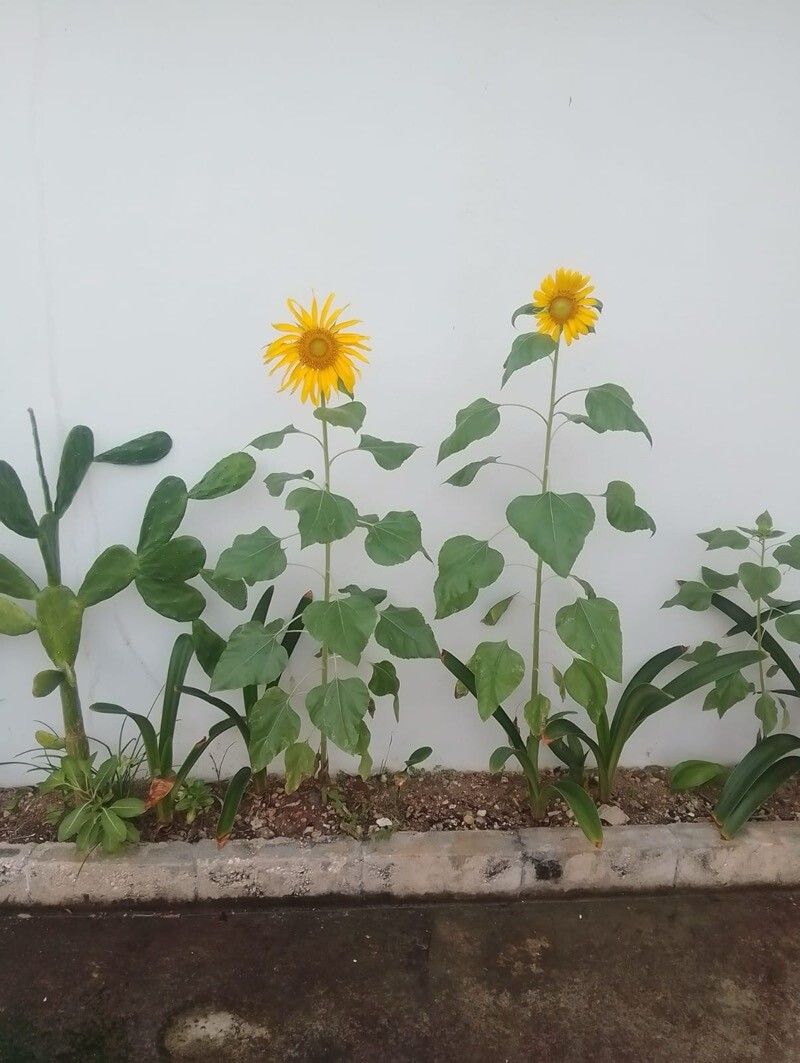
Helianthus x annuus, commonly known as the sunflower, is a tall flowering plant belonging to the Asteraceae family. Although native to North America, it has been extensively cultivated worldwide for its edible seeds and ornamental value. The plant can grow up to 3 meters tall and features a large flower head that can reach up to 30 cm in diameter.
The sunflower's leaves are broad and heart-shaped, with rough surfaces covered in tiny hairs. The flowers boast yellow petals surrounding a dark central disk filled with small florets. These florets mature into seeds, which are commonly used for oil production or as snacks.
Sunflowers require full sunlight and well-drained soil for optimal growth. They are easy to grow from seeds and can be planted directly into the ground or started indoors before being transplanted outside after the danger of frost has passed.
It is a common belief that sunflowers always turn to follow the sun as it moves across the sky. However, in reality, blooming sunflowers consistently face east. FUN FACT · FROM THE LIBRARY
In addition to their practical uses, sunflowers have been used symbolically throughout history to represent happiness, loyalty, longevity, and adoration. Their striking appearance has also made them popular subjects in art throughout the ages.
Overall, Helianthus x annuus is an attractive plant that offers practical benefits, such as oil production and snacks, while also serving as a striking ornamental addition. Its appeal has made it popular among gardeners around the world!
The common sunflower: Many people believe that sunflowers are named for their tendency to follow the sun from sunrise to sunset. In reality, mature sunflowers face east and do not rotate to track the sun's movement. Despite this, the misconception that sunflowers turn to face the sun is deeply ingrained in people's minds, leading to their name, the common sunflower.
Common sunflower is generally resistant to disease and usually not susceptible to it. However, it may be prone to leaf spots if light and ventilation are poor and watering is excessive. The plant's care level is considered easy, since it only requires regular watering and little else. Common sunflower is suitable for those who do not have the time and energy to devote to regular care.
How to keep Helianthus Annuus.
Light
The typical sunflower flourishes when it is exposed to plenty of light for the majority of the day. It can continue to bloom healthily even if there is a reduction in light for several hours. Accustomed to a surplus of sunlight in its natural, open setting, it can, however, experience less blooming if it gets too little sunlight, while an excess might result in the plant's color fading or wilting.
Water
The common sunflower thrives in open, arid plains thanks to its deep root system, which enhances its drought tolerance. To support rapid growth and blooming, especially during the growing season, it's recommended to water the plant thoroughly twice a week. This is particularly important since sunflowers are often grown for their large, striking flower heads.
Humidity
This plant will thrive in moderate humidity, which is probably the level in your home. However, misting it a few times a week can be very beneficial. Make sure the room has good ventilation.
Temperature
The common sunflower originates from climates where the average temperature typically fluctuates between 68 and 95℉ (20 to 35℃). These are the conditions in which it flourishes most. Altering the temperature to stay within this span, depending on the time of year, may potentially promote ideal growth.
Fertilizer
When most of the blossoms on a Common sunflower have completely bloomed, it indicates it's the right time to resume fertilizing. Start the fertilizing process once again when the flowers are in their prime, typically once every three to four weeks depending on the weather conditions. Once the Common sunflower begins to produce fewer fresh blossoms, cease the fertilization as it becomes unnecessary when the plant is not capable of generating more blooms.
Pruning
The common sunflower is a tall plant known for its large, striking blooms. To keep it healthy and vibrant, prune it between early and late spring by removing dead stems and lateral shoots. Deadheading, or removing spent flowers, encourages the plant to continue blooming. Proper pruning also improves air circulation and light access, which helps prevent disease and ensures a lively display throughout the season.
Pot & Repot
For repotting the Common sunflower, choose a pot with a diameter 1-2 inches bigger, making sure it has excellent drainage. Opt for a potting mix that drains well, and think about integrating perlite for additional drainage. Carry out the repotting in the spring or early summer, water it thoroughly and place it in a moderately shaded area at first.
Toxicity
Sunflowers are not only perfectly safe for humans, but also non-toxic to dogs, cats, and horses.
Further reading →
The toxicity and danger assessments provided are for reference only. We do not assure their accuracy, so it's crucial not to depend on them. Seek professional advice when necessary for accurate guidance.
Botanical profile.
- Plant Type
- Herb
- Life Cycle
- Annual
- Genus
- Helianthus
- Family
- Asteraceae
- Hardiness Zone
- 4-8
- Mature Height
- 0.91 m to 3.05 m
- Mature Spread
- 30 cm to 91 cm
- Leaf Color
- Green
- Leaf Type
- Deciduous
- Flower Color
- Yellow, Gold
- Flower Size
- 10.16 cm to 30.48 cm
- Bloom Time
- Summer
- Planting Time
- Spring, Summer
- Harvest Time
- Mid summer, Late summer, Early fall
- Native Area
- Belize, Honduras, Mexico, Guatemala, El Salvador
Other names.
Reader questions.
When Should I Water My Common Sunflower?
To ensure the health and development of your common sunflower, it's crucial to water it properly. The ideal time to water is when the soil moisture is low; you can check this by feeling the soil at a depth of 1-2 inches. If the soil feels dry, it's time to water. Also, look out for signs like drooping or wilting leaves, yellowing or fading of the leaves, stunted growth, and reduced flower production as indicators of the need for watering. To minimize water loss through evaporation, water early in the morning or late in the afternoon. Be cautious not to over-water, particularly when the soil is still moist, to prevent root rot, fungus infestation, and other root diseases. Conversely, watering too late when the plant has been excessively dry can lead to temporary wilting or even stunt the plant's growth, potentially causing plant death in extreme conditions.
Why should I put fertilizer on my Common sunflower?
Plants, including the Common sunflower, need nutrients to survive. This is common knowledge among gardeners, regardless of their experience. Without proper nutrition, the Common sunflower will die soon after its first pollination. To ensure the plant thrives throughout the blooming season and produces big, beautiful flowers, it is crucial to provide the right type and amount of nutrients. Fertilizer is particularly beneficial for the Common sunflower as it helps in developing a strong and healthy root system. This is important because the plant's root system is thin and susceptible to damage. By fertilizing at planting, a robust root structure is established, offering both stability and setting the stage for impressive flowering. When timed correctly, fertilization can significantly prolong the Common sunflower's flowering period.
What are the sunlight requirements for a common sunflower (Helianthus annuus)?
The common sunflower requires full sun, meaning it thrives best with more than 6 hours of sunlight daily. However, it can also tolerate partial sun conditions, getting about 3-6 hours of sunlight. It's crucial to observe your garden's sunlight exposure throughout the day to identify spots that offer a balanced environment for your plants. Excessive or insufficient sunlight can impact the plant's health, affecting its flowering and overall wellbeing.
What is the native environment and ideal temperature range for Common Sunflower?
The Common Sunflower (Helianthus annuus) is native to temperate environments, thriving best in conditions where temperatures generally range from 68 to 95°F (20 to 35°C). These warm conditions are optimal for the sunflower’s growth, and maintaining temperatures within this range can enhance its development. Despite its strong cold resistance, it's important to provide cold protection if winter temperatures are expected to drop below -30°C by covering the plant with soil, straw, or similar materials. Abundantly watering the plant before the first freeze in autumn helps the soil remain moist and enter a frozen state, preventing drought and water scarcity for the plant during winter and early spring.
How Should I Water My Common Sunflower?
Watering your common sunflower correctly involves deep and infrequent watering, targeting the entire root system and allowing the soil to dry out slightly between waterings. This promotes healthy root growth and avoids overwatering, which can cause root rot and other issues. Water directly at the base of the plant rather than overhead to prevent excessive wetting of the foliage, which can increase the risk of fungal diseases. Using a watering can with a narrow spout is recommended for precision, and a removable rose attachment can help distribute the water gently to avoid soil erosion.
When should I fertilize my Common sunflower?
The Common sunflower grows rapidly early in the growing season, after the last frost has passed. It is best to fertilize this plant during planting, when it is first put in the ground or in planters. This initial fertilization should be the only dose of fertilizer until later in the year when the blooms are fully developed. Once the season is in full swing and the Common sunflower has opened most of its blooms, it is time to resume fertilizing. This should be done once every three to four weeks, depending on the weather. However, when the plant starts producing fewer new blooms, there is no need to continue fertilizing.
What are the essentials for growing a healthy common sunflower?
For optimal growth, common sunflowers need to be exposed to abundant sunlight for most of the day. They can tolerate a decrease in light for a few hours and still flourish, thanks to their natural adaptation to open environments filled with sunlight. However, too little sunlight can result in decreased flowering, and too much can cause issues like fading or wilting. In settings where natural light is insufficient, artificial lighting can serve as an excellent alternative, promoting healthier plant growth. LED lights are commonly used due to their ability to provide specific wavelengths needed by plants, with full sun plants requiring 30-50W/sq ft, partial sun plants 20-30W/sq ft, and full shade plants 10-20W/sq ft of artificial light.
How does low temperature affect Common Sunflower, and what measures should be taken?
Common Sunflower is cold-tolerant, ideally thriving in temperatures above 20°C. Throughout the winter, it's crucial to maintain temperatures above 0°C for its survival. When temperatures fall below -30°C, while there might not be immediate visible damage during the winter, there could be a noticeable decrease in sprouting, or in some cases, no sprouting may occur during spring. To address this, it is recommended to remove any parts of the plant that have failed to sprout in the spring as a measure to promote healthy growth.
How Much Water Does Common Sunflower Really Need?
The amount of water needed by a common sunflower varies with its growth stage, the size of its container, and the depth of its roots. A mature plant might need up to 1-1.5 gallons of water each time to keep the soil moist at all depths, while a smaller potted plant could require just 1-2 cups. Signs of correct watering include vibrant foliage, firm stems, and a saturated root ball after watering. Overwatering and underwatering can cause leaves to wilt and yellow and can affect the plant's growth and blooming. Deep watering that reaches the roots is crucial for optimal hydration and to support the sunflower during dry spells.
When shouldn't I add fertilizer to my Common sunflower?
Regular fertilizing is important for Common sunflowers, but it's essential to apply it at the right time. There are situations where it's necessary to hold back on fertilizer. These situations are usually related to climate, but they can also be influenced by other factors that can be controlled. When there's something wrong with the plant, soil, or climate, it's best to wait until the issue is resolved and the plant has recovered before applying fertilizer. An example of when to avoid fertilizing is when there are severe or unexpected weather changes. If there's a sudden cold spell in the middle of summer, it's better to wait until the weather warms up before starting to fertilize. The same applies if the soil is too dry or compacted to absorb the fertilizer. In such cases, the fertilizer will bypass the soil and go straight to the roots, which is not beneficial for the Common sunflower. Additionally, it's important to avoid applying fertilizer when temperatures reach the 90-degree Fahrenheit range during the hottest parts of the day. The speed at which fertilizer breaks down can vary with temperature, so it's crucial not to allow hot temperatures to break it down too quickly. Furthermore, any pests or diseases should be treated and cleared up before reapplying fertilizer.
What are some common symptoms of inappropriate light exposure in common sunflowers?
Common sunflowers can show various symptoms when they're not receiving an adequate amount of light. Some signs of insufficient light include small or lighter-colored new leaves, leggy or sparse growth, faster leaf drop, and slower or no new growth, which indicate that the plant is not photosynthesizing effectively. Conversely, symptoms of too much sunlight exposure include chlorosis, sunscald, leaf curling, wilting, and leaf scorching. These symptoms can significantly affect the plant's health, highlighting the importance of finding the right balance of sunlight exposure.
What are the effects of high temperature on Common Sunflower and how can they be mitigated?
During the summer months, it's important to ensure that temperatures surrounding the Common Sunflower do not exceed 35°C. Temperatures surpassing 38°C can result in the plant's leaves becoming lighter in color, curling, and becoming susceptible to sunburn. In severe cases, the plant may completely wilt and dry out. To mitigate these effects, sunburned and dried parts of the plant should be trimmed away. Consider moving the plant to a shaded location or using a shade cloth to protect it from midday and afternoon sun. Additionally, watering the plant in the morning and evening can help keep the soil moist and support the plant's health.