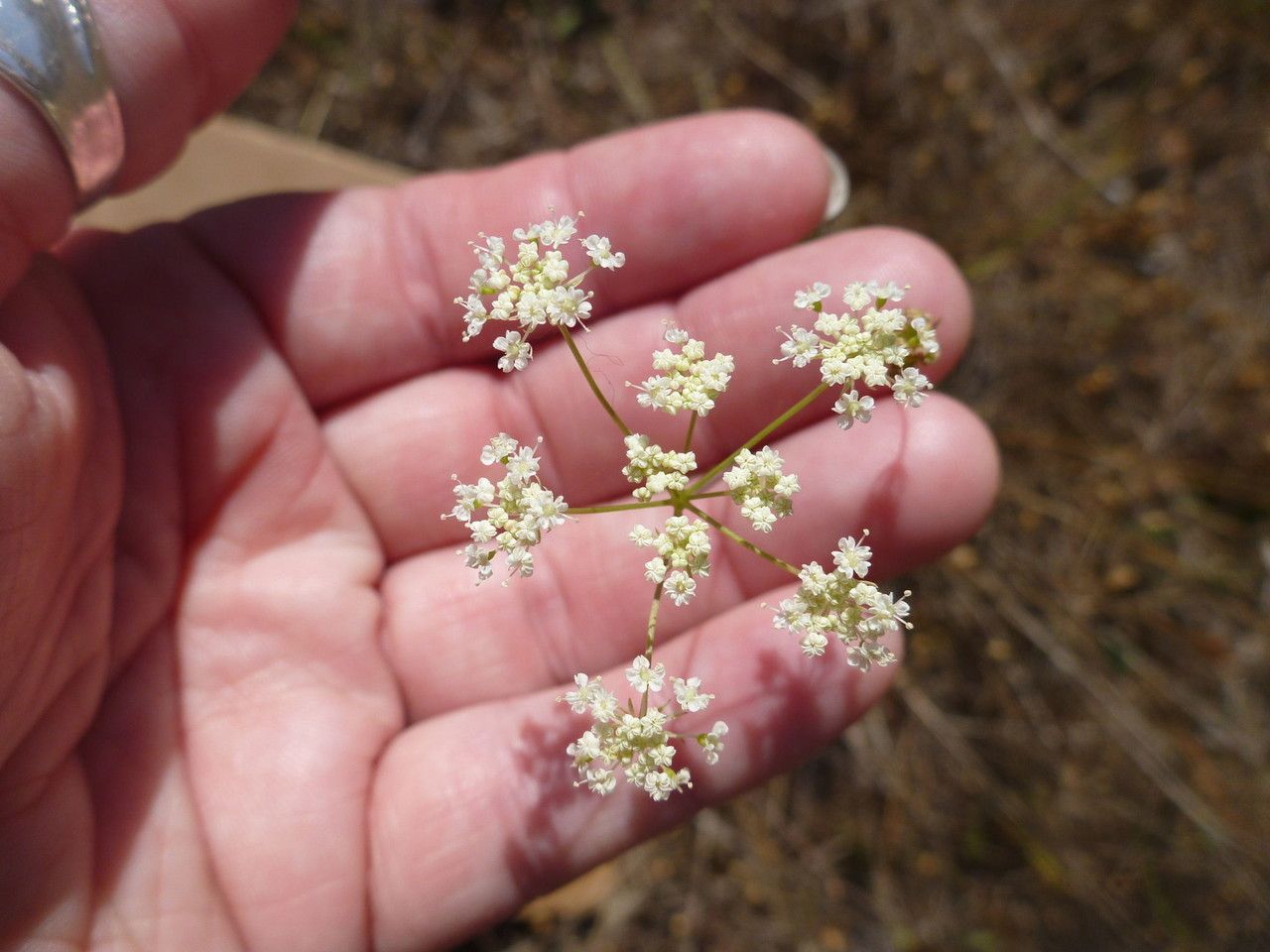
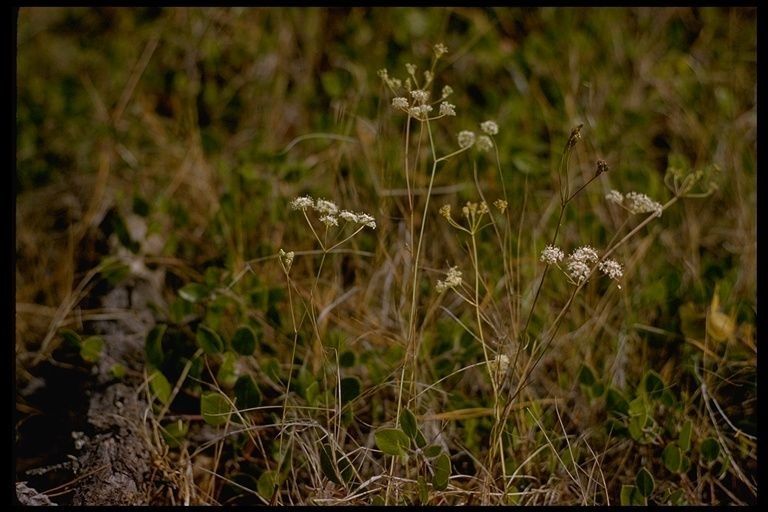
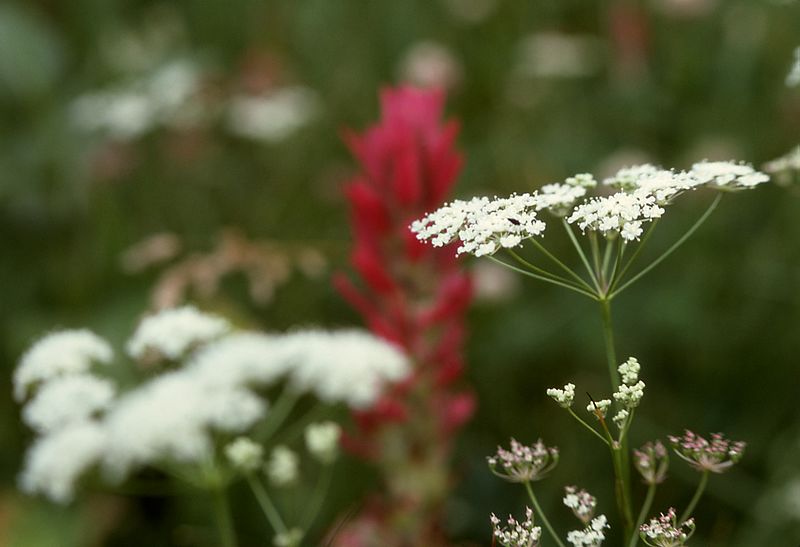
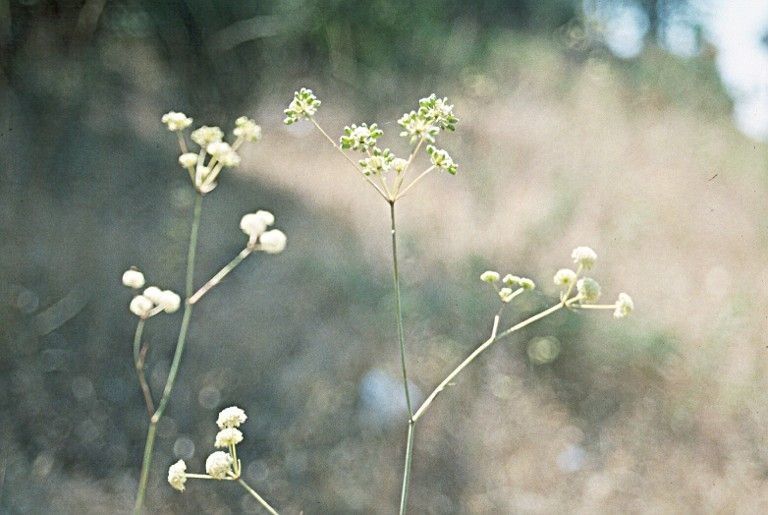
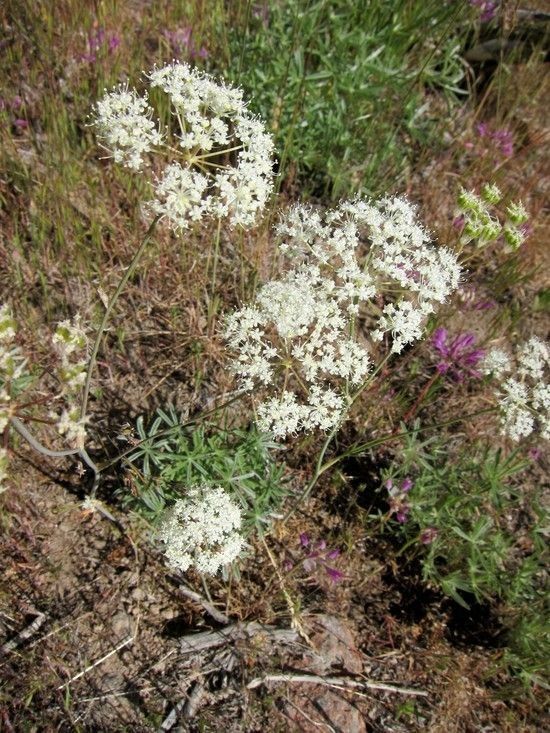
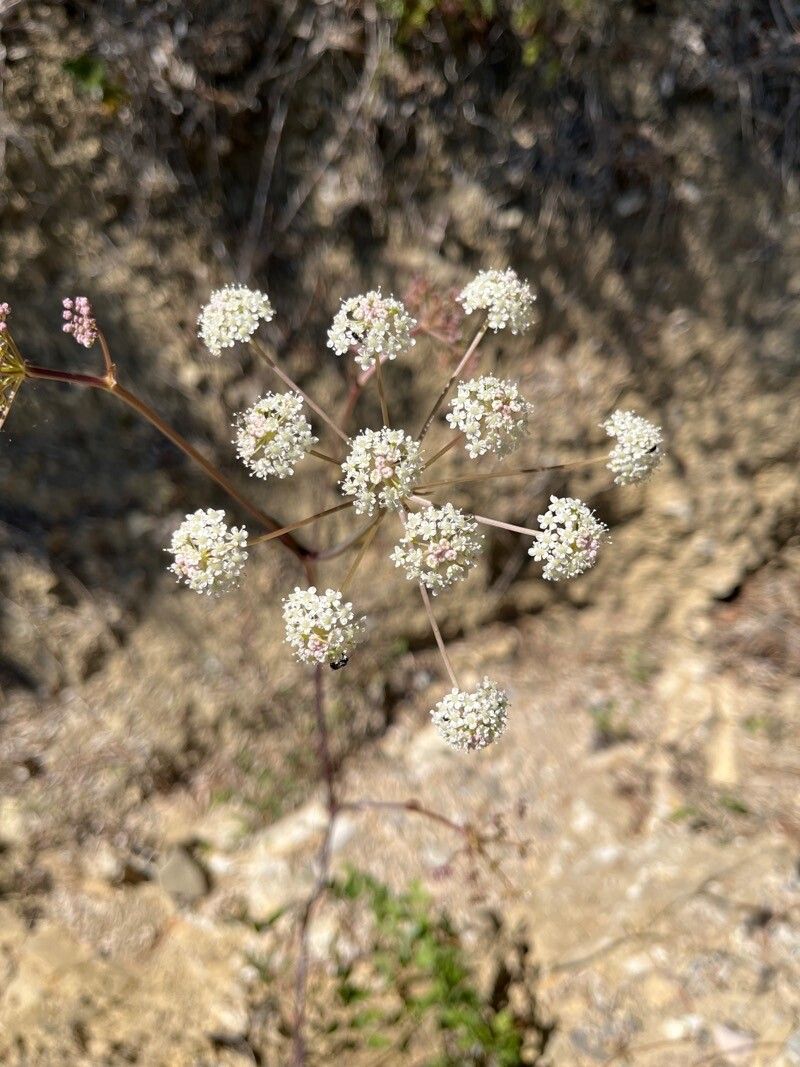
Perideridia gairdneri is a species of flowering plant in the family Apiaceae known by the common names common yampah, Gardner's yampah and Squaw root. It is native to western North America from southwestern Canada to California to New Mexico, where it grows in many types of habitat. It is a perennial herb which grows to around .6–1 metre (2.0–3.3 ft). Its slender, erect stem grows from cylindrical tubers measuring up to 8 centimeters long. Leaves near the base of the plant have blades up to 35 centimeters long which are divided into many narrow, subdivided lobes. Leaves higher on the plant are smaller and less divided. The inflorescence is a compound umbel of many spherical clusters of small white flowers. These yield ribbed, rounded fruits each a few millimeters long. The entire plant is edible, but caution should be maintained as it has a similar appearance to the carrot family's deadly water hemlock and poison hemlock. It was an important food plant, even a staple food, for many Native American groups, including the Blackfoot, Northern Paiute, Cheyenne and Comanche. It would seem certain that the term yampa would be a version on the Comanche name for the tuber, variously yap, and yampa. One of the main divisions of the Comanche, the Yapainuu, were named the yap eaters, whose chief was the famous Ten Bears. More commonly referred to as the Yamparikas, this division roamed in the Northern Oklahoma area in historic times. The tuberous roots could be eaten like potatoes, roasted, steamed, eaten fresh or dried, made into mush or pinole, used as flour and flavoring, and were also used medicinally. Meriwether Lewis encountered the plant in 1805 and 1806, referring to it as a species of fennel.This food root is called cawíitx in Nez Perce , sawítk in Sahaptin and yap in Comanche. Blackfoot Indians knew the root by the name nits-ik-opa ("double root") and by those tribes of the Pacific Northwest as either yampa, ipo, or sa'-hweet.
Common yampah has moderate resistance to disease and can be prone to problems like leaf spot. Its sensitivity to insect pests varies by variety, though most varieties are relatively less resistant to pests. For care, common yampah requires regular watering and fertilization, along with frequent removal of yellow leaves. It is important to address pests and diseases when they appear and to harvest the plant promptly. Common yampah is suited to people who can spend some time and energy on regular maintenance.
How to keep Perideridia Gairdneri.
Light
Common yampah is found in habitats with plentiful sunlight, such as open fields and sunlit meadows. It favors full sun but can also tolerate partial sun.
Water
Common yampah flourishes in environments with plenty of moisture and prefers soil that remains consistently damp. Watering it weekly helps maintain the ideal moisture level. As an outdoor herb, it also benefits from natural rainfall, which supports its growth cycle.
Temperature
Common yampah performs best in moderate temperatures similar to what most people consider comfortable. It prefers conditions that are neither too warm nor too cool. The primary concern with high temperatures is the risk of sunburn, so offering some shade in summer is recommended to prevent excessive heat. When temperatures decline, Common yampah goes dormant. To sustain continuous growth, warmer conditions must be kept through winter. Frost can harm the plant and should be avoided.
Fertilizer
Common yampah species do well with one or two applications of organic, natural fertilizers that provide potassium and phosphorus. Apply the fertilizer before planting, incorporate it into the soil and water thoroughly. Usually one application suffices, but a second can be applied after seedlings have become established. Avoid overusing fertilizer to prevent damage to the plants.
Pruning
Common yampah is characterized by its umbrella-like clusters of white flowers and its edible roots. To promote healthy growth and blooming, prune the plant from early to late spring, when it is budding. Remove any dead stems and thin out dense areas to improve air circulation, which will enhance the plant's health and productivity.
Botanical profile.
- Plant Type
- Herb
- Life Cycle
- Perennial
- Genus
- Perideridia
- Family
- Apiaceae
- Hardiness Zone
- 4-8
- Mature Height
- 0.3 m to 1.22 m
- Mature Spread
- 20 cm to 40 cm
- Leaf Color
- Green
- Leaf Type
- Deciduous
- Flower Color
- White
- Flower Size
- 0.20 cm to 0.25 cm
- Bloom Time
- Early summer, Mid summer
- Planting Time
- Spring, Summer, Autumn
- Harvest Time
- Late summer, Early fall
Other names.