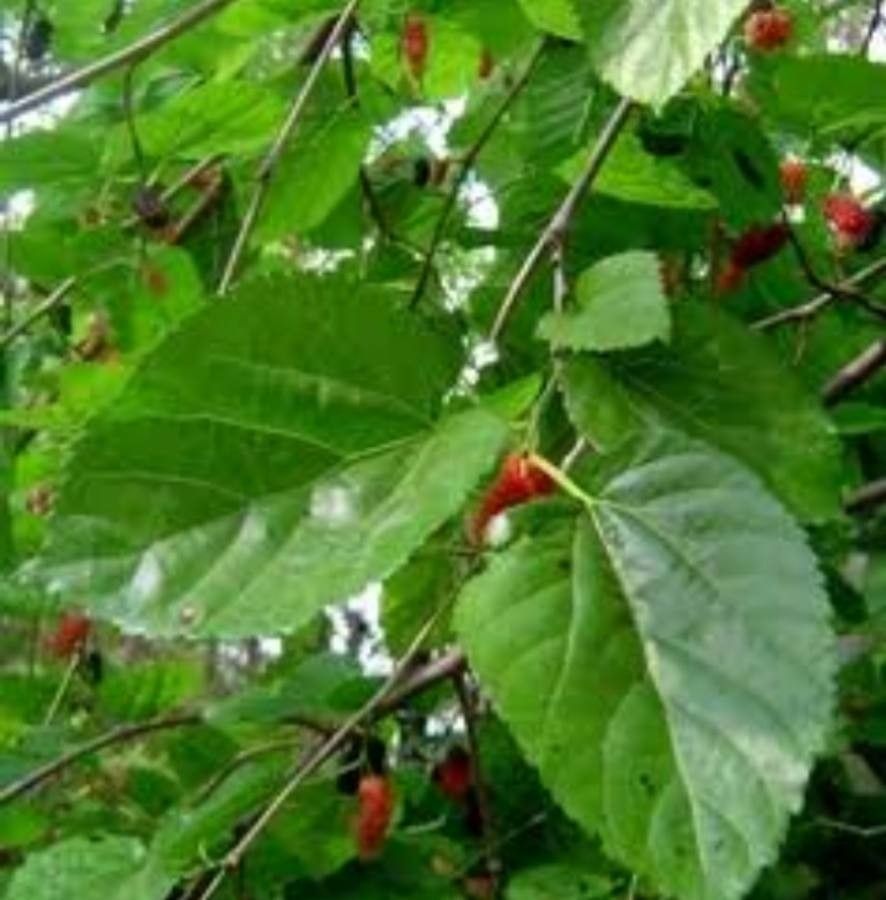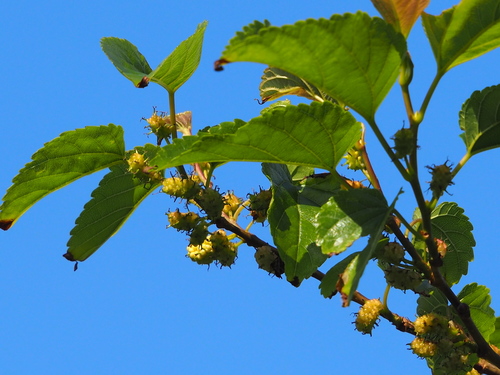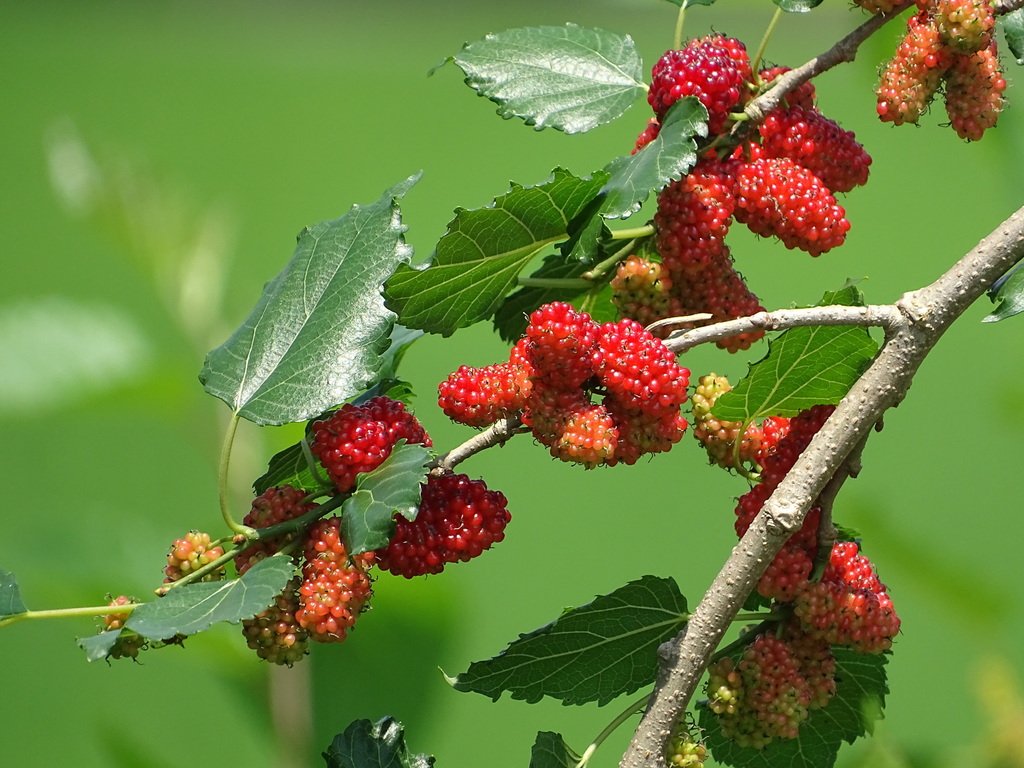
Morus alba, commonly known as the white mulberry, is a deciduous tree belonging to the Moraceae family. Native to China, it has been extensively cultivated worldwide for its edible fruit and ornamental value. The tree can reach heights of up to 20 meters, with a spreading crown that can span up to 15 meters in diameter. The leaves of Morus alba are alternate, simple, and lobed with serrated edges. They are glossy green on top and pale green underneath. The flowers are small and inconspicuous, appearing in early spring before the leaves emerge. The fruit of Morus alba is an edible berry that varies in color from white to pink or black when ripe. It has a sweet flavor and can be eaten fresh or used to make jams, jellies, pies, or wine. Morus alba is also known for its medicinal properties, as it contains compounds such as flavonoids that have antioxidant properties, helping to protect against oxidative stress caused by free radicals. In addition to its culinary uses and medicinal benefits, Morus alba serves as an ornamental plant due to its attractive foliage, which turns yellow in autumn before falling off. Overall, Morus alba holds great significance due to its various uses, ranging from culinary and medicinal purposes to ornamental applications, making it an important plant species globally.
White mulberry, scientifically known as Morus alba, is a plant with a history spanning over 4,000 years. Before the fruit ripens, the berries resemble a charming and attractive cluster of milky-white grapes. Additionally, the male catkin is enveloped in a thick layer of white silk. This distinctive appearance is the reason behind the common name "mulberry."
Mulberry has strong resistance to disease and is typically not susceptible to illnesses. With regard to care, this plant is fairly low maintenance. When grown outdoors it needs only minimal watering, and larger specimens generally do not require pruning. Smaller plants, however, should be pruned after they finish blooming. Mulberryt is appropriate for anyone who has outdoor space, such as a garden or a deck, and it does not demand extensive experience in plant care.
How to keep Morus Alba.
Light
Mulberry flourishes best with abundant sunlight, mirroring the conditions of its original environment. Adequate light is crucial for its well-being, as it impacts the plant's effectiveness in photosynthesis. It's also capable of tolerating places with slightly less sunlight. Too much or too little sunlight can detrimentally affect its development, potentially leading to leaf scorch or inadequate growth.
Water
Mulberry trees thrive in regions with distinct seasons, requiring moderate moisture and tolerating short periods of drought. Water the tree once every 1-2 weeks, allowing the soil to dry out slightly between waterings. During the colder months, when the tree becomes dormant, its water needs decrease, making it easier to care for indoors.
Humidity
This plant will thrive in moderate humidity, which is probably the level in your home. However, misting it a few times a week can be very beneficial. Make sure the room has good ventilation.
Temperature
Mulberry, originating from Asia, thrives in a climate that's temperate, ideally featuring an average temperature that fluctuates between 32 to 95 ℉ (0 to 35 ℃). This kind of timber-like plant favors direct sunlight and can withstand hot summers, though it is unable to handle exceedingly warm temperatures. Sub-zero temperatures during winter could lead to harm or even kill it. Broadly cultivated for its tasty produce , it can acclimate to a variety of temperature conditions given appropriate maintenance.
Fertilizer
The Mulberry plant needs ample nutrients to produce fruit at its best. To encourage new growth and the formation of blooms, apply fertilizer in the early spring. Frequent fertilization supports the plant's health, promotes the growth of tastier fruit, and averts problems associated with nutrient scarcity, such as yellow leaves and substandard fruit yield.
Pruning
Mulberry trees benefit greatly from pruning in late winter. The focus during this time should be on removing dead wood, thinning branches to improve air circulation, and shaping the tree for aesthetic purposes. This practice enhances fruit production and promotes a healthy growth cycle by retaining enough buds, while also minimizing stress during the dormant season.
Pot & Repot
To ensure optimal growth for your mulberry plant, use a high-quality potting mix and make sure to feed the plant regularly during the growing season. This will help keep the plant healthy and encourage strong growth.
Botanical profile.
- Plant Type
- Tree
- Life Cycle
- Perennial
- Genus
- Morus
- Family
- Moraceae
- Hardiness Zone
- 3-10
- Mature Height
- 9.14 m to 20.12 m
- Mature Spread
- 9.14 m to 14.94 m
- Leaf Color
- Green
- Leaf Type
- Deciduous
- Flower Color
- Green, Yellow
- Flower Size
- 1.02 cm to 3.56 cm
- Bloom Time
- Mid spring, Late spring
- Planting Time
- Autumn
- Harvest Time
- Late spring, Early summer, Mid summer
- Native Area
- Turkey, India, Myanmar, Pakistan, Laos, China
Other names.
Reader questions.
When should I water my Mulberry?
Watering your mulberry at the right time is essential for its growth, health, and fruiting. If the mulberry's leaves start to wilt, it indicates dehydration and the need for immediate watering, though you should also check the soil to avoid overwatering. Assess the soil's moisture level; if it feels dry at a depth of one to two inches, it's time to water the mulberry. In hot and dry climates, mulberries will need more frequent watering. Also, observe the bark texture, as rough or cracked bark can indicate a lack of hydration. Be mindful of the risks; watering too early or late can result in waterlogging and root rot or dehydration, which impacts the plant's health and yield.
Why is it important to add fertilizer to my Mulberry plant?
Regular fertilization is important for the healthy growth of plants, particularly fast-growing types like Mulberry. This is because the plants extract nutrients from the soil as they grow, which can lead to a depletion of nutrients. By providing Mulberry with additional nutrients through fertilization, not only will it remain healthy, but it will also produce more delicious fruit. If plants are not fertilized for an extended period, they may experience various issues due to nutrient deficiencies. The most common problem is the development of yellow leaves, but they may also exhibit red discoloration, distorted shapes, withered tips, or dieback in significant areas of the plant. Bark disorders, slow growth, poor shoot development, and a lack of fruit production can result from specific nutrient deficiencies.
What are the sunlight requirements for Mulberry plants?
Mulberry plants thrive best when they receive ample exposure to sunlight, which is crucial for their healthy growth and the efficacy of their photosynthesis. They are versatile enough to moderately withstand areas with less sunlight exposure as well. However, both a lack and an excess of sunlight can have negative impacts on their growth, potentially causing leaf burn or stunted growth. In terms of direct sunlight, 'full sun' is defined as over 6 hours of sunlight, while 'partial sun' is about 3-6 hours of sunlight per day. Observing how sunlight moves through your garden can help you choose the optimal spots that offer a perfect balance of light and shade, ensuring the plants' well-being.
What is the best temperature for Mulberry?
The ideal temperature for Mulberry to thrive is between 65 and 80 degrees Fahrenheit (18-27 degrees Celsius). During the main growth phase, the highest temperature that it can tolerate is 95 degrees Fahrenheit (35 degrees Celsius), while the lowest temperature it can handle is 15 degrees Fahrenheit (-10 degrees Celsius). This species is able to survive freezing winters as it is tolerant of low temperatures. The recommended temperature ranges are: Perfect: 65-80 degrees Fahrenheit (18-27 degrees Celsius), Highest: 85-95 degrees Fahrenheit (30-35 degrees Celsius), Lowest: -5 to 15 degrees Fahrenheit (-20 to -10 degrees Celsius) or below.
How should I water my Mulberry?
Mulberry plants prefer consistently moist soil without being waterlogged, benefiting from deep watering that reaches the deep roots. A watering can with a long, narrow spout or a soaker hose is ideal for this. For potted mulberries, bottom-watering by placing the pot in a tray of water allows the plant to absorb moisture as needed. Remember to focus the water near the base of the plant to avoid wetting the foliage, which can cause leaf scorching, and avoid over-saturating the soil surface to prevent root rot and fungal diseases.
When should I put fertilizer on my Mulberry tree?
The best time to fertilize a Mulberry tree is in early spring, before the buds start to grow. During this time, the Mulberry tree uses the stored nutrients from winter to produce new growth. To support the development of blooms, it's recommended to fertilize the tree about 2 to 4 weeks before you expect it to bloom. This allows enough time for the nutrients to soak into the soil and be absorbed by the plant. While you can continue to fertilize the tree throughout the spring, it's not advisable to fertilize in the autumn. Fertilizing during this time can cause excessive foliage growth, which makes the leaves more susceptible to damage during winter.
Can artificial lighting be used for indoor Mulberry plants, and if so, how?
Yes, artificial lighting can be a vital solution for indoor Mulberry plants, especially when natural sunlight is insufficient, such as in winter or less sunny spaces. For optimal growth under artificial lights, one should consider: choosing the right type of artificial light, with LED lights being a popular choice due to their customizability to provide specific wavelengths needed by plants; determining the appropriate distance, which is usually between 12-36 inches above the plant; and the duration of exposure, most plants benefit from 8-12 hours of light per day. Full sun plants require 30-50W/sq ft, partial sun plants need 20-30W/sq ft, and full shade plants need 10-20W/sq ft of artificial light.
Do I need to change the temperature for Mulberry during different growing stages?
Research indicates that Mulberry trees are more likely to experience stunted growth when faced with extended periods of higher temperatures. This is particularly true during the development of axillary buds and the growth of main shoots. To promote healthy growth after germination or transplanting, it is important to maintain consistent and cooler temperatures, ideally around 65℉ (18℃).
How much water does Mulberry really need?
The watering needs for mulberry depend largely on the plant's size and the pot's size, if applicable. With a deep taproot system that can reach 20 to 30 feet, mulberries require thorough, deep soaking about once a week. Adjust the frequency and amount based on the plant's growth stage and the season, aiming for the top 1 to 2 inches of soil to remain moist but not soggy. Signs of proper hydration include lush, green leaves and sturdy stems. Conversely, wilting or drooping leaves indicate under-watering, while yellowing leaves or mold on the soil surface suggest overwatering. Ensure there's no water stagnation and adjust watering according to the season and plant's growth.
When is it a bad idea to add fertilizer to my Mulberry plant?
Here are some tips to follow when fertilizing Mulberry: 1. Avoid fertilizing in the first year of growth. If fertilizer is not necessary, be cautious about providing it. 2. Do not fertilize if you pruned 20% or more of the plant the previous year. 3. Hold off on fertilizing diseased or damaged plants as it can do more harm. 4. Remember that fertilizer is not a cure-all solution. Identify the root cause of the issue before considering fertilizing. 5. Avoid fertilizing after the peak of summer, as it can cause excessive growth before winter. 6. Do not fertilize during hot and dry times of the year, as dry soil doesn't distribute fertilizer effectively and can stimulate growth that requires more water. 7. It's best to fertilize Mulberry earlier in the season when temperatures are cooler. 8. Be cautious about inadvertently giving nearby plants a double dose of fertilizer, as Mulberry can absorb fertilizer from other sources.
What are some common symptoms of insufficient or excessive sunlight in Mulberry plants?
Mulberry plants may display several symptoms under suboptimal light conditions, including small or lighter-colored new leaves, leggy or sparse growth, faster leaf drop, and slower or halted new growth, indicating insufficient sunlight. Excessive sunlight can cause chlorosis, sunscald, leaf curling, wilting, and leaf scorching. These symptoms range from leaves losing their green color and turning yellow, to physical damage like pale, bleached areas or brown, crispy edges on leaves caused by intense sun exposure. Adapting the light exposure accordingly can help mitigate these issues.
How can I make sure Mulberry stays warm when it's cold outside?
Mulberry trees can tolerate freezing temperatures in the ground as long as the temperature does not drop below 15°F (-10°C). However, if the trees are planted in pots or containers, it is important to protect the roots from the winter cold. This can be done by wrapping the container in a blanket or bringing it inside where it will be fully sheltered from the elements.