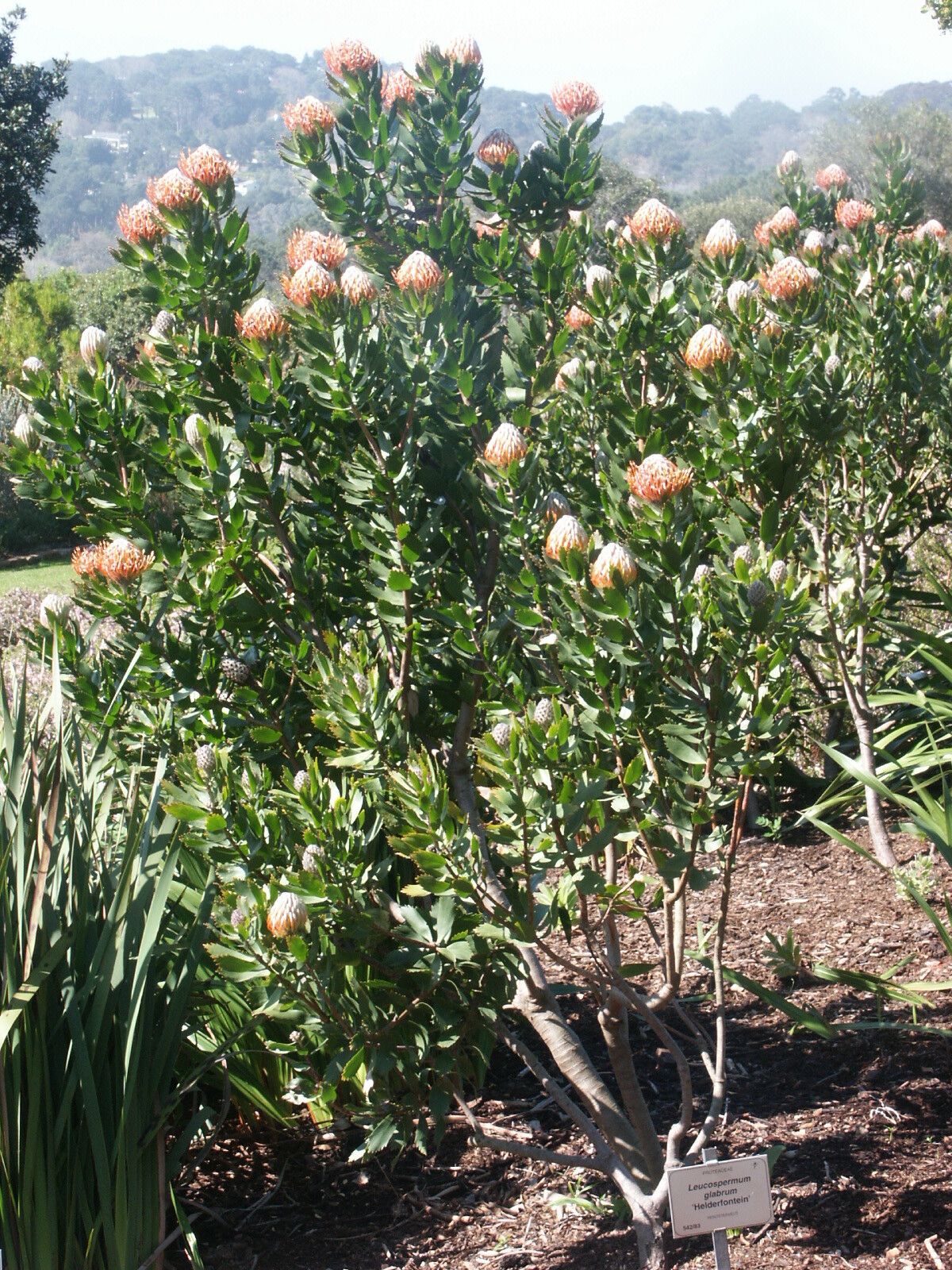
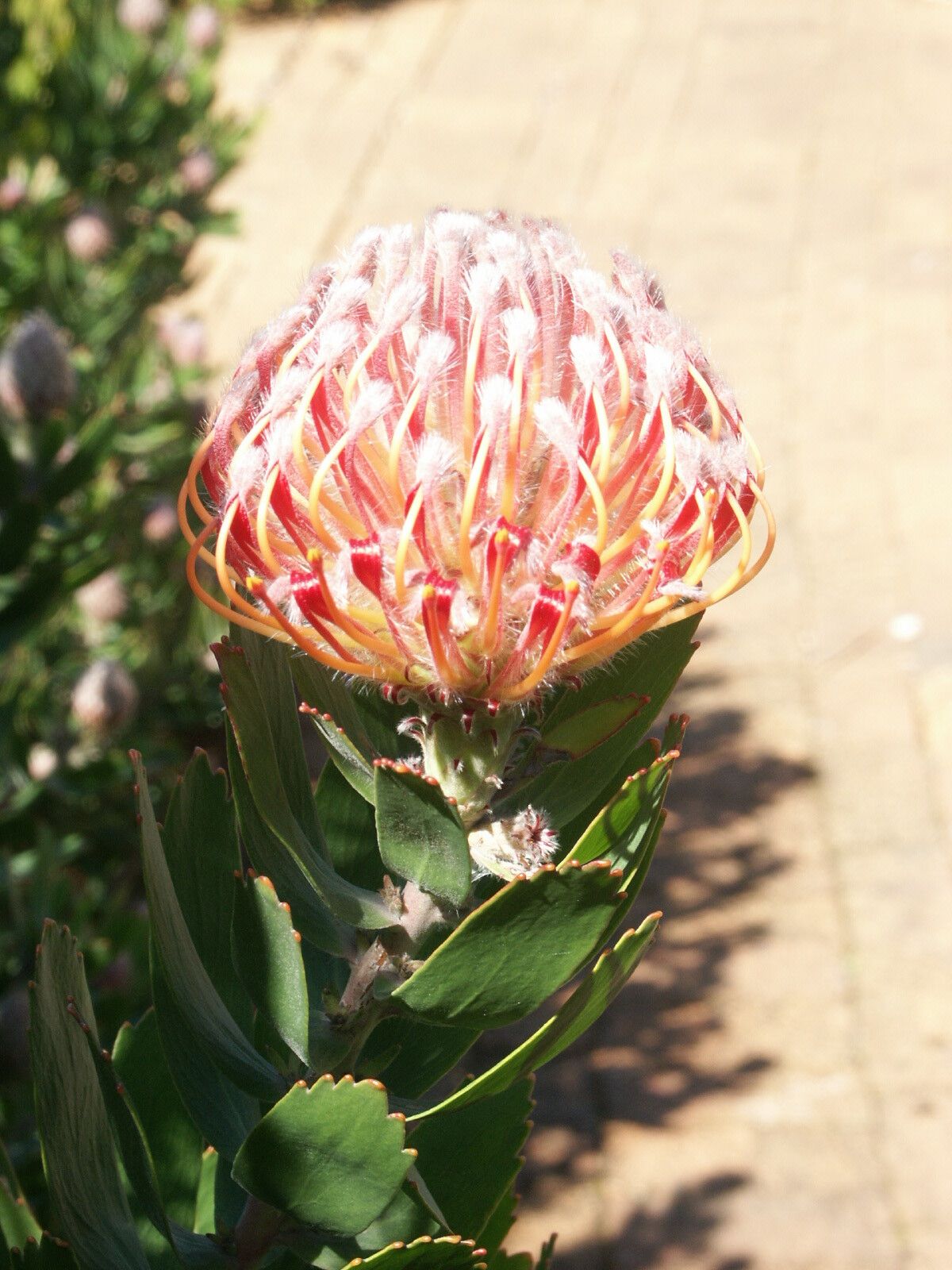
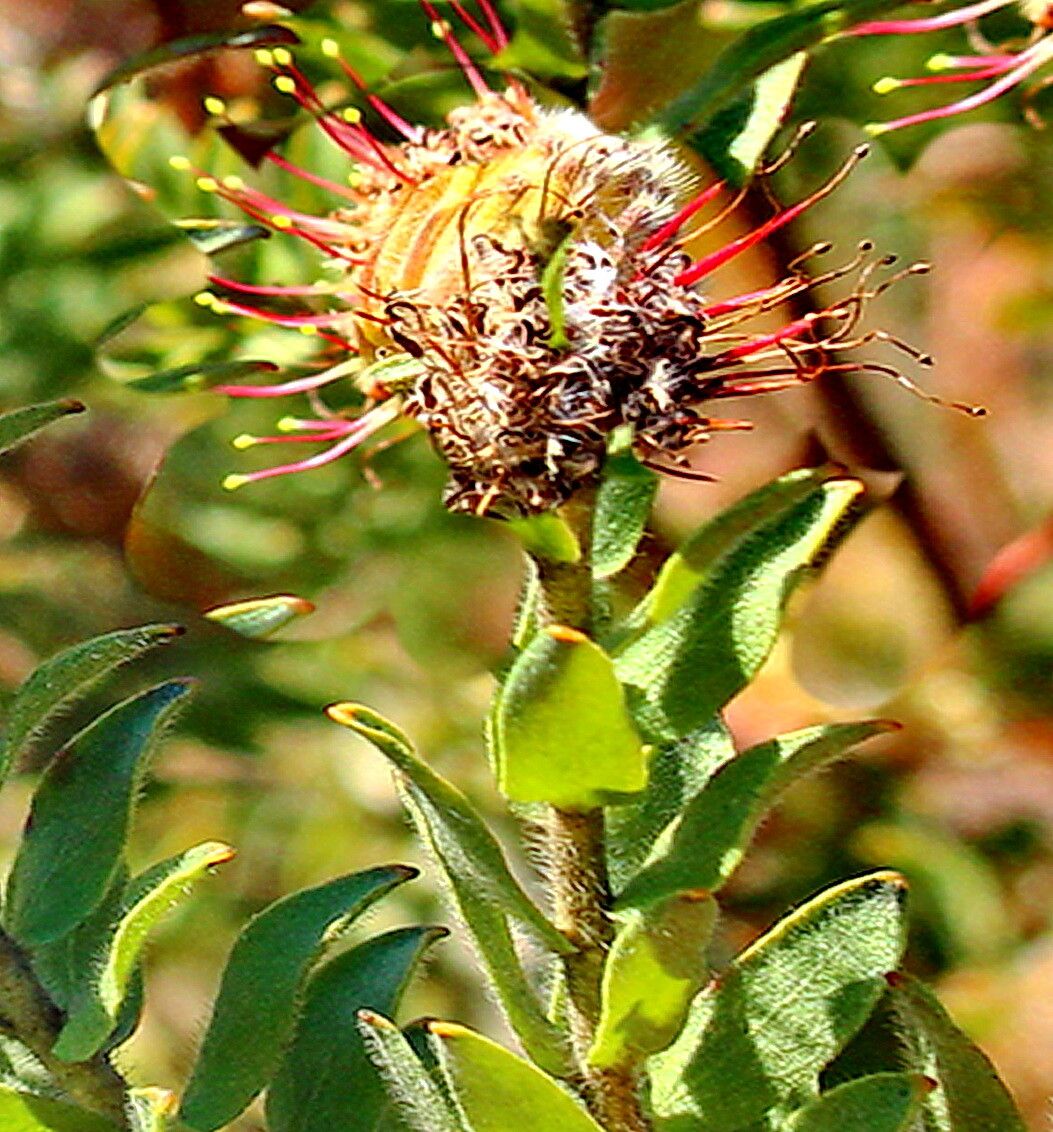
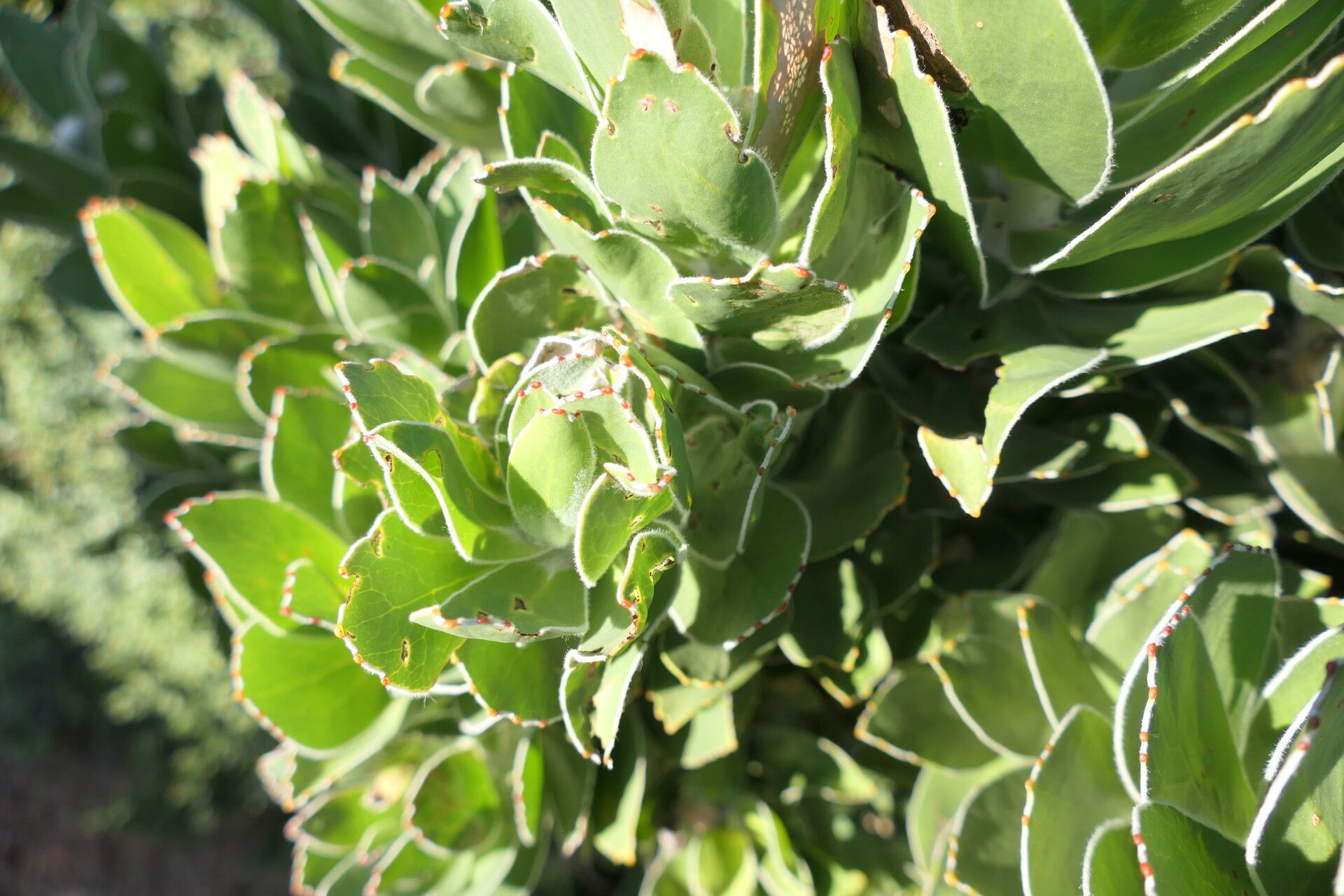
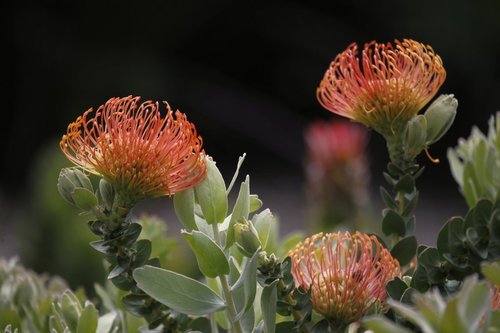
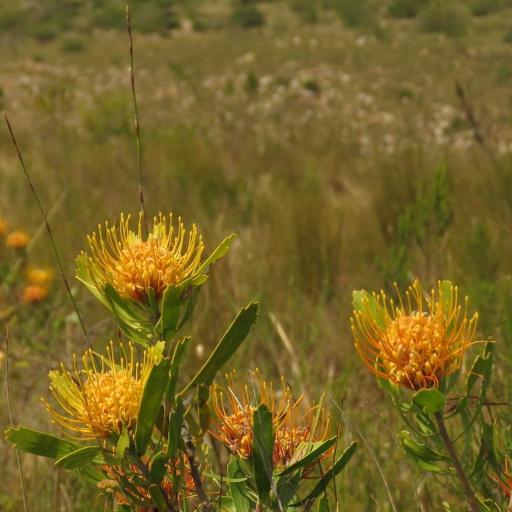
Leucospermum glabrum is an evergreen, rounded, upright shrub of up to 2½ m (8 ft) high, that is assigned to the family Proteaceae. It has broad inverted egg-shaped leaves with seven to fourteen teeth near their tips, and oval flower heads of about 8 cm (3.2 in) in diameter, with hairy, orange and carmine-coloured flowers from which long styles with a thickened end emerge, giving the flowerhead as a whole the appearance of a pincushion. It flowers between August and October. Its common name is Outeniqua pincushion in English and Outeniekwa-kreupelhout in Afrikaans. It naturally occurs in a limited area on the south coast of South Africa.
Scarlet ribbon has strong disease resistance and is generally not susceptible to disease. In terms of care, this plant is fairly low-maintenance. When planted outdoors it needs only minimal watering, and larger plants typically do not require pruning. Smaller plants, however, should be pruned after they have bloomed. Scarlet ribbon is suitable for anyone with an outdoor space, such as a garden or deck, and does not demand much care experience.
How to keep Leucospermum Glabrum.
Light
Scarlet ribbon springs from open settings like sunlit meadows and the periphery of forests, which offer plenty of light. It flourishes in direct sunlight but can also withstand slightly shaded conditions, demonstrating a good adaptability to diverse light circumstances.
Water
The scarlet ribbon plant is drought-tolerant. After planting, be sure to water it regularly during its first two years. In loamy soil, you should water the plant two to three times a week. If you are growing the plant in sandy soil or in a pot, it may need daily watering. Always water at the base of the plant to prevent diseases.
Temperature
The Scarlet ribbon demonstrates an impressive capacity to cope with fluctuations in temperature, especially when these are on the higher end of the scale. It's essential to monitor their hydration levels and supply enough shade during high temperatures to guard against sun scorch. Conversely, the Scarlet ribbon isn't as adept at dealing with cooler climates. If the temperature drops too much, it risks suffering from frost damage, although it can endure slight cold weather.
Fertilizer
The schedule for fertilizing Scarlet ribbon is critical. Begin adding fertilizer in the early spring and keep doing it monthly up to the early summer. Fertilizer contributes to beautiful blossoms and supplies energy throughout the periods of dormancy and active growth.
Pruning
Prune scarlet ribbons in early spring to encourage healthy growth and abundant blooms. Remove any dead branches and thin out dense areas to improve air circulation. Light trimming helps maintain the plant's shape and enhances its appearance, promoting vigorous new growth. This results in a strong and floriferous plant throughout the season.
Botanical profile.
- Plant Type
- Shrub
- Life Cycle
- Perennial
- Genus
- Leucospermum
- Family
- Proteaceae
- Hardiness Zone
- 9-11
- Mature Height
- 0.91 m to 2.13 m
- Mature Spread
- 0.91 m to 1.52 m
- Leaf Color
- Dark Green
- Leaf Type
- Evergreen
- Flower Color
- Yellow, Orange
- Flower Size
- 6.35 cm to 7.62 cm
- Bloom Time
- Late summer, Early fall, Mid fall
- Planting Time
- Spring, Summer, Autumn
- Harvest Time
- Late fall, Early winter, Mid winter
- Native Area
- South Africa
Other names.