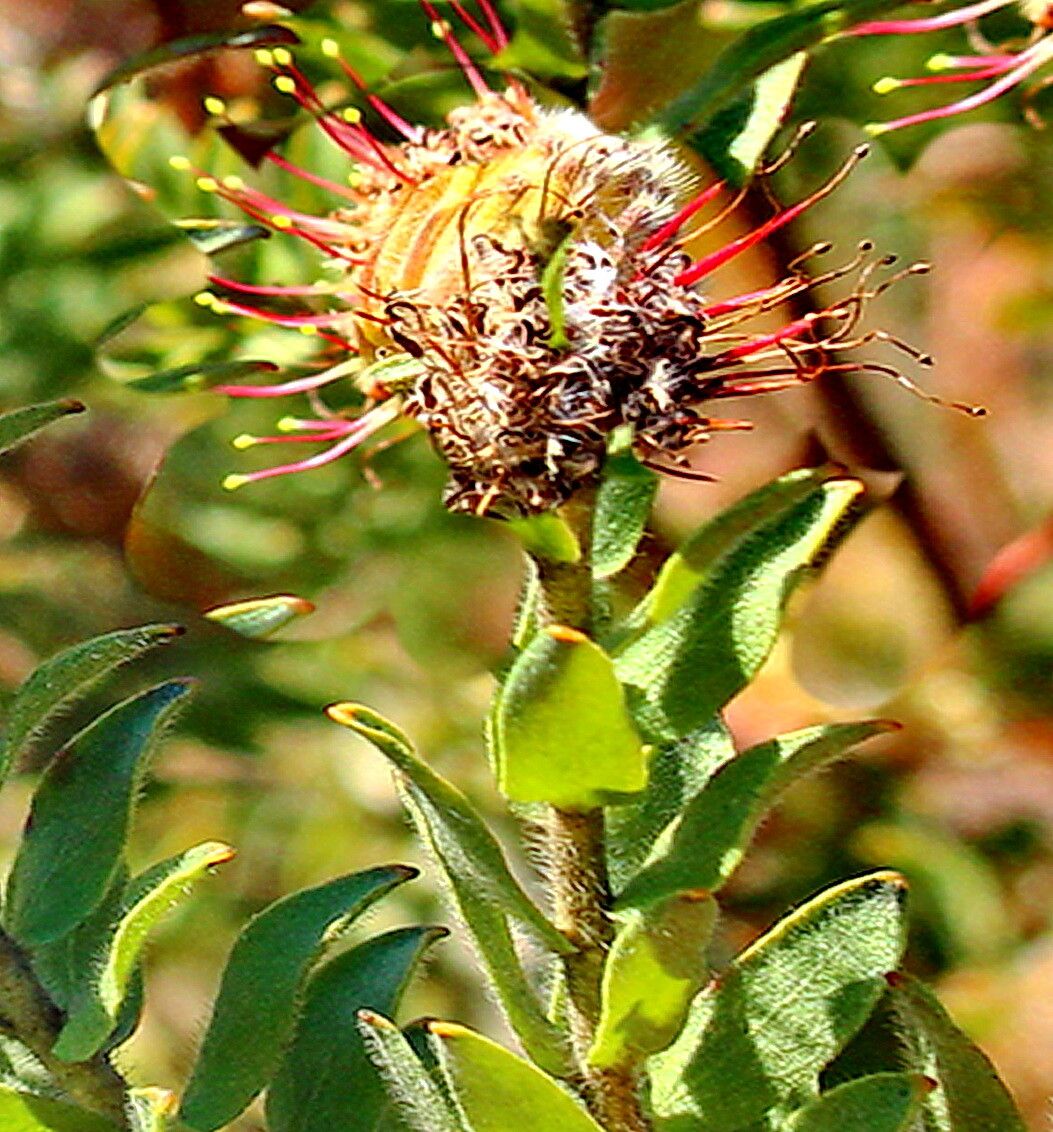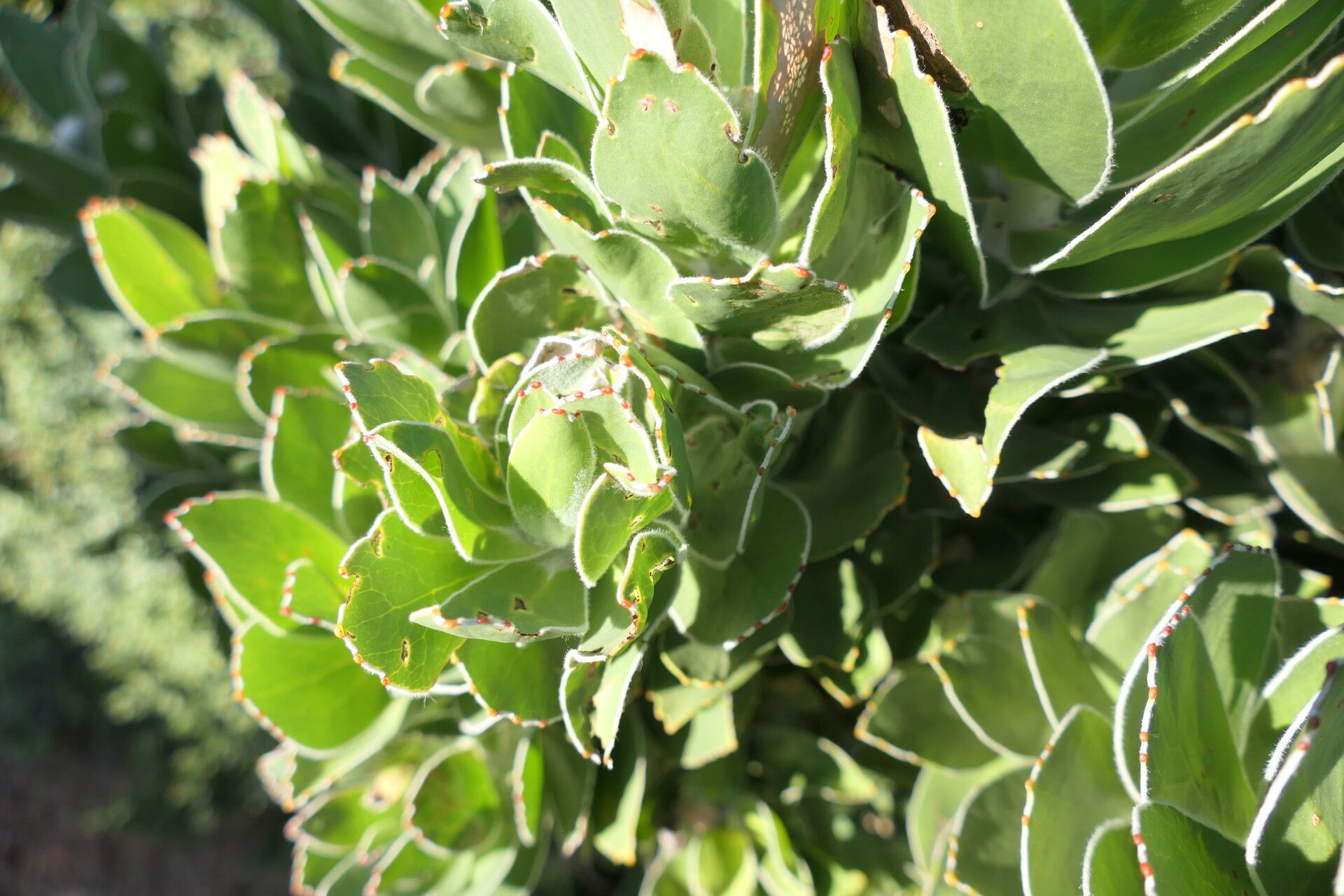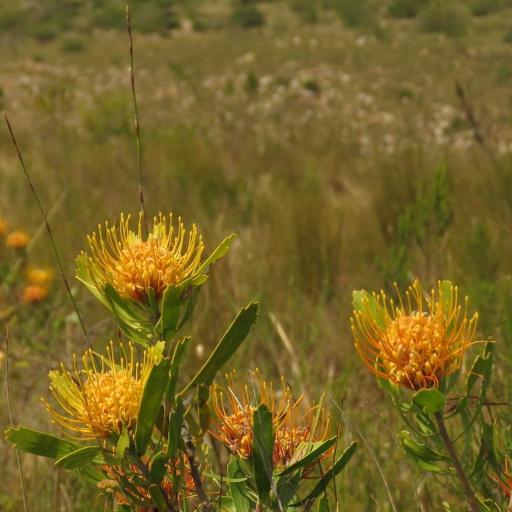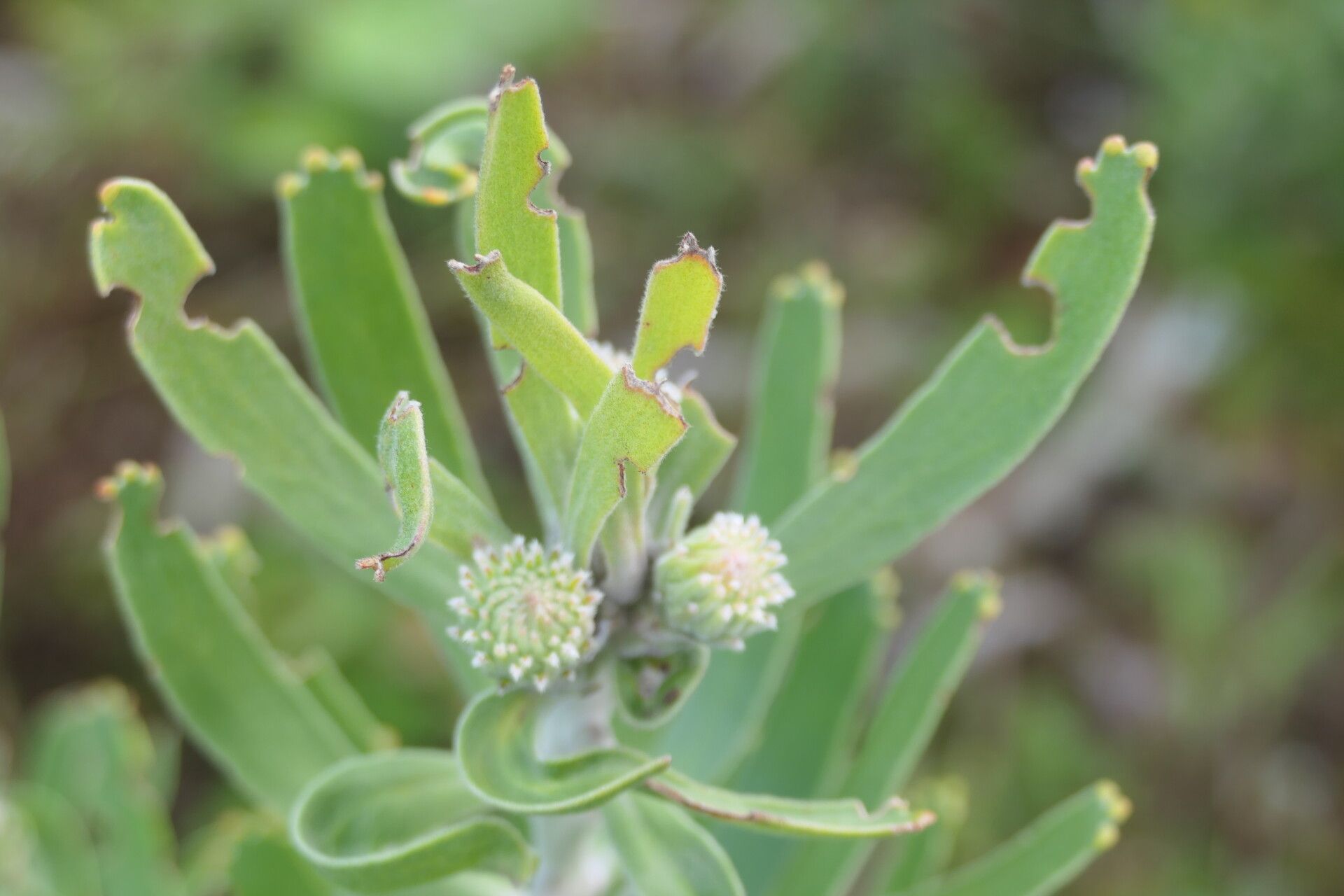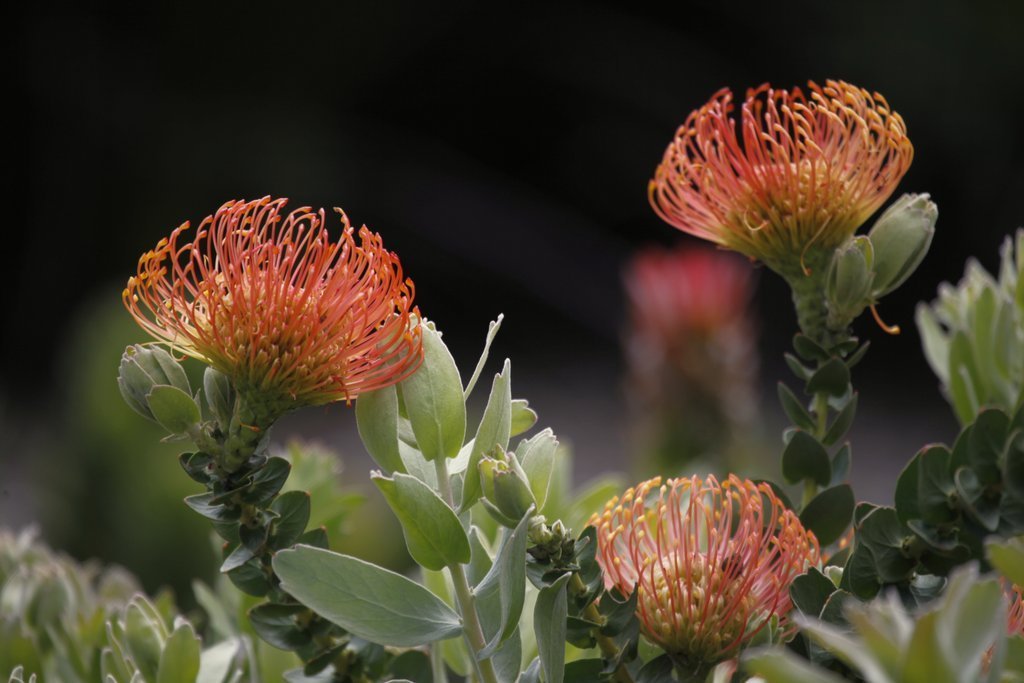
Leucospermum cordifolium is an upright, evergreen shrub of up to 1½ m (5 ft) high from the Proteaceae. The flower heads are globe-shape with a flattened top, 10–12 cm (3.9–4.7 in) in diameter, and are carried individually or with two or three together mostly at a right angle to its branch. The perianth is 3–3½ cm long, yellow, orange or crimson in color. From each flower emerges a 4½–6 cm (1.8–2.4 in) long style sticking out horizontally but curving upwards near the obliquely, shell-shaped, thicker pollen presenter. This gives each head the appearance of a pincushion. Its common name is ornamental pincushion in English and bobbejaanklou in Afrikaans. It flowers between the middle of July and the end of November. It naturally occurs near the south coast of the Western Cape province of South Africa. Varieties and hybrids of this species are used as cut flower and garden plant.
Ornamental Pincushion: The ornamental pincushion gets its name because its flower resembles a decorative pincushion. The flower's dense cluster of slender petals looks like numerous pins or needles protruding from a cushion, as if prepared for a sewing project.
Pincushion-protea resists disease well and is typically not vulnerable to illnesses. Regarding care, this plant is fairly low-maintenance. When grown outdoors it needs only occasional watering, and larger plants usually do not require pruning. Smaller plants, however, should be pruned after they finish blooming. Pincushion-proteat is appropriate for anyone with an outdoor area, such as a garden or deck, and does not demand much experience in plant care.
How to keep Leucospermum Cordifolium.
Light
Pincushion-protea grows best in locations where it receives plentiful sunlight throughout the day. It can adjust to areas with varying sun exposure, but its growth may be less vigorous there. In its native habitat it is exposed to unobstructed sunlight, which supports its flourishing. Insufficient light can result in poor flowering, while too much exposure may scorch the leaves.
Water
The ornamental pincushion plant originates from the fynbos region and thrives in Mediterranean climates, characterized by wet winters and dry summers. It prefers well-drained soil and should be watered every one to two weeks, allowing the soil to dry out between waterings. As an evergreen shrub, it benefits from natural rainfall, but it requires good drainage to prevent root rot.
Temperature
The pincushion-protea typically thrives in warmer regions where daytime temperatures average between 68 and 100 ℉ (20 to 38 ℃). It favors full sun and soil that drains well. In winter, it is advisable to keep temperatures above the freezing point to prevent any damage to the plant.
Fertilizer
The best time to fertilize a Pincushion-protea is in early spring when it comes out of dormancy. This encourages overall growth and flower production. Fertilization improves the foliage, stems, and branches, and encourages large, vibrant, long-lasting blooms. It also helps transport nutrients from the roots to the flowers and boosts the plant’s health and resistance to disease.
Pruning
Pruning ornamental pincushion plants helps enhance their growth and shape by removing dead flowers and trimming older stems back to healthy nodes. The best time to prune is in late spring, after the blooming period, as this promotes future flowering. Pruning also improves air circulation and helps prevent disease, ensuring a healthier plant. Be sure to always use clean, sharp tools for the best results.
Pot & Repot
When repotting Pincushion-protea, select a pot 1-2 inches (2.5–5.1 cm) larger with good drainage. Use a well-draining potting mix. Repot in spring or fall, making sure the root ball sits slightly lower than the rim of the flower pot. Water thoroughly after repotting and place the plant in a warm spot with indirect sunlight.
Botanical profile.
- Plant Type
- Shrub
- Life Cycle
- Perennial
- Genus
- Leucospermum
- Family
- Proteaceae
- Hardiness Zone
- 9-11
- Mature Height
- 1.52 m
- Mature Spread
- 2.13 m
- Leaf Color
- Green
- Leaf Type
- Evergreen
- Flower Color
- Orange, Yellow
- Flower Size
- 10.16 cm to 11.43 cm
- Bloom Time
- Mid spring, Late spring, Early summer, Mid summer
- Planting Time
- Spring, Autumn
- Harvest Time
- Early spring, Late summer, Fall, Winter
- Native Area
- South Africa
Other names.
Reader questions.
How much water does my Ornamental pincushion plant need?
When watering your Ornamental pincushion, you may be surprised to learn that it doesn't always require a lot of water. Instead, if only a few inches of soil have dried since the last watering, you can give it about five to ten ounces of water each time. You can also judge how much water to give based on the moisture of the soil. If more than half of the soil is dry, you should consider giving more water until you see excess water draining from the pot's holes. If your pincushion is planted in a rainy area, it may not need additional watering. When it's young or getting established, it needs 1-2 inches of rain per week. Once it's fully grown and established, it can survive on rainwater alone unless there's a prolonged drought.
Why do I have to put fertilizer on my Ornamental pincushion?
Proper fertilization is crucial for the overall health and well-being of your Ornamental pincushion. It promotes the development of healthy foliage, sturdy stems, and branches. While the flowers of this plant are particularly prized by gardeners, fertilization also plays a key role in producing large, vibrant, and long-lasting blooms. The right fertilizer aids in the efficient transfer of fuel from the roots to the flowers, resulting in their optimal growth. Additionally, proper fertilization helps maintain the plant's overall health, making it more resistant to diseases.
What are the sunlight requirements for an ornamental pincushion?
The ornamental pincushion, or Leucospermum cordifolium, thrives best in full sun conditions, requiring more than 6 hours of sunlight daily to flourish. It can also adapt to partial sun, with about 3-6 hours of sunlight. It's essential to observe your garden's sunlight patterns to find a spot that offers the right balance of light and shade to ensure the plant's health. Without sufficient light, the pincushion may experience poor blooming, whereas excessive light can lead to leaf scorch.
What are the essentials for growing an Ornamental pincushion?
The Ornamental pincushion, or Leucospermum cordifolium, prospers in warmer climates, thriving best in average daytime temperatures between 68 to 100°F (20 to 38°C). It has a preference for full sun exposure and well-draining soil. To prevent damage, it's crucial to keep the plant above freezing temperatures during winter months. This heat-loving plant suffers in cold, hence moving it indoors in autumn to a location near a bright window while avoiding proximity to heaters is recommended to maintain temperatures above 20°C, ensuring its well-being. Temperatures nearing 0°C are harmful and should be avoided.
How do I know if I am giving enough water to my Ornamental pincushion?
The Ornamental pincushion plant commonly faces issues with overwatering. There are certain indicators to watch out for if this happens. Generally, an overwatered plant will develop yellowing leaves and may even shed some leaves. Overwatering can also cause the overall structure of the plant to shrink and can lead to root rot. On the other hand, if the Ornamental pincushion is not given enough water, it will start to droop. Additionally, its leaves may turn brown or become brittle to the touch. Regardless of whether you observe signs of overwatering or underwatering, it is important to take action and restore the health of your plant.
When should I put fertilizer on my Ornamental pincushion?
To fertilize an Ornamental pincushion, the best time is during early spring when the plant is coming out of dormancy and getting ready to bloom. This feeding will provide the plant with the energy it needs for growth and flower development. However, it's also beneficial to give the plant another dose of fertilizer in the fall, although this one doesn't need to be as big as the first. Some gardeners opt to fertilize the Ornamental pincushion during planting, but it's not always necessary.
How does artificial lighting support ornamental pincushion growth?
Artificial lighting is invaluable for the growth of ornamental pincushion, especially indoors or in areas with insufficient natural sunlight. Adequate artificial lighting, such as LED lights, can be customized to provide specific wavelengths needed for optimal growth. For full sun plants, 30-50W per square foot is recommended; for partial sun plants, 20-30W per square foot; and for full shade, 10-20W per square foot. The artificial light source should be placed 12-36 inches above the plant for 8-12 hours per day to mimic natural daylight conditions.
How should I care for my Ornamental pincushion in low temperatures?
Ornamental pincushion is sensitive to cold and thrives when temperatures are maintained above 20°C, especially in winter where it should remain above 0°C to avoid damage. Exposure to temperatures below -5°C may cause the leaves to lighten, and following frost damage, the leaves can turn brown or black accompanied by wilting and drooping. For frost-damaged plants, trim off the affected parts and move the plant to a warmer indoor space. Placing it near a south-facing window can ensure it gets enough sunlight without the risk of dryness from nearby heaters or air vents.
What's the difference between watering my Ornamental pincushion inside and outside?
Your Ornamental pincushion may not need watering if it grows outside and gets enough rain. However, if you live in a low rainfall area, water the plant every two weeks. If you live outside the plant's natural hardiness zone, grow it indoors. Indoors, the plant's soil can dry out faster in containers or near HVAC units like air conditioners. In these cases, water the plant more frequently than if it were grown outdoors.
When is not a good time to fertilize my Ornamental pincushion?
During the winter, you don't need to fertilize your Ornamental pincushion since it is in a dormant phase and doesn't require much energy from the soil. Fertilizing during this time can lead to overfertilization issues. The best times to feed your Ornamental pincushion are in early spring and fall. Therefore, during most of spring and summer, the plant won't need fertilizer. It's also advisable to hold off on feedings when the plant is exposed to excessive heat or dry conditions.
What are the symptoms of light deficiency in ornamental pincushions?
When ornamental pincushions do not receive enough light, they exhibit several symptoms, including the growth of smaller leaves, leggy or sparse growth, accelerated leaf drop, halted or no new growth, and the development of lighter-colored or chlorotic leaves. Additionally, excessive sunlight can cause chlorosis, sunscald, leaf curling, wilting, and leaf scorching, indicating both under and overexposure to light can significantly impact the plant's health.
What should I do if my Ornamental pincushion experiences high temperatures?
In the summer, it is important to protect the Ornamental pincushion from extreme heat, ensuring temperatures stay below 100°F (38°C). If temperatures exceed 109°F (43°C), the plant may show signs of stress, such as lightened leaf color and susceptibility to sunburn. In such cases, trim away sunburned or dried-up parts and relocate the plant to a shaded area during peak sun hours. To alleviate heat stress, watering the plant in the morning and evening helps keep the soil consistently moist.