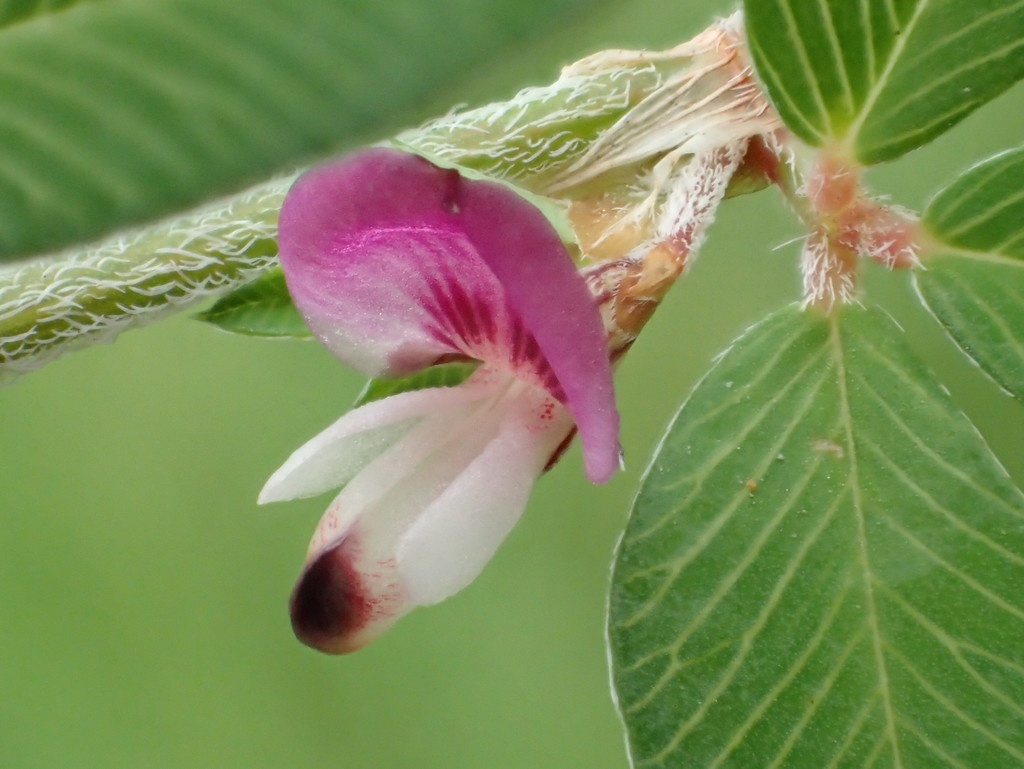
Kummerowia striata, commonly known as Japanese clover or Korean clover, is a small annual plant belonging to the legume family. Native to East Asia, it thrives in various habitats such as grasslands, fields, and roadsides. This plant exhibits a prostrate growth habit, with stems that can extend up to 50 cm in length. The leaves are trifoliate, featuring oval-shaped leaflets that are approximately 1-2 cm long.
From July to September, Kummerowia striata produces small pink or purple flowers, which are followed by small pods containing seeds. The plant is highly tolerant of drought and poor soil conditions, making it an ideal cover crop for erosion control and soil improvement.
In traditional medicine, Kummerowia striata has been used for its anti-inflammatory properties and as a remedy for various ailments, including fever, coughs, and sore throats.
Overall, Kummerowia striata is an important species due to its ecological significance in improving soil quality, as well as its medicinal properties, making it a valuable resource in traditional medicine practices.
Japanese clover is fairly resistant to disease and typically does not succumb to illnesses. However, it can be vulnerable to pests and diseases present in its environment. Such infections tend to be mild. Regarding care, the plant needs moderate maintenance. It should be pruned regularly to preserve a neat appearance and encourage healthy growth. Fertilizing can also support flowering. Japanese clover is appropriate for anyone with outdoor space, like a garden or patio, and does not demand extensive gardening experience. It may need more attention when grown indoors.
How to keep Kummerowia Striata.
Light
Japanese clover grows best beneath a clear, open sky with plenty of sunlight. It is, however, hardy enough to endure locations with less sun or even mostly shaded spots. Too much exposure, while somewhat helpful, is not required. Conversely, insufficient sunlight can limit its growth and vigor.
Water
Japanese clover thrives in humid, temperate climates and prefers consistent moisture. While it is moderately drought-tolerant, it thrives in evenly damp soil. Watering it weekly is ideal. Although typically grown outdoors, Japanese clover is resilient across various climate zones, performing exceptionally well in areas that mimic its native patterns of rainfall and dry periods.
Temperature
Japanese clover originates from areas where temperatures typically range from 68 to 95 °F (20 to 35 ℃). It performs well in these warm conditions and may need climate control during cooler seasons. For optimum growth, keep these temperatures throughout the year.
Fertilizer
Japanese clover benefits from regular, light fertilization to encourage robust leaf development. You should apply fertilizer about once per month throughout the summer. Nitrogen is essential for foliage, and supplying nitrogen-rich sources helps Japanese clover thrive.
Botanical profile.
- Plant Type
- Herb
- Life Cycle
- Annual
- Genus
- Kummerowia
- Family
- Fabaceae
- Hardiness Zone
- 4-7
- Mature Height
- 30 cm to 40 cm
- Mature Spread
- 30 cm to 61 cm
- Leaf Color
- Green
- Leaf Type
- Deciduous
- Flower Color
- Pink, White
- Flower Size
- 2.54 cm
- Bloom Time
- Early summer, Mid summer
- Planting Time
- Autumn
- Harvest Time
- Mid summer
- Native Area
- Russia, India, Vietnam, Japan, Koppen, South Korea, China
Other names.
Reader questions.
How should I water my Japanese clover?
There are multiple ways to water Japanese clover, such as using a garden hose with a spray nozzle, a watering can, or any other common watering tool. Japanese clover is not too particular about the type of water it receives and can survive on rainwater, tap water, or filtered water. However, it's generally recommended to avoid watering this plant from above, as it can harm the leaves and flowers and potentially cause disease. A drip irrigation system is often the best choice for watering Japanese clover, as it ensures even and direct application of water to the soil. For Japanese clover in a container, you can use a similar watering method but with different tools, like a cup, watering can, or tap, to directly water the soil.
What are the sunlight requirements for Japanese clover?
Japanese clover (Kummerowia striata) requires full sun, which means it thrives best with more than 6 hours of sunlight daily. However, it can also grow under partial sun to full shade conditions, needing about 3-6 hours of sunlight. Observing the movement of sunlight through your garden will help you choose the optimal spots for planting, ensuring a perfect balance of light and shade for the health and happiness of your plants.
What is the native climate for Japanese clover?
Japanese clover, or Kummerowia striata, thrives in its native climate where temperatures generally range between 68°F to 95°F (20°C to 35°C). It flourishes in warm temperatures and may require climate control in regions that experience cooler seasons. To ensure optimum growth, maintaining these temperatures year-round is recommended.
What should I do if I give my Japanese clover too much or too little water?
Underwatering Japanese clover is easily resolved by watering it more frequently when you notice it lacks moisture. On the other hand, overwatering can be a serious issue, as it can lead to diseases and the eventual decline and death of the plant. To avoid this, it is important to choose a suitable location for growth that receives enough sunlight to dry the soil and has good drainage to prevent pooling of excess water. If you have overwatered Japanese clover in a pot, you may need to consider transferring it to a new pot with proper drainage. When repotting, use loose soil and ensure the new pot is efficient in draining water.
Can Japanese clover grow in indoor or shaded environments?
Yes, Japanese clover can grow in less sunny environments or even in largely shaded areas. It is robust enough to endure these conditions. Overexposure to sunlight is beneficial to an extent but isn't essential, as a lack of sunlight can negatively impact its growth and vitality. For indoor plants, artificial lighting is crucial for optimal growth, especially when natural sunlight is insufficient. LEDs are recommended for their ability to provide specific wavelengths needed by plants. The required intensity depends on the plant's specific sunlight needs, with full sun plants needing 30-50W/sq ft, partial sun plants 20-30W/sq ft, and full shade plants 10-20W/sq ft of artificial light.
Does Japanese clover require frost protection measures?
Despite being highly cold-tolerant, Japanese clover does not require additional frost protection measures during winter. However, it is recommended to water the plant generously before the first freeze in autumn. This ensures that the soil remains moist and enters a frozen state, thereby preventing drought and water scarcity for the plant during the colder months and early spring.
How many times should I water my Japanese clover?
To properly care for Japanese clover, it is important to water it regularly throughout the growing season. In the spring, watering once a week is sufficient. However, as the season progresses and temperatures rise, you may need to increase watering to two to three times a week. It's crucial not to exceed this rate as it can harm the plant. Additionally, the soil should be kept relatively moist but not overly wet. If your Japanese clover is in a pot, you'll need to water it more frequently compared to one planted in the ground. Container-grown plants can dry out faster, so watering a few times a week is generally recommended, instead of once a week for those in the ground.
What are the symptoms of insufficient or excessive light exposure in Japanese clover?
Insufficient light can cause symptoms such as small leaves, leggy or sparse growth, faster leaf drop, slower or no new growth, lighter-colored new leaves, indicating a lack of chlorophyll and nutrients. Excessive sunlight can lead to chlorosis, sunscald, leaf curling, wilting, and leaf scorching. These symptoms show the plant's struggle with intense light exposure or inadequate sunlight, impacting photosynthesis and overall health.
How does Japanese clover react to low temperatures?
Japanese clover is extremely cold-tolerant and can withstand winter temperatures above -30°C. If the temperature dips below this level, while there may not be any noticeable changes during the winter, a decrease in sprouting or even a complete lack of sprouting may occur in the spring. In such cases, removing any parts that have failed to sprout in spring is advised.
How much water does my Japanese clover require?
Determining how much water to give your Japanese clover can be done in a few different ways. Some gardeners rely on feeling the soil to gauge moisture. They suggest watering until the first six inches of soil feel moist. Another approach is using a set measurement. Generally, two gallons of water per week is recommended, taking into account the temperature and how quickly the soil dries out. However, strictly following these guidelines might result in overwatering if your plant doesn't require that much water. When growing Japanese clover in a container, a different approach is needed. It's best to moisten all the dry layers of soil. Testing for moisture can be done by sticking your finger in the soil or watering until you notice a slight trickle of excess water coming out of the drainage holes.
How can I adjust the lighting conditions for my Japanese clover?
To optimize growth for Japanese clover, gradually move plants to locations receiving at least 6 hours of direct sunlight daily. This can be achieved by using south-facing windows or providing artificial light for indoor or non-movable plants. For outdoor plants, it's essential to avoid sudden changes in light intensity. Pruning obstructive trees or transplanting to sunnier locations with good drainage may also be necessary. Although parts of the plant affected by insufficient sunlight may not recover, new growth should be healthy following these adjustments.
What should be done if Japanese clover is exposed to high temperatures?
When exposed to temperatures exceeding 35°C, Japanese clover's growth will halt, and it becomes more susceptible to rot. To mitigate this, it’s advisable to trim away any sunburned and dry parts. Moving the plant to a location with shade from the midday and afternoon sun, or using a shade cloth, can protect it. Additionally, watering the plant in the morning and evening helps keep the soil moist, further aiding in its care under high temperature conditions.
