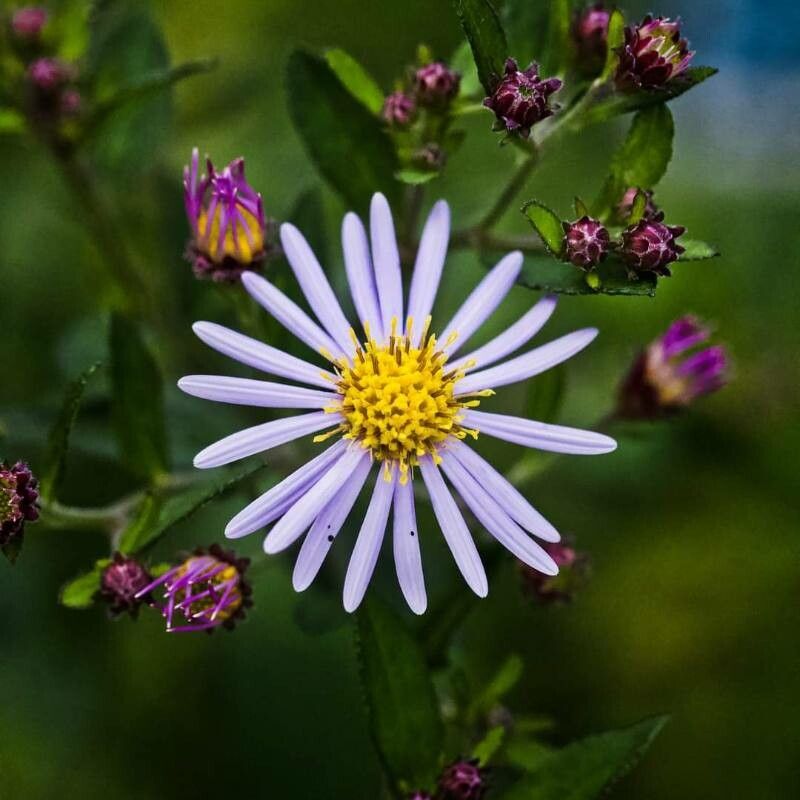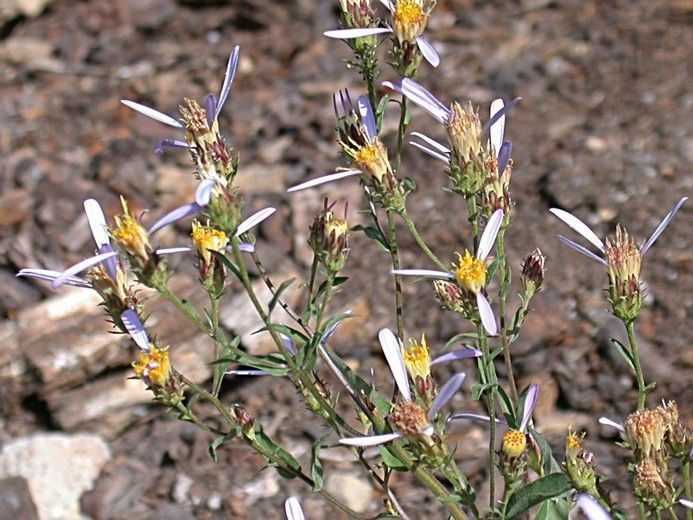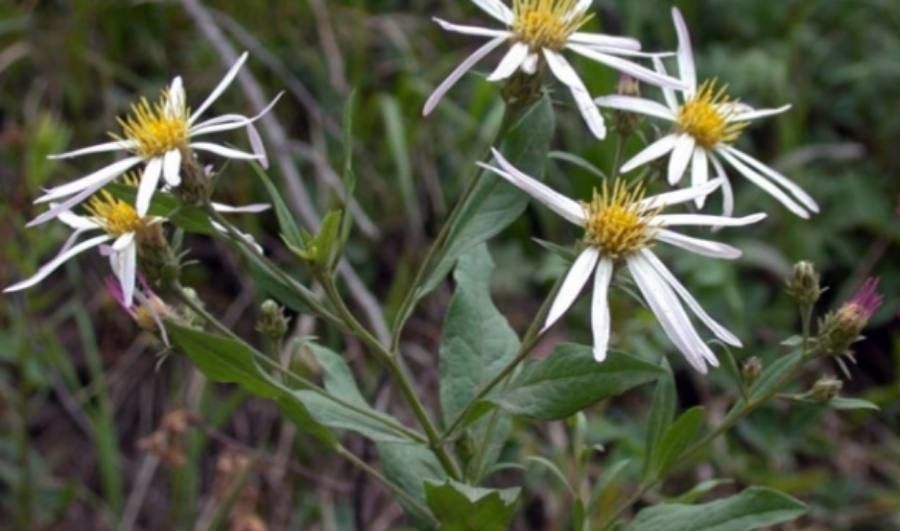
Eucephalus engelmannii is a North American species in the family Asteraceae known by the common name Engelmann's aster. It is native to the United States and Canada from Alberta and British Columbia to far northern California and Colorado.E. engelmannii grows in mountain woods and meadows. It is a perennial herb growing from a woody caudex and sending a slender, branching, hairy stem to a maximum height near 1.5 metres (5 feet). The mostly leaves are generally oval and up to 10 centimetres (4 inches) long, with some hair on the bottom and the basal leaves much reduced. The inflorescence holds several flower heads lined in keeled, pointed, hairy-edged phyllaries with purplish margins at the tips. Each head has 8–13 white to pinkish or purplish ray florets each up to 2 cm (3⁄4 in) long, surrounding a 4–6.5 cm (1+1⁄2–2+1⁄2 in) circle of yellow disc florets. The fruit is a hairy achene.
Engelmann's aster is fairly resistant to disease and typically does not suffer from many illnesses. That said, it can be vulnerable to local pests and diseases found in its environment. Such problems are generally mild. Regarding maintenance, this plant needs a moderate level of care. Regular pruning is necessary to preserve an attractive look and encourage healthy growth. Applying fertilizer can also aid in boosting its blooms. Engelmann's aster is well suited for anyone with outdoor areas like a garden or patio and does not demand extensive gardening experience. When cultivated indoors, it may need more attentive care.
How to keep Eucephalus Engelmannii.
Light
The Engelmann's aster mainly thrives in highly shaded environments, showing a strong inclination towards areas with substantial lack of light. The plant's native living conditions demonstrate this preference for low light levels, which are associated with its overall wellbeing and growth trends. Exposure to excess light might induce stress, while complete absence of light might hinder its growth progress.
Water
Engelmann's aster is native to the temperate regions of North America, where it thrives in consistently moist soils, as long as they are not waterlogged. While it can tolerate some drought, it is best to water it weekly to keep it healthy. When planted outdoors, Engelmann's aster adjusts well to seasonal rainfall and prospers when the amount of rain meets its growth requirements.
Temperature
Engelmann's aster originates from temperate climates with temperatures varying from 32 to 77 °F (0 to 25 ℃). It flourishes in these thermal ranges, though it can also acclimate to slightly colder or warmer conditions by modifying its water intake.
Fertilizer
The best period to fertilize an Engelmann's aster is during early spring as it exits dormancy and starts growing actively. Through fertilization, crucial nutrients are provided for its healthy development. Even though Engelmann's aster does not require a significant amount of fertilizer, fertilizing it every year could increase its lifespan and encourage the growth of more durable flowers.
Pruning
Engelmann's aster showcases vibrant flowers and bushy growth. To enhance the plant's health and appearance, prune it from early to late spring. Trim any damaged stems to improve airflow and light penetration. This practice encourages denser foliage, promotes blooming, and prevents legginess, significantly boosting the plant's vitality and aesthetic appeal.
Botanical profile.
- Plant Type
- Herb, Shrub
- Life Cycle
- Perennial
- Genus
- Eucephalus
- Family
- Compositae
- Hardiness Zone
- 2-3
- Mature Height
- 0.52 m to 1.52 m
- Mature Spread
- 30 cm to 46 cm
- Leaf Color
- Green, Dark Green
- Leaf Type
- Semi-evergreen
- Flower Color
- Lavender, White
- Flower Size
- 3.56 cm to 5.08 cm
- Bloom Time
- Mid summer, Late summer, Early fall
- Planting Time
- Spring, Summer, Autumn
- Harvest Time
- Early fall, Mid fall
Other names.
Reader questions.
What are the sunlight requirements for Engelmann's aster?
Engelmann's aster thrives in full shade environments, which means it prefers less than 3 hours of sunlight daily. It flourishes best in considerably obscured settings, indicating a significant absence of light exposure is beneficial for its health and growth. When planning your garden, observe how sunlight moves through the area throughout the day to ensure you choose spots that provide the perfect balance of light and shade for these plants.
What is the native climate for Engelmann's aster?
Engelmann's aster, botanically known as Eucephalus engelmannii, is native to temperate climates where temperatures fluctuate between 32 to 77 °F (0 to 25 °C). It thrives in these temperature ranges but can withstand slightly cooler or hotter weather with adjustments in hydration. The plant is highly cold-tolerant and does not require additional frost protection measures during the winter. However, it is recommended to water the plant generously before the first freeze in autumn to ensure the soil remains moist and enters a frozen state, preventing drought and water scarcity for the plant during winter and early spring.
How should artificial lighting be used for Engelmann's aster?
For Engelmann's aster plants kept indoors or in settings where natural sunlight is insufficient, artificial lighting can be a vital solution. It's recommended to choose the right type of artificial light, with LED lights being a popular choice because they can be customized to provide specific wavelengths needed by the plants. The ideal amount of artificial light varies by plant type: 30-50W/sq ft for full sun plants, 20-30W/sq ft for partial sun plants, and 10-20W/sq ft for full shade plants like Engelmann's aster. The light source should be placed 12-36 inches above the plant, mimicking natural sunlight as closely as possible, and provided for 8-12 hours per day.
How does Engelmann's aster respond to low temperatures?
Engelmann's aster is extremely cold-tolerant, capable of handling winter temperatures well above -40°C (-40°F). Despite this high tolerance, if temperatures drop below this threshold, there may not be noticeable changes during the winter. However, a decrease in sprouting or even a complete lack of sprouting might be observed during springtime. To mitigate this, in spring, any parts of the plant that have failed to sprout should be removed.
What are the key symptoms of light deficiency in Engelmann's aster?
Light deficiency in Engelmann's aster can manifest as small leaves, leggy or sparse growth, faster leaf drop, slower or no new growth, and lighter-colored new leaves. These symptoms are crucial indicators that the plant is not receiving adequate light. On the opposite spectrum, symptoms of excessive light include chlorosis, sunscald, leaf curling, wilting, and leaf scorching. Each symptom provides valuable insights into the plant's health in relation to its exposure to light.
What should I do if Engelmann's aster is exposed to high temperatures?
Engelmann's aster does not tolerate high temperatures well. Growth will halt, and the plant becomes more susceptible to rot when temperatures exceed 25°C (77°F). To protect the plant under high temperatures, sunburned and dried-up parts should be trimmed away. It is beneficial to move the plant to a location that provides shade during the midday and afternoon sun, or alternatively, use a shade cloth to create shade. Ensure the soil is kept moist by watering the plant in the morning and evening.
What are some effective solutions for light-related issues in Engelmann's aster?
To address light-related issues in Engelmann's aster, indoor plants can be moved to spots where they receive ample filtered light, including brief direct morning sunlight, ideally 1-2 meters away from a window. Artificial lights, such as desk or ceiling lamps, should be used for at least 8 hours daily if natural light is insufficient. For outdoor plants, gradual relocation to sunnier spots helps in adaptation without causing sunburn. Pruning surrounding trees or obstacles that block sunlight and transplanting during the dormant period can also improve light accessibility. It's important to note that parts of the plant affected by insufficient sunlight may not recover, but new growth will be healthy after adjusting light exposure.