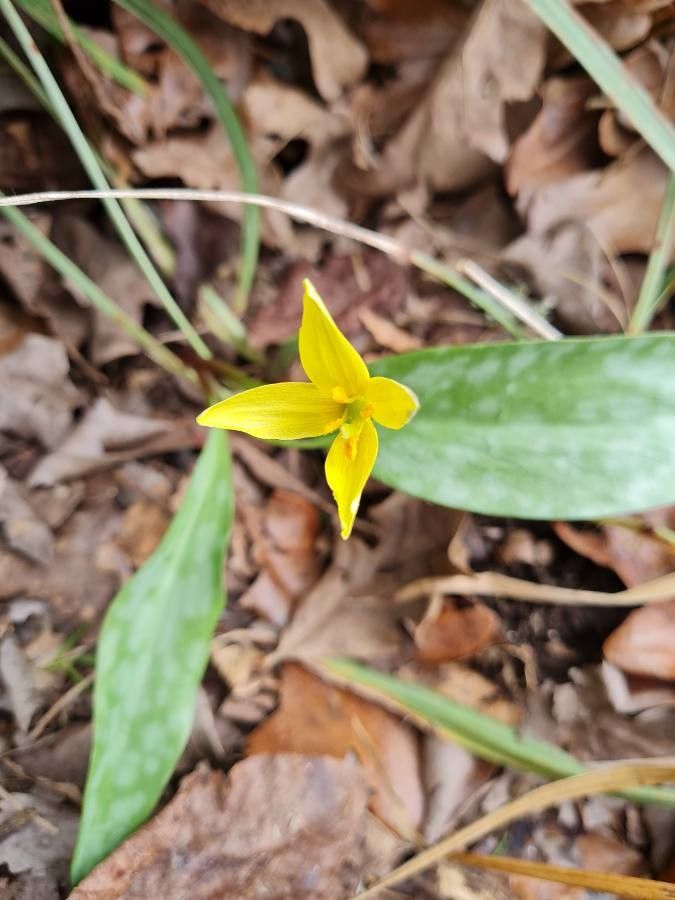
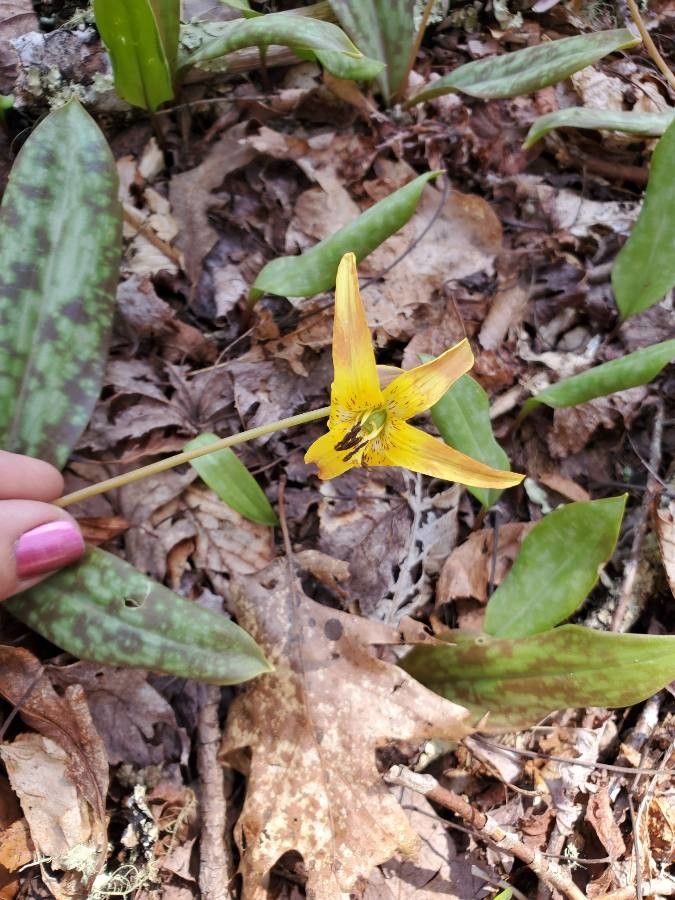
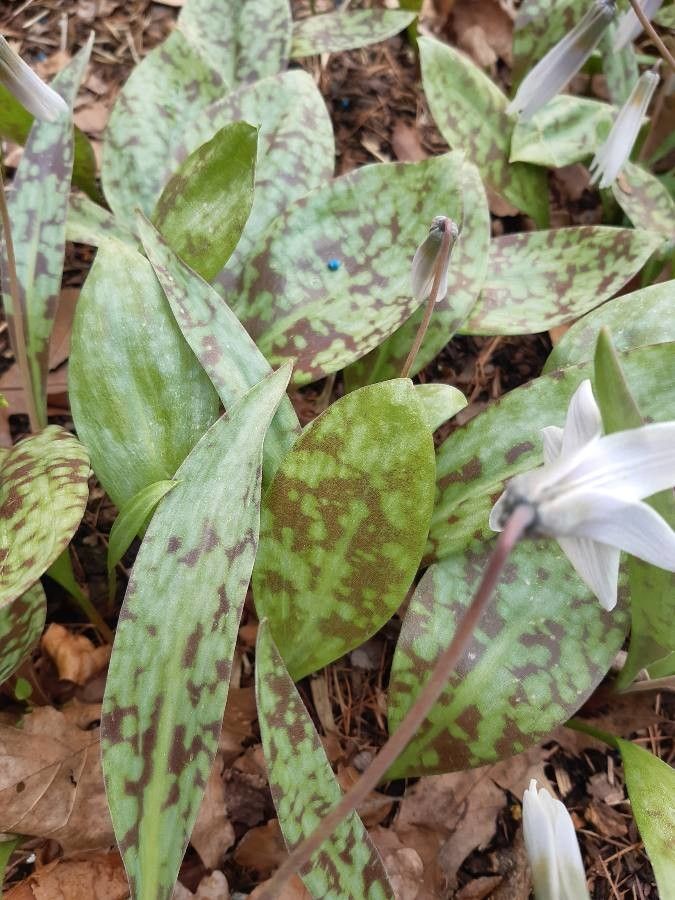
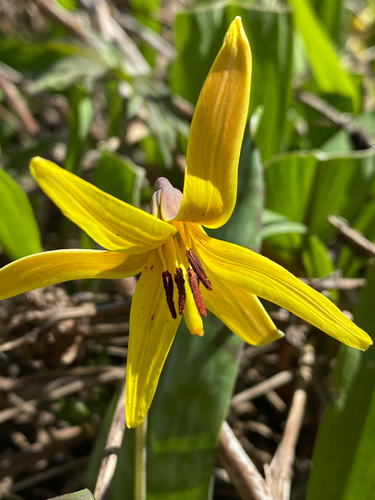
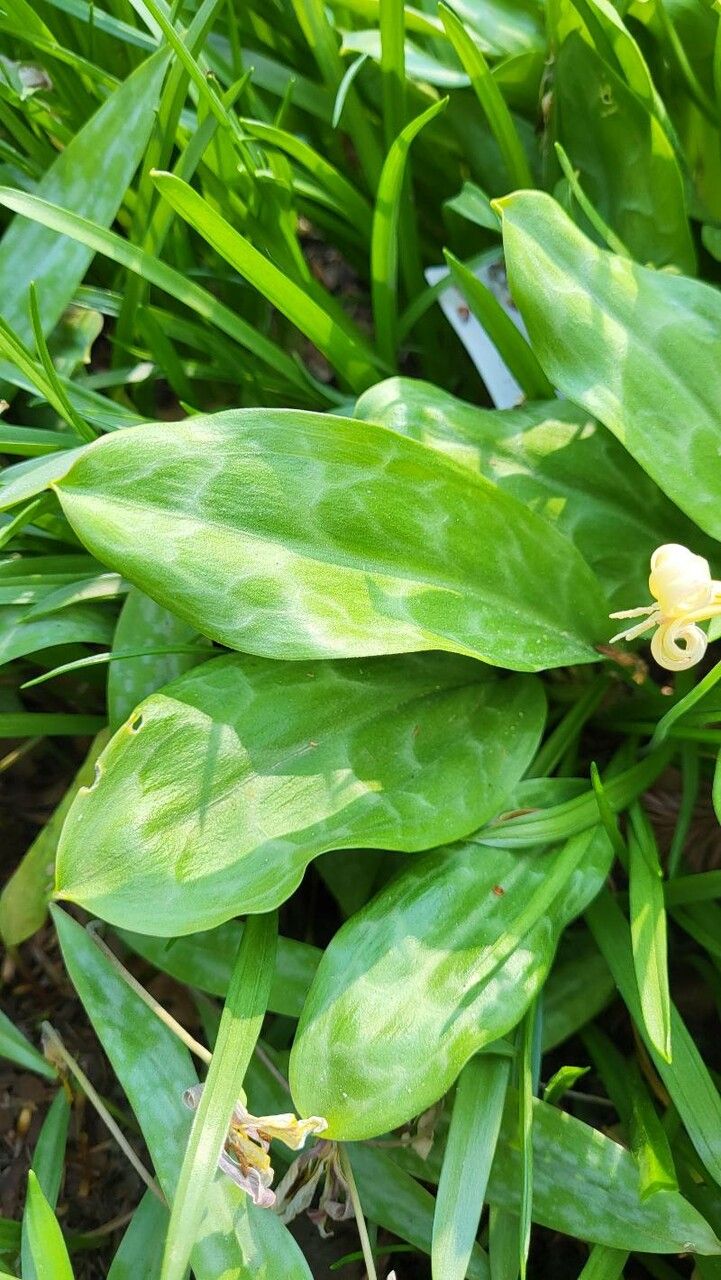
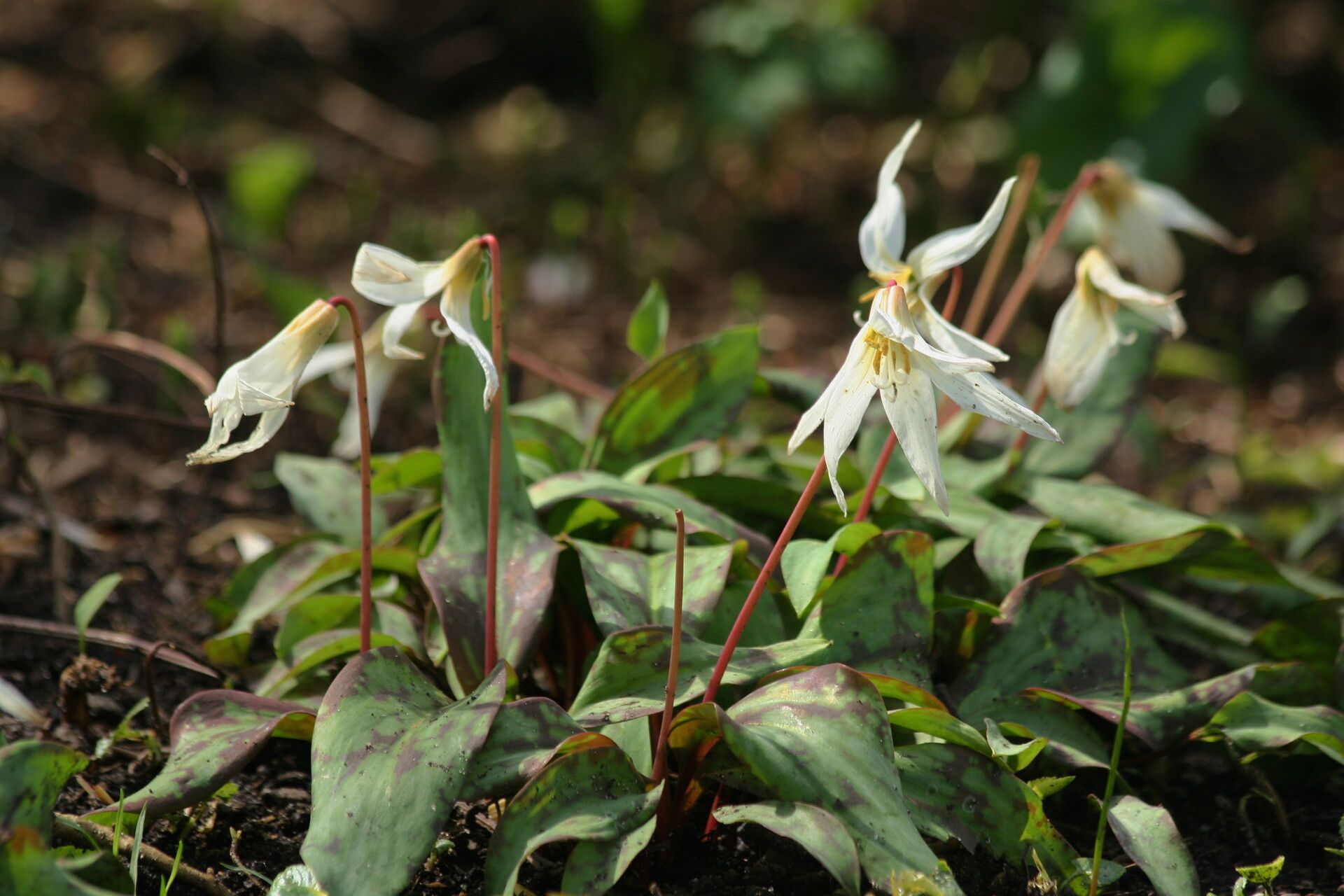
Erythronium umbilicatum, the dimpled trout lily, is a species of flowering plant in the lily family. It is native to the Southeastern United States, primarily in the Piedmont and Southern Appalachian areas. It is reported from West Virginia, Alabama, Florida, Georgia, Kentucky, Maryland, North Carolina, South Carolina and Virginia.Erythronium umbilicatum is a spring ephemeral and its preferred habitat is forests. It has egg-shaped bulbs up to 25 cm long. Leaves are up to 20 cm long, mottled. Scape is up to 20 cm long, bearing one yellow flower, sometimes with brown spots on the tepals.
Dimpled troutlily has moderate resistance to disease but can be vulnerable to illnesses such as leaf spot. Its vulnerability to insect pests differs by variety, although most varieties have lower pest resistance. For care, dimpled troutlily requires consistent watering and fertilizing, along with frequent pruning of yellowing leaves. It is crucial to address pest and disease issues as they arise and to harvest the plant promptly. Dimpled troutlily is best suited for people who can commit some time and effort to regular upkeep.
How to keep Erythronium Umbilicatum.
Light
Dimpled troutlily does best with moderate sun exposure, though it can tolerate lower light. In its native woodland, it commonly grows beneath a canopy that filters sunlight. Too much light can be harmful, while too little may hinder healthy development. Its sunlight requirements can change at different stages of growth.
Water
The dimpled troutlily flourishes in consistently moist environments and typically needs watering once every one to two weeks. Native to woodland areas, it is well-adapted to seasonal rainfall patterns, making it ideal for outdoor growth in locations where soil drainage and moisture levels resemble its natural habitat.
Temperature
Dimpled troutlily is native to mild environments and prefers temperatures from 41 to 95 °F (5 to 35 ℃). It tolerates seasonal fluctuations well, but its optimal growth occurs within that range. Seasonal adjustments to temperature may be needed to optimize the plant's health.
Fertilizer
Dimpled troutlily species do well with one or two applications of organic natural fertilizers containing potassium and phosphorus. Apply the fertilizer before planting, make sure it is incorporated into the soil, and water thoroughly. One application is usually enough, but a second can be made after the seedlings have become established. Avoid using too much fertilizer to prevent damage to the plants.
Pruning
The dimpled troutlily is a spring ephemeral known for its vibrant yellow flowers and mottled leaves. To encourage stronger blooms in the future, prune the spent flower stalks from early to late spring, after the plant has finished blooming. Be careful not to damage the basal foliage, as it is essential for photosynthesis. This will help promote healthy growth and impressive flower displays in the coming seasons.
Botanical profile.
- Plant Type
- Herb
- Life Cycle
- Perennial
- Genus
- Erythronium
- Family
- Liliaceae
- Hardiness Zone
- 4-9
- Mature Height
- 10 cm to 25 cm
- Mature Spread
- 10 cm to 18 cm
- Leaf Color
- Green, Gray, Purple, Brown, Lavender
- Leaf Type
- Deciduous
- Flower Color
- Yellow
- Flower Size
- 2.54 cm to 5.08 cm
- Bloom Time
- Early spring, Mid spring
- Planting Time
- Spring
- Harvest Time
- Late spring, Early summer
Other names.
Reader questions.
What are the sunlight requirements for Dimpled troutlily?
Dimpled troutlily flourishes best under moderate sun exposure and can adapt to lower light conditions. Typically found in its native woodland habitat, it grows under a filtered sunlight canopy. It's crucial that the plant does not receive too much light, as excessive exposure may harm it, while insufficient light could impede its healthy development. Furthermore, the requirements for sunlight can vary across different growth stages of the plant.
What is the native climate for Dimpled troutlily?
Dimpled troutlily, or Erythronium umbilicatum, thrives in mild environments, with its ideal temperature range being between 41 to 95°F (5 to 35°C). It is capable of tolerating seasonal temperature fluctuations well, but for optimal growth, maintaining temperature within this range is crucial. Especially during the winter, it's important to keep the plant in relatively warm conditions, above 5°C, and ensure that temperatures do not drop below freezing to prevent freezing damage.
What should I do if my Dimpled troutlily does not get enough natural sunlight?
If your Dimpled troutlily is not receiving adequate natural sunlight, especially during winter or in less sunlit spaces, introducing artificial lighting can be a crucial solution. LED lights are a popular choice due to their ability to mimic specific wavelengths needed by plants. For full sun plants, 30-50W/sq ft of artificial light is recommended, partial sun plants require 20-30W/sq ft, and full shade plants should have 10-20W/sq ft. Ensure the artificial light source is placed 12-36 inches above the plant to mimic natural sunlight conditions, and provide 8-12 hours of light per day.
How should Dimpled troutlily be cared for in winter?
In winter, the Dimpled troutlily should be protected from temperatures dropping below -5°C (25°F) by bringing it indoors or providing protection. This can be done by setting up a temporary greenhouse or using materials like plastic film or fabric to wrap the plant. It is essential to keep the plant above the freezing point to prevent damage from cold temperatures.
What are the common symptoms of improper lighting for Dimpled troutlily?
Common symptoms indicating inappropriate lighting conditions for Dimpled troutlily include small or immature leaves, leggy or sparse growth, faster leaf drop, slower or halted new growth, leaves exhibiting lighter color or irregular color patterns indicating a lack of chlorophyll, chlorosis (leaves turning yellow), sunscald (damage from intense sunlight exposure), leaf curling or twisting, wilting, and leaf scorching. These symptoms are critical to observing as they directly affect the plant's health and growth.
What are the symptoms of Dimpled troutlily's exposure to low temperatures, and how can they be treated?
Dimpled troutlily displays moderate tolerance to low temperatures, but it is best kept between 5°C and 35°C. Exposure to temperatures below -30°C may lead to darkening of leaves, water-soaked necrosis, wilting, and eventual browning of leaves. To treat frost damage, frost-damaged parts should be trimmed away, and the plant should be moved to a warmer indoor environment or a makeshift greenhouse. A south-facing window is preferred for ample sunlight, but supplemental lighting can be used if natural light is insufficient.
How can I ensure my Dimpled troutlily receives the right amount of sunlight?
To ensure your Dimpled troutlily receives the appropriate amount of sunlight, gradually acclimate it to sunnier locations by moving it closer to sunlight sources weekly until it gets 3-6 hours of direct sunlight daily if indoors. For outdoor plants, similar gradual adjustments towards sunnier areas help prevent sunburn. Additionally, you can use artificial light sources to supplement light exposure, particularly for large or immovable plants. Observing and reducing obstructions to sunlight, such as pruning nearby trees or relocating the plant, can also improve light access.
How does Dimpled troutlily react to high temperatures, and what care should be taken?
During summer, it is crucial to ensure that temperatures around the Dimpled troutlily do not exceed 35°C. If temperatures climb above 38°C, the plant's growth may slow, its leaves may lighten in color, and it can become more susceptible to sunburn. In response to such conditions, sunburned and dried parts should be trimmed away. The plant should be moved to a shaded area, especially to avoid afternoon sun, and watered in the morning and evening to maintain soil moisture.
What light conditions should I watch for in my garden to ensure the growth of Dimpled troutlily?
Monitoring how sunlight moves through your garden is essential for determining the ideal spots for your Dimpled troutlily. Aim for locations that offer a balance of light and shade to match the plant's needs, ensuring it receives about 3-6 hours of sunlight or less than 3 hours for full shade conditions. This mindfulness helps in providing your plants with the environmental conditions necessary for their happiness and growth.