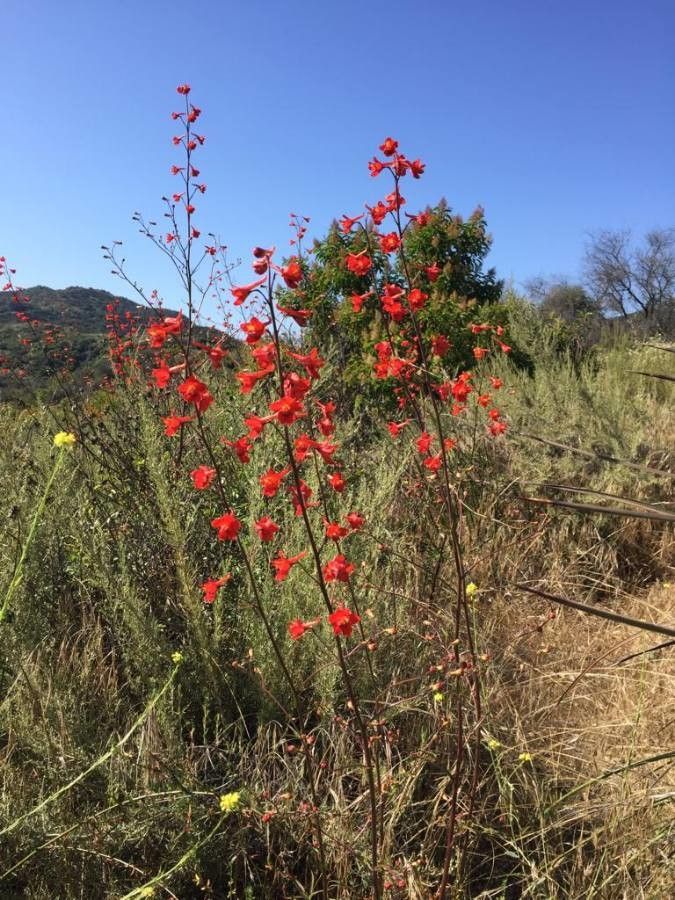
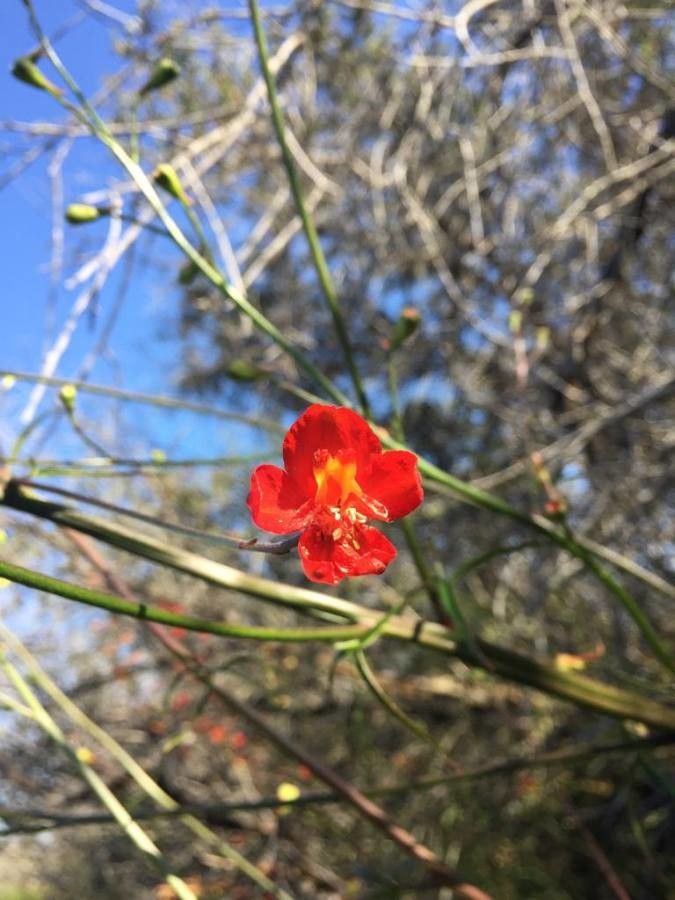
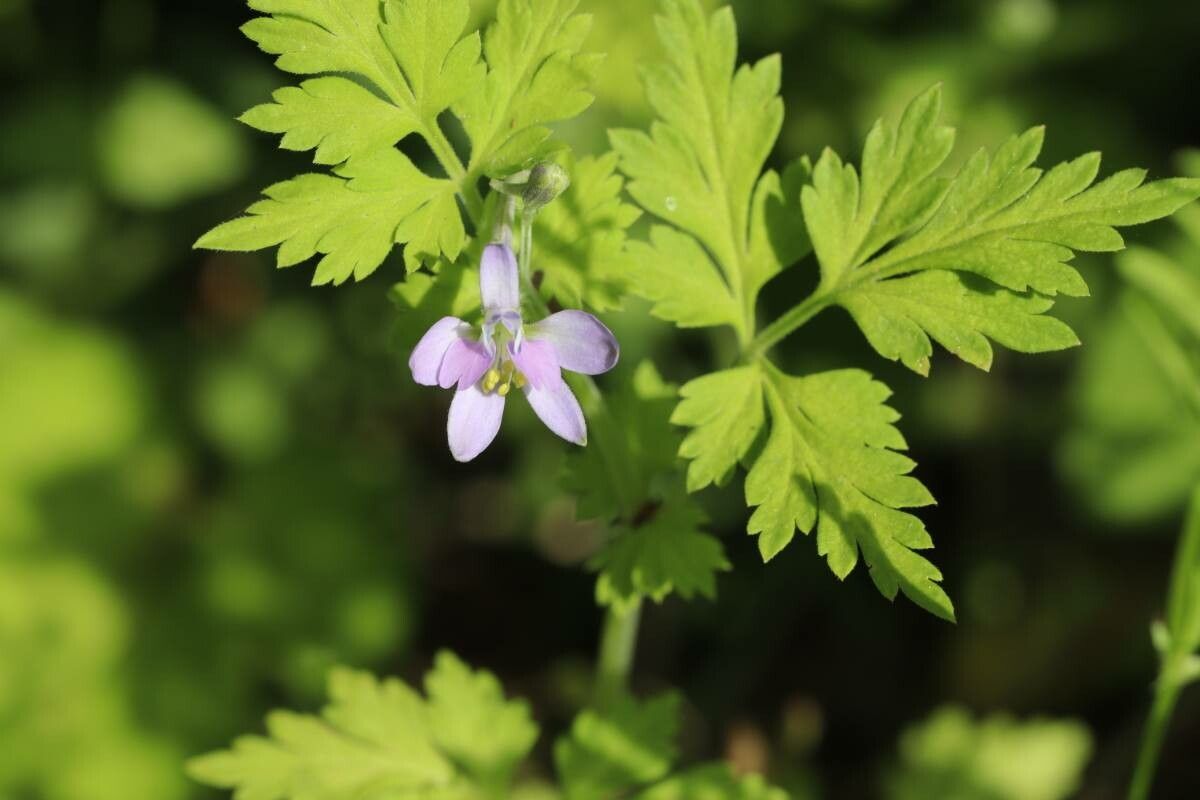
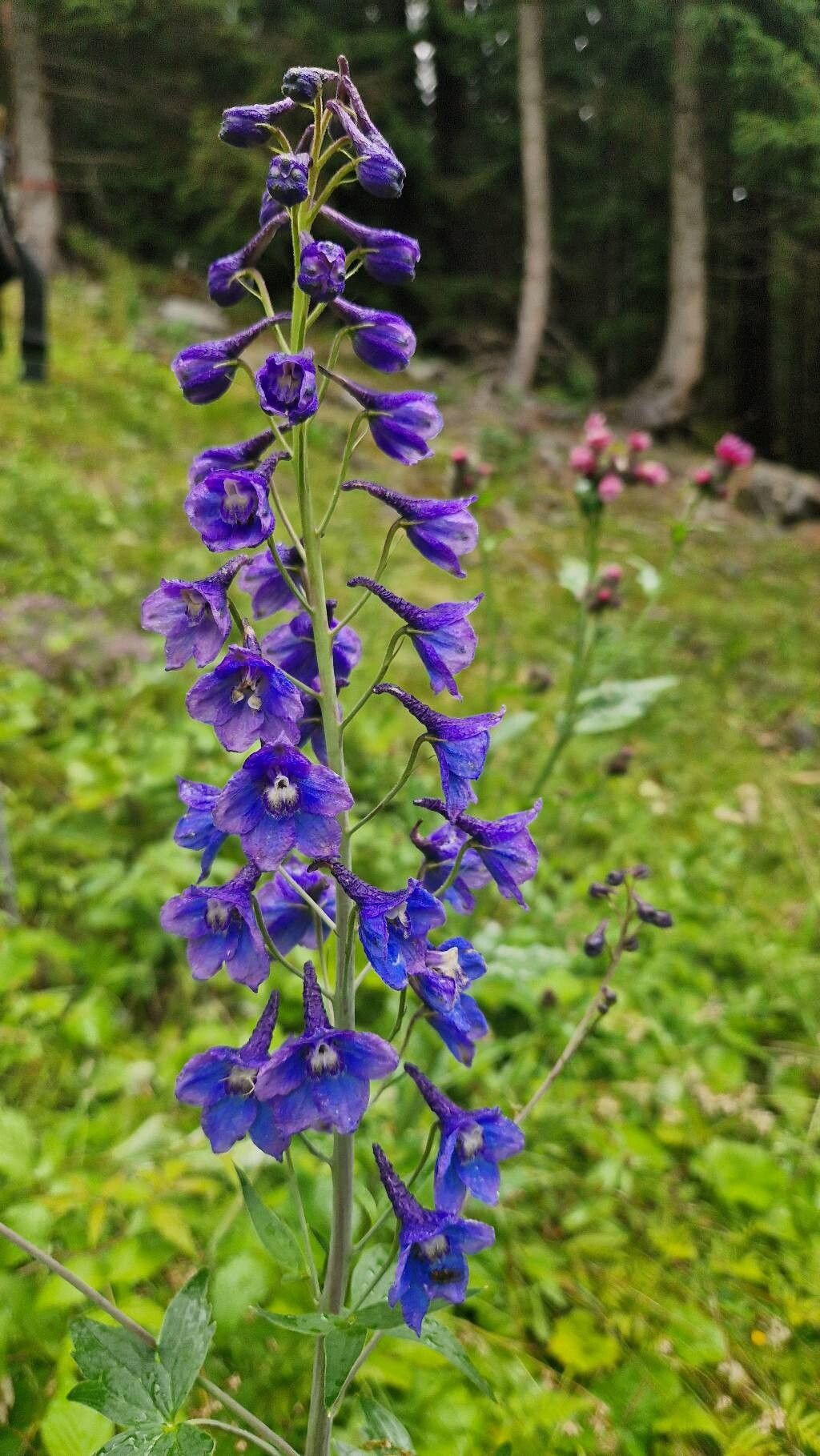
Delphinium cardinale, commonly known as scarlet larkspur, is a perennial herbaceous plant belonging to the buttercup family, Ranunculaceae. Native to California, it thrives in open woodlands, meadows, and along streams. This striking plant can grow up to 6 feet tall, showcasing tall spikes of bright red flowers that bloom during the summer months.
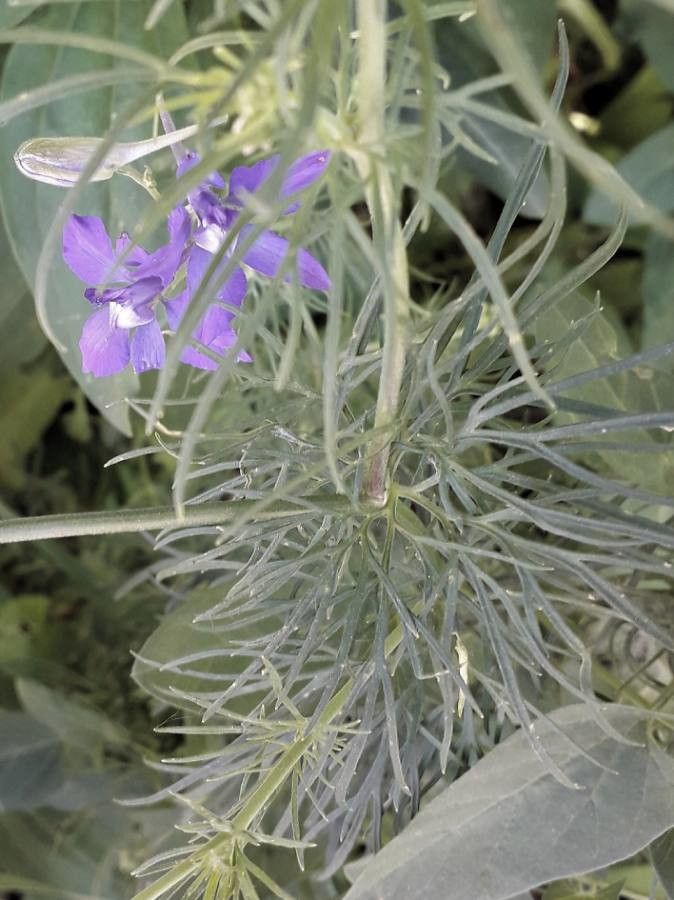
The leaves of Delphinium cardinale are deeply lobed with toothed edges and are alternately arranged on the stem. The vibrant red flowers are densely clustered on long spikes that rise above the foliage, with each flower featuring five petals that form a distinctive spur at the back.
Scarlet larkspur prefers well-drained soil and full sun exposure but can also tolerate some shade. It requires moderate watering during its growing season, though the soil should be allowed to dry out between waterings.
Known for attracting hummingbirds, bees, and butterflies, Delphinium cardinale's bright red flowers serve as an essential source of nectar for these pollinators.
In traditional medicinal practices, Native Americans used Delphinium cardinale to treat various ailments such as headaches, fever, and rheumatism, owing to its anti-inflammatory properties.
Overall, Delphinium cardinale is an attractive ornamental plant that adds color and beauty to any garden or landscape, while also providing important ecological benefits by attracting pollinating insects.
Scarlet larkspur is fairly resistant to disease and generally not prone to illness. However, it can be affected by pests and diseases present in its surroundings. These problems are usually mild. Regarding care, this plant requires moderate maintenance. It should be pruned regularly to maintain a neat appearance and healthy growth. Fertilizing can also help encourage flowering. Scarlet larkspur is suitable for anyone with outdoor space, such as a garden or patio, and does not need extensive care experience. It may need more attention when grown indoors.
How to keep Delphinium Cardinale.
Light
Scarlet larkspur does best with ample light; lacking this can somewhat restrict its growth. In the wild it generally occurs in places with abundant sun during various stages of its development. Nonetheless, it can tolerate locations with moderate sunlight. Excessive exposure, however, can potentially damage the plant.
Water
Scarlet larkspur is native to the dry woodlands of California and thrives in a Mediterranean climate characterized by wet winters and dry summers. This plant prefers well-drained soils that receive occasional moisture. To maintain its health, provide weekly watering, which helps prevent root rot. During its growing season, it also benefits from natural rainfall.
Temperature
Scarlet larkspur originates from temperate regions and does best when temperatures are around 59 to 95 °F (15 to 35 ℃). You should closely monitor the surrounding temperature, particularly during major seasonal shifts, to ensure optimal growth.
Fertilizer
The best time to fertilize a Scarlet larkspur is in early spring, as it comes out of dormancy and begins active growth. Fertilizing supplies essential nutrients for healthy development. While Scarlet larkspur doesn't require much fertilizer, applying it once a year can improve its survival and encourage stronger, longer-lasting blooms.
Pruning
The scarlet larkspur is a striking perennial known for its tall spikes and vivid red flowers. To keep it healthy, prune it from early to late spring to remove any damaged stems and encourage new growth. Cutting back spent flowers can lead to a second blooming period. Make sure to maintain healthy leaves to support photosynthesis, which also improves airflow and helps reduce the risk of disease.
Botanical profile.
- Plant Type
- Herb
- Life Cycle
- Perennial
- Genus
- Delphinium
- Family
- Ranunculaceae
- Hardiness Zone
- 7-10
- Mature Height
- 2.13 m
- Mature Spread
- 30 cm to 61 cm
- Leaf Color
- Dark Green, Forest Green
- Leaf Type
- Semi-evergreen
- Flower Color
- Red
- Flower Size
- 2.54 cm
- Bloom Time
- Summer
- Planting Time
- Spring, Summer
- Harvest Time
- Late summer, Early fall, Mid fall
- Native Area
- Mexico
Other names.
Reader questions.
How should I water my Scarlet larkspur?
To properly water the Scarlet larkspur, it's recommended to use filtered water at room temperature. Tap water may contain harmful particles that can affect the plant's health. It's important to use room temperature or slightly warm water because the Scarlet larkspur is accustomed to warm conditions, and cold water can be a shock to its system. Instead of watering from overhead, it's best to apply filtered room temperature water directly to the soil until it becomes completely saturated. This helps the plant by moistening the roots and allowing them to continue spreading through the soil and absorbing necessary nutrients.
What are the sunlight requirements for Scarlet larkspur?
Scarlet larkspur thrives when it receives generous light exposure, ideally thriving in full sun with over 6 hours of sunlight or partial sun with about 3-6 hours of sunlight. It's important to observe your garden's sunlight patterns to find spots that offer the right balance of light and shade for the plant, ensuring its optimal growth and happiness.
What is the native climate for Scarlet larkspur?
Scarlet larkspur is native to temperate climates and thrives best in temperatures ranging from 59 to 95 °F (15 to 35 °C). These conditions are optimal for its growth, and it's important to monitor the ambient temperature, especially during major seasonal transitions, to ensure the plant's health and development.
What do I do if I give my Scarlet larkspur too much or too little water?
Overwatering is a more common issue than underwatering with Scarlet larkspur. When overwatered, the stems and leaves may wilt and turn yellow. It can also lead to diseases like root rot, mold, and mildew, which can be fatal to the plant. Underwatering is less common, but still a possibility. In this case, the leaves may become brittle and brown. It's important to notice signs of overwatering early on, as some diseases may not be reversible if left too long. Reduce watering if signs of overwatering are observed and consider replacing poorly draining soil. If underwatering is suspected, simply increase watering until signs improve.
How does artificial lighting affect the growth of Scarlet larkspur?
When natural sunlight is insufficient, especially during winter or in less sunny areas, artificial lighting can significantly promote healthier and faster growth of Scarlet larkspur. LED lights are recommended because they can be customized to provide specific wavelengths needed by the plant. Full sun plants require 30-50W/sq ft, partial sun plants need 20-30W/sq ft, and full shade plants need 10-20W/sq ft of artificial light. The light source should be placed 12-36 inches above the plant to mimic natural conditions, with 8-12 hours of light per day.
Does Scarlet larkspur require frost protection in winter?
Scarlet larkspur has strong cold resistance, meaning special frost protection measures are typically not needed during winter. However, in environments where winter temperatures are expected to drop below -15°C, it's crucial to provide cold protection. This can be accomplished by covering the plant with soil or straw. Additionally, watering the plant abundantly before the first freeze in autumn to keep the soil moist helps prevent drought and water scarcity during the winter and early spring months.
How frequently should I water my Scarlet larkspur?
If your Scarlet larkspur is in a pot, you can check if it needs water by putting your finger in the soil. If the top two to three inches of soil are dry, it's time to water it. For outdoor Scarlet larkspur plants in the ground, you can use the same method. Again, if the top few inches of soil are dry, it's time to water. Usually, during the spring and early fall, watering once a week is sufficient. But during very hot weather, you may need to water twice a week or more. However, mature Scarlet larkspur plants that are well-established can handle drought well.
What are some common symptoms of inadequate lighting for Scarlet larkspur?
Scarlet larkspur may exhibit several symptoms when exposed to poor lighting, including smaller new leaves, leggy or sparse growth, faster leaf drop, halted or no new growth, lighter-colored new leaves, chlorosis, sunscald, leaf curling, wilting, and leaf scorching. These signs indicate either insufficient sunlight or excessive exposure, each harming the plant's development and health.
How does low temperature affect Scarlet larkspur and what are the solutions?
Scarlet larkspur is cold-tolerant and performs best when temperatures stay above 15°C. If winter temperatures remain above -10°C, the plant generally manages well. However, if temperatures fall below -15°C, while there may not be noticeable changes during winter, there could be a reduction in sprouting or even a failure to sprout in the spring. In such cases, removing any parts of the plant that have failed to sprout in the spring is recommended.
How much water does my Scarlet larkspur plant require?
When watering your Scarlet larkspur, don't be afraid to give it plenty of water. Make sure the top few inches of soil are dry before watering, and then give the plant a thorough soaking, enough water to saturate the entire soil. You should water it enough so that excess water flows out through the drainage holes at the bottom of the pot. If you don't see any excess water draining, you probably haven't given it enough water. Be careful not to let water accumulate in the soil, as this can harm the plant. On the other hand, if water doesn't drain through the pot, it could indicate poorly draining soil, which is bad for the plant's health. If the plant is outside, it only needs about an inch of rain per week.
How can inadequate sunlight exposure for Scarlet larkspur be managed?
To manage inadequate sunlight exposure, gradually move Scarlet larkspur plants to sunnier locations within your garden or home. For indoor plants, use a south-facing window for maximum sunlight or complement with artificial light for at least 8 hours daily. For outdoor plants, ensure a gradual adjustment to sunnier spots to prevent sunburn. Also, consider pruning or transplanting to reduce obstructions and improve sunlight access. It's crucial to understand that parts of the plant affected by light deficiencies may not recover, but new growth will be healthy with increased light exposure.
How does high temperature affect Scarlet larkspur and what are the solutions?
During summer, it's critical to ensure that temperatures around Scarlet larkspur do not exceed 35°C. Exposure to temperatures above 41°C can cause the leaves to lighten in color, curl, become susceptible to sunburn, and in severe cases, lead to the wilting and drying out of the entire plant. To mitigate these issues, trim away sunburned and dried parts, relocate the plant to a shaded area or use a shade cloth to protect it during the hottest parts of the day. Additionally, watering the plant in the morning and evening will help keep the soil moist and reduce stress.