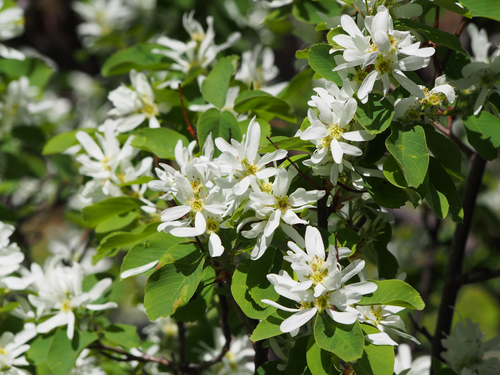
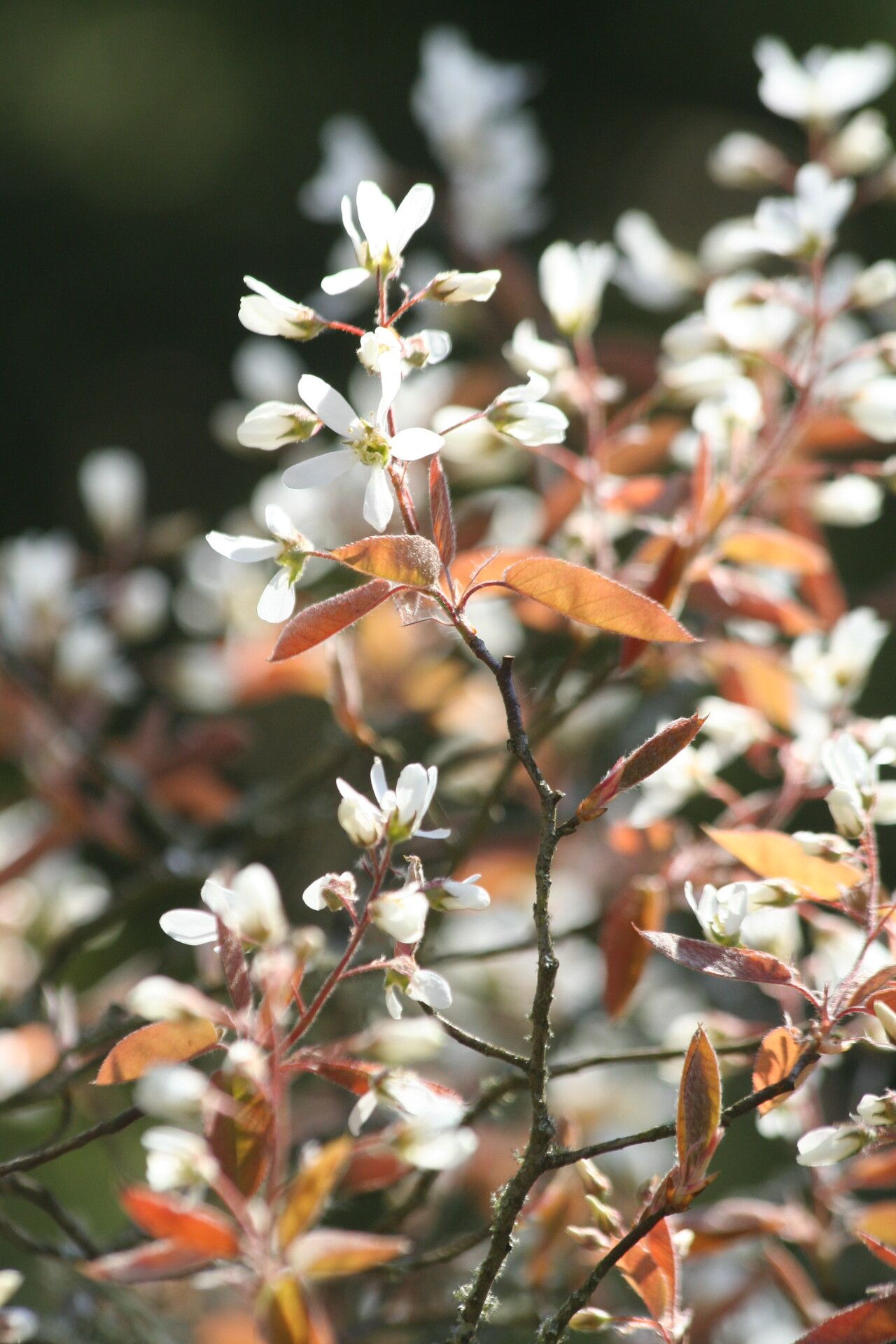
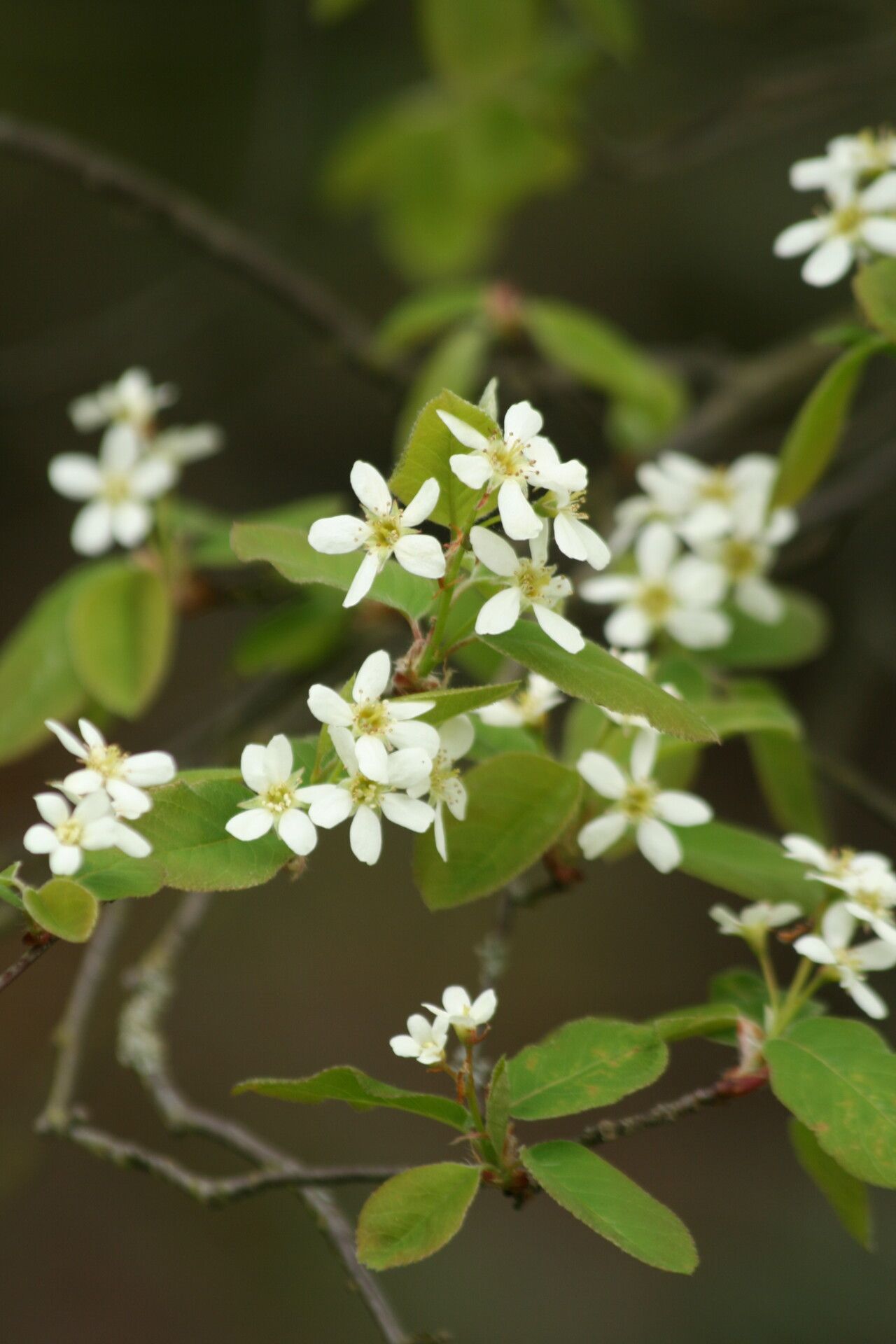
Amelanchier canadensis, commonly known as the Canadian serviceberry or shadbush, is a deciduous shrub or small tree native to North America. Typically, it grows up to 20 feet tall and features a rounded shape with multiple stems. The leaves are oval-shaped with serrated edges, transforming from green to yellow-orange in the fall.
In early spring, Amelanchier canadensis blooms with clusters of white flowers, followed by small blue-black berries in early summer. The fruit is edible, with a sweet taste similar to blueberries.
This plant prefers moist soil and partial shade but can also tolerate full sun. It is often used in landscaping for its ornamental value, thanks to its attractive flowers, vibrant fall foliage, and fruit production.
Before the advent of markets, Native Americans relied on trees and plants for both culinary and medicinal purposes. Serviceberries, valued for their sweet and juicy flavor, were a dietary staple for the Cheyenne, Lakota, and Blackfoot tribes. These tribes used the berries to sweeten meat, and they also made wine, tea, desserts, and jams with them. FUN FACT · FROM THE LIBRARY
Amelanchier canadensis holds cultural significance among Native American tribes, who used it for medicinal purposes, such as treating coughs and colds. The flexible branches were also traditionally used for making baskets.
In summary, Amelanchier canadensis is an attractive plant with cultural importance, offering both ornamental value and potential medicinal uses.
The Canadian serviceberry has an interesting story associated with its name. When the first settlers arrived in New England, they often planned funeral services to coincide with the blooming of this tree. Its flowers were a signal that the ground had thawed enough to dig graves. Because the tree is native to Canada, it became known as the Canadian serviceberry.
Canadian serviceberry has strong disease resistance and is typically not prone to illnesses. Regarding care, this plant is fairly low-maintenance. When planted outdoors, it needs minimal watering; larger plants usually do not require pruning, while smaller plants should be pruned after they finish blooming. Canadian serviceberry is appropriate for anyone with outdoor space, such as a garden or a deck, and does not demand much experience in plant care.
How to keep Amelanchier Canadensis.
Light
Canadian serviceberry thrives in locations with plenty of sunlight throughout the day, although it can also remain healthy where sunlight is not present all day. If the light is either too intense or too limited, it may affect the plant’s normal growth and development.
Water
The Canadian serviceberry, native to areas with moderate moisture, thrives when the soil is kept consistently moist. It should be watered every 1-2 weeks. While it can tolerate some drought, using mulch to retain soil moisture is beneficial, as this mimics its natural woodland habitat. Due to its size and growth habits, it is typically grown outdoors.
Temperature
The Canadian serviceberry prefers temperatures from 41 to 90 ℉ (5 to 32 ℃) and is capable of enduring extreme cold in its native habitat. In hot summer months, it is advisable to give it enough water and keep it out of direct sunlight to avoid heat stress. In winter, it should be sheltered from strong winds and from temperatures below freezing.
Fertilizer
Fertilize your Canadian serviceberry in early spring to encourage healthy development. Regular feeding improves overall health, producing strong growth, increased tolerance of harsh conditions, and enhanced resistance to pests and diseases. Keep to a specific fertilizing routine for your Canadian serviceberry to maintain foliage that is vibrant, richly colored, and lush in appearance.
Pruning
The Canadian serviceberry is a deciduous shrub known for its white flowers in the spring and edible berries. For optimal health and aesthetics, prune the shrub in early spring, removing any dead or overcrowded branches. This practice enhances air circulation and boosts fruit production. Additionally, always sterilize your tools before pruning to prevent disease and promote healthier growth in the Canadian serviceberry.
Pot & Repot
For Canadian serviceberry to thrive in pots, excellent drainage is essential. Proper drainage prevents root rot and supports healthy growth.
Botanical profile.
- Plant Type
- Tree, Shrub
- Life Cycle
- Perennial
- Genus
- Amelanchier
- Family
- Rosaceae
- Hardiness Zone
- 4-8
- Mature Height
- 0.49 m to 7.92 m
- Mature Spread
- 3.96 m to 6.1 m
- Leaf Color
- Green, Yellow, Red, Orange
- Leaf Type
- Deciduous
- Flower Color
- White
- Flower Size
- 0.20 cm to 0.51 cm
- Bloom Time
- Mid spring, Late spring
- Planting Time
- Spring, Autumn
- Harvest Time
- Early summer, Mid summer
Other names.
Reader questions.
How should I water my Canadian serviceberry plant to keep it healthy?
To ensure excellent root development and promote healthy plants, follow these watering tips: - Place a garden hose at the base of the plant, avoiding direct spraying of the leaves. If the plants are outdoors and exposed to direct sunlight, the leaves may require additional watering. - Consider using bubblers or soaker hoses to moisten the roots of each plant. Soaker hoses are especially useful for covering the entire garden or bed when adding or removing plants, as they encourage deep root growth. - After watering, drain any excess water and allow the soil to dry before watering again. This helps prevent water-related diseases. - To prevent diseases, water the plants at ground level rather than overhead. On sunny days, it may be beneficial to spray the entire bush with water. - Whether your Canadian serviceberry is planted in a pot or in the ground, remember that it prefers deep watering instead of light sprinkling.
Why should I add fertilizer to my Canadian serviceberry plant?
To ensure your Canadian serviceberry plant remains healthy and resilient, it is important to regularly fertilize it regardless of the specific variety you own. This will provide the necessary nutrients for robust growth, increasing its ability to withstand challenging growing conditions and ward off diseases and pests. The appealing foliage of your Canadian serviceberry is a noteworthy feature, therefore, it is crucial to prioritize its preservation. By implementing a consistent fertilization schedule tailored to your Canadian serviceberry, you can encourage the development of richly colored leaves and an overall luscious appearance.
What are the sunlight requirements for Canadian serviceberry?
Canadian serviceberry thrives in conditions with abundant sunlight throughout the day but can also grow healthy in environments where sunlight is not available all day. It requires full sun, which is above 6 hours of sunlight daily, or partial sun, about 3-6 hours of sunlight. However, either excessive sunlight or insufficient light can affect its normal growth and development.
What are the ideal temperature conditions for the Canadian serviceberry?
The Canadian serviceberry thrives in temperatures ranging from 41°F to 90°F (5°C to 32°C). It has strong cold resistance and can withstand extremely cold conditions native to its growing environment. However, during the hot summer months, it is crucial to ensure the plant receives adequate water and is shielded from direct sunlight to prevent heat stress. In winter, the plant should be protected from strong winds and freezing temperatures, although it usually does not require special frost protection measures. If temperatures are expected to drop below -30°C, it's important to provide cold protection by wrapping the trunk and branches with materials like non-woven fabric or cloth. Additionally, watering the plant abundantly before the first freeze in autumn helps prevent drought and water scarcity during winter and early spring.
What should I do if I give too much or too little water to the Canadian serviceberry?
A Canadian serviceberry that is overwatered may develop yellow, wilting leaves and a generally dull and unhealthy appearance, with mushy stems being a potential indicator. It is important to adjust your watering schedule when these signs begin to show. On the other hand, wilting can also be a sign of under watering, with crispy and dry leaves being a characteristic of this condition. When the soil is dry and simply watering is not enough, giving the plant a thorough watering can help. However, even with sufficient water, the plant may still exhibit dryness and yellowing leaves due to damage to the root system. Once the plant returns to normal, the yellowing of the leaves will stop. For indoor Canadian serviceberries, it is advisable to regularly check the moisture levels in the pot and avoid overwatering. If black spots appear, allow the soil to dry out by withholding water for a few days. Overwatering can lead to root rot, so it may be necessary to transfer the plant to a different pot if discolored and slimy roots are observed. It is always important to prevent root rot by avoiding excessive moisture in the soil. When planting a Canadian serviceberry outdoors, it is recommended to dig a bit deeper. If the soil feels too dry when checked with your fingers, it may indicate underwatering, thus requiring adequate watering for the plant's recovery.
When should I fertilize my Canadian serviceberry?
To help your Canadian serviceberry grow well, it's best to fertilize it in late winter or early spring. This gives it the nutrients it needs to thrive once the weather warms up. If you live in a warm climate region, it's also helpful to fertilize in early fall. This provides additional nutrients for the upcoming growing season and improves the serviceberry's ability to withstand cold temperatures without leaf damage. Fertilizing earlier in the fall ensures that new branches have adequate time to grow and withstand winter conditions.
What should I do if my indoor Canadian serviceberry isn't getting enough natural light?
If your indoor Canadian serviceberry is not receiving sufficient natural light, especially during winter or in less sunny spaces, consider using artificial lighting as a vital solution for optimal growth. Opt for artificial lights like LED lights, which can be customized to your plant's specific needs. Full sun plants require 30-50W/sq ft, partial sun plants 20-30W/sq ft, and full shade plants 10-20W/sq ft of artificial light. The light source should be placed 12-36 inches above the plant to mimic natural sunlight, and most plants benefit from 8-12 hours of light per day.
How does low temperature affect the Canadian serviceberry and what are the remedies?
The Canadian serviceberry is cold-tolerant and performs best when temperatures are above 5°C. It should be kept above -25°C during winter. While the plant may not show noticeable changes when temperatures fall below -30°C during winter, the branches can become brittle and dry by spring, with no new shoots emerging. To remedy this, dead branches that have failed to produce new leaves should be pruned away in spring.
How frequently should I water my Canadian serviceberry?
The Canadian serviceberry prefers deep and infrequent watering, especially when grown in pots. Since the water storage in pots is limited, the soil dries out faster, so it's important to soak the plant in a gallon of water each time. In colder regions, watering is needed every 3 to 5 days. The best time to water is early in the morning when the soil is dry, both indoors and outdoors. You can check if watering is necessary by examining the soil inside. When the top 2-3 inches of soil is dry, it's time to give the plant a thorough watering. On hot days, it may be necessary to check the moisture daily as the heat can quickly dry out the pot's soil. If you have a garden, you'll need to irrigate the soil as well. In hot climates, watering once a week is sufficient. Only water when you notice that about 2 to 3 inches of soil have become too dry. Be mindful of rainfall and avoid watering if the plant has already received enough water. Canadian serviceberry typically grows in spring and fall. When the plant is outdoors, adding a layer of mulch 3 to 4 inches deep helps conserve water. Sandy soil drains faster, so plants in sandy soil require more frequent watering. However, with clay soil, watering can be done less frequently, allowing the plant to dry out for 2-3 days to avoid root rot. To keep track of watering, mark the date on the calendar and be attentive to any drooping leaves, as this may indicate a need for water.
When is the best time to not fertilize my Canadian serviceberry?
There are specific periods when it is not recommended to fertilize your Canadian serviceberry. Firstly, it should not be fertilized during the early and mid-winter when the plant is dormant and does not require any nutrients. Additionally, it is advisable to avoid fertilizing during the late spring and summer when the weather is usually hotter and drier. These conditions can have a negative impact on the plant's response to fertilizer. To prevent any issues, it is best to fertilize your Canadian serviceberry only in the early spring and early fall.
What are common symptoms of insufficient or excessive sunlight in Canadian serviceberry?
Canadian serviceberry may show symptoms of stress under improper lighting conditions. Insufficient light can cause smaller new leaves, leggy or sparse growth, faster leaf drop, slower or no new growth, and lighter-colored new leaves. Excessive sunlight can lead to chlorosis, or the yellowing of leaves due to chlorophyll breakdown, sunscald, leaf curling as a defense against water loss, wilting from increased transpiration, and leaf scorching, indicated by brown, dry, and crispy leaf edges.
What are the effects of high temperatures on the Canadian serviceberry and how can they be mitigated?
During summer, it is advisable to keep the Canadian serviceberry's temperature below 32°C. Should temperatures exceed 35°C, the plant's leaves may lighten in color, tips can become dry and withered, and the plant may be more prone to sunburn. To mitigate these effects, sunburned and dried-up parts of the plant should be trimmed away. The plant should be moved to a shadier location or protected with a shade cloth during midday and afternoon sun. Additionally, watering the plant in the morning and evening will help keep the soil moist and support the plant's well-being.