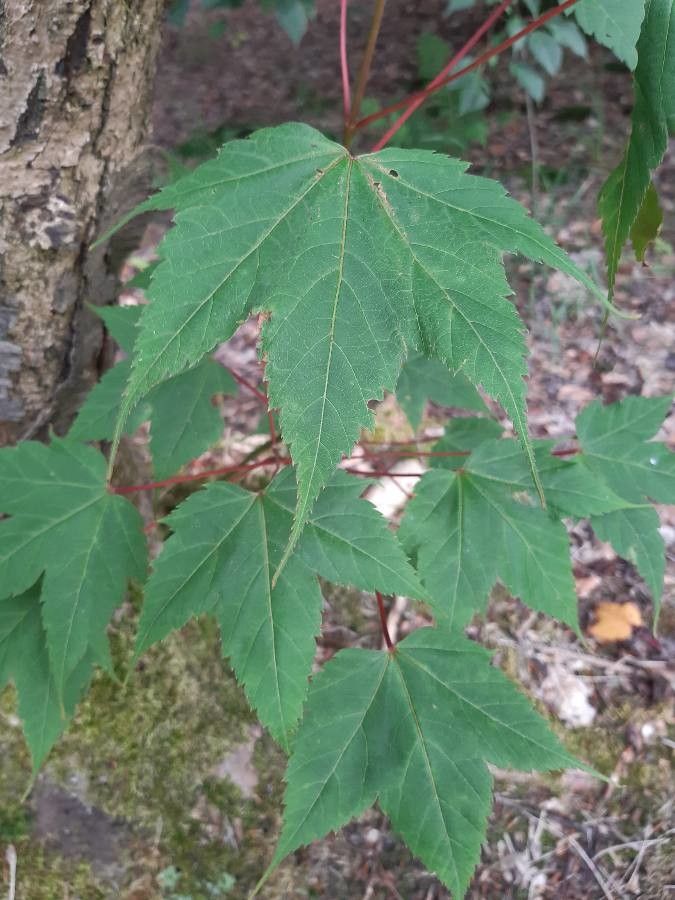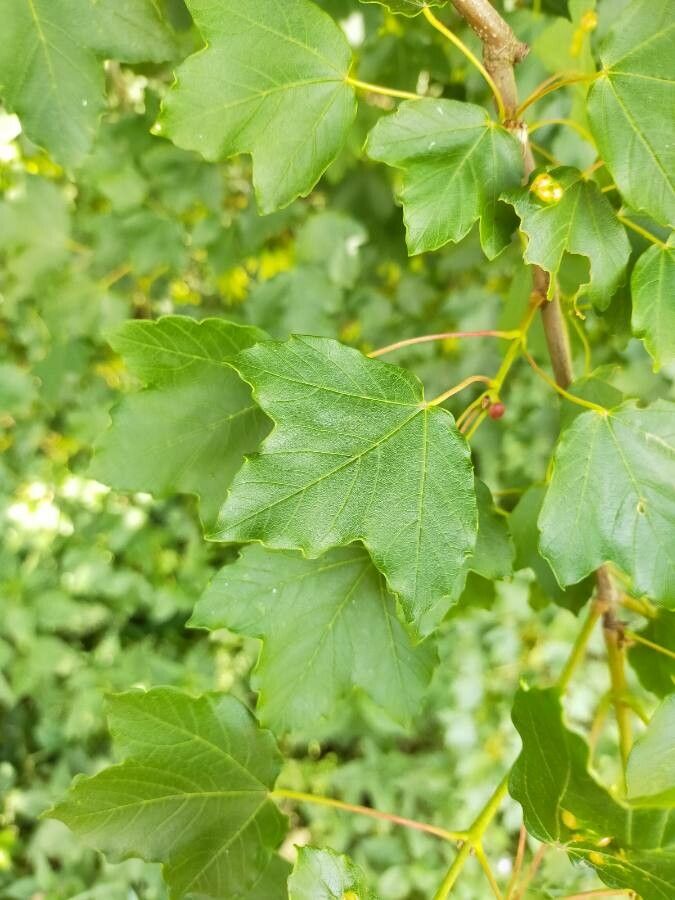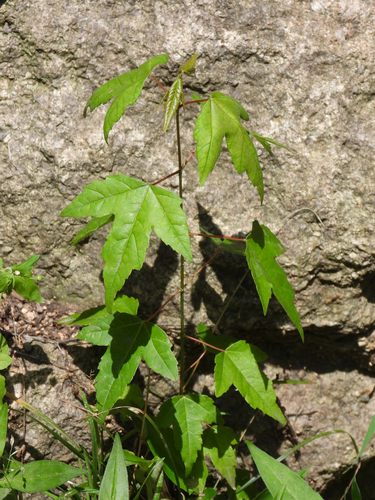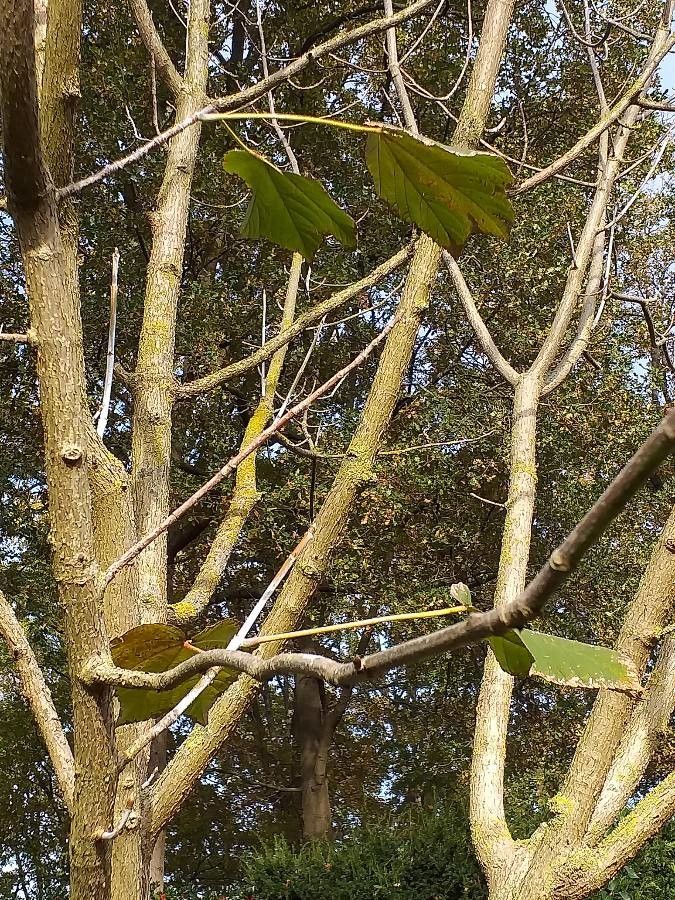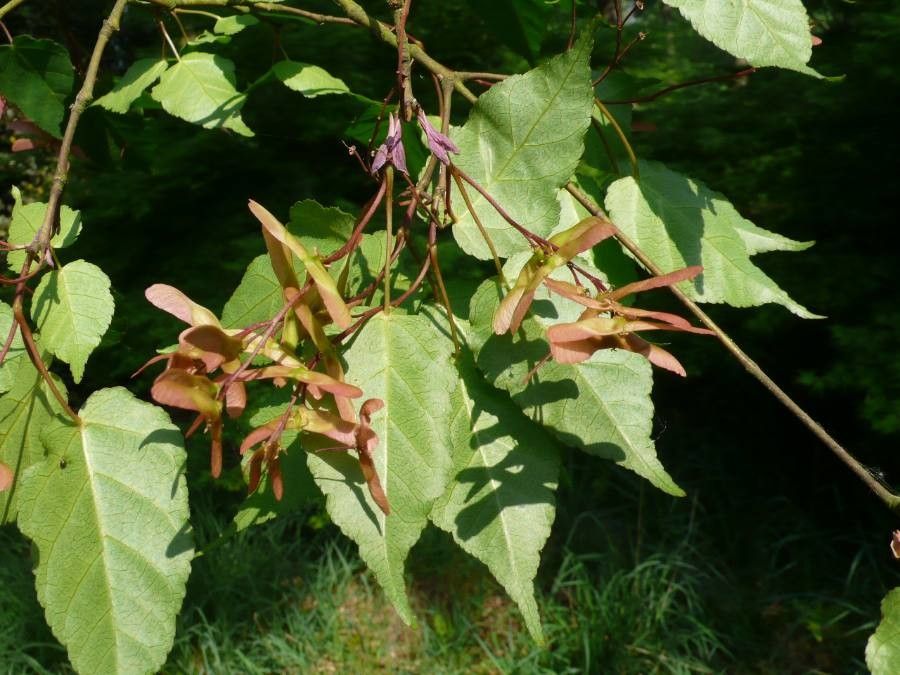
Acer crataegifolium (hawthorn-leaf maple or uri maple; Japanese: ウリカエデ urikaede, "melon maple"), is a species of maple in the snakebark maple group, native to mountains forests of central and southern Japan, on Honshū (Fukushima southward), Kyūshū, and Shikoku.It is a deciduous small tree or shrub that grows to a height of 5–10 m, with a trunk up to 30 cm diameter. The bark is green to greenish-brown, with narrow vertical white or pale grey stripes; the young shoots are slender, green to purplish-red and the buds purplish-red. The leaves are 5–8 cm (rarely to 15 cm) long and 4–7 cm broad, dark green to bluish green and often tinged reddish above, paler green below, ovate-triangular, and may be either unlobed or three-lobed; the petiole is red, 2–3 cm long. The flowers are small, pale yellow, produced on arched to drooping racemes 3–5 cm long. The fruit is a paired samara 1–2 cm long, pink or red maturing brown, with nutlets not more than 4 mm wide.There are two varieties: Acer crataegifolium var. crataegifolium. Leaves up to 7 cm long. Acer crataegifolium var. macrophyllum Hara. Leaves up to 15 cm long.The Japanese name urikaede refers to the bark pattern resembling the skin of a melon, as also in the similar bark of Acer rufinerve (urihadakaede). The scientific name derives from the supposed resemblance of its leaves to those of hawthorns (Crataegus), though this is somewhat fanciful, only making sense if certain species of hawthorn are considered.
Hawthorn maple is resistant to disease and is generally not susceptible to illnesses. In terms of care, this plant is fairly low maintenance. When grown outdoors it needs only minimal watering, and larger plants typically do not require pruning. Smaller plants, however, should be pruned after they have finished blooming. Hawthorn maplet is suitable for anyone with an outdoor area, such as a garden or a deck, and does not demand extensive plant-care experience.
How to keep Acer Crataegifolium.
Light
Hawthorn maple is native to habitats like forest understories and rocky areas, where it grows in natural shade. It prefers partial sun but can tolerate full sun or full shade, demonstrating its versatile and hardy nature.
Water
The hawthorn maple comes from temperate regions and grows best in well-drained soils with moderate moisture levels. While it prefers consistent moisture, it can tolerate short dry spells. It is recommended to water the tree every 1 to 2 weeks. Applying mulch is helpful for retaining moisture, mimicking the conditions of its natural woodland habitat.
Temperature
Hawthorn maple is very adaptable to a variety of climatic conditions, whether facing blistering summers or frigid winters. That said, it does have a preferred temperature range for healthy growth. If temperatures climb too high, the plant becomes vulnerable to heat and humidity stress, which can cause it to die. In areas where temperatures near the lower limit of its cold tolerance, insulating the plant is important to protect it.
Fertilizer
Timing is important for fertilizing Hawthorn maple. Apply fertilizer in early spring and continue monthly until early summer. Fertilizer promotes lovely blooms and supplies energy during both dormant and active growth phases.
Pruning
The Hawthorn maple is a deciduous tree known for its three-lobed leaves and vibrant autumn colors. To maintain its health, it's best to prune the tree in early spring. Use thinning cuts to improve air circulation and shape the tree, but avoid heavy pruning to reduce stress. Proper pruning encourages healthy growth and lowers the risk of disease.
Botanical profile.
- Plant Type
- Tree
- Life Cycle
- Perennial
- Genus
- Acer
- Family
- Sapindaceae
- Hardiness Zone
- 5-8
- Mature Height
- 4.57 m to 6.1 m
- Mature Spread
- 4.57 m to 6.1 m
- Leaf Color
- Light Green, Dark Green
- Leaf Type
- Deciduous
- Flower Color
- Yellow
- Flower Size
- 2.54 cm
- Bloom Time
- Mid spring, Late spring
- Planting Time
- Spring, Autumn
- Harvest Time
- Late summer, Early fall, Mid fall
- Native Area
- Japan
Other names.
Reader questions.
What are the sunlight requirements for a Hawthorn maple (Acer crataegifolium)?
The Hawthorn maple (Acer crataegifolium) thrives under specific sunlight conditions to ensure its happiness and healthy growth. For 'Full sun' exposure, the plant requires above 6 hours of sunlight daily, ideal for areas in your garden that receive abundant light. 'Partial sun' conditions, involving about 3-6 hours of sunlight, are also suitable, catering to spots that offer a balance between light and shade. It's important to observe how sunlight moves through your garden throughout the day to choose the best locations for your Hawthorn maple, aligning with its light requirements to promote its well-being.
What is the botanical name of the Hawthorn maple?
The botanical name of the Hawthorn maple is Acer crataegifolium. This species is known for its unique characteristics, but specific information about its essentials, content, and symptoms are not provided in the given data.