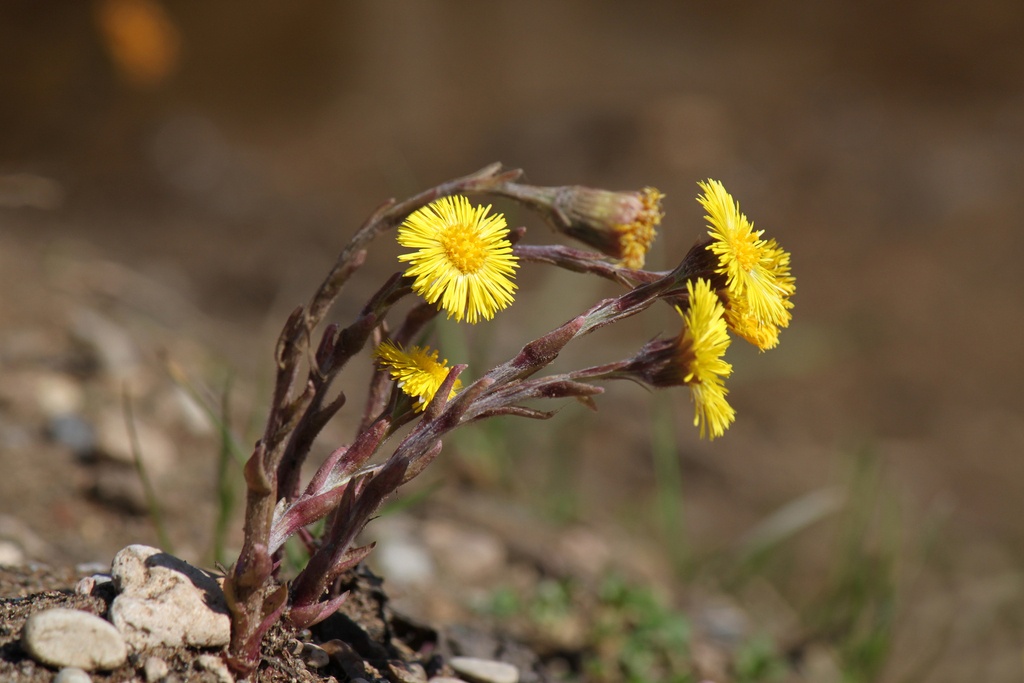
Tussilago farfara, commonly known as coltsfoot, is a perennial herbaceous plant that belongs to the Asteraceae family. Native to Europe and Asia, it has also been introduced to other parts of the world. The plant has a distinctive appearance with large, round leaves resembling a colt's foot, and yellow daisy-like flowers that bloom in early spring, before the leaves emerge.
Coltsfoot has been used for medicinal purposes for centuries due to its anti-inflammatory and expectorant properties. Traditionally, it has served as a remedy for coughs, asthma, bronchitis, and other respiratory ailments. The plant contains various compounds such as mucilage, tannins, and flavonoids, which contribute to its therapeutic effects.
In addition to its medicinal uses, coltsfoot also has culinary applications in some parts of Europe. It is used to make tea and can be added as an ingredient in salads or soups.
The Tussilago farfara, commonly known as Coltsfoot, is a member of the aster family and is characterized by its leaves that resemble a colt's foot. Its daisy-like flowers open during the day and close at night. This nightly closing allows the flowers to rest in the coolness of the night, conserving energy to grow and bloom in the direct sunlight. FUN FACT · FROM THE LIBRARY
However, it is important to note that Tussilago farfara contains pyrrolizidine alkaloids, which can be toxic if consumed excessively over long periods. Therefore, caution should be exercised when using this herb medicinally or culinarily without proper guidance from an expert herbalist or medical professional.
Coltsfoot is a plant whose flowers resemble those of a dandelion and bloom before the leaves appear. The name "coltsfoot" comes from the leaf's likeness to a colt's foot.
Coltsfoot is fairly resistant to disease and typically does not suffer from illnesses. Still, it can be vulnerable to pests and diseases found in its environment. These problems are generally mild. Regarding upkeep, the plant needs a moderate level of care. Regular pruning is necessary to preserve its appearance and support healthy growth. Applying fertilizer can also encourage blooming. Coltsfoot is well-suited for anyone with outdoor areas like a garden or patio and does not demand extensive gardening experience. It may need more attention if cultivated indoors.
How to keep Tussilago Farfara.
Light
Coltsfoot prefers locations where sunlight is not constant. The plant can also cope with areas of unobstructed sun, but it should not remain in such conditions for long. Its native habitat indicates a balance between shade and sun. Excessive light can cause wilting, while too little light can inhibit its growth.
Water
Coltsfoot thrives in moist environments and prefers consistent soil moisture, similar to its natural stream bank habitats. Although it can tolerate moderate drought, it truly flourishes when watered weekly. As an herbaceous perennial, it benefits from natural rainfall during the growing season, which supports its hydration needs.
Temperature
Coltsfoot prefers temperatures of 41 to 77 ℉ (5 to 25 ℃) in its native growth environment. In summer it favors cooler conditions for growth, and its development is restricted on hot summer days. The temperature range in spring and fall is ideal for growth. It can tolerate low temperatures in winter but does not prefer them.
Fertilizer
One fertilizer treatment in spring is generally enough for Coltsfoot, though repeated feedings can maximize growth. Apply fertilizer every month to six weeks. Fertilizing improves the leaves’ appearance and function, promoting even color and a healthy texture. It also encourages root development and nutrient uptake, supporting the plant’s long-term health.
Pruning
Coltsfoot is characterized by its bright yellow flowers, and it should be pruned between early and late spring. To encourage growth, control its invasiveness, and improve its appearance, remove spent flowers and dead stems. Make sure to use sharp, clean tools to prevent the spread of disease, and perform pruning in a timely manner to maintain the plant's health and aesthetics.
Botanical profile.
- Plant Type
- Herb
- Life Cycle
- Perennial
- Genus
- Tussilago
- Family
- Asteraceae
- Hardiness Zone
- 4-6
- Mature Height
- 10 cm to 30 cm
- Mature Spread
- 20 cm
- Leaf Color
- Green, Silver
- Leaf Type
- Deciduous
- Flower Color
- Yellow
- Flower Size
- 2.54 cm to 3.05 cm
- Bloom Time
- Early spring, Mid spring
- Planting Time
- Autumn, Winter
- Harvest Time
- Late spring, Early summer, Mid summer
- Native Area
- Turkey, Sweden, India, Austria, Slovakia, Montenegro, Pakistan, Slovenia, Morocco, Croatia, Belarus, Uzbekistan, Russia, Germany, Iceland, Estonia, Romania, Latvia, Belgium, Moldova, Netherlands, Nepal, France, Tajikistan, Czech Republic, Cyprus, Bulgaria, Poland, Armenia, Greece, Ukraine, Serbia, Lebanon, Lithuania, Norway, China, Afghanistan, Kyrgyzstan, Kazakhstan, Italy, Spain, Switzerland, Denmark, Finland, Iran, Albania, Ireland, United Kingdom, Hungary, Algeria, Azerbaijan, Turkmenistan
Other names.
Reader questions.
How should I water my Coltsfoot plant?
To properly water your Coltsfoot plant, it is recommended to use filtered water at room temperature. Tap water may have harmful particles, so filtering it is preferable. The reason for using room temperature water is that the Coltsfoot is accustomed to warm environments and cold water may be unpleasant for it. Additionally, it is best to avoid overhead watering as it can cause issues with the foliage. Instead, water the plant by applying filtered room temperature water directly to the soil until it is fully saturated. This helps the roots absorb moisture and nutrients, aiding their growth and overall health.
Why should I put fertilizer on my Coltsfoot?
Coltsfoot relies heavily on its leaves for its structure. Fertilization is key to ensuring vibrant and healthy leaves that do their job effectively. Not only does proper fertilization maintain leaf color and texture, but it also supports root growth and maintenance. This means that fertilizing your Coltsfoot will not only keep it healthy currently but also improve its ability to absorb nutrients in the future.
What are the sunlight requirements for coltsfoot?
Coltsfoot thrives best in conditions where it receives a balance of sunlight and shade, resembling its native habitat. It prefers partial sun, defined as about 3-6 hours of sunlight daily, but can also tolerate full sun—more than 6 hours of sunlight per day. However, it's crucial to avoid exposing coltsfoot to prolonged periods of intense sunlight, as too much direct light may lead to wilting, while inadequate light can inhibit its growth. Observing the way sunlight moves through your garden will help you choose the optimal location for your coltsfoot, ensuring it receives the right amount of light and shade for healthy growth.
What are the ideal temperature conditions for coltsfoot growth?
Coltsfoot, scientifically known as Tussilago farfara, thrives in temperatures between 41 to 77 °F (5 to 25 °C). During the summer, it favors cooler temperatures within this range and its growth becomes limited on hot summer days. The spring and fall seasons offer an optimal temperature range for coltsfoot's growth. While coltsfoot is cold-tolerant, and doesn't need extra protection against frost during the winter, it prefers not to be in low temperatures. To help it through winter and early spring, it's advisable to water the plant generously before the first freeze of autumn, ensuring the soil is moist as it freezes. This aids in preventing drought and water scarcity for the plant.
What do I do if I give my Coltsfoot plant too much water or too little water?
Overwatering is a more common issue and can be harmful to your Coltsfoot. If your plant receives too much water, the stems and leaves may wilt and turn yellow. Prolonged overwatering can also lead to diseases like root rot, mold, and mildew, which can kill your plant. Underwatering is less common, but still possible. If your Coltsfoot is underwatered, the leaves may become brittle and brown. It's important to be vigilant for signs of overwatering and take action quickly. Some diseases caused by overwatering may not be fixable if you wait too long. If you see early signs of overwatering, reduce your watering schedule and check the soil drainage. Replace poorly draining soil with a loose, well-draining potting mix. If you notice signs of underwatering, simply water your plant more regularly until the signs improve.
When should I put fertilizer on my Coltsfoot plant?
If you grow your Coltsfoot outdoors, it will send out new growth in early spring. This is when you should start fertilizing it. Usually, a single application of fertilizer in the spring will be enough for the Coltsfoot to thrive. However, if you want to maximize its growth, you can feed it multiple times throughout the spring and early summer. In this case, you can fertilize it about once every month to a month and a half.
What are the essential care tips for coltsfoot regarding sunlight and artificial lighting?
To cater to coltsfoot's lighting needs, especially indoors or during less sunny periods, artificial lighting can be an effective solution. For optimal growth under artificial lights, consider the following: choose LED lights as they can be tailored to provide specific wavelengths needed for plant growth; make sure to provide 30-50W/sq ft of artificial light for full sun plants, 20-30W/sq ft for partial sun plants, and 10-20W/sq ft for full shade plants. Additionally, the light source should be placed 12-36 inches above the plant to mimic natural sunlight, and the duration of lighting should mimic natural daylight hours, typically needing 8-12 hours of light per day. This approach helps in fostering faster, healthier plant growth.
How does coltsfoot respond to low temperatures and how can these effects be mitigated?
Coltsfoot is extremely cold-tolerant, yet it is crucial that winter temperatures stay above a certain threshold to avoid affecting its growth. If temperatures fall below this critical limit, coltsfoot may exhibit a reduced sprouting rate or fail to sprout at all in the spring. To mitigate the adverse effects of low temperatures experienced over winter, it's recommended to remove any parts of the plant that have failed to sprout as the warmer weather of spring arrives.
How much water should I give my Coltsfoot plant?
If your Coltsfoot plant is in a pot, the best way to determine if it needs water is to stick your finger into the soil. If the top two to three inches of soil are dry, then it's time to water it. If you're growing the plant outdoors in the ground, you can use the same method. When the top few inches of soil have dried out, it's time to water. Usually, during spring and early fall, you'll need to water once a week. However, during extremely hot weather, you may need to water twice a week or more. It's worth noting that mature, well-established Coltsfoot plants can withstand drought well.
When is it not a good time to fertilize my Coltsfoot plant?
During late fall and winter, your Coltsfoot goes into a dormant phase and stops growing. So, it's best not to fertilize during this time. In spring and summer, if you choose to fertilize, start reducing the amount as summer approaches because the growth rate of your Coltsfoot slows down too. It's a bad idea to fertilize when the weather is unusually hot or the soil is very dry, as this can stress your Coltsfoot and cause it to die earlier.
What symptoms indicate insufficient or excessive sunlight exposure in coltsfoot?
Coltsfoot can exhibit various symptoms in response to light conditions. Insufficient light may lead to smaller new leaves, leggy or sparse growth, faster leaf drop, slowed or halted new growth, and lighter-colored or pale new leaves. Excessive sunlight exposure can cause chlorosis, sunscald, leaf curling, wilting, and leaf scorching. Chlorosis refers to the loss of green color in leaves, turning them yellow, while sunscald shows as damaged areas on the plant tissue. Leaf curling is a defense against sunlight by minimizing surface area exposed, and wilting occurs from water loss. Lastly, leaf scorching is characterized by brown, dry edges on leaves due to excessive sunlight.
What should be done if coltsfoot is subjected to high temperatures?
Coltsfoot does not tolerate high temperatures well. Exposure to temperatures above its comfort zone halts its growth and increases its susceptibility to rot. To assist coltsfoot in dealing with high temperature stress, it's advisable to trim away any sunburned or dried-up parts. Moving the plant to a shaded location, especially away from midday and afternoon sun, or installing a shade cloth, can also be beneficial. Additionally, watering the plant in the morning and evening will help keep the soil at an adequate moisture level, further aiding in its health and growth under high temperature conditions.