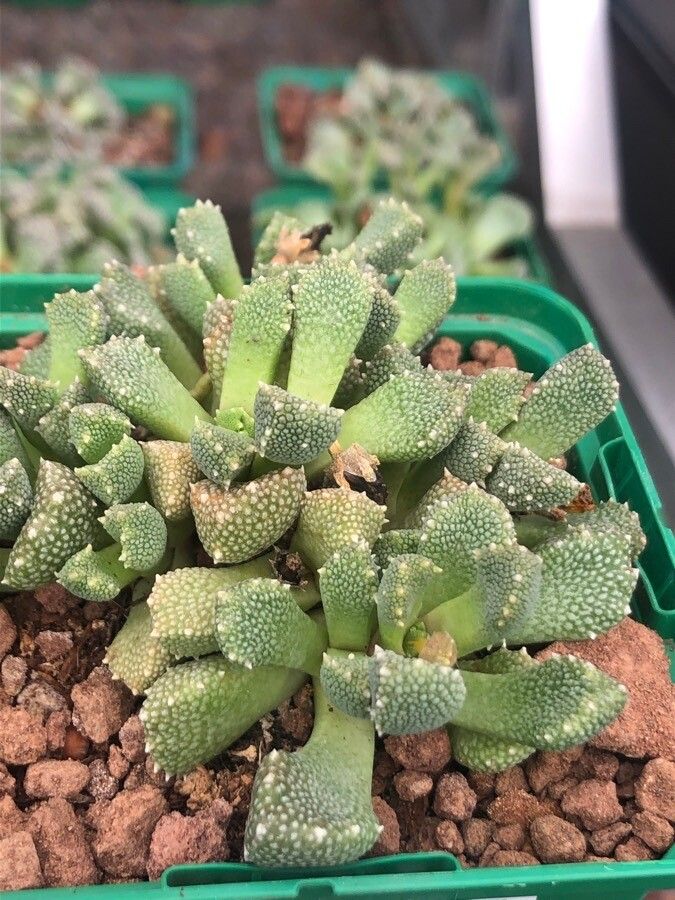
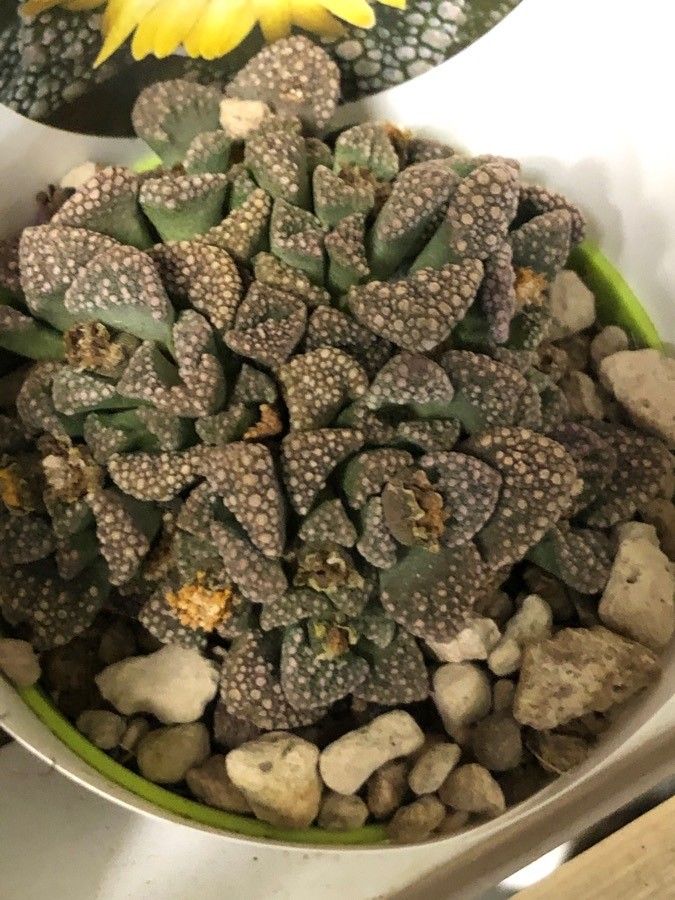
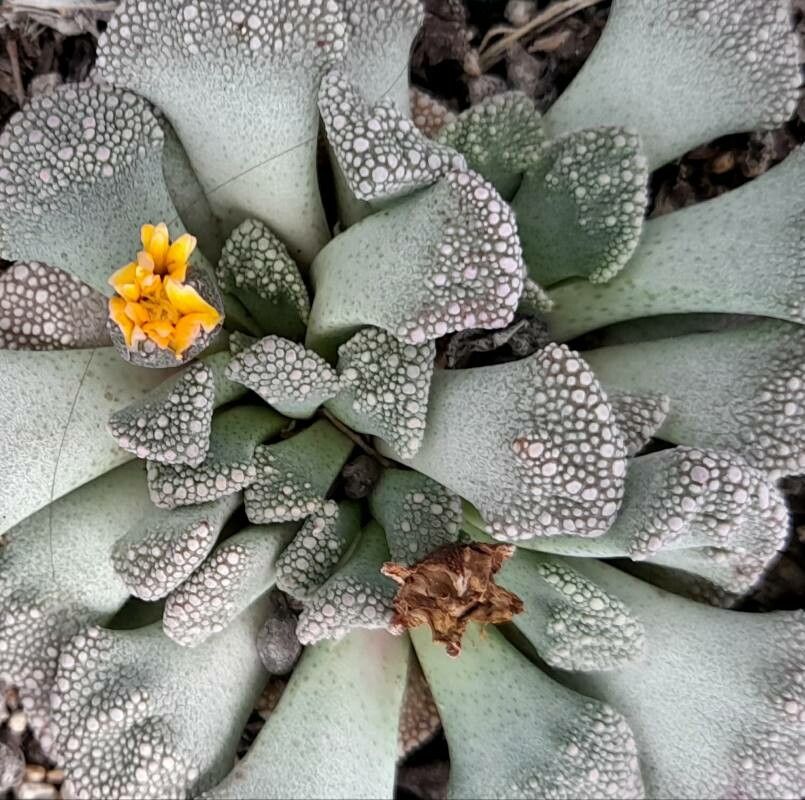
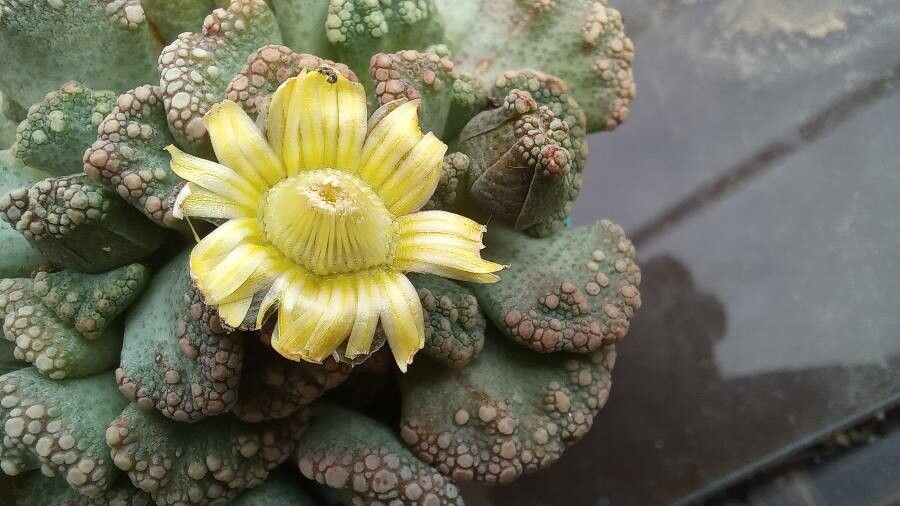
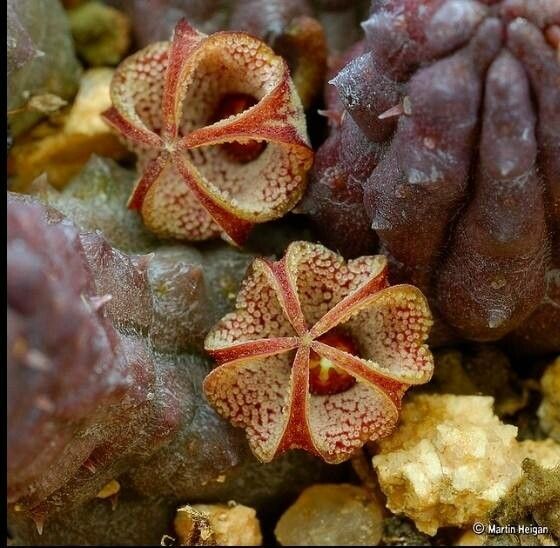
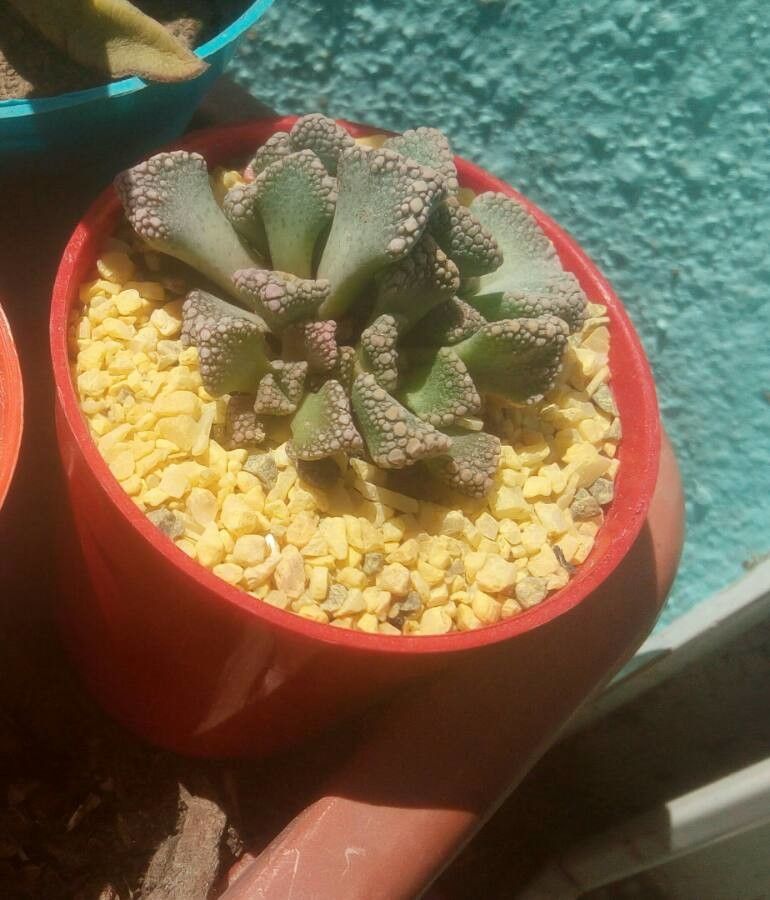
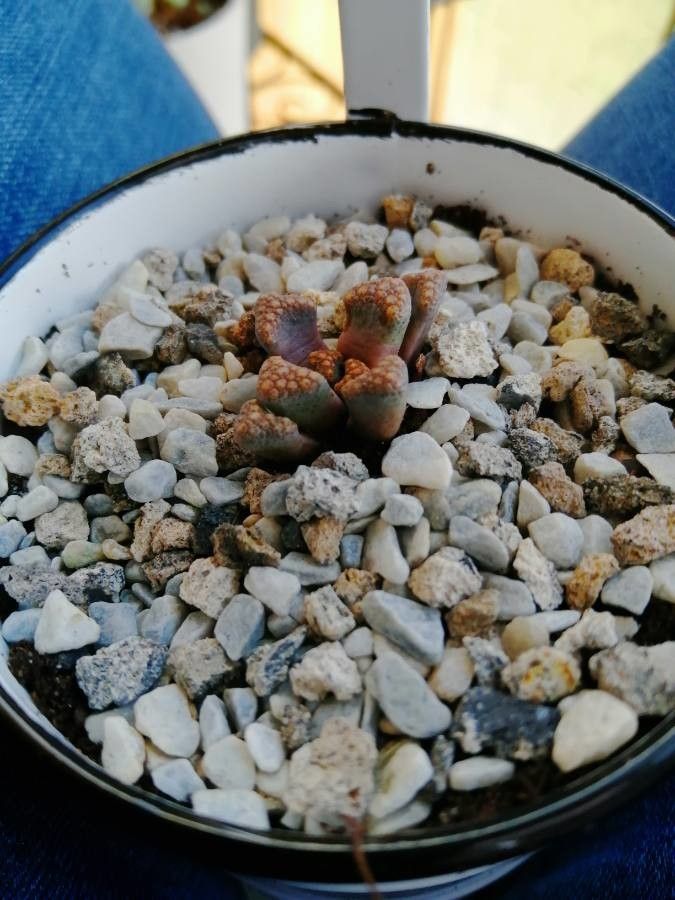
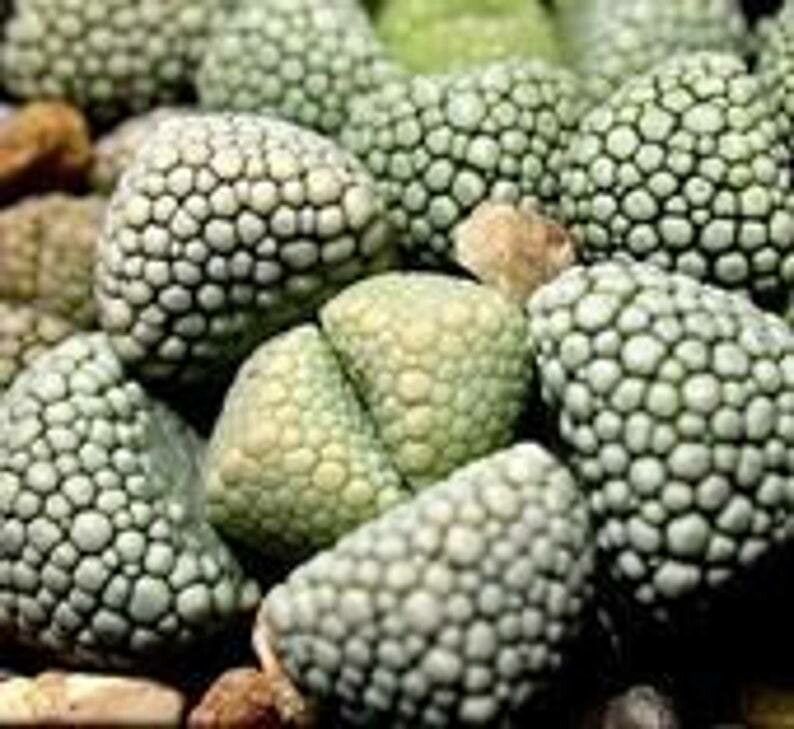
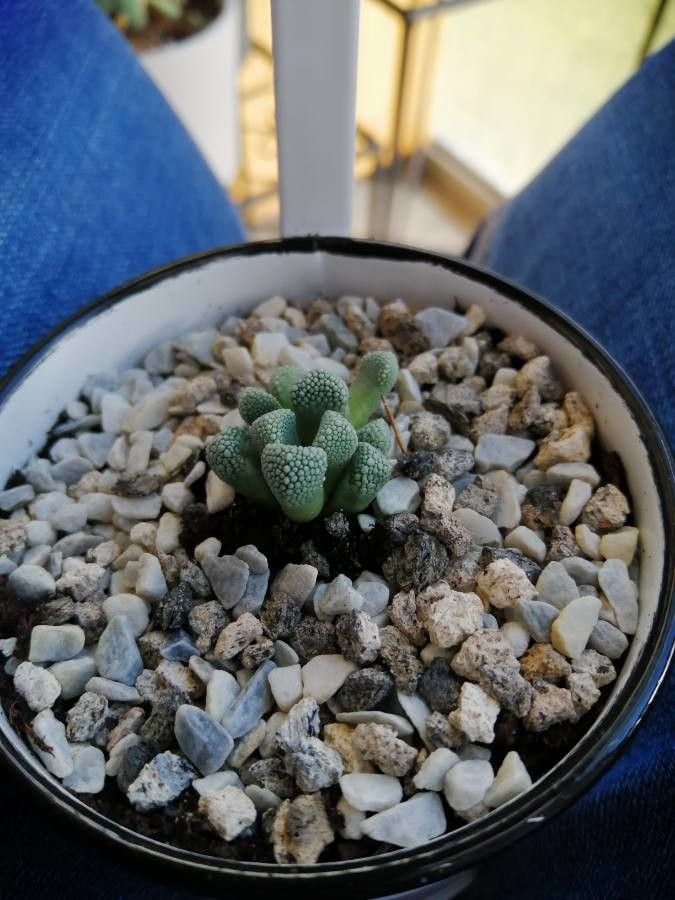
Titanopsis calcarea is a small, succulent plant from the family Aizoaceae, native to the rocky areas of South Africa and Namibia. It thrives in dry, arid conditions. This plant features a compact rosette of thick, fleshy leaves covered in tiny white hairs. The triangular leaves are bluish-green with reddish-brown tips. During the summer, Titanopsis calcarea produces small yellow flowers that emerge from the center of the rosette on short stems. Each flower is about 1 cm in diameter and has five petals. This plant is easy to grow and requires minimal care. It prefers well-draining soil with low to moderate moisture levels and full sun exposure for optimal growth. In its natural habitat, Titanopsis calcarea can endure long periods without water by storing moisture in its thick leaves. The plant's distinctive appearance makes it an excellent addition to rock gardens or succulent collections, both indoors and outdoors. Its low maintenance needs make it an ideal choice for novice gardeners seeking an easy-to-care-for plant with striking visual appeal. Overall, Titanopsis calcarea is a highly attractive succulent, prized for its unique look and ease of care. It has become popular worldwide among gardeners who appreciate these qualities, both at home and in office spaces.
Concrete leaf has moderate disease resistance but is more sensitive to humidity. It is vulnerable to disease when humidity is high and can develop root rot during dormancy. For care, Concrete leaf tolerates drought but requires increased watering in the growing season. Watering should be greatly reduced or stopped entirely during the dormant period. Concrete leaf is best for people with some growing experience, though it can be challenging to maintain, especially during dormancy. It is particularly appropriate for those who can dedicate time to its care in the winter months.
How to keep Titanopsis Calcarea.
Light
The concrete leaf requires abundant sunlight to grow well. Originating from habitats with plentiful sun, it does best with generous sun exposure for ideal health and development. It can tolerate some shade, but inadequate sunlight leads to poor vigor, while excessive exposure can cause sunburn.
Water
The Concrete Leaf is well-suited to arid conditions, needing water only every three weeks. Its efficient water storage makes it highly drought-tolerant. This succulent thrives best outdoors, where it can experience seasonal cycles that influence its moisture requirements.
Temperature
Concrete leaf originates from habitats with temperatures between 68 and 100 °F (20 to 38 ℃). It does well within that temperature range, and seasonal adjustments may not be required.
Fertilizer
For Concrete leaf, light amounts of fertilizer once or twice a year during the growing season are adequate. Avoid fertilizing in winter and summer when the plant is dormant. Cut back on fertilizer for repotted plants and wait a couple of months after repotting before applying fertilizer. Fertilizing supports healthy growth and encourages blooms.
Pruning
To maintain the shape of a concrete leaf, pruning is necessary in both spring and autumn. This involves removing any redundant or dense branches. For propagation, cut sturdy stems that have 5-6 leaves. Apply sulfur powder to the wounds and allow them to heal before planting. Use a watering can to lightly moisten the soil for the cuttings.
Pot & Repot
When repotting Concrete leaf, choose a container a bit bigger than the current one that has good drainage. Fill it with a gritty, well-draining succulent or cactus potting mix. Gently take the plant out of its old pot, brush away excess soil, and place it back in at the same depth. Hold off on watering for several days so any damaged roots can recover. Repot during spring or fall and keep the plant in a spot with bright light.
Botanical profile.
- Plant Type
- Succulent
- Life Cycle
- Perennial
- Genus
- Titanopsis
- Family
- Aizoaceae
- Hardiness Zone
- 9-11
- Mature Height
- 5 cm
- Mature Spread
- 10 cm
- Leaf Color
- Green, Blue, Brown
- Leaf Type
- Evergreen
- Flower Color
- Yellow
- Flower Size
- 2.03 cm
- Bloom Time
- Summer, Fall
- Planting Time
- Spring, Summer, Autumn
- Harvest Time
- Late summer, Fall, Early winter, Mid winter
- Native Area
- South Africa
Other names.
Reader questions.
What should I do if I give my Concrete leaf too much or too little water?
Concrete leaf and other succulents can typically tolerate periods without water. However, if you neglect to water your Concrete leaf for a month or more, you may notice signs of thirst or damage. Underwatered Concrete leaf plants appear lackluster and wrinkled, with some leaves drying up, turning brown or crispy, and falling off. The soil will also be completely dried out. To address underwatering, thoroughly water the plant by submerging the pot in water for 5-10 minutes until the soil is moisturized. Overwatering is harmful and can even be fatal to Concrete leaf plants. Excessive moisture over time causes root rot, preventing roots from absorbing nutrients and water. Root rot occurs due to fungi and bacteria thriving in wet soil. Overwatered plants exhibit yellow, swollen, and translucent organs that may burst from being overly full of water. If left untreated, the plant may turn brown or black and easily fall off. To address overwatering, improve air ventilation, adjust the frequency of watering, and change the growing conditions. Check the soil to confirm if overwatering is the issue. Saving an overwatered plant is challenging but possible if caught early. Start by removing the plant from its pot and inspecting the roots and soil. Gently remove wet soil, rinse the roots in room-temperature water to eliminate fungi, and assess the root health. Dark brown or black, soft, mushy, or slimy roots indicate root rot. If most of the roots are affected, saving the plant may be unlikely. In this case, remove any healthy stems to propagate a new Concrete leaf. If only a portion of the roots are affected, there's a chance to save the plant. Use a sterilized cutting tool to remove unhealthy roots, dip the remaining firm, pale roots in fungicide, and repot in fresh, well-draining soil. While not always successful, most plants with root rot can recover and produce new growth in the next growing season.
Why do I need to add fertilizer to my Concrete plant?
Applying plant food to the growing medium of Concrete leaf helps add nutrients and support healthy growth. Fertilizing during the growing season can also prompt mature specimens to produce blooms. While Concrete leaf does store water and nutrients, adding plant food further enhances its growth.
What are the sunlight requirements for Concrete leaf plants?
Concrete leaf plants, known botanically as Titanopsis calcarea, require abundant sunshine to flourish, thriving best with generous sun exposure. They originate from habitats where sunlight is plentiful, making full sun conditions ideal for their optimal health and growth. While they can tolerate some shade, too little sun may result in poor plant vigor, and too much direct exposure could lead to sunburn. It's important to find spots in your garden that offer the right balance of light and shade, observing how sunlight moves through the area to ensure plant happiness.
What is the optimal temperature range for growing Concrete Leaf?
Concrete Leaf, also known by its botanical name Titanopsis calcarea, thrives in environments where temperatures range between 68 to 100°F (20 to 38°C). It prefers high temperatures and does not require adjustments for seasonal changes. However, it enters a dormant state and stops growing during the winter. When temperatures fall below 32°F (0°C), it is necessary to move the plant indoors, preferably near a south-facing window to ensure it receives ample sunlight. Supplemental lighting may be used if natural light is insufficient. As the temperature drops below 68°F (20°C), the plant's growth slows, necessitating a reduction or halt in watering to prevent root rot.
How often do I need to water my Concrete leaf?
Determining how often to water Concrete leaf is not a strict rule. The best approach is to check the soil and only water when it is completely dry. To check the soil moisture, you can either use your finger or a moisture meter to assess the soil beneath the surface. If you are using a deep pot, you can also use a stick or chopstick to do this. If the soil feels slightly moist, it is advisable to wait a few days and check again. On average, most people typically water Concrete leaf every two weeks during summer and once a month in winter. However, there are several factors that can affect the watering frequency. Below, you will find a list of considerations that can help you determine how often to water.
When should I fertilize my Concrete leaf?
Concrete leaf plants only require a small amount of fertilizer during their growing season. It is recommended to fertilize them 1-2 times a year, preferably in the spring and autumn, while avoiding fertilization in the winter and summer when they are dormant. When repotting, be cautious and reduce the amount of fertilizer used. It is also advisable to wait a couple of months after repotting before applying any fertilizer.
How can artificial lighting support Concrete leaf plants indoors?
Indoor Concrete leaf plants benefit greatly from adequate lighting, especially when natural sunlight is insufficient, like during winter or in less sunny spaces. Artificial lights can be a critical solution, promoting healthier and faster growth. LED lights are recommended for their ability to provide specific wavelengths needed by the plants. For full sun plants, 30-50 Watts per square foot is needed; partial sun plants require 20-30 Watts per square foot, and full shade plants need 10-20 Watts per square foot. The light source should be placed 12-36 inches above the plant, mimicking natural sunlight as closely as possible. Most plants will thrive with 8-12 hours of artificial light per day.
How should Concrete Leaf be cared for in low temperatures?
In low temperatures, especially when the temperature is above 68°F (20°C) but drops below 32°F (0°C), Concrete Leaf requires special care to survive. During winter, it's crucial to ensure the plant is kept above freezing. Exposure to temperatures below -13°F (-25°C) can cause the plant to become weak, wilt, and become prone to root rot. For mild frost damage, trim off affected areas and check for root rot, removing rotted roots as necessary. The plant may be propagated through cuttings if needed. Immediately move the plant to a warmer, indoor environment near a south-facing window for sunlight, and use supplemental lighting if natural light is scarce.
What do I need to think about when watering my Concrete leaf?
To properly water your Concrete leaf, there are a few environmental factors to consider. These include the size of the container, the type of soil, the temperature, and the humidity. First, the container and soil you choose will determine how often and how much you should water the plant. It's important to use a container with good drainage to allow excess water to escape. A small container with less soil won't hold as much moisture, so it will need to be watered more often. On the other hand, a larger pot will stay wet longer and require less frequent watering. It's crucial not to use an oversized pot as this can lead to overwatering. When repotting, choose a container that is just one size larger than the current one. A shallow container is preferable since Concrete leaf has shallow root systems. During the winter, Concrete leaf will need to be watered less often because growth slows down and the plant isn't using as much energy or water. The cooler air results in less evaporation, so the soil stays wet for a longer period than in the summer. Additionally, the general climate in your location plays a role. If you live in a humid area with ample rainfall, you will need to water less frequently compared to a dry and arid climate. Keep in mind that conditions can vary throughout the year and due to indoor heating and air conditioning. If you have a Concrete leaf planted in the ground, it typically won't require additional watering beyond what it receives naturally from precipitation and dew once the root system is established. However, during extended dry periods, occasional watering may be necessary. For areas where Concrete leaf can only be grown in a container, it can be moved outdoors in the spring and summer when the temperature is suitable, but should be brought indoors as temperatures start to drop. A potted Concrete leaf kept outside will generally need more water than if it's kept indoors, mainly due to increased sun exposure even on a shaded porch.
When should I not put fertilizer on my Concrete leaf?
Like most plants, Concrete leaf experiences a dormancy period, during which it is advisable to halt the application of fertilizer. This occurs in both the summer and winter, when the plant stops growing. It is recommended to also abstain from fertilizing for the first few months after repotting in the spring.
What are the signs of light deficiency in Concrete leaf plants?
Concrete leaf plants may exhibit several symptoms when they do not receive enough light. These include smaller than usual new leaves, leggy or sparse growth due to longer spaces between leaves or stems, faster leaf drop as older leaves are shed early to conserve resources, slower or no new growth as the plant enters survival mode, and irregular color patterns or paler new leaves indicating insufficient chlorophyll and nutrients. Chlorosis or yellowing of the leaves, sunscald showing as pale or necrotic areas, leaf curling as a defense against excessive sunlight, wilting from loss of turgor pressure, and leaf scorching with brown, crispy edges are also symptoms associated with suboptimal light conditions.
What actions should be taken if Concrete Leaf experiences high temperatures?
During the summer, Concrete Leaf should be kept in temperatures below 100°F (38°C). Exposure to temperatures above 109°F (43°C) can halt its growth and make it vulnerable to water loss, wilting, and sunburn. To care for the plant in such conditions, remove any sunburned or rotten parts and protect it from the harsh afternoon sunlight until it recovers and resumes growth. If the plant suffers from root rot, cease watering until new roots start to develop.