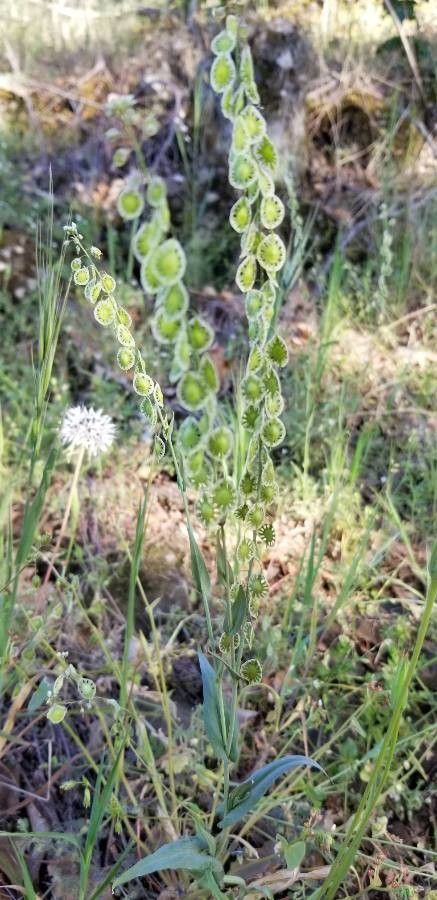
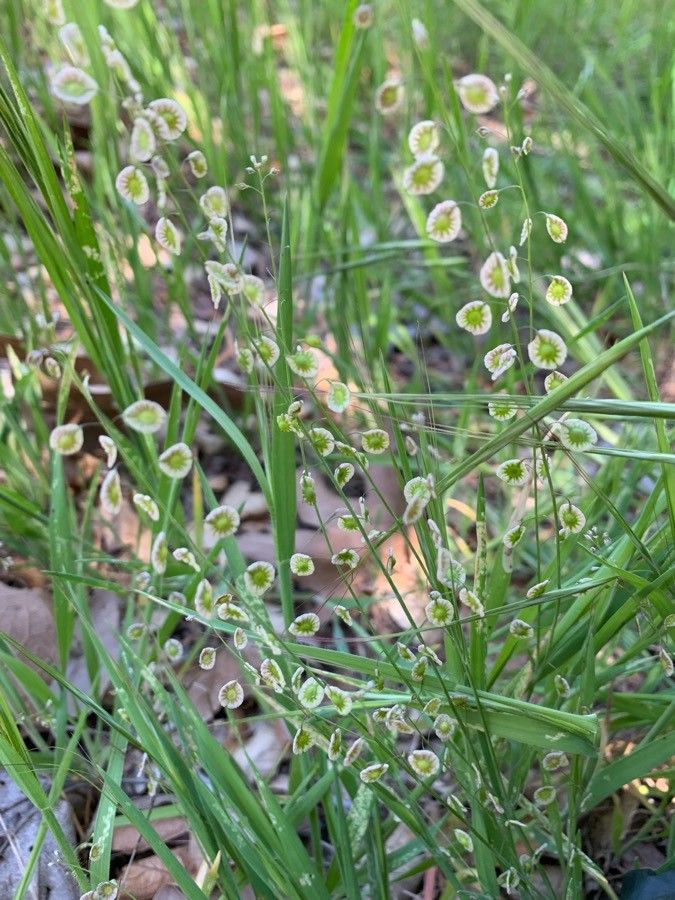
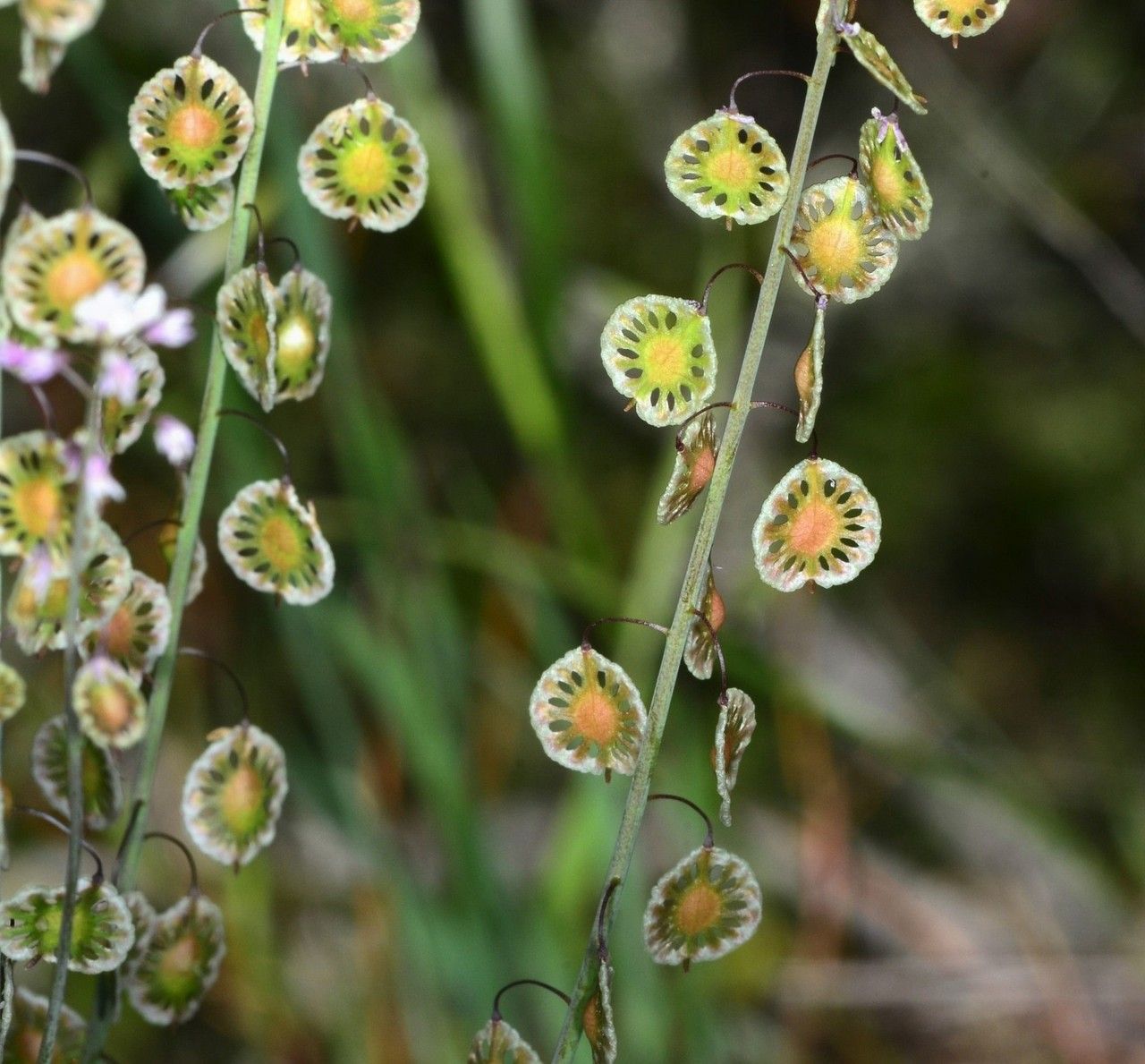
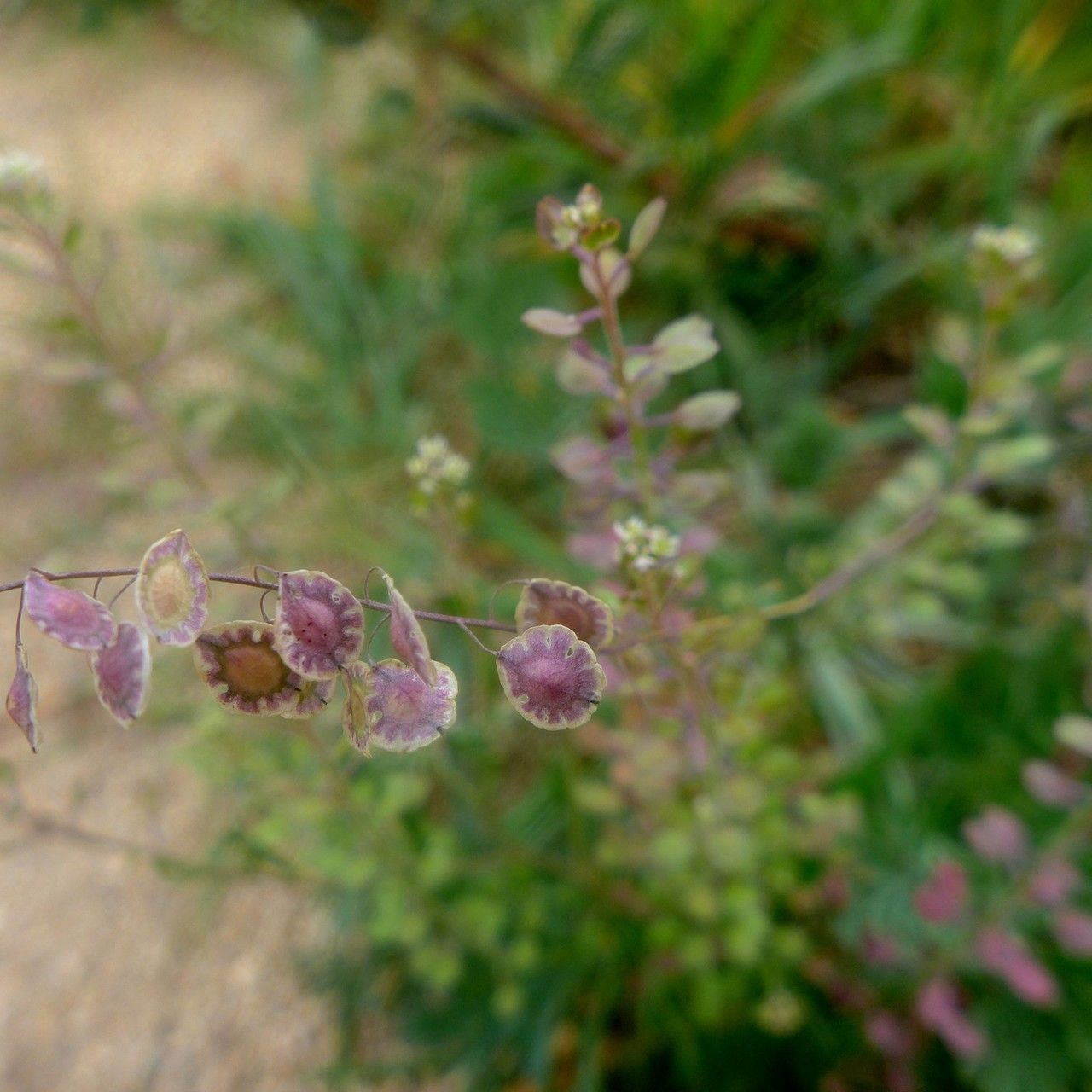
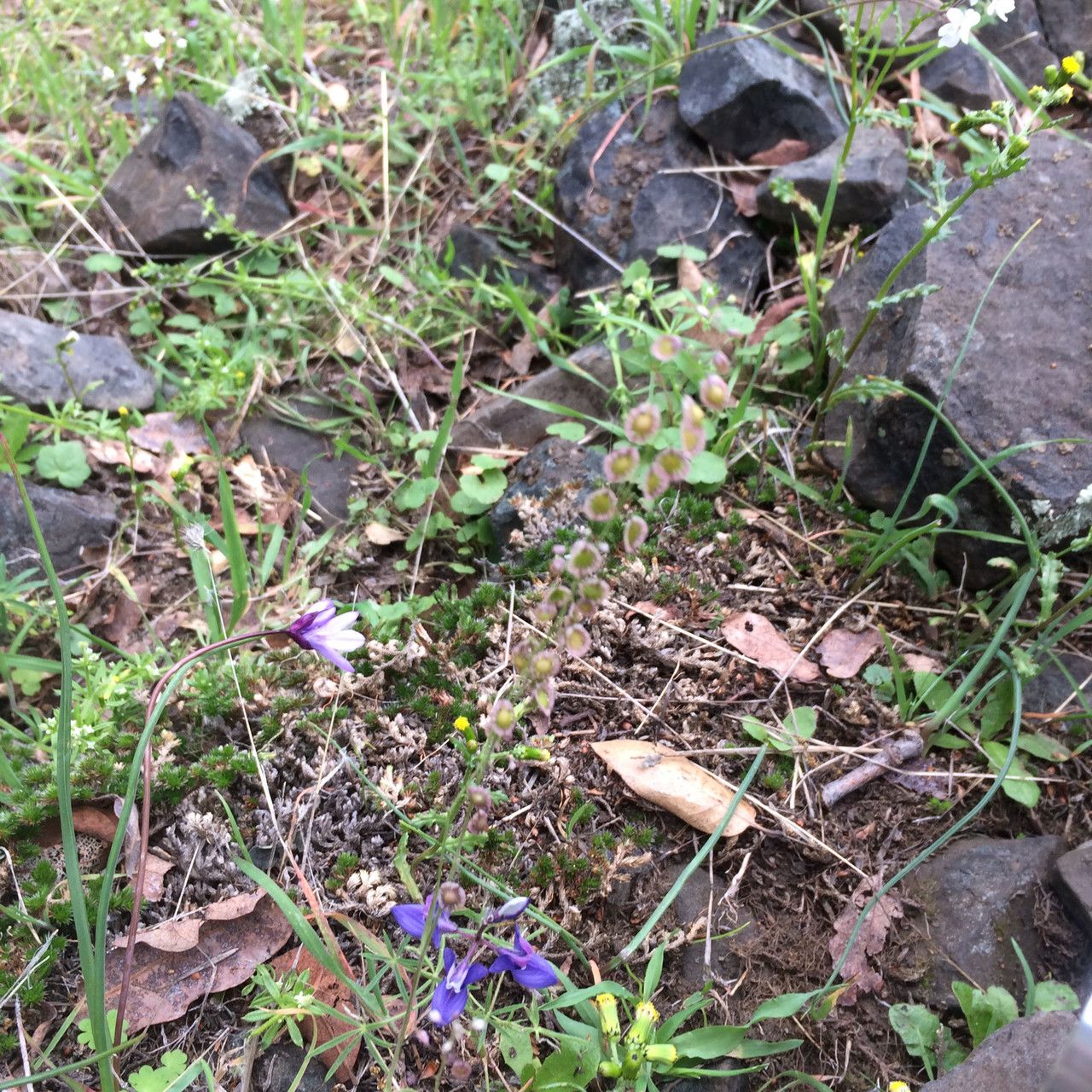
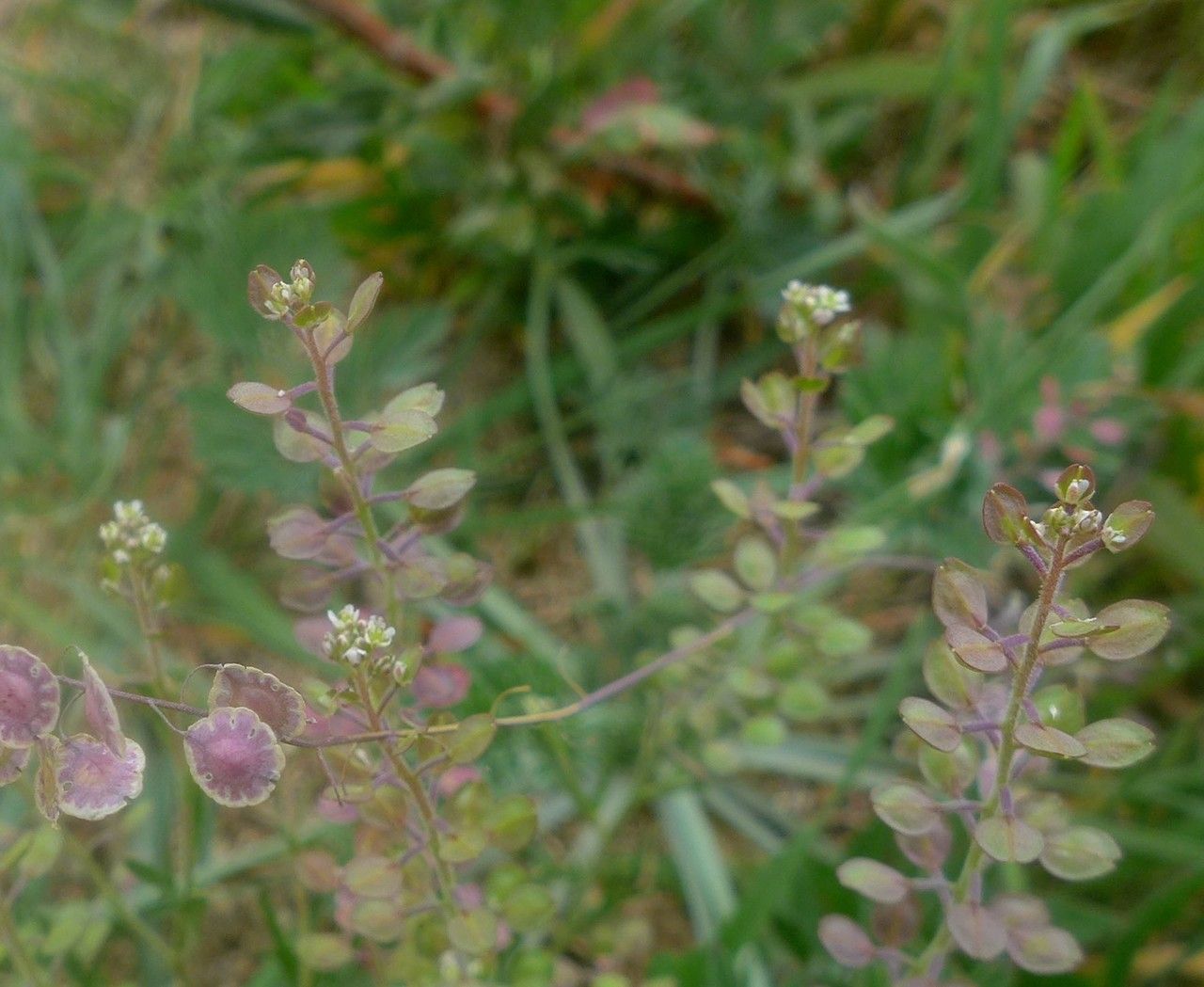
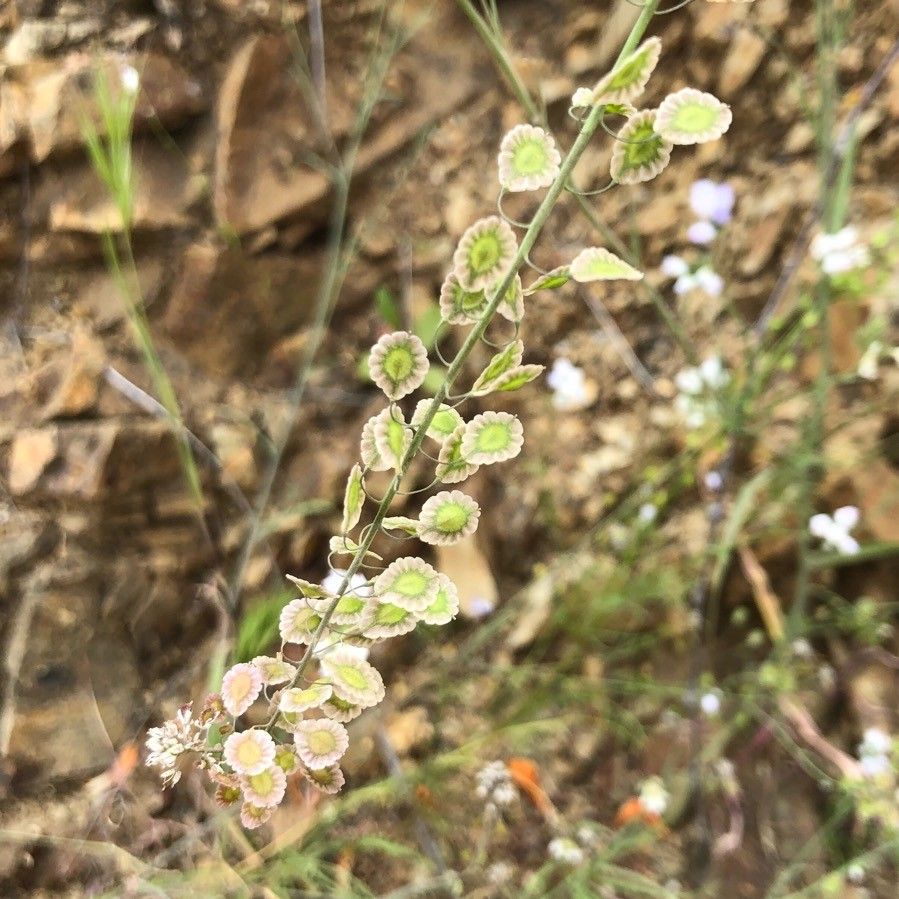
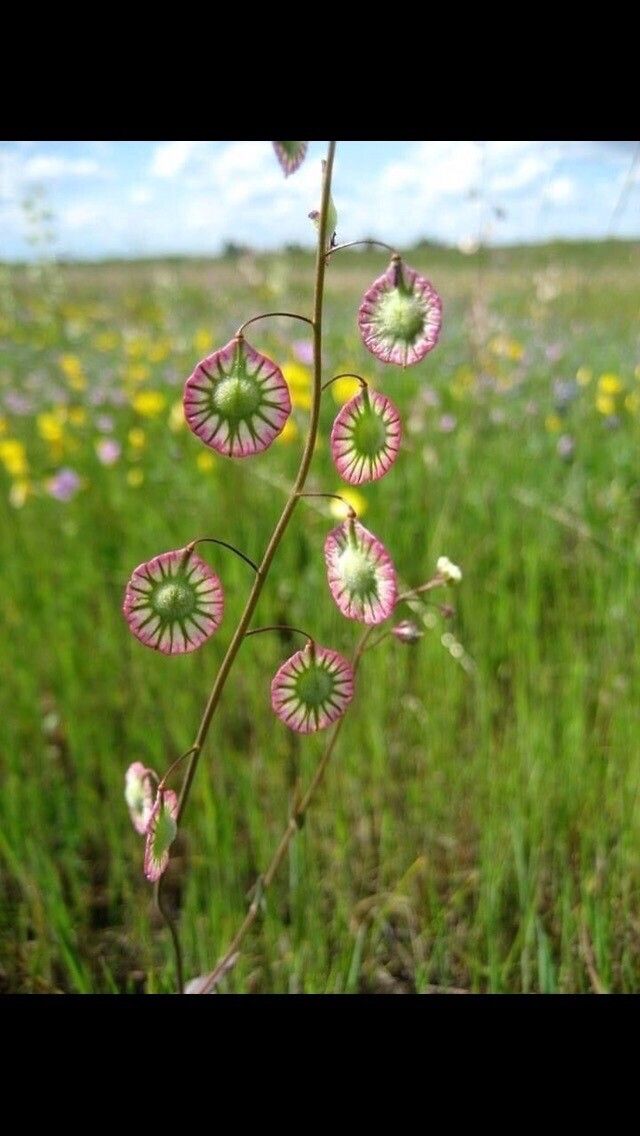
Thysanocarpus curvipes is a species of flowering plant in the family Brassicaceae known by the common names sand fringepod and lacepod. It is native to western North America from British Columbia through the western United States to Baja California, where it grows in many types of habitat. It is a common plant in much of its range. It is variable in appearance. It is an annual herb producing a branching or unbranched stem 10 to 80 centimeters tall. The leaves are mostly lance-shaped but variable. The lower ones are sometimes borne on petioles and the upper ones may clasp the stem at their bases. They may be smooth-edged, toothed, or lobed. The inflorescence is a raceme of flowers with four white or purple-tinged petals and purple sepals. The fruit is a flattened, rounded or oval disclike capsule with a thin wing around the edge. The fruit is under a centimeter long and the wing is variable in appearance, flat or wavy, sometimes perforated.
Sand fringepod has strong disease resistance and is usually not susceptible to illnesses. However, it can be affected by pests and diseases present in its environment. These infections are typically not serious. As for care, this plant requires a moderate level of maintenance. It needs regular pruning to preserve a neat appearance and support healthy growth. Fertilizing can also encourage more flowering. Sand fringepod is suitable for anyone with an outdoor area, such as a garden or patio, and does not demand extensive plant-care experience. It may need more care when grown indoors.
How to keep Thysanocarpus Curvipes.
Light
Sand fringepod performs best in direct, unshaded sunlight. It evolved in open habitats and depends heavily on light for optimal growth, having no tolerance for lower-light conditions. Insufficient sunlight can lead to stunted growth or other plant health problems, while excessive sun exposure is not an issue.
Water
The Sand fringepod thrives best with moderate hydration, needing weekly watering to avoid over-saturation. It does well in conditions that mimic its native habitat, which includes regular periods of moisture followed by drying. As an outdoor plant, the Sand fringepod adapts well to seasonal rainfall and variable watering throughout its growing season.
Temperature
Sand fringepod originates from areas with moderate to high temperatures and generally does best between 68 and 100.4°F (20 and 38°C). It prefers warm climates; exposure to cooler conditions may inhibit its growth.
Fertilizer
Sand fringepod responds well to regular, weak applications of fertilizer to encourage healthy leaf growth. Fertilize Sand fringepod about once a month during the summer. Nitrogen is important for foliage, and adding nitrogen-rich sources helps Sand fringepod thrive.
Pruning
To keep Sand fringepod healthy and thriving, it's important to prune it regularly, ideally from early to late spring. This practice helps remove weak growth and encourages robust foliage. When pruning, make cuts just above the nodes to improve airflow, reduce the risk of disease, and enhance flowering. Be sure to sterilize your tools before use to prevent infection and promote vigorous growth.
Botanical profile.
- Plant Type
- Herb
- Life Cycle
- Annual
- Genus
- Thysanocarpus
- Family
- Brassicaceae
- Hardiness Zone
- 1-11
- Mature Height
- 10 cm to 76 cm
- Mature Spread
- 30 cm to 61 cm
- Leaf Color
- Green, Light Green
- Leaf Type
- Semi-evergreen
- Flower Color
- White
- Flower Size
- 0.51 cm
- Bloom Time
- Early spring, Mid spring
- Planting Time
- Spring, Summer
- Harvest Time
- Late spring, Early summer
Other names.
Reader questions.
How should I water my Sand fringepod in the best way?
To water the Sand fringepod plant, there are several options you can choose from. You can use a garden hose with a spray nozzle, a watering can, or any other common watering tool you have available. The good news is that the Sand fringepod plant is not too particular about how it receives water. It can survive with rainwater, tap water, or even filtered water. However, it's generally best to avoid watering this plant from above, as doing so can harm its leaves and flowers, and potentially lead to disease. A recommended method for watering this plant is by using a drip irrigation system, which evenly and directly delivers water to the soil. If you have a container-grown Sand fringepod plant, you can use a similar approach of watering directly at the soil, but with a cup, watering can, or even your tap.
What are the sunlight requirements for Sand fringepod?
Sand fringepod requires full sun, defined as above 6 hours of sunlight daily, to thrive optimally. It's vital to observe the movement of sunlight through your garden and select spots that ensure a perfect mix of light and shade, making sure your plants are happy. Sand fringepod is adapted to live in open habitats and relies heavily on sunlight for growth, showing little tolerance for lesser light conditions. Insufficient sunlight may lead to stunted growth and potential health issues, although the plant does not have concerns with excessive sunlight exposure.
What is the optimal temperature range for Sand Fringepod?
Sand fringepod, known botanically as Thysanocarpus curvipes, thrives best in temperatures ranging from 68 to 100.4°F (20 to 38°C). These warm climate conditions are considered optimal for its growth, and any significant adjustments to cooler temperatures may impede its development.
What should I do if I give my Sand fringepod plant too much water or too little water?
To fix the problem of underwatering Sand fringepod, simply water it more regularly. However, overwatering can be a bigger issue that can lead to diseases and even death. To prevent this, choose a sunny location with good drainage, so excess water doesn't pool and the soil can dry out. If your potted Sand fringepod is overwatered, consider changing to a new pot with better drainage and loose soil.
How can artificial lighting be used for indoor plants?
For indoor plants, especially when natural sunlight is insufficient, artificial lighting becomes essential for optimal growth. Indoor plants require adequate lighting, and in spaces with low natural sunlight or during winter, artificial lights can be a crucial solution. LED lights are considered ideal because they can be tailored to provide specific wavelengths needed by the plants. The requirements vary with the type of plant, with full sun plants needing 30-50W/sq ft, partial sun plants 20-30W/sq ft, and full shade plants 10-20W/sq ft. The artificial light should be placed 12-36 inches above the plant and kept on for 8-12 hours per day to mimic natural daylight conditions.
Does Sand Fringepod require frost protection during winter?
Due to its strong cold resistance, Sand fringepod usually does not require special frost protection measures during the winter. However, if temperatures are expected to fall below -45°C, it is important to provide cold protection. This can be done by covering the plant with protective materials such as soil or straw. Additionally, watering the plant abundantly before the first freeze in autumn to keep the soil moist can help prevent drought and water scarcity during winter and early spring.
How much water does my Sand fringepod need and how often?
Sand fringepod requires regular watering throughout the growing season. In spring, water the plant once a week. As the season progresses and the weather gets warmer, increase the watering to two to three times a week. However, be cautious not to exceed this frequency as it can harm the plant. Regardless of how often you water, ensure that the soil remains moist but not wet. When watering a potted Sand fringepod, you'll need to water more frequently since the soil can dry out faster. Typically, water a container-grown plant a few times a week, compared to just once a week for an in-ground plant.
What are common symptoms of insufficient light in Sand fringepod?
When Sand fringepod is grown indoors with inadequate light, several symptoms can indicate light deficiency. These include smaller new leaves, leggy or sparse growth, faster leaf drop, slower or halted growth, paler new leaves, and conditions like chlorosis (leaf yellowing), sunscald, leaf curling, wilting, and leaf scorching. These symptoms result from the plant's inability to perform photosynthesis efficiently due to insufficient light.
How does low temperature affect Sand Fringepod, and what are the solutions?
Sand fringepod is cold-tolerant and performs best when temperatures are above 20°C. During winter, it's crucial to keep it above 0°C. Exposure to temperatures below -45°C might not show immediate effects during winter, but it can lead to decreased sprouting or even a complete lack of sprouting in spring. The recommended solution for affected plants in spring is to remove any parts that have failed to sprout.
How much water does my Sand fringepod plant need?
Determining how much water to give your Sand fringepod can be done in a few different ways. Some gardeners prefer to assess the soil moisture by feeling it, suggesting that watering should continue until the first six inches of soil feel moist. Another approach is to use a specific measurement, such as providing about two gallons of water per week, taking into account factors like temperature and how fast the soil dries. However, it's important to be cautious not to overwater if your plant needs less water. When growing Sand fringepod in a container, a different method is needed. This involves making sure all the dry layers of soil are moistened, which can be checked by inserting your finger into the soil or watering until a small amount of excess water drains from the pot's holes.
What solutions are available for light deficiency in Sand fringepod?
To combat light deficiency in Sand fringepod, a gradual increase in light exposure is recommended. For indoor plants, moving them to a south-facing window or using artificial light sources like a desk or ceiling lamp for at least 8 hours daily can help. Outdoor plants should be moved to sunnier spots gradually to avoid sunburn. If trees block sunlight, consider pruning to improve light penetration. For ground plants, choosing a location with ample sunlight and good drainage is crucial. Note that while parts of the plant affected by insufficient light may not recover, new growth will be healthy with improved light exposure.
How does high temperature affect Sand Fringepod, and what are the solutions?
In the summer, it's essential to keep Sand fringepod's environment below 38°C. Temperatures exceeding 43°C can cause the plant's leaves to lighten in color, curl, become susceptible to sunburn, and, in severe cases, cause the plant to wilt and dry out. Solutions include trimming away the sunburned and dried-up parts, moving the plant to a shaded location away from midday and afternoon sun, or using a shade cloth. Watering the plant in the morning and evening to keep the soil moist is also beneficial.