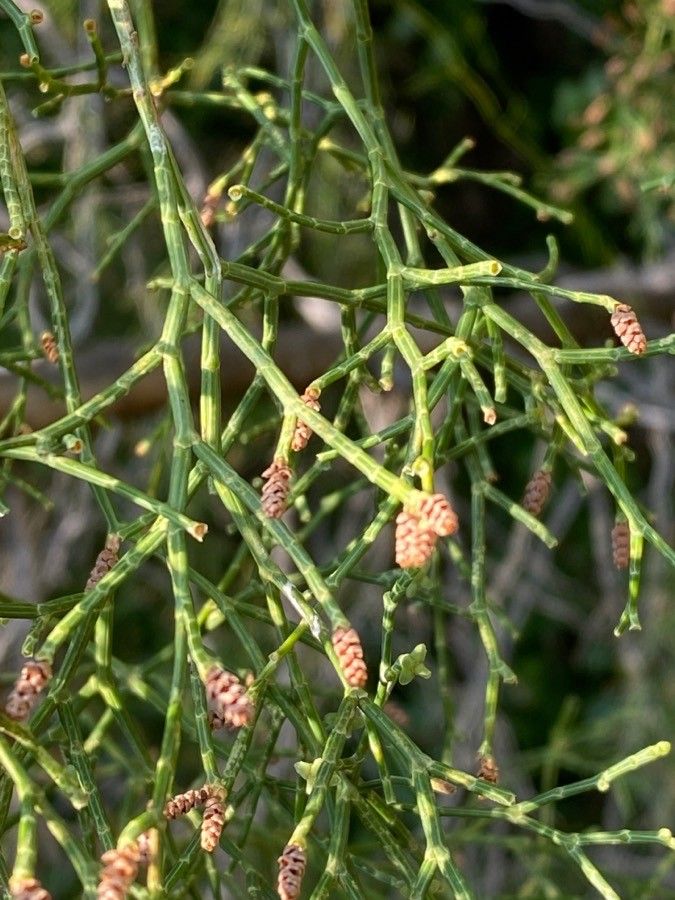
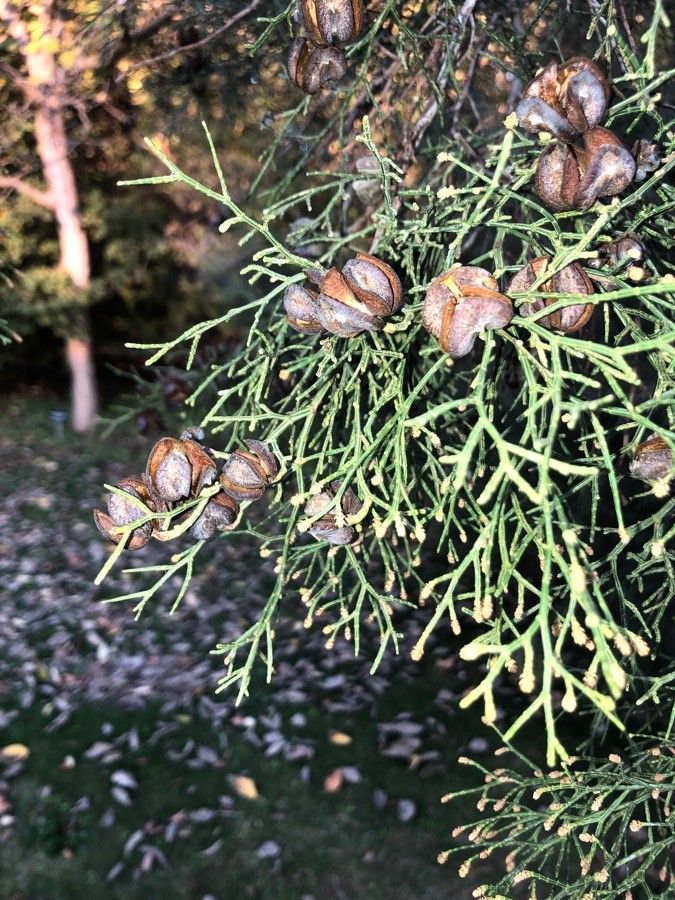
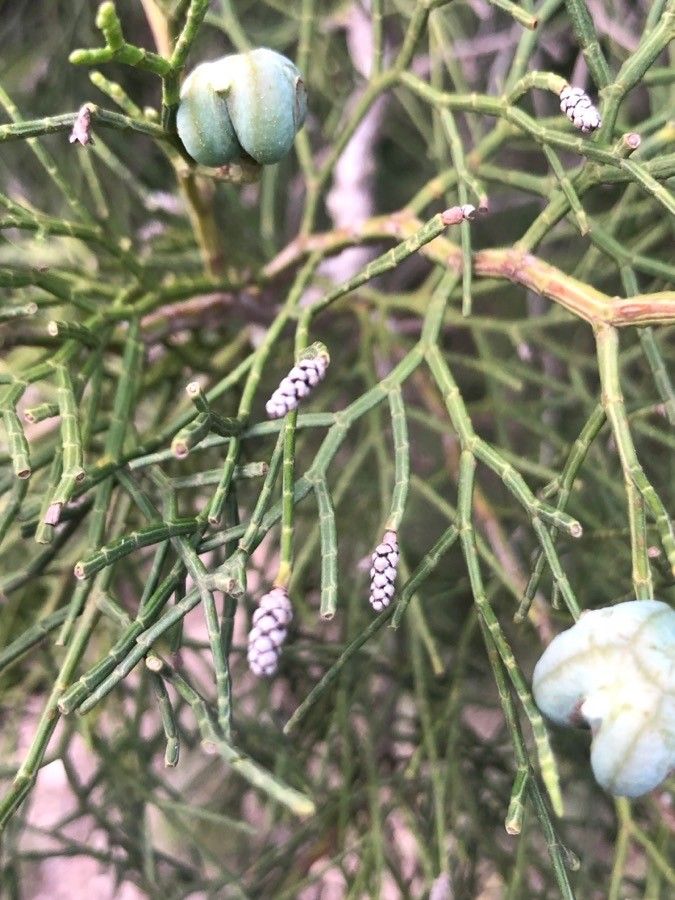
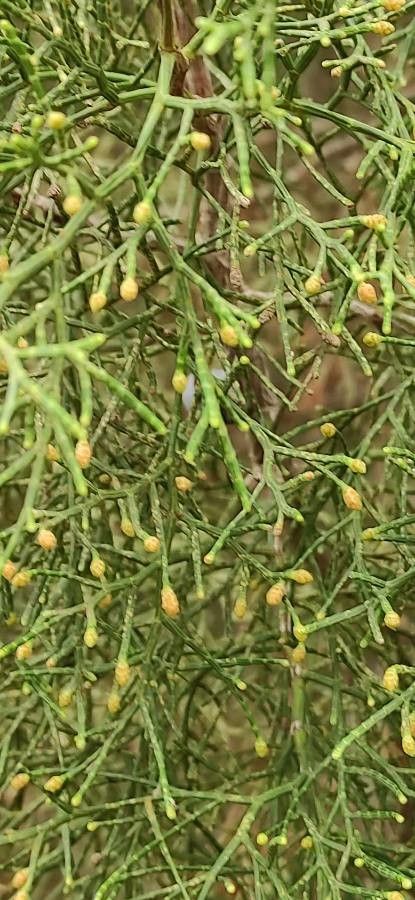
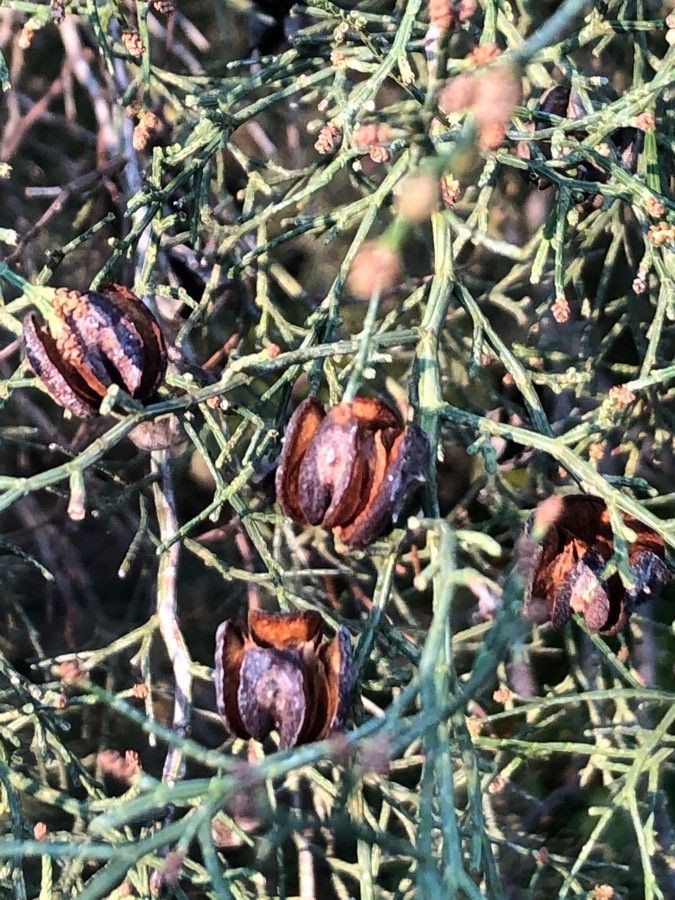
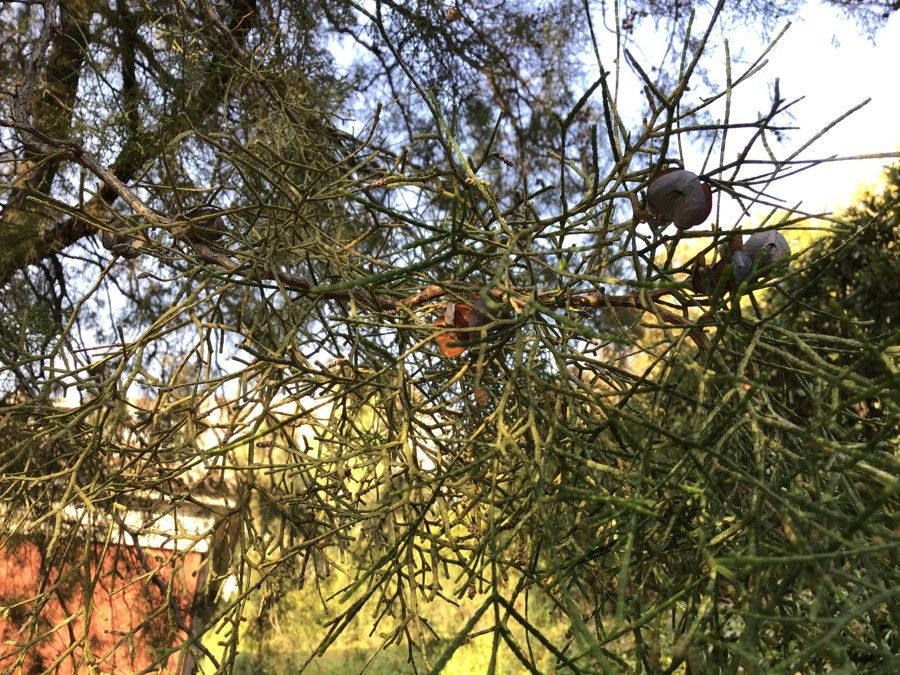
Tetraclinis articulata, commonly known as the Sandarac tree or Barbary thuja, is a small evergreen tree in the cypress family. Native to North Africa and the western Mediterranean region, it can grow up to 10 meters tall. The Sandarac tree has a distinctive conical shape, featuring a dense crown of blue-green foliage that turns yellowish-brown in winter.
The bark of Tetraclinis articulata is reddish-brown and peels off in thin strips. Its scale-like leaves are arranged in opposite pairs along the branches and emit an aromatic scent when crushed. The tree produces small cones that are initially green but turn brown upon maturing.
Historically, Tetraclinis articulata has been used for various purposes. Its wood was utilized in furniture making, and its resin found applications in varnish and incense production. In traditional medicine, it was believed to have antiseptic properties and was used as an expectorant or diuretic.
The Sandarac tree thrives in dry climates with well-drained soil but can also tolerate some moisture during its growing season. Often planted as an ornamental plant due to its attractive foliage and shape, it also serves practical purposes as a windbreak or erosion control plant thanks to its deep root system.
Overall, Tetraclinis articulata is a fascinating plant with both historical and current uses, while also offering aesthetic value for landscaping.
The arar tree has good resistance to disease and is generally not prone to illnesses. In terms of care, this plant is relatively low-maintenance. When planted outdoors it needs only minimal watering, and larger plants generally do not require pruning. Smaller plants should, however, be pruned after they have bloomed. The arar tree is suitable for anyone with an outdoor space, such as a garden or deck, and does not require a lot of gardening experience.
How to keep Tetraclinis Articulata.
Light
The Arar tree is native to open habitats, such as sunny meadows and forest margins, which provide abundant light. It does best in full sun but can also tolerate partial sun, adapting well to various light conditions.
Water
The Arar tree, native to North Africa, is well-suited for dry environments due to its drought tolerance. It should be watered once every one to two weeks. This tree is an ideal choice for xeriscaping or rock gardens because it efficiently makes use of limited rainfall, making it perfect for warm climates.
Temperature
The Arar tree is adaptable to temperature, able to endure high heat and wide temperature fluctuations. In hot conditions, care should be taken with watering and providing suitable shade to avoid sunburn. However, the Arar tree tolerates low temperatures poorly; although it can withstand some cold, excessively low temperatures can cause frost damage.
Fertilizer
The Arar tree has specific nutrient needs and does not require heavy fertilization. Fertilizing in spring is best for achieving optimal growth. Supplying nutrients improves its health, increases its resistance to pests and diseases, and helps sustain a long lifespan.
Pruning
The Arar tree is a type of conifer known for its aromatic resin and scale-like leaves. For optimal care, prune the tree from early to late winter. Focus on removing dead or damaged branches, as well as any crossing limbs, to improve air circulation. Always use clean, sharp tools to minimize stress on the tree and encourage healthy growth and denser foliage.
Botanical profile.
- Plant Type
- Tree
- Life Cycle
- Perennial
- Genus
- Tetraclinis
- Family
- Cupressaceae
- Hardiness Zone
- 10
- Mature Height
- 10.06 m to 14.94 m
- Mature Spread
- 4.88 m to 7.92 m
- Leaf Color
- Dark Green
- Leaf Type
- Evergreen
- Flower Size
- 0.25 cm to 0.51 cm
- Bloom Time
- Early spring, Mid spring
- Planting Time
- Spring, Summer, Autumn
- Harvest Time
- Late summer, Early fall, Mid fall
- Native Area
- Morocco, Tunisia, Spain, Algeria
Other names.
Reader questions.
How should I water my Arar tree?
Watering your Arar tree is a straightforward task. One easy way to do it is by turning on your garden hose and slowly soaking the soil. For mature Arar trees, the garden hose is ideal because they need a lot of water. However, for smaller trees, you can use a watering can or other smaller tools. Avoid overhead watering as it can cause disease, especially for young trees.
What are the sunlight requirements for Arar tree?
The Arar tree, also known as Tetraclinis articulata, flourishes in environments that offer plenty of sunlight. It thrives best in full sun conditions, which means it requires more than 6 hours of sunlight per day. However, it can also adapt and grow well in partial sun, with about 3-6 hours of sunlight. It's important to monitor the movement of sunlight through your garden to ensure that your Arar tree is planted in a spot that provides an ideal balance of light and shade, catering to its needs and promoting its health and growth.
What is the Arar tree?
The Arar tree, known botanically as Tetraclinis articulata, is a distinctive species recognized for its unique characteristics. Unfortunately, the provided data does not include detailed descriptions of its essentials or symptoms, focusing solely on its nomenclature.
What should I do if I give my Arar tree too much water or too little water?
Overwatering your Arar tree can occur due to poor soils that do not allow proper drainage. If this happens, you can improve the soil's drainage or relocate your tree to a better spot. If your Arar tree is in a pot, you may need to use looser soils in a container with better drainage. Overwatering can also lead to diseases, which should be treated promptly. To rectify an underwatered Arar tree, simply water it more frequently. To determine if your tree is overwatered, examine its foliage, particularly the new growth. Discolored or fragile new growth suggests excessive moisture. If you observe standing water or slow drainage in the growing area, the soil may be too moist. Underwatered trees will show symptoms in the form of sparse, brown leaves. Consider recent excessive rainfall or consistent high temperatures if you notice these symptoms.
How does artificial lighting benefit indoor Arar trees?
Indoor Arar trees benefit significantly from artificial lighting, especially when natural sunlight is insufficient, such as during winter or in areas within homes that receive less sunlight. Artificial lights, like LED lights, can be customized to provide specific wavelengths needed by plants, encouraging faster and healthier growth. For optimal growth under artificial light, full sun plants require 30-50W/sq ft, partial sun plants need 20-30W/sq ft, and full shade plants should have 10-20W/sq ft. The artificial light source should be placed 12-36 inches above the plant, imitating natural sunlight's distance, and the plants usually need 8-12 hours of light per day to mimic natural daylight hours.
How often do I need to water my Arar tree?
A mature Arar tree is drought tolerant and mainly relies on rainfall for survival. During the hottest months, watering may be necessary once a week, but during other seasons, watering may not be needed at all. Newly planted Arar trees should be watered regularly to establish their roots. However, it's important to avoid overwatering as Arar trees cannot tolerate standing water. It's best to err on the side of not watering rather than risking overwatering.
What are the symptoms of light deficiency in Arar trees?
Arar trees show several symptoms when they experience light deficiency, especially when grown indoors or in conditions with suboptimal lighting. These include smaller new leaves, leggy or sparse growth, faster leaf drop, slower or halted new growth, lighter-colored new leaves indicating a lack of chlorophyll, chlorosis or yellowing of leaves, sunscald identified by pale or necrotic areas on plant tissues, leaf curling as a defense mechanism against excessive sunlight, wilting from loss of turgor pressure, and leaf scorching seen as brown, dry edges or patches on leaves due to excessive light.
How much water does my Arar tree require?
During the peak of summer, you'll usually need to water your Arar tree once a week, giving it around one inch of water. However, this amount may vary if it has already rained that week. If it has rained one inch or more, no additional watering is necessary. Keep in mind that a newly planted Arar tree requires more water during the initial period of establishment. Generally, watering once every one to two weeks for the first few growing seasons is recommended.
How can I address light deficiency symptoms in Arar trees?
To combat light deficiency in Arar trees, consider gradually moving them to sunnier locations, ensuring they receive at least 6 hours of direct sunlight daily. For indoor plants, place them near south-facing windows for maximum sunlight or use artificial lights such as desk lamps or professional grow lights for at least 8 hours daily. For outdoor plants, transitioning them gradually to sunnier spots can help avoid sunburn. Additionally, reducing obstructions such as pruning trees to allow more sunlight, and transplanting smaller plants during their dormant period to more sunlit areas can improve light exposure. Note, while parts of the plant affected by insufficient light may not recover, new growth following these adjustments should be healthy.
How do I correctly water my Arar tree during different seasons?
The Arar tree requires the most water in the summer when it's hottest. During this time, water the plant once per week if there is no rainfall. In other seasons, the Arar tree can survive with no water. In spring and fall, it may need water if it's exceptionally hot, but this is rare. Unlike most plants, the Arar tree keeps growing during winter and doesn't go into full dormancy. However, its water needs in winter are low since the cool temperatures don't cause the soil to dry out quickly.
How do I water my Arar tree when it is growing at different stages?
Young Arar trees require more water compared to established trees. To promote root development, it is important to water a newly planted tree at least once a week, ensuring that the soil remains moist. After the first growing season, your Arar tree will have adapted to its new location and will require less water. At this point, you can follow the standard instructions for watering this species, providing supplemental water once a week during the summer when there is no rain. You do not need to adjust your watering habits based on the growth stages of the Arar tree tree outside of these guidelines.
What's the difference between watering an Arar tree inside and outside?
The Arar tree is commonly grown outdoors, but it is also possible to grow it indoors in a container, often as a bonsai plant. Whether you choose to grow it indoors or outdoors, the water needs of the Arar tree are similar. However, there is one difference - indoor Arar trees may require slightly more water. This is because they don't have access to rainfall during the summer and indoor areas are usually drier than outdoor growing locations. Additionally, the size of the pots limits water retention, which can increase the water needs of indoor Arar trees.