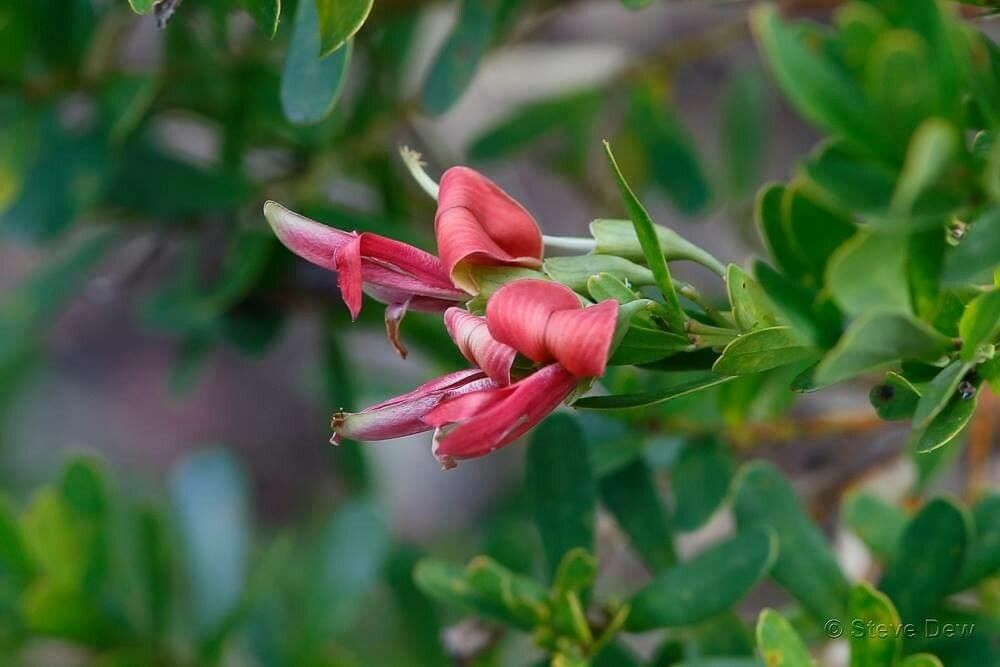
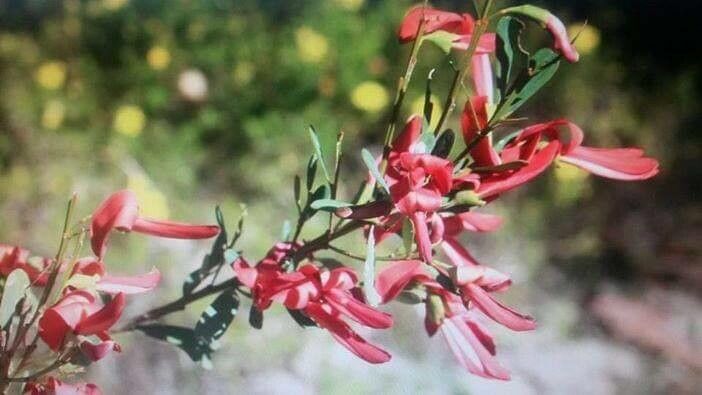
Templetonia retusa, known as cockies tongues, cocky's tongues, or coral bush is a shrub in the family Fabaceae (Leguminosae) that grows in southern and south-western Australia. It grows up to 2 metres (6 ft 7 in) high, with leaves 15–40 millimetres (0.6–1.6 in) long and 7–25 mm (0.3–1.0 in) wide. Its flowers are normally a rich red colour, and are 25–40 mm (1.0–1.6 in) long. The seed pods are 40–50 mm (1.6–2.0 in) long and around 10 mm (0.4 in) wide. It is found in coastal woodland and heaths over limestone from Shark Bay, Western Australia, to near Kangaroo Island, as well as inland in the Flinders Ranges of South Australia.
Cockies tongue shows strong resistance to disease and is usually not vulnerable to illnesses. Regarding care, this plant is fairly low-maintenance. When grown outdoors it needs little watering, and larger specimens typically do not require pruning. Smaller specimens, however, should be pruned after they finish flowering. Cockies tongue is appropriate for anyone who has outdoor space, such as a garden or a deck, and does not demand extensive care experience.
How to keep Templetonia Retusa.
Light
Cockies tongue occurs in open habitats, such as sunny meadows and forest margins, which provide plenty of light. It performs best in Full Sun but can also tolerate Partial Sun, adjusting well to different light conditions.
Temperature
Cockies tongue shows strong adaptability to different climate conditions, from scorching summers to cold winters. Still, it has a preferred temperature range for growth. If temperatures become too high, the plant is vulnerable to heat and humidity stress, which can kill it. In places where temperatures near the lower limit of its cold tolerance, providing insulation to protect the plant is important.
Fertilizer
Timing is essential when fertilizing Cockies tongue. Apply fertilizer in early spring and continue once a month until early summer. Fertilizer encourages attractive blooms and supplies energy during both dormancy and periods of active growth.
Pruning
The Cockie's Tongue plant is known for its striking red flowers and benefits greatly from pruning in early spring. To support healthy growth, remove any dead or damaged branches, but be careful not to cut into the old wood. Pruning helps increase airflow, reduces the risk of disease, and encourages a bushier shape, which is essential for producing vibrant blooms.
Botanical profile.
- Plant Type
- Shrub
- Life Cycle
- Perennial
- Genus
- Templetonia
- Family
- Fabaceae
- Hardiness Zone
- 9-11
- Mature Height
- 0.91 m to 3.05 m
- Mature Spread
- 0.91 m to 2.13 m
- Leaf Color
- Green, Dark Green
- Leaf Type
- Evergreen
- Flower Size
- 2.03 cm to 3.05 cm
- Bloom Time
- Mid winter, Late winter, Early spring, Mid spring
- Planting Time
- Spring, Summer
- Harvest Time
- Mid spring, Late spring, Early summer
Other names.