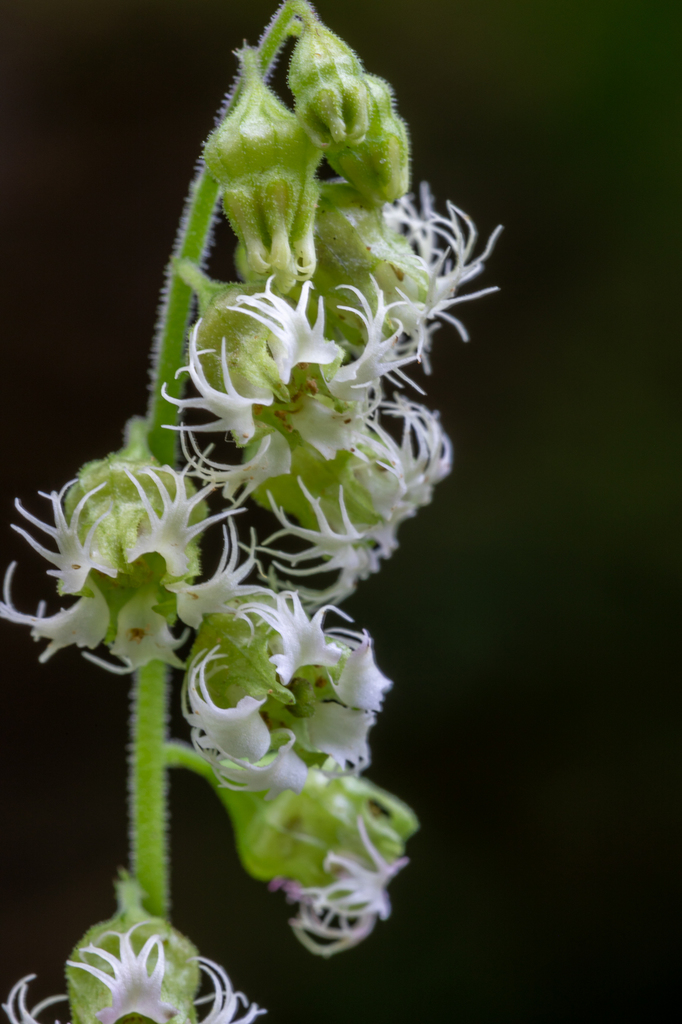
Tellima grandiflora, commonly known as Fringecups, is a herbaceous perennial plant that belongs to the Saxifragaceae family. Native to the western regions of North America, it thrives in moist woodlands, meadows, and along stream banks. The plant grows up to 60 cm tall and forms clumps with basal rosettes of large, deeply lobed leaves with toothed edges. These leaves are hairy and have a velvety texture.
In late spring or early summer, Tellima grandiflora produces tall spikes of bell-shaped flowers that are greenish-white with fringed edges. These flowers attract bees and other pollinators to the garden.
Tellima grandiflora prefers partial to full shade but can tolerate some sun if grown in moist soil. It requires well-drained soil that is rich in organic matter for optimal growth.
Fringecups have been used medicinally by Native Americans as an herbal remedy for various ailments such as coughs, colds, sore throats, and wounds due to its antibacterial properties.
Overall, Tellima grandiflora is an attractive perennial plant suitable for woodland gardens or shady borders. Its unique foliage texture and showy flowers make it an excellent addition to any garden landscape design!
Fragrant fringecup is fairly disease-resistant and generally does not tend to get illnesses. However, it can be vulnerable to pests and diseases present in its environment. These infections are typically mild. Regarding care, this plant requires moderate maintenance. Regular pruning is necessary to maintain a tidy appearance and support healthy growth. Fertilizing can also help encourage flowering. Fragrant fringecup is suitable for anyone with outdoor space, such as a garden or patio, and does not demand extensive care experience. It may need more attention when grown indoors.
How to keep Tellima Grandiflora.
Light
The fragrant fringecup does best under moderate light levels, although it can tolerate both full sun and shade. Nevertheless, too much sun or prolonged shade can hinder the plant's optimal growth. Its natural habitat reflects these light conditions.
Water
Fragrant fringecup, a plant native to shaded woodlands, thrives best in consistently moist and well-hydrated soil. To keep its foliage healthy, water it weekly, although it can withstand short periods of dryness. This versatile plant is suitable for both indoor and outdoor cultivation and is particularly well-suited for container gardening, where humidity and hydration can be easily managed.
Temperature
The fragrant fringecup plant is native to temperate regions and prefers temperatures from 41 to 95 ℉ (5 to 35 ℃). It can tolerate a broad span of temperatures within that range, though fluctuations may impact its growth. In winter it withstands cooler conditions than in summer, when it favors a warmer environment.
Fertilizer
Usually one fertilizer application in spring is adequate for Fragrant fringecup, though several feedings can optimize growth. Apply fertilizer every month to six weeks. Fertilization improves the leaves’ appearance and function, maintaining even color and a healthy texture. It also encourages root development and nutrient uptake, supporting the plant’s long-term health.
Pruning
In early spring, prune the fragrant fringecup to remove any dead growth. After the plant has finished flowering in late spring, you can prune again to shape it. Avoid heavy pruning, as this can hinder the plant's growth for the next season. Regular pruning helps improve air circulation and overall plant health. For the best practices, consult local guidelines.
Botanical profile.
- Plant Type
- Herb
- Life Cycle
- Perennial
- Genus
- Tellima
- Family
- Saxifragaceae
- Hardiness Zone
- 5-9
- Mature Height
- 40 cm to 91 cm
- Mature Spread
- 49 cm
- Leaf Color
- Green
- Leaf Type
- Evergreen, Deciduous
- Flower Color
- Green, Cream, White, Red
- Flower Size
- 1.52 cm
- Bloom Time
- Late spring, Early summer
- Planting Time
- Spring
- Harvest Time
- Mid summer
Other names.
Reader questions.
How should I water my Fragrant fringecup plant?
To properly water the Fragrant fringecup plant, it is recommended to use filtered water at room temperature. Tap water should be avoided because it can contain harmful particles. Since the Fragrant fringecup comes from a warm environment, it is best to use room temperature or slightly warm water to avoid shocking the plant's system. It is also important to not water the plant from above, as this can cause problems with the foliage. Instead, gently water the soil with filtered room temperature water until it is completely soaked. This will benefit the plant by providing moisture to the roots and helping them spread through the soil to collect necessary nutrients.
Why should I put fertilizer on my Fragrant fringecup?
The Fragrant fringecup relies on its leaves for structure and appearance. Fertilization is a key way to enhance the quality of these leaves, ensuring they maintain a vibrant color and healthy texture. Fertilization also benefits the plant beneath the soil's surface, enabling the development of new roots and maintaining existing ones. By fertilizing, you not only promote immediate health but also enhance the plant's ability to absorb nutrients from the soil in the future.
What are the sunlight requirements for Fragrant Fringecup?
Fragrant Fringecup (Tellima grandiflora) thrives in a range of sunlight conditions from partial sun (about 3-6 hours of sunlight) to full sun or full shade (above 6 hours of sunlight). It's important to observe the movement of sunlight through your garden to choose the best spots that offer a balance of light and shade, ensuring the plant's well-being. However, it's essential to avoid both overexposure to the sun and prolonged periods in deep shade, as these conditions can impair the plant's optimal growth.
What are the temperature preferences and essential care for Fragrant Fringecup?
The fragrant fringecup (Tellima grandiflora) is a plant native to temperate regions, flourishing in temperatures ranging from 41°F to 95°F (5°C to 35°C). It showcases remarkable temperature adaptability within this spectrum, although its growth could be influenced by temperature fluctuations. Winter months see the plant demonstrating strong cold resistance, eliminating the need for special frost protection measures. Nevertheless, should winter temperatures threaten to fall beneath its growth limit temperature, protective steps such as covering the plant with soil or straw are advised. To further safeguard against winter challenges, ample watering before the season's first freeze is recommended to maintain soil moisture and prevent drought stress during the colder months.
What should I do if I give my Fragrant fringecup plant too much water or too little water?
Overwatering is a more common problem for Fragrant fringecup plants and can cause wilting, yellowing of leaves, and diseases like root rot, mold, and mildew. Underwatering is less common, but can result in brittle and brown leaves. It's important to recognize signs of overwatering early and reduce watering accordingly. If the soil drains poorly, replace it with a well-draining potting mix. If the plant is not receiving enough water, increase watering until signs of dehydration are gone.
When should I fertilize my Fragrant fringecup?
If you grow your Fragrant fringecup outdoors each year, it will start to grow new leaves in early spring. This is the time to start fertilizing the plant for the year. It's usually enough to apply fertilizer once in the spring, but if you want your Fragrant fringecup to grow as much as possible, you can repeat the feeding multiple times from spring to early summer. If you choose this option, you can feed your Fragrant fringecup about once every month to a month and a half.
How can artificial lighting be used for indoor Fragrant Fringecup plants?
For indoor Fragrant Fringecup plants, artificial lighting is crucial when natural sunlight is insufficient, especially during winter or in less sunny spaces. LED lights are a popular artificial light source because they can be customized to provide specific wavelengths needed for plant growth. Full sun plants need 30-50W/sq ft, partial sun plants need 20-30W/sq ft, and full shade plants require 10-20W/sq ft of light. The artificial light source should be placed 12-36 inches above the plant, mimicking natural sunlight conditions, and the duration should match the natural daylight hours required by the species, usually 8-12 hours per day.
How does low temperature affect Fragrant Fringecup and what are the recommended solutions?
Fragrant fringecup is notably cold-tolerant, preferring temperatures above its specific suitable growth minimum. When winter temperatures drop below its growth limit, the plant may not show immediate visible changes but could experience reduced or nonexistent sprouting come spring. The recommended approach to address this issue involves the removal of any non-sprouting parts as the warmer spring weather begins.
How often should I give water to my Fragrant fringecup plant?
If your Fragrant fringecup is in a pot, you can determine if it needs water by sticking your finger into the soil. If the first two to three inches of soil are dry, it's time to water it. If your Fragrant fringecup is outdoors in the ground, you can use the same method to test the soil. Again, if the first few inches of soil have dried out, it's time to water it. Generally, during the spring and early fall, you'll need to water this plant about once a week using this method. However, during extremely hot weather, you may need to increase watering to about twice a week or even more. It's worth noting that mature, well-established Fragrant fringecup plants have a good ability to withstand drought.
When is it not a good idea to add fertilizer to my Fragrant fringecup plant?
During the late fall and winter, your Fragrant fringecup will become dormant and stop producing new growth. Therefore, it is not recommended to fertilize it during this period. In spring and summer, if you choose to fertilize, you should reduce the amount as summer approaches because the growth rate of your Fragrant fringecup will also slow down. It is never a good idea to fertilize your Fragrant fringecup during very hot weather or when the soil is extremely dry, as this can stress the plant and cause it to die before its time.
What are the symptoms of light deficiency in Fragrant Fringecup?
Symptoms of light deficiency in Fragrant Fringecup include smaller new leaves, leggy or sparse growth, faster leaf drop, slower or no new growth, lighter-colored new leaves, chlorosis (yellowing of leaves), sunscald, leaf curling, wilting, and leaf scorching. These symptoms indicate the plant's struggle with insufficient light, leading to reduced chlorophyll and essential nutrients, stretching for light, or damage from excessive sunlight exposure.
What should be done if Fragrant Fringecup is exposed to high temperatures?
During the warmer summer months, it is crucial to ensure that fragrant fringecup remains below its suitable growth maximum temperature. Exceeding this limit might result in the plant exhibiting symptoms such as leaf discoloration, curling, susceptibility to sunburn, and in extreme cases, wilting and dryness. In response to such conditions, one should trim away the sunburned and dried parts of the plant. Relocating the plant to a shaded area during the peak sun of midday and afternoon or employing a shade cloth can offer relief. Additionally, watering the plant in the morning and evening will help keep the soil suitably moist.