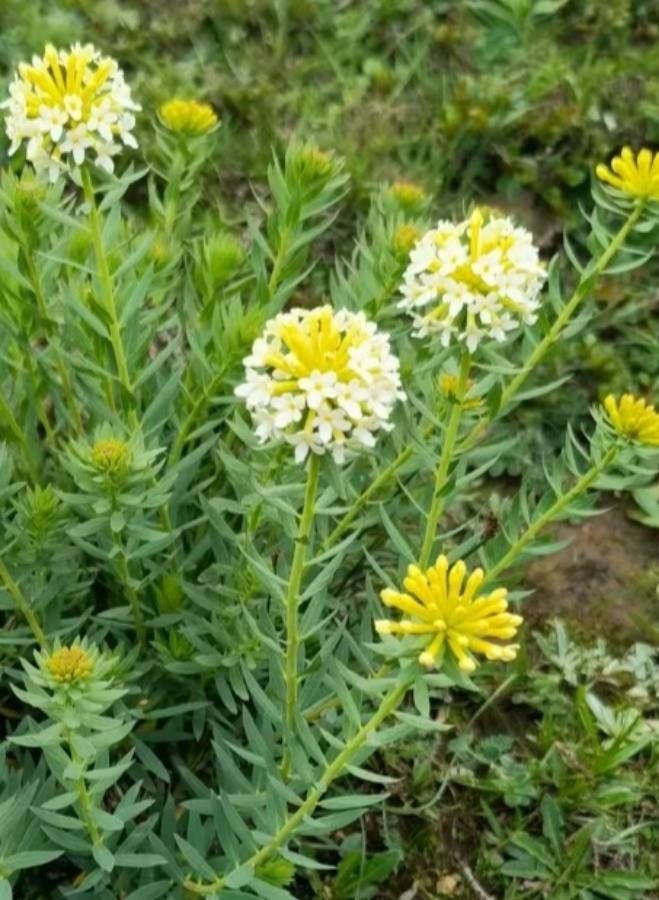
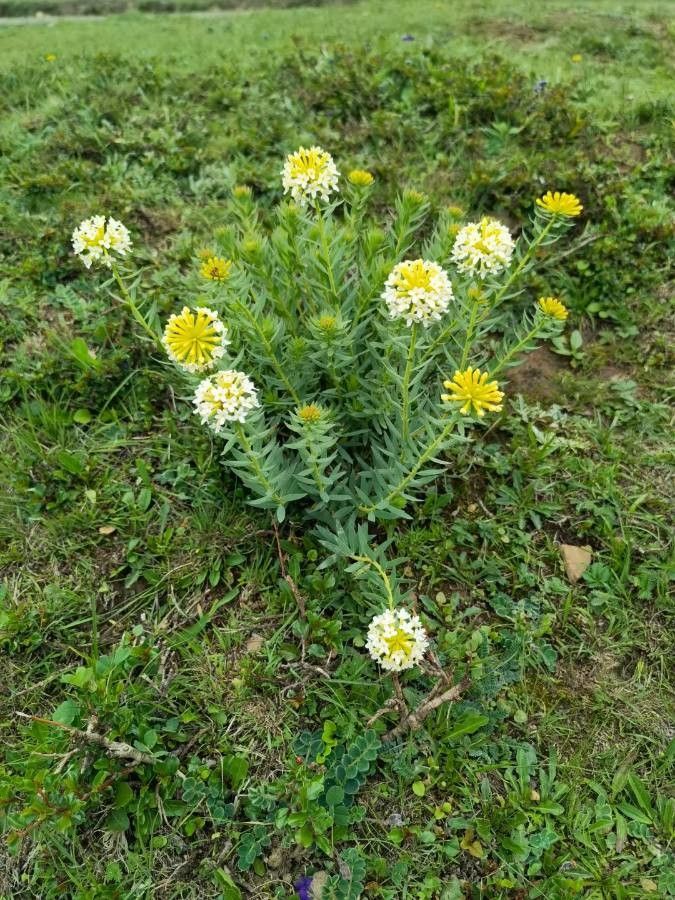
Stellera is a genus of flowering plant in the family Thymelaeaceae, with a single species Stellera chamaejasme found in mountainous regions of Central Asia, China, Siberia and South Asia. S. chamaejasme is a herbaceous perennial plant with heads of white, pink or yellow flowers, grown as an ornamental plant in rock gardens and alpine houses, but considered a weed playing a rôle in the desertification of grasslands in parts of its native range. Like many others of its family, it is a poisonous plant with medicinal and other useful properties.
Himalayan stellera is fairly disease-resistant and generally does not develop many illnesses. However, it can be vulnerable to pests and diseases present in its environment. These problems are typically minor. In terms of care, the plant requires moderate maintenance. It should be pruned regularly to preserve a neat appearance and encourage healthy growth. Fertilizing can also help stimulate flowering. Himalayan stellera is suitable for anyone with outdoor space, such as a garden or patio, and does not need extensive care experience. It may demand more attention when grown indoors.
How to keep Stellera Chamaejasme.
Light
Himalayan stellera tends to tolerate continual exposure to the sun. Coming from sunny habitats, it does best when in direct, unfiltered sunlight. Although it can endure lower light levels, insufficient sun or prolonged shade can hinder its healthy growth.
Water
The Himalayan stellera is well-suited to high-altitude environments, where it endures significant temperature fluctuations and occasional moisture stress. This plant prefers moderate hydration and should be watered weekly. As an herbaceous perennial, it efficiently makes use of rainwater during its growing season, allowing it to stay hydrated even in cooler climates.
Temperature
Himalayan stellera is a plant native to high-altitude environments that requires specific temperature conditions. It does best in a temperature range of 41 to 90 °F (5 to 32 ℃). Temperature adjustments should be made in extreme seasons to ensure its growth.
Fertilizer
The best time to fertilize a Himalayan stellera is in early spring, when it is coming out of dormancy and starting active growth. Fertilizing supplies essential nutrients for healthy development. Although Himalayan stellera has relatively low fertilizer requirements, an annual application can improve its survival and encourage healthier, longer-lasting blooms.
Pruning
To ensure the optimal health of Himalayan stellera, it is important to prune the plant annually, ideally between early and late spring. Begin by removing any dead or diseased wood and shape the plant to improve air circulation and encourage strong blooms. Always use clean, sharp tools to prevent damage and the spread of disease.
Botanical profile.
- Plant Type
- Herb
- Life Cycle
- Perennial
- Genus
- Stellera
- Family
- Thymelaeaceae
- Hardiness Zone
- 4-8
- Mature Height
- 20 cm to 49 cm
- Mature Spread
- 37 cm to 46 cm
- Leaf Color
- Green, Dark Green
- Leaf Type
- Semi-evergreen
- Flower Color
- White, Yellow, Pink, Purple, Red
- Flower Size
- 1.02 cm to 1.52 cm
- Bloom Time
- Mid spring, Late spring, Early summer
- Planting Time
- Spring, Summer
- Harvest Time
- Summer
- Native Area
- Russia, Nepal, India, Mongolia, Koppen, Bhutan, Pakistan, South Korea, China
Other names.
Reader questions.
How should I water my Himalayan stellera?
To properly water the Himalayan stellera, it is best to use filtered water at room temperature. Tap water may contain harmful particles, so filtering is preferable. Since the plant originates from warm environments, it is important to use water that is at room temperature or slightly warmer to avoid shocking the plant. Additionally, overhead watering should be avoided as it can cause problems with the foliage. Instead, you should directly water the soil with filtered room temperature water until it is fully saturated. This method benefits the plant by keeping the roots moist and helping them spread through the soil to gather necessary nutrients.
What are the sunlight requirements for Himalayan stellera?
The Himalayan stellera requires above 6 hours of sunlight daily to flourish, making full sun conditions ideal for its growth. It is a plant that thrives in environments that receive unfiltered solar rays. While it can survive in less sunny conditions, inadequate sunlight or persistent shade can negatively impact its growth. Observing how sunlight moves through your garden and selecting spots that offer a good balance of light and shade will ensure the plant's happiness and health.
What is Himalayan stellera and where is it native to?
Himalayan stellera, botanically known as Stellera chamaejasme, is a plant native to high altitude environments. It thrives in specific temperature conditions, typically within a range of 41 to 90 °F (5 to 32 °C). This plant exhibits strong cold resistance, an adaptation to its natural high-altitude habitats, making it a unique addition to diverse garden settings.
What do I need to do if I give my Himalayan stellera plant too much or too little water?
Taking care of your Himalayan stellera requires finding the right balance when it comes to watering. While both overwatering and underwatering can harm your plant, overwatering is more common and can lead to wilted, yellow leaves and even diseases like root rot. Underwatering is less likely but can cause brittle, brown leaves. Pay attention to the signs of overwatering and act quickly by reducing watering and improving soil drainage if needed. If you notice signs of underwatering, simply increase the frequency of watering until the plant recovers.
What should I do if my indoor Himalayan stellera isn't getting enough natural sunlight?
If your indoor Himalayan stellera is not receiving adequate natural sunlight, particularly during winter or in less sunny spaces, using artificial lights can be an effective solution. Artificial lighting promotes faster, healthier growth by providing the necessary light spectrum. LED lights are recommended due to their ability to offer specific wavelengths needed by plants. Full sun plants should have 30-50W/sq ft, partial sun plants 20-30W/sq ft, and full shade plants 10-20W/sq ft of artificial light. The light source should be placed 12-36 inches above the plant, mimicking natural sunlight, and be kept on for 8-12 hours per day to simulate the natural length of daylight.
What are the optimal temperature conditions for Himalayan stellera?
The optimal temperature range for the growth of Himalayan stellera is between 41 to 90 °F (5 to 32 °C). This broad range allows the plant to accommodate various seasonal changes without requiring extreme adjustments. However, during periods of extreme temperatures, certain measures should be taken to ensure the plant remains within this ideal temperature spectrum for optimal growth.
How frequently do I need to water my Himalayan stellera?
To determine if your potted Himalayan stellera plant needs watering, simply insert your finger into the soil. If you find that the top two to three inches of soil are dry, it's time to water. The same method applies if you have planted the Himalayan stellera outdoors in the ground. Once again, check if the top few inches of soil are dry before watering. Generally, watering once a week is sufficient during spring and early fall. However, during hot weather, you might need to water your plant twice per week or even more. It's worth noting that mature and well-established Himalayan stellera plants have a remarkable ability to tolerate drought.
What are the signs that my Himalayan stellera isn't getting enough light?
When the Himalayan stellera does not receive enough light, several symptoms may appear, including small and lighter-colored new leaves, leggy or sparse growth, faster leaf drop, slower or halted growth, and conditions like chlorosis and sunscald. Chlorosis is characterized by leaves losing their green color and turning yellow due to the breakdown of chlorophyll. Sunscald presents as pale, bleached, or necrotic areas on the plant tissue caused by intense sunlight exposure. Other symptoms like leaf curling, wilting, and leaf scorching can occur due to extreme sunlight or inadequate sunlight conditions, each affecting the plant's health and appearance.
How should Himalayan stellera be protected during extreme winter conditions?
In anticipation of extreme winter conditions where temperatures may drop below the plant's cold tolerance limit, it's advisable to provide additional cold protection. This can be achieved by covering the Himalayan stellera with protective materials such as soil or straw to insulate it against the cold. Moreover, watering the plant abundantly before the first freeze in autumn helps the soil stay moist and freeze, a condition that supports the plant's needs during winter and early spring by preventing drought and water scarcity.
How much water does my Himalayan stellera plant require?
When watering your Himalayan stellera, don't be afraid to give it a generous amount of water. Make sure the first two to three inches of soil are dry before watering, and when you do, give it a thorough watering, enough to completely saturate the soil. You'll know you've added enough water when you see excess water flowing out of the drainage holes at the bottom of the pot. If no water is draining out, then you probably haven't watered enough. However, be careful not to let water accumulate in the soil, as this can harm the plant. Also, if water is not draining properly from the pot, it might indicate that the soil doesn't drain well, which is not good for the plant's health. If the plant is outside, it will typically only need about 1 inch of rain per week.
How can I improve the growth of my Himalayan stellera if it's not receiving enough sunlight?
To improve the growth of your Himalayan stellera that's not receiving enough sunlight, gradually move it to a location where it can get at least 6 hours of direct sunlight daily. For indoor plants, using a south-facing window and keeping curtains open during the day maximizes sunlight exposure. If the plant is large or not easily movable, consider utilizing artificial light, keeping a desk or ceiling lamp on for at least 8 hours daily or investing in professional plant grow lights. For outdoor plants, gradually moving them to sunnier spots each week helps them adapt without causing sunburn. If trees block sunlight, pruning branches and leaves may increase sun exposure. Transplanting smaller plants during their dormant period to a location with ample sunlight and good drainage can also benefit growth.
What are the symptoms of low temperature stress on Himalayan stellera, and how can it be managed?
Despite its cold tolerance, when temperatures fall below the plant's lower growth limit, you may not notice immediate changes. However, there could be a decrease in sprouting or no sprouting at all during the spring. To manage this, it is recommended to remove any parts of the plant that fail to sprout once spring arrives. This helps encourage new growth and maintains the health of the plant.