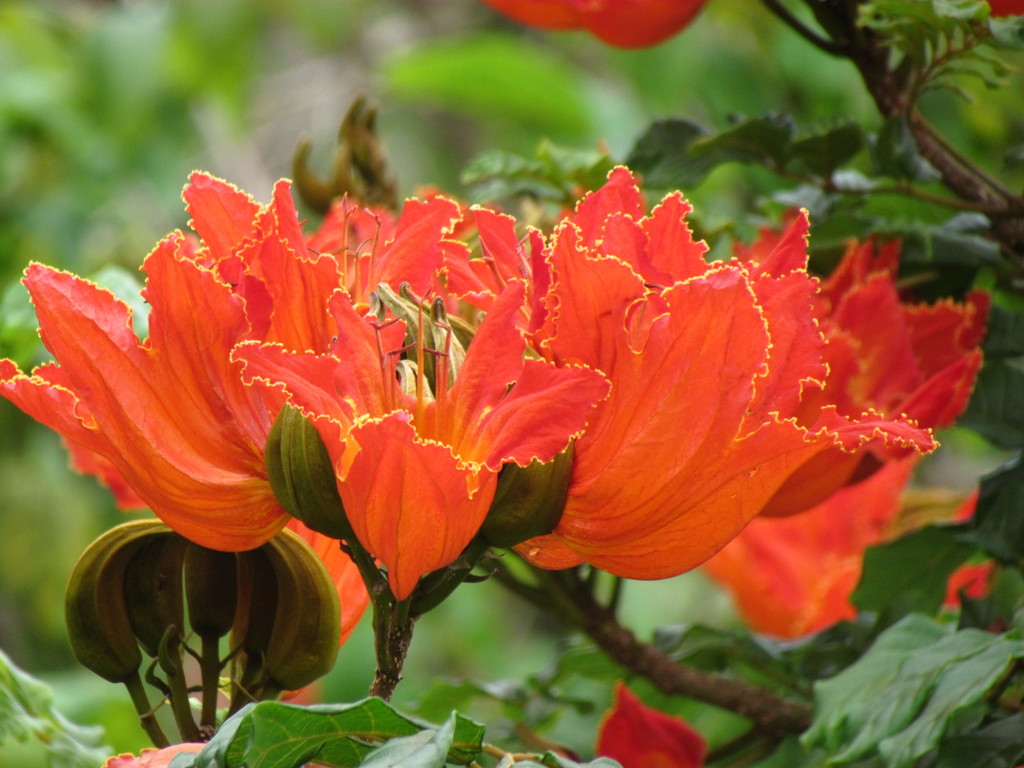
Spathodea campanulata, commonly known as the African tulip tree, is a large, fast-growing evergreen tree native to tropical Africa. Belonging to the Bignoniaceae family, it can reach up to 25 meters in height and boast a trunk diameter of up to 1.5 meters.
The African tulip tree features large, glossy green leaves arranged oppositely along its branches. Its trumpet-shaped flowers, ranging in color from bright orange-red to scarlet red with yellow tips, bloom in clusters at the ends of branches during spring and summer.
Widely cultivated as an ornamental plant, the African tulip tree is prized for its striking flowers and attractive foliage. Additionally, it possesses medicinal properties; its bark can be used to treat various ailments, including fever, malaria, dysentery, and diarrhea.
The flowers of the African tulip tree are known for attracting hummingbirds, which feed on their nectar. However, after it rains, many other birds visit these trees. The cup-shaped flowers collect rainwater and morning dew, providing convenient watering sources high in the forest canopy. In contrast, the tree's fruit is poisonous, and some African hunters use it to coat their arrows. FUN FACT · FROM THE LIBRARY
However, it is important to note that this plant can have negative impacts on ecosystems where it has been introduced beyond its native range. Its invasive nature threatens biodiversity by outcompeting native species for resources such as light and water.
In summary, Spathodea campanulata is a beautiful yet potentially problematic plant species. While it offers significant benefits for humans, it can negatively impact ecosystems outside of Africa, where it originates.
The African tulip tree gets its name from its native habitat in Africa and its tulip-shaped flowers. Despite the resemblance, it is not related to the tulip plant. The vibrant red or orange flowers have also earned it other names, such as Nandi Flame or Flame of the Forest.
The African tulip tree possesses strong disease resistance and is generally unlikely to suffer from illnesses. Regarding care, this species is fairly low-maintenance. When grown outdoors it needs only light watering, and mature specimens typically do not require pruning. Smaller plants, however, should be trimmed after they finish blooming. The African tulip tree is appropriate for anyone with an outdoor area, such as a garden or deck, and does not demand extensive gardening experience.
How to keep Spathodea Campanulata.
Light
The African tulip tree does best in strong sunlight all day but can also tolerate moderate light levels. It comes from the equatorial forest canopy, which indicates it benefits from extended periods of sun. Excessively intense light can scorch its leaves, whereas too little light can restrict its growth and flowering.
Water
The African tulip tree, native to tropical regions of Africa, thrives in areas with high humidity and consistent moisture. However, it is important to avoid waterlogging the soil. Water the tree every 1 to 2 weeks, allowing the soil to dry out slightly between waterings. This tree is often grown outdoors and flourishes in rainfall patterns similar to those of its native environment, which promotes its health and growth.
Humidity
This plant will thrive in moderate humidity, which is probably the level in your home. However, misting it a few times a week can be very beneficial. Make sure the room has good ventilation.
Temperature
The African tulip tree needs a warm setting, naturally occurring in tropical and subtropical zones. Its ideal temperature range is 68 to 105℉ (20 to 41℃). In summer, maintain a steady temperature with minimal fluctuations. In cooler months, set the temperature to 50 to 68℉ (10 to 20℃) to promote optimal growth.
Fertilizer
The best time to fertilize an African tulip tree is in early spring, as it comes out of dormancy. This encourages overall growth and supports flower development. Fertilization improves the foliage, stems, and branches, while encouraging large, vibrant, and long-lasting flowers. It helps transfer nutrients from the roots to the flowers and enhances the plant's health and resistance to disease.
Pruning
To keep the African tulip tree looking vibrant, prune it between early and late winter. Focus on removing dead or crossing branches. Thinning out dense growth helps improve air circulation and allows more sunlight to reach the inner branches. Regular maintenance not only enhances flowering but also boosts the tree’s overall vigor, ensuring it remains stable and attractive.
Pot & Repot
When repotting an African tulip tree, pick a pot 1–2 inches (2.5–5.1 cm) larger with ample drainage. Use a well-draining potting mix. Repot in spring or fall, making sure the root ball sits slightly lower than the rim of the flower pot. Water thoroughly after repotting and place in a warm spot with indirect sunlight.
Botanical profile.
- Plant Type
- Tree
- Life Cycle
- Perennial
- Genus
- Spathodea
- Family
- Bignoniaceae
- Hardiness Zone
- 10-13
- Mature Height
- 7.01 m to 24.99 m
- Mature Spread
- 10.36 m to 14.94 m
- Leaf Color
- Green, Blue
- Leaf Type
- Evergreen
- Flower Color
- Red
- Flower Size
- 5.08 cm to 6.35 cm
- Bloom Time
- Early spring, Mid spring, Fall, Winter
- Planting Time
- Spring, Autumn
- Harvest Time
- Spring, Mid fall, Late fall, Winter
- Native Area
- Angola, Sudan, Zambia, Rwanda, Nigeria, Guinea, Gabon, Guinea-Bissau, Kenya, Uganda, Tanzania, Benin, Central African Republic, Sierra Leone, Equatorial Guinea, Cameroon, Liberia, Burundi, Togo, Ghana, Senegal, Côte d'Ivoire, Congo (DRC), Congo
Other names.
Reader questions.
How should I water my African tulip tree?
You can water your African tulip tree using any common watering tool. This includes watering cans, hoses, or even cups. It's important to apply the water directly to the soil and make sure all areas are evenly moistened. Using filtered water is recommended as tap water may have harmful particles. It's also best to use water that is at or slightly above room temperature since extremely cold or hot water can shock the tree. However, the African tulip tree generally responds well to any type of water.
Why is it important to put fertilizer on my African tulip tree?
Ensuring the overall health and well-being of your African tulip tree relies heavily on proper fertilization. By providing the right balance of energy and nutrients, your tree will develop lush foliage and strong stems and branches. More specifically, fertilization plays a crucial role in the growth of vibrant and long-lasting flowers, which are highly valued by gardeners. This is achieved by enabling the efficient transfer of fuel from the roots to the flowers through the stems. Additionally, proper fertilization promotes the tree's overall health, making it more resistant to diseases.
What are the sunlight requirements for African Tulip Tree?
The African Tulip Tree requires full sun exposure of above 6 hours of sunlight daily for optimal growth, but it can also survive under partial sun conditions, receiving about 3-6 hours of sunlight. It's crucial to observe the sunlight's movement through your garden to find spots that offer a healthy balance of light and shade for your plants. This ensures they thrive by getting just the right amount of sunlight needed for their growth while avoiding potential harm from too much direct exposure.
What are the essential care requirements for an African Tulip Tree?
The African tulip tree thrives in warm, tropical, and subtropical environments, requiring temperatures between 68 to 105°F (20 to 41°C) for optimal growth. During summer, it's crucial to maintain these temperature conditions consistently, while in cooler months, adjusting the temperature to 50 to 68°F (10 to 20°C) promotes healthier development. The tree is extremely heat-loving and sensitive to cold, which can be damaging. Thus, in autumn, it's recommended to move outdoor-grown African tulip trees indoors, positioning them near a bright window but away from direct heat sources to ensure temperatures stay above 20°C during winter. It's important to avoid exposure to temperatures closer to 5°C to protect the plant's well-being.
What should I do if I give my African tulip tree too much or too little water?
Outdoor plants, especially newly planted ones or seedlings, are prone to lack of watering. It's important to remember to water them enough for the first few months, when the tree is small or recently planted. This is because once the roots are established, African tulip trees can rely on rain most of the time. When African tulip trees are planted in pots, overwatering is more likely. If you accidentally overwater your African tulip tree, there are steps you can take to remedy the situation. First, stop watering the plant immediately to minimize the impact of overwatering. Then, remove the tree from its pot and check the roots for any signs of root rot. If there is no root rot, you can return the tree to its pot. However, if there are signs of root rot, trim away the affected roots and apply a fungicide to prevent further damage. Finally, repot the tree in well-draining soil. On the other hand, if the African tulip tree is underwatered, simply water it more frequently. Underwatering is usually easy to fix - if the leaves droop, dry out, and fall off, they will quickly return to normal after sufficient watering. Make sure to adjust your watering frequency as soon as you notice underwatering.
When should I put fertilizer on my African tulip tree?
The best time to fertilize an African tulip tree is in early spring when the plant is coming out of dormancy and preparing to bloom. This will provide the tree with extra energy for growth and flower development. However, fertilizing can also be done in the fall, although a smaller amount is needed. Some gardeners choose to fertilize when planting the tree, but it's not always necessary.
What are the essential care tips for African Tulip Trees?
African Tulip Trees prosper under intense sun exposure but can manage moderate illumination as well, mimicking their natural equatorial forest canopy habitat. They benefit from prolonged sunlight hours; however, excessive light can damage their leaves, and insufficient sunlight can impede their growth and flowering. Indoor plants may require artificial lighting, especially in less sunny spaces or during winter. LED lights are often recommended for indoor plants, needing 30-50W/sq ft for full sun plants, 20-30W/sq ft for partial sun plants, and 10-20W/sq ft for full shade plants. The artificial light should be placed 12-36 inches above the plant for 8-12 hours per day to ensure optimal growth.
How should you care for an African Tulip Tree when temperatures drop?
When temperatures fall, it's essential to protect the African tulip tree, which thrives above 20°C and must be kept above 5°C during winter to avoid cold damage. Exposure to temperatures below 1°C can cause the leaves to lighten in color, and after frost damage, leaves may turn brown or black with symptoms like wilting and drooping appearing. To care for a cold-affected tree, trim off the frost-damaged parts and move it to a warm indoor environment. Placing the plant near a south-facing window ensures it receives enough sunlight while keeping it away from heaters or air conditioning vents to avoid overly dry air.
How frequently should I water my African tulip tree?
To ensure proper growth, most outdoor plants can rely on rainfall. However, if your area doesn't receive enough rain, you should water them adequately every 2 weeks in the spring and fall. In the summer, when plants require more water, you'll need to water them more frequently. During winter, when growth slows down and plants need less water, you can water them sparingly or not at all. If you have a young or newly planted African tulip tree, you'll need to water it more frequently to help it establish and grow. For potted plants, there are two main ways to determine the watering schedule for your African tulip tree. One approach is to set a predetermined schedule, such as watering once a week or once every other week. However, this may not be effective because it doesn't consider the specific conditions of your plant's environment. Another option is to assess soil moisture. Wait until the top two to four inches of soil (around 1/3 to 1/2 depth of the pots) have completely dried out before watering again. Keep in mind that during summer, when the plant's water needs are highest, a predetermined schedule may not be sufficient.
When is the wrong time to fertilize my African tulip tree?
During the winter, African tulip trees are in a dormant phase and do not require fertilization. This is because they do not need much energy from the soil to develop new growth at this time. It is not recommended to fertilize during winter, as overfertilization can lead to negative outcomes. The best times to feed an African tulip tree are during early spring and fall. Therefore, for most of the spring and summer, fertilization is not necessary. Additionally, if the plant is experiencing excessively hot or dry conditions, it is advisable to delay feedings.
What are common symptoms of insufficient sunlight in African Tulip Trees?
When African Tulip Trees do not receive enough light, they may exhibit several symptoms: new leaves may grow smaller, the plant might show leggy or sparse growth, and there could be faster leaf drop as the plant tries to conserve resources. Growth may slow down or stop, and new leaves might appear lighter in color, indicating a lack of essential nutrients. Other symptoms include chlorosis, or yellowing of leaves, due to the breakdown of chlorophyll, sunscald on leaves or stems, leaf curling as a defense mechanism, wilting due to loss of turgor pressure, and leaf scorching characterized by brown, dry edges on leaves.
What steps should be taken if an African Tulip Tree is exposed to high temperatures?
During the summer, it's important to ensure that the African tulip tree's surroundings do not exceed 41°C to prevent the plant from heat damage. If temperatures go beyond 45°C, the leaves may lighten in color and the plant becomes more vulnerable to sunburn. The care procedure involves trimming away sunburned and dried-up parts, then moving the plant to a shaded area during the peak sun hours. Also, watering the plant in the morning and evening will help keep the soil moist and support its recovery from exposure to high temperatures.