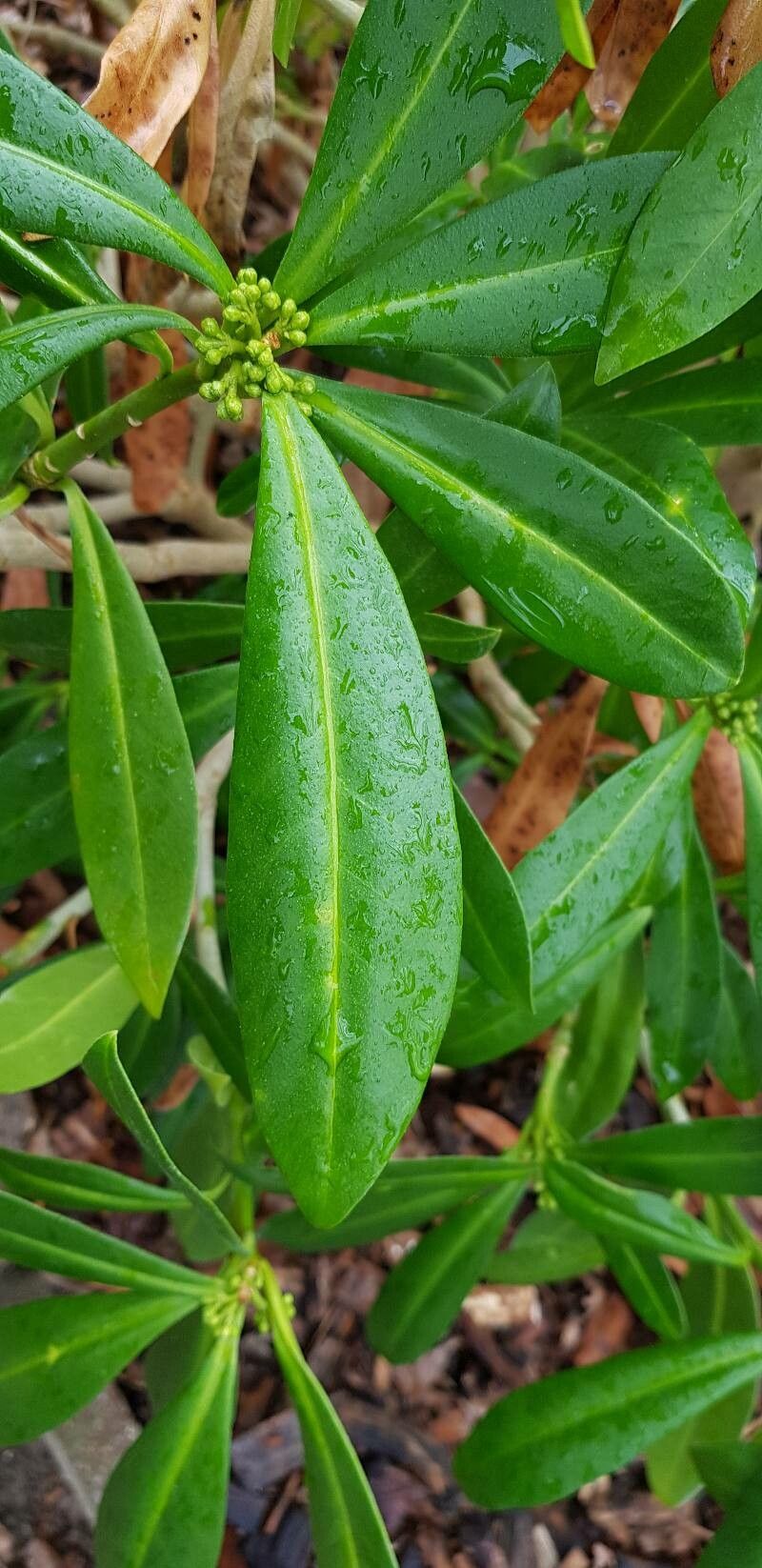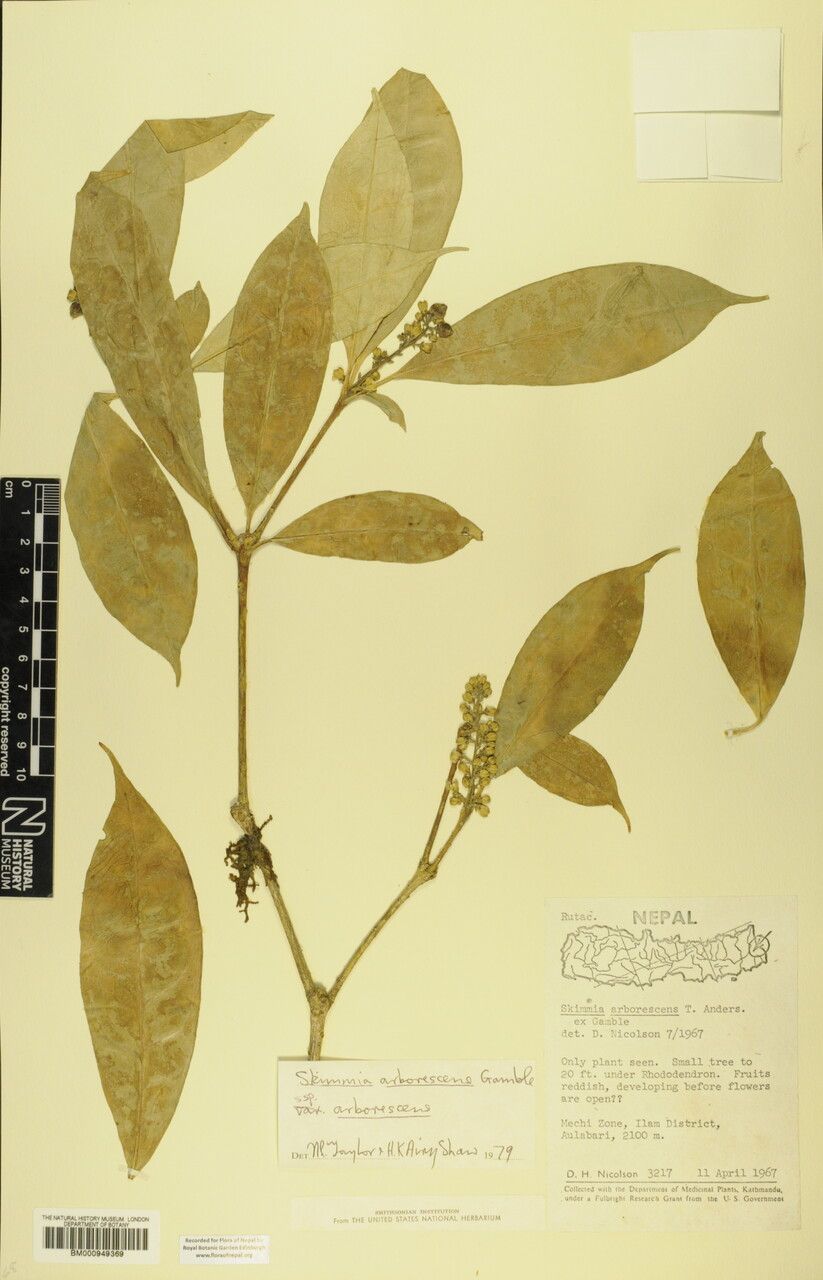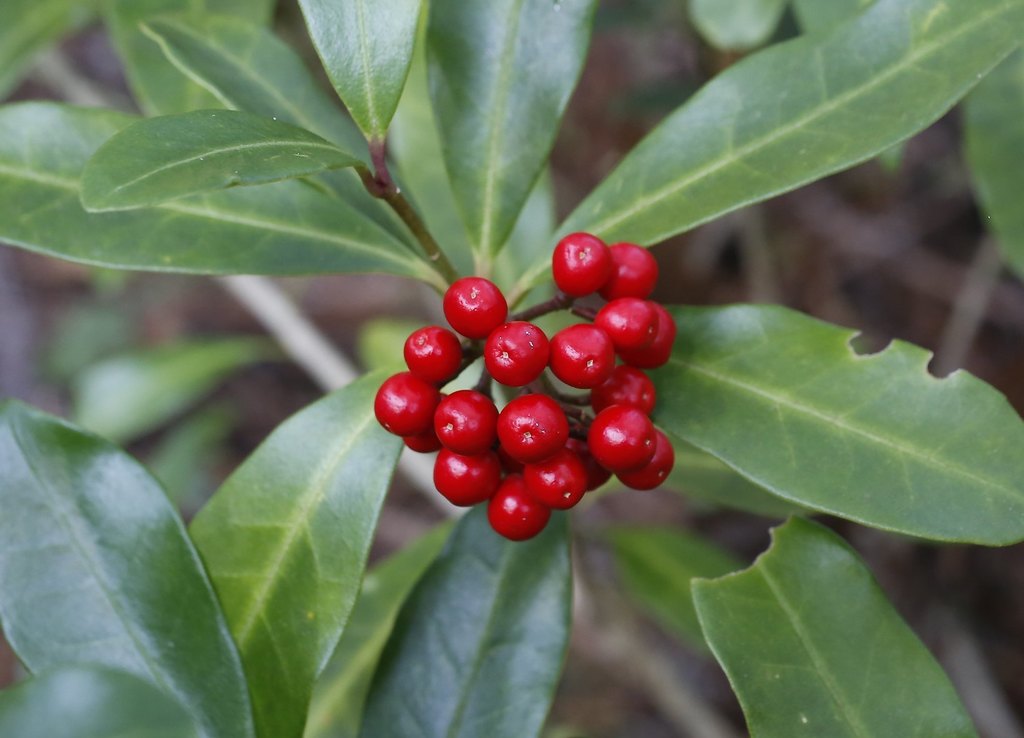
Skimmia japonica, the Japanese skimmia, is a species of flowering plant in the family Rutaceae, native to Japan, China, and Southeast Asia. Growing to 6 m (20 ft) tall and wide, it is a rounded evergreen shrub with glossy, leathery leaves. It is widely cultivated as an ornamental plant in gardens and parks. Its fragrant flowers are cream-yellow or white, followed on female plants by small, round, red fruits. The plant tolerates a wide range of conditions, including frost, drought, and atmospheric pollution. It is suitable for bonsai and for Chinese gardens. Many cultivars have been developed for ornamental garden use, including varieties which are significantly more compact than their parents. These cultivars have gained the Royal Horticultural Society's Award of Garden Merit:-
The Japanese skimmia derives its common English name from its Japanese name, 'miyami shikimi'. In Japanese, the word 'shikimi' or 'ashiki-mi' translates to 'a bad, poisonous, or harmful fruit', which applies to all plants within the Skimmia genus.
Japanese skimmia is resistant to disease and generally not prone to illnesses. As for care, this plant is relatively low-maintenance. When grown outdoors it needs only minimal watering, and larger specimens typically do not require pruning. Smaller plants, however, should be pruned after they have finished blooming. Japanese skimmiat is suitable for anyone with an outdoor area, such as a garden or deck, and does not demand extensive gardening experience.
How to keep Skimmia Japonica.
Light
Japanese skimmia prefers moderate light but can also tolerate areas with limited daylight. Its native environment, which offers abundant yet sheltered light, has a strong effect on its growth. Excessive sun can damage the plant, while insufficient light can impede its development.
Water
Japanese skimmia flourishes in moist woodland environments, preferring soil that remains consistently damp. To prevent over-saturation, water the plant every 1-2 weeks. Often cultivated for its evergreen features, Japanese skimmia benefits from the application of mulch, which helps to retain moisture and mimic its natural habitat.
Humidity
This plant will thrive in moderate humidity, which is probably the level in your home. However, misting it a few times a week can be very beneficial. Make sure the room has good ventilation.
Temperature
Japanese skimmia thrives in cooler environments and is native to regions where the usual temperatures range from 50 to 89.6 °F (10 to 32 ℃). To encourage healthy growth, keep temperatures within this range and adjust appropriately for seasonal fluctuations.
Fertilizer
The timing of fertilizing Japanese skimmia is important. Feed it in early spring and continue monthly through early summer. Fertilizer encourages attractive blooms and gives the plant energy during both dormancy and active growth.
Pruning
Japanese skimmia does not require heavy pruning because they have a compact growth habit and keep themselves tidy on their own. Only prune as needed to form the shrub and remove stray branches. Pruning should be done when the plant is dormant in the winter.
Pot & Repot
Japanese skimmia is a compact, evergreen shrub that requires repotting every 2 to 3 years. The best time for this is early spring. Choose a slightly larger pot with good drainage to accommodate its growth. After repotting, place the plant in a spot with dappled light and ensure it receives consistent moisture. However, be careful not to overwater, as this can affect its growth and health.
Botanical profile.
- Plant Type
- Shrub
- Life Cycle
- Perennial
- Genus
- Skimmia
- Family
- Rutaceae
- Hardiness Zone
- 6-7
- Mature Height
- 6.1 m
- Mature Spread
- 6.1 m
- Leaf Color
- Green
- Leaf Type
- Evergreen
- Flower Color
- White
- Flower Size
- 2.54 cm
- Bloom Time
- Mid spring, Late spring
- Planting Time
- Spring, Autumn
- Harvest Time
- Early spring, Mid spring, Mid summer, Late summer, Fall, Winter
- Native Area
- Japan, China
Other names.
Reader questions.
How should I water my Japanese skimmia?
Your Japanese skimmia isn't too picky about how you water it. You can use any common watering tool like cans, hoses, or even cups. Just make sure to water the soil directly and evenly, so all parts of the root system get enough water. It's better to use filtered water, as tap water may have harmful particles. Also, try to use water at or slightly above room temperature, as very cold or hot water can shock the plant. However, the Japanese skimmia generally does well with any type of water.
Why should I use fertilizer on my Japanese skimmia plant?
To make sure your Japanese skimmia thrives, fertilizing is crucial for a few reasons. Firstly, it will promote beautiful blooms. Applying fertilizer in early spring is especially beneficial for achieving spectacular flowers during that season. Moreover, fertilizer provides your skimmia with ample energy that it can store in the ground while it is dormant. Adding extra nutrients during fall planting or late spring enables your skimmia to store more energy for when it resumes active growth.
What are the sunlight requirements for Japanese skimmia?
Japanese skimmia requires moderate sunlight but can adapt to areas with less daylight, reflecting its natural habitat which provides ample yet filtered light. It thrives in conditions of partial sun, receiving about 3-6 hours of sunlight daily. Full shade areas, with less than 3 hours of sunlight, are also suitable. However, it's crucial to observe the movement of sunlight through your garden to find spots that offer a balanced light environment for your plants, considering overexposure to sunlight can be harmful while too little light may impede growth.
What is the ideal climate for Japanese skimmia?
Japanese skimmia, or Skimmia japonica, thrives best in cooler environments and is native to regions where temperatures typically range between 50 to 89.6 °F (10 to 32 °C). This plant is highly cold-tolerant and does not require additional frost protection measures during winter. However, it is important to water the plant generously before the first freeze in autumn to ensure the soil remains moist and enters a frozen state, helping to prevent drought and water scarcity for the plant during the colder months.
If I give my Japanese skimmia too much or too little water, what can I do?
When caring for outdoor plants, especially newly planted ones or seedlings, it's important to ensure they receive enough water. This is particularly crucial during the first few months when the plant is small or recently planted. Once the roots are established, Japanese skimmia can generally rely on rainfall. If you have potted Japanese skimmia plants, be cautious as overwatering is a common issue. In the event that you accidentally overwater them, there are steps you can take to address the situation. Firstly, stop watering the plant immediately to minimize the impact of overwatering. Secondly, consider removing the plant from its pot to examine the roots. If no root rot is found, you can return the plant to the container. However, if root rot is present, trim the affected roots and apply a fungicide to prevent further damage. Finally, repot the Japanese skimmia in well-draining soil. In the case of underwatered Japanese skimmia, the solution is relatively simple. If the plant is lacking water, its leaves may droop, dry out, and fall off. Providing sufficient watering will quickly restore the leaves to their normal state. It's important to adjust your watering frequency promptly once you notice underwatering occurring.
When should I add fertilizer to my Japanese skimmia plant?
To ensure effective fertilization of Japanese skimmia, timing is crucial. It is important to avoid applying fertilizer too early, while the plant is still dormant, as this can result in ineffective use and wastage. Therefore, the first application of fertilizer should be done in early spring. To promote healthy growth, continue fertilizing monthly until early summer.
How can artificial lighting benefit indoor Japanese skimmia plants?
For indoor Japanese skimmia plants, when natural sunlight is inadequate, especially during winter or in spaces with limited sunlight, artificial lighting becomes essential. It supports optimal growth by compensating for the lack of natural light, encouraging faster and healthier development. LED lights are recommended for their ability to mimic the specific light wavelengths plants need. The requirements vary with the type of plant: full sun plants need 30-50W/sq ft, partial sun plants 20-30W/sq ft, and full shade plants 10-20W/sq ft. Position the light source 12-36 inches above the plant and ensure it receives 8-12 hours of light per day to emulate natural sunlight conditions.
What should I do if my Japanese skimmia experiences temperatures below -25°C?
If the winter temperature drops below -25°C, Japanese skimmia, which is known for its cold tolerance, may not show immediate signs of stress. However, its branches could become brittle and dry by spring, potentially failing to produce new shoots. In such cases, you should prune away any dead branches that have failed to produce new leaves come spring to help encourage new growth.
How often should I pour water on my Japanese skimmia?
Most plants grow naturally with rainfall, but if your area doesn't get much rain, you'll need to water them every 2 weeks in the spring and fall, and more often in the summer. In winter, water less because plants grow slower and need less water. Japanese skimmia plants need more watering when they're young or newly planted, so they can establish and become drought tolerant. For potted plants, there are two ways to decide how often to water the Japanese skimmia. One way is to stick to a set schedule, like once a week or every other week. But this might not work if your plant needs specific conditions. Another approach is to check the soil moisture. Wait until the top 2 to 4 inches of soil have dried out before watering again.
When should I not add fertilizer to my Japanese skimmia?
To ensure optimal growth and blooming of Japanese skimmia, it is important to take a few factors into consideration when applying fertilizer. Firstly, avoid using a fertilizer with high nitrogen content as it may encourage excessive leaf growth at the expense of bloom development. Instead, choose a fertilizer with a lower nitrogen level relative to other nutrients. Additionally, it is advisable to refrain from fertilizing after early autumn to prevent excessive growth just before winter. Moreover, during hot and dry periods, it is not recommended to fertilize Japanese skimmia as dry soil does not effectively deliver the nutrients. Fertilizing at this time can also stimulate growth, increasing the water requirements that may not be readily available. Therefore, it is best to apply fertilizers earlier in the season when temperatures are cooler. Lastly, bear in mind that Japanese skimmia can absorb fertilizer that has been applied to nearby plants or lawns. Hence, exercise caution to avoid inadvertently giving the tree or shrub a double-dose of fertilizer.
What are some common symptoms of light deficiencies in Japanese skimmia?
When Japanese skimmia is grown indoors and faces insufficient light, several symptoms may manifest, including smaller new leaves, leggy or sparse growth, faster leaf drop, slower or halted growth, and paler or irregularly colored new leaves. Conditions such as chlorosis, sunscald, leaf curling, wilting, and leaf scorching can also occur, primarily caused by excessive sunlight exposure or insufficient light, impacting the plant's health and ability to photosynthesize effectively. These symptoms can help diagnose and rectify improper lighting conditions.
How does Japanese skimmia react to high temperatures, and what steps should I take?
Japanese skimmia is not tolerant of high temperatures. When exposed to temperatures exceeding 32°C, the plant may suffer significant leaf drop, and in severe cases, it could wither and die. To mitigate damage, you should trim away sunburned and dried-up parts of the plant. It may also be beneficial to move the plant to a shaded location or use a shade cloth to protect it from the midday and afternoon sun. Additionally, watering the plant in the morning and evening can help keep the soil moist and reduce stress.