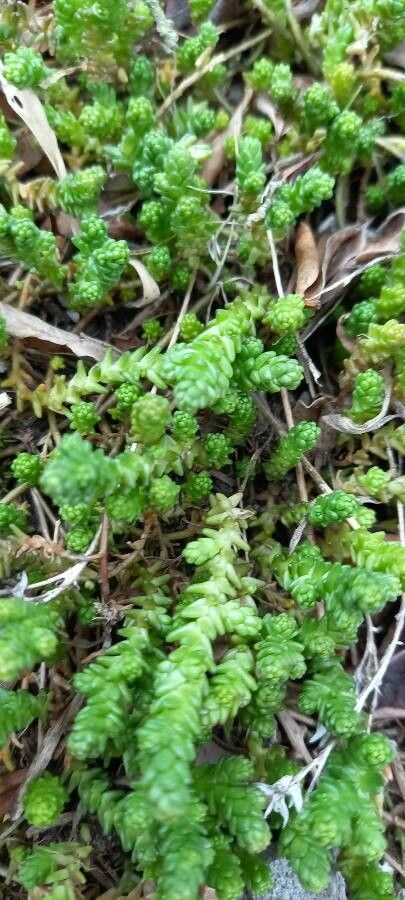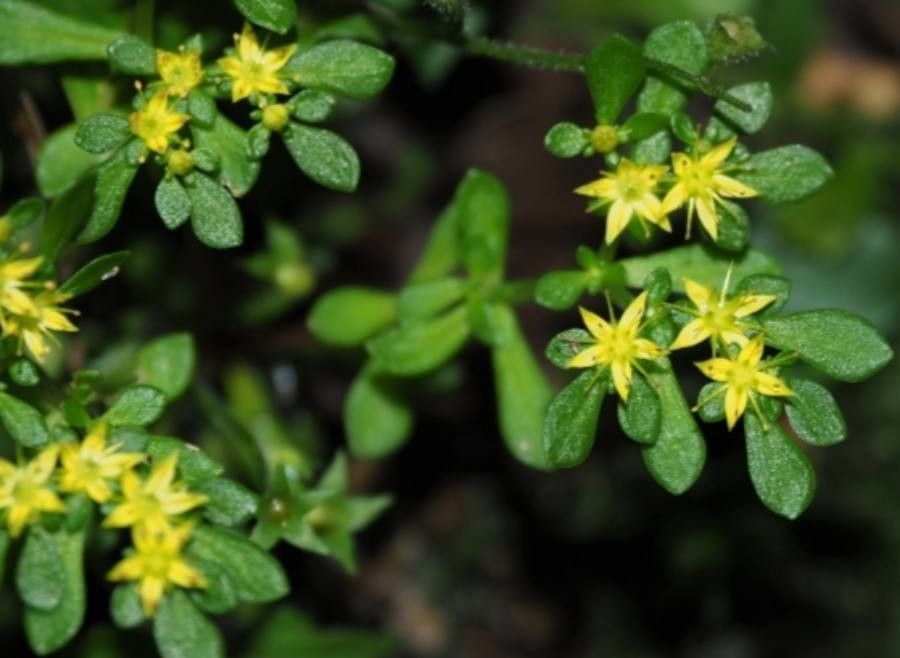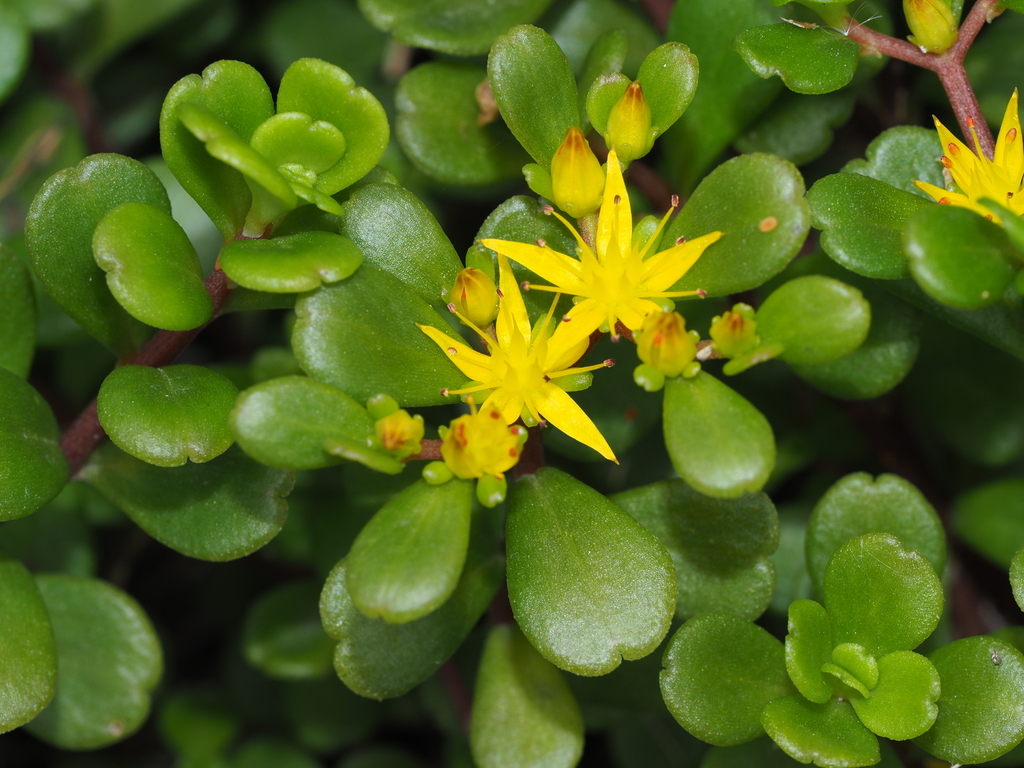
Sedum makinoi, commonly known as Makino's Stonecrop, is a low-growing succulent plant native to Japan. It belongs to the Crassulaceae family. This plant features small, round, green leaves that grow in a rosette pattern. The leaves are fleshy with a slightly glossy texture.
During the summer, Sedum makinoi produces small, star-shaped flowers that can be pink or white. These flowers bloom on long stems that rise above the foliage.
This species prefers well-draining soil with moderate moisture levels. While it can tolerate full sun or partial shade, it thrives best in bright, indirect light.
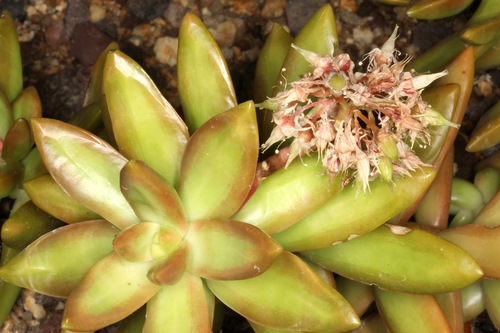
Golden sedum is a beautiful succulent with spoon-shaped leaves and a lotus-like form. Each leaf has a small tip at its end. The plant appears golden or yellow-green, making it instantly charming and delightful at first sight. FUN FACT · FROM THE LIBRARY
Sedum makinoi is often used as ground cover due to its low-growing habit and its ability to spread quickly through offsets or stem cuttings. It also works well in rock gardens, container gardens, or as an accent plant for borders.
Overall, Sedum makinoi is an attractive succulent with unique foliage that can enhance any garden setting while requiring minimal care and maintenance.
Golden japanese sedum has moderate disease resistance and is more sensitive to humidity. It is prone to illness when humidity is high and can develop root rot during dormancy. In terms of care, Golden japanese sedum tolerates drought but requires more frequent watering during the growing season. Watering should be greatly reduced or stopped entirely while it is dormant. Golden japanese sedum is suitable for growers with some experience, though it can be challenging to maintain, particularly during dormancy. It is especially appropriate for people who can dedicate time to its care throughout the winter months.
How to keep Sedum Makinoi.
Light
Golden Japanese sedum grows best with continuous sunlight. While it can tolerate partially shaded spots, plentiful sun is preferable for its health. Its native habitat favors sunlit areas. Both excessive and too little light can influence its growth.
Water
Golden Japanese sedum, a plant native to Japan's rocky slopes, thrives in dry conditions. This drought-tolerant succulent requires minimal water and prefers well-draining soil, needing only weekly watering. It grows best in full sunlight, where it develops a thick cuticle and waxy leaves to minimize water loss through transpiration.
Humidity
This plant prefers dry conditions, so don't mist it. However, watering it less often can also thrive in higher humidity.
Temperature
Golden japanese sedum comes from habitats with temperatures between 50 and 95 °F (10 to 35 ℃). It prefers warm climates and adjusts best to temperature changes within that range. During seasonal changes, avoid exposing golden japanese sedum to extreme heat or cold.
Fertilizer
For Golden japanese sedum, apply small amounts of fertilizer once or twice a year during the growing season. Do not fertilize in winter or in summer while it is dormant. Use less fertilizer on repotted plants and wait a couple of months after repotting before feeding. Fertilizing promotes healthy growth and encourages blooms.
Pruning
Golden Japanese sedum features small, succulent leaves and a sprawling growth habit. To promote new growth and maintain a compact form, prune it from early to late spring. Remove any dead stems and leggy growth to enhance its bushiness. Always use clean tools to prevent disease and regularly monitor the plant's overall health for the best results.
Pot & Repot
To keep your golden Japanese sedum healthy, it's best to repot it every 2 to 3 years, ideally in the spring. Choose a small, shallow container to accommodate its roots and ensure it has excellent drainage. After repotting, place the sedum in a bright location and water it sparingly. This will help promote a strong recovery and enhance its vibrant colors.
Toxicity
Some sources indicate that this plant is somewhat harmful when consumed, while others do not. Young and fragile stems and leaves may be consumed uncooked in any case. After the stems and leaves have aged but before the plant flowers, the edible portions may still be consumed if they are gently fried. The sap may irritate the skin of certain individuals, and excessive consumption of the leaves can induce gastrointestinal troubles.
Further reading →
The toxicity and danger assessments provided are for reference only. We do not assure their accuracy, so it's crucial not to depend on them. Seek professional advice when necessary for accurate guidance.
Botanical profile.
- Plant Type
- Herb
- Life Cycle
- Perennial
- Genus
- Sedum
- Family
- Crassulaceae
- Hardiness Zone
- 6-9
- Mature Height
- 10 cm
- Mature Spread
- 46 cm
- Leaf Color
- Light Green, Yellow Green
- Leaf Type
- Semi-evergreen
- Flower Color
- Yellow
- Flower Size
- 2.54 cm
- Bloom Time
- Late spring, Early summer, Mid summer
- Planting Time
- Spring
- Harvest Time
- Mid summer
- Native Area
- South Korea, Japan, China
Other names.
Reader questions.
How should I water my Golden Japanese sedum?
To ensure the health of your Golden Japanese Sedum, it is best to water it with filtered water at room temperature. Tap water may contain harmful particles, so filtered water is preferred. Since the plant is accustomed to warm environments, using cold water can be a shock to its system. It's also important to avoid overhead watering, as this can cause problems with the foliage. Instead, simply water the soil directly until it is completely soaked. This helps the roots stay moist and spread through the soil to gather necessary nutrients.
Why should I add fertilizer to my Golden japanese sedum?
The Golden Japanese sedum relies heavily on its leaves for structure, making fertilization essential for maintaining their appearance and function. By properly fertilizing, you can ensure that these leaves stay consistently vibrant and healthy. Fertilization also benefits the sedum beneath the soil, promoting the growth of new roots and maintaining existing ones. This not only improves the plant's current health but also enhances its ability to absorb nutrients from the soil in the future.
What are the sunlight requirements for Golden Japanese Sedum?
Golden Japanese Sedum thrives best when exposed to full sun, which is defined as more than 6 hours of sunlight daily, but it can also manage in partial sun, receiving about 3-6 hours of sunlight. The plant's origin and optimal growth conditions indicate a strong preference for sun-bathed areas, though it can tolerate some shade. It's essential to watch how sunlight moves through your garden to select the ideal spots that offer a balance of light and shade, ensuring the plants' health and happiness.
What is the ideal temperature range for Golden Japanese sedum?
The ideal temperature range for Golden Japanese sedum is between 50 to 95 °F (10 to 35 °C). It thrives in warm climates and is best adapted to temperature changes within this interval. To ensure the plant's health, it's important to prevent exposure to extreme heat or cold during seasonal shifts. While the plant has strong cold resistance and usually doesn't require special frost protection measures, if winter temperatures are expected to fall below -25°C, measures such as covering the plant with soil or straw should be taken to protect it from extreme cold.
What should I do if I give my Golden japanese sedum too much or too little water?
Overwatering and underwatering can harm your Golden japanese sedum, but overwatering is more common. Too much water causes wilting and yellowing of stems and leaves. Prolonged overwatering can lead to root rot, mold, and mildew, which can kill the plant. Underwatering is less common due to the plant's moderate drought tolerance. However, it can still occur, resulting in brittle and brown leaves. Promptly recognizing signs of overwatering is crucial because some diseases like root rot may be irreversible if left too long. Reduce watering immediately if signs appear early. Check the soil's drainage and replace it with a well-draining potting mix if it drains poorly. For underwatering, water more regularly until signs subside.
When should I put fertilizer on my Golden japanese sedum?
If you grow your Golden Japanese Sedum outdoors each year, it will send new growth shooting out in early spring. This is a sign that it's time to start fertilizing. Typically, a single application of fertilizer in the spring is enough for the plant. However, if you want to maximize its growth, you can repeat the feeding multiple times throughout the spring and early summer, ideally once every month to a month and a half.
What should be done if natural sunlight is insufficient for indoor Golden Japanese Sedum?
If natural sunlight is insufficient for Golden Japanese Sedum, especially indoors, artificial lighting can be a viable solution. LED lights are recommended due to their ability to be customized to provide specific wavelengths needed by plants. For full sun plants, 30-50W/sq ft of artificial light is needed; for partial sun plants, 20-30W/sq ft; and for shade plants, 10-20W/sq ft. The light source should be placed 12-36 inches above the plant to mimic natural sunlight, and the duration should match the natural daylight hours, usually 8-12 hours per day.
How should Golden Japanese sedum be cared for in winter?
In winter, Golden Japanese sedum showcases strong cold resistance, meaning special frost protection measures are not typically necessary. However, if temperatures are expected to drop below -25°C, it is important to provide the plant with cold protection by covering it with materials like soil or straw. Additionally, before the first freeze of autumn, it's recommended to water the plant abundantly to ensure the soil remains moist and enters the frozen state, helping the plant to avoid drought and water scarcity during the colder months and into early spring.
How often should I water my Golden japanese sedum plant?
If your Golden Japanese Sedum is in a pot, the most precise way to determine when it needs water is by checking the soil. Insert your finger into the soil and if the top two to three inches are dry, it's time to water. For those growing the Golden Japanese Sedum outdoors in the ground, you can use a similar method. Check the top few inches of soil and if it's dried out, it's time to water. Usually, during spring and early fall, watering once a week should be sufficient. However, during extremely hot weather, you may need to water twice or more per week. It's important to note that mature, well-established Golden Japanese Sedum plants have a remarkable ability to withstand drought.
When is it best to not fertilize my Golden Japanese sedum?
During late fall and winter, your Golden Japanese sedum will go into a dormant phase and stop producing new growth. It's best to avoid fertilizing it during this time. In spring and summer, if you choose to fertilize, gradually decrease the frequency as summer approaches since the sedum's growth rate will slow down too. Avoid fertilizing when it's unseasonably hot or when the soil is excessively dry, as it can put stress on the sedum and cause it to die sooner than expected.
What are the symptoms of insufficient sunlight in Golden Japanese Sedum?
Symptoms of insufficient sunlight in Golden Japanese Sedum include new leaves growing smaller, leggy or sparse growth due to longer spaces between leaves or stems, faster leaf drop, slower or no new growth, lighter-colored new leaves, and symptoms of overexposure like chlorosis, sunscald, leaf curling, wilting, and leaf scorching. These symptoms reflect the plant's struggle under inadequate or excessive light conditions, impacting its overall health and growth.
What are the important symptoms to watch for in Golden Japanese sedum related to temperature?
Important symptoms to watch for in Golden Japanese sedum include reactions to low and high temperatures. At low temperatures, specifically below -25°C, the plant may display decreased or no sprouting during spring, despite its cold tolerance. The solution is to remove any parts that have failed to sprout come spring. At high temperatures above 38°C, the leaves might lighten in color, become prone to curling, and the plant can suffer from sunburn or even wilt and dry up. To mitigate these effects, trim away sunburned and dried-up parts, relocate the plant to a shaded area or create shade with a cloth, and water it in the mornings and evenings to maintain soil moisture.