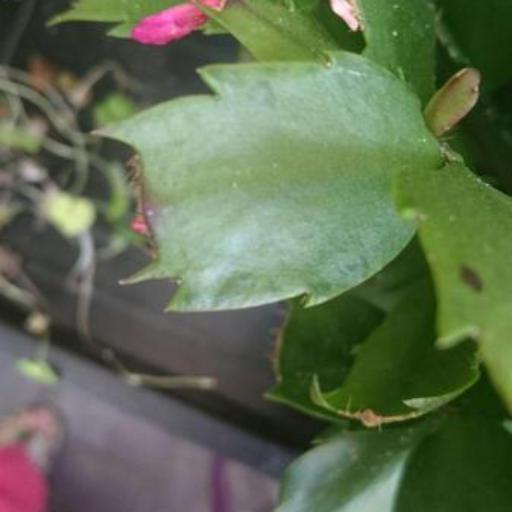
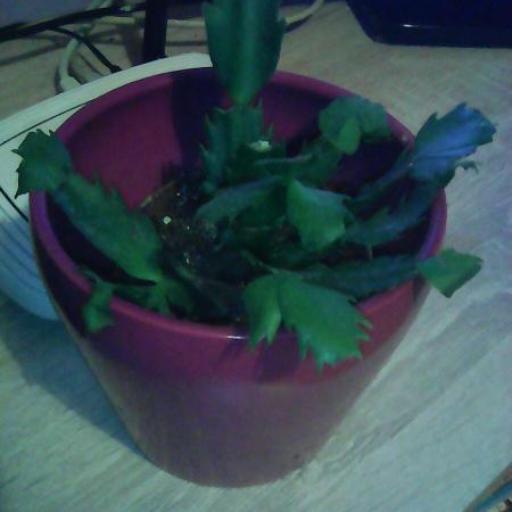
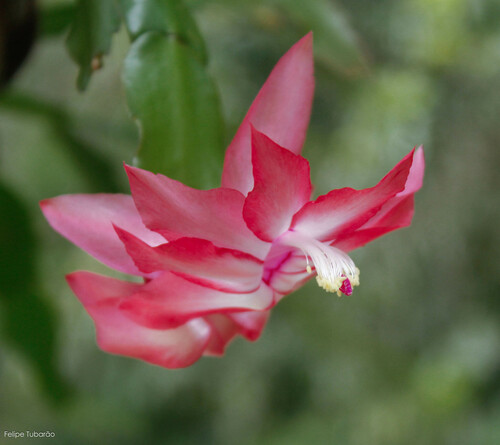
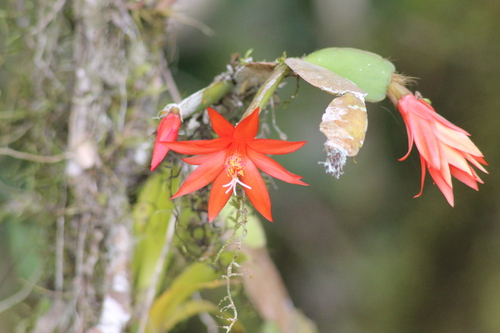
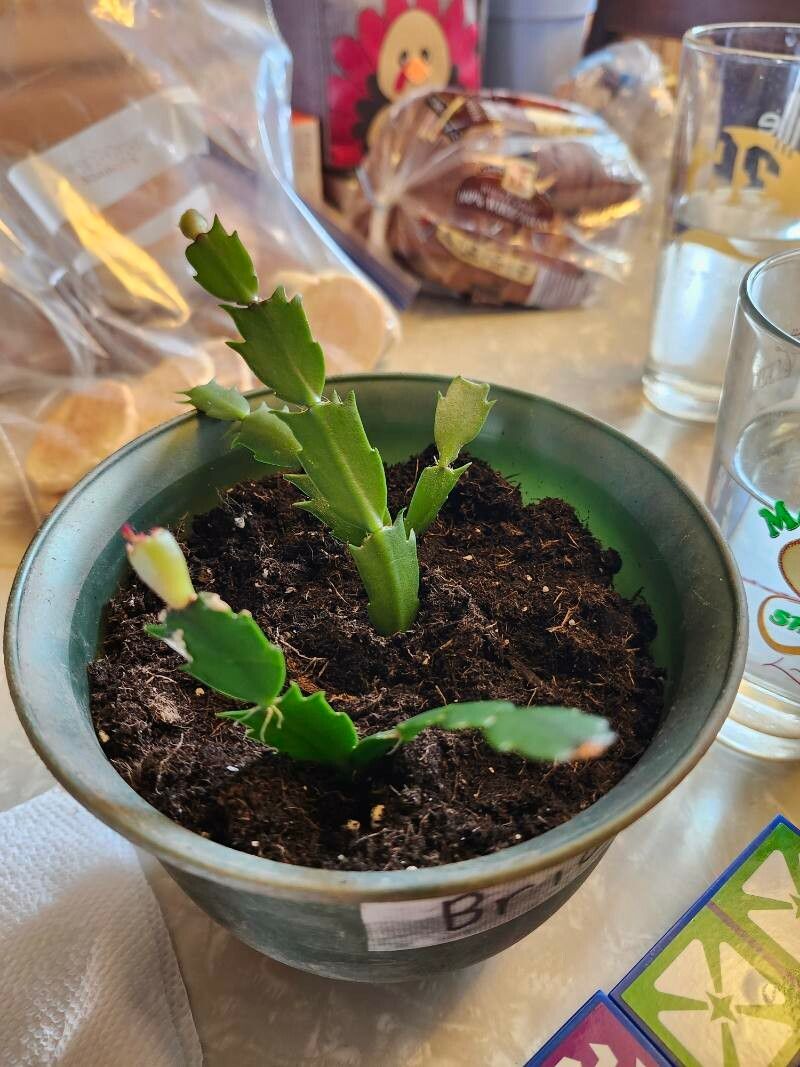
Schlumbergera is a small genus of cacti with six to nine species found in the coastal mountains of south-eastern Brazil. These plants grow on trees or rocks in habitats that are generally shady with high humidity, and can be quite different in appearance from their desert-dwelling cousins. Most species of Schlumbergera have stems which resemble leaf-like pads joined one to the other and flowers which appear from areoles at the joints and tips of the stems. Two species have cylindrical stems more similar to other cacti. Recent phylogenetic studies using DNA have led to three species of the related genus Hatiora being transferred into Schlumbergera, though this change is not universally accepted. Common names for these cacti generally refer to their flowering season. In the Northern Hemisphere, they are called Christmas cactus, Thanksgiving cactus, crab cactus and holiday cactus. In Brazil, the genus is referred to as Flor de Maio (May flower), reflecting the period in which they flower in the Southern Hemisphere. Most of the popular houseplants are cultivars of Schlumbergera, rather than species, with flowers in white, pink, yellow, orange, red or purple. The Easter cactus or Whitsun cactus, until recently placed in the genus Hatiora, is also called a holiday cactus and has flowers in red, orange, pink and white. The cultivars of the Christmas cactus fall into two main groups: The Truncata Group contains all cultivars with features derived mainly from the species S. truncata: stem segments with pointed teeth; flowers held more or less horizontally, usually above the horizontal, whose upper side is differently shaped from the lower side (zygomorphic); and pollen which is yellow. They generally flower earlier than members of the Buckleyi Group and, although common names are not applied consistently, may be distinguished as Thanksgiving cactus, crab cactus or claw cactus. The Buckleyi Group contains all cultivars with at least some features clearly showing inheritance from S. russelliana: stem segments with rounded, more symmetrical teeth; more or less symmetrical (regular) flowers which hang down, below the horizontal; and pollen which is pink. They generally flower later than members of the Truncata Group and are more likely to be called Christmas cactus.
The Christmas cactus has strong resistance to disease and typically remains healthy under normal care without easily falling ill. That said, it can be vulnerable to mealybugs; these pests may inflict some harm but are usually not a major danger. Regarding care, the Christmas cactus tolerates drought and does not require frequent watering. It can go long stretches without water and needs little fertilizer. Still, it is very prone to root rot if lighting is inadequate and it is overwatered. In general, the Christmas cactus is a good choice for people who prefer to spend less time on plant care, though it’s important to meet its basic needs. It is especially suitable for those who are away for extended periods and might forget to water their plants regularly.
How to keep Schlumbergera Ux Buckleyi.
Light
The Christmas cactus comes from habitats with dappled or filtered light, such as the forest understory or rocky sites that offer natural shade. It prefers partial sun but can also tolerate full sun.
Water
The Christmas cactus flourishes in humid environments similar to its tropical rainforest origins. While it can tolerate moderate drought, it should be watered every two weeks. Typically grown indoors, the Christmas cactus requires careful management of soil moisture. Its roots have adapted to quickly absorb water from the air and surroundings.
Temperature
A Christmas cactus performs best in warm conditions and needs higher temperatures during the growing season to support growth and metabolic processes. It prefers abundant sunlight, suitable moisture levels, and good air circulation. However, it is vulnerable to harm from very low temperatures and from overwatering. Maintaining a balance is important; excessively high temperatures and overly dry conditions should be avoided as well.
Fertilizer
Christmas cactus only needs light fertilizer applications once or twice a year during the growing season. Do not fertilize in winter or summer while it is dormant. Use less fertilizer for repotted plants and wait a couple of months after repotting before applying fertilizer. Fertilizing helps maintain healthy growth and encourages blooms.
Pruning
The Christmas cactus is known for its vibrant, drooping flowers and segmented stems. To improve its shape and encourage growth, perform light pruning in early spring after it has finished blooming. Remove any dead or overcrowded segments to improve air circulation, which promotes overall health and better flowering. Always use clean, sharp tools to prevent the spread of disease.
Pot & Repot
Repot a Christmas cactus in spring or summer, choosing a pot slightly larger than the current one that has good drainage. Use a sandy or gritty cactus mix that drains well. Handle the plant carefully to avoid its spikes. Let the cactus dry out before repotting to help prevent root rot. After repotting, wait a week before watering so the roots can heal.
Botanical profile.
- Plant Type
- Succulent
- Life Cycle
- Perennial
- Genus
- Schlumbergera
- Family
- Cactaceae
- Hardiness Zone
- 10-12
- Mature Height
- 25 cm
- Mature Spread
- 76 cm
- Leaf Color
- Green
- Leaf Type
- Evergreen
- Flower Color
- Red, Pink
- Flower Size
- 6.35 cm to 7.62 cm
- Bloom Time
- Mid winter, Late winter
- Planting Time
- Spring, Summer, Autumn
- Harvest Time
- Early spring, Mid spring
Other names.