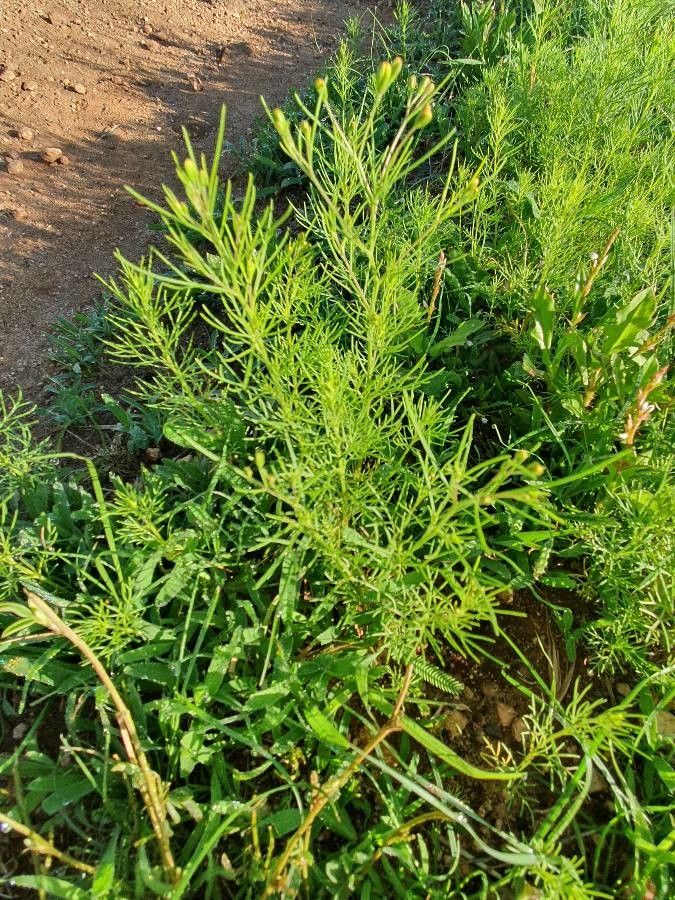
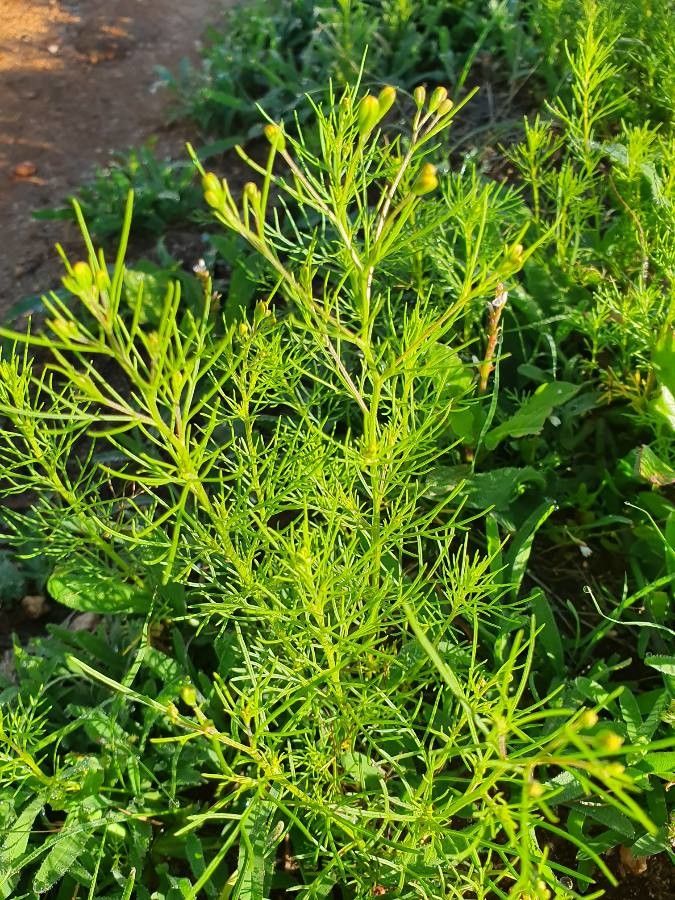
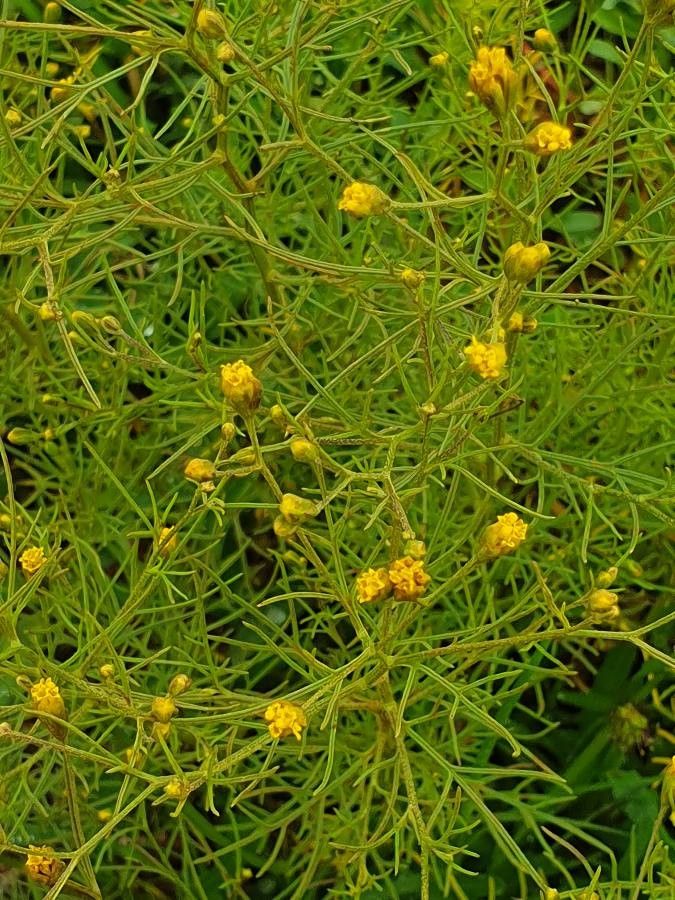
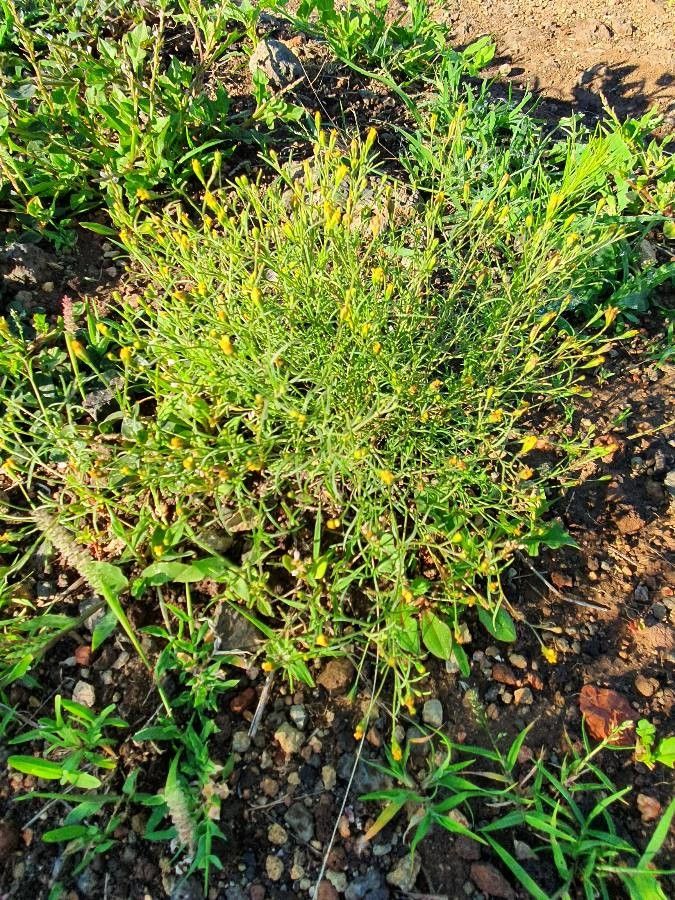
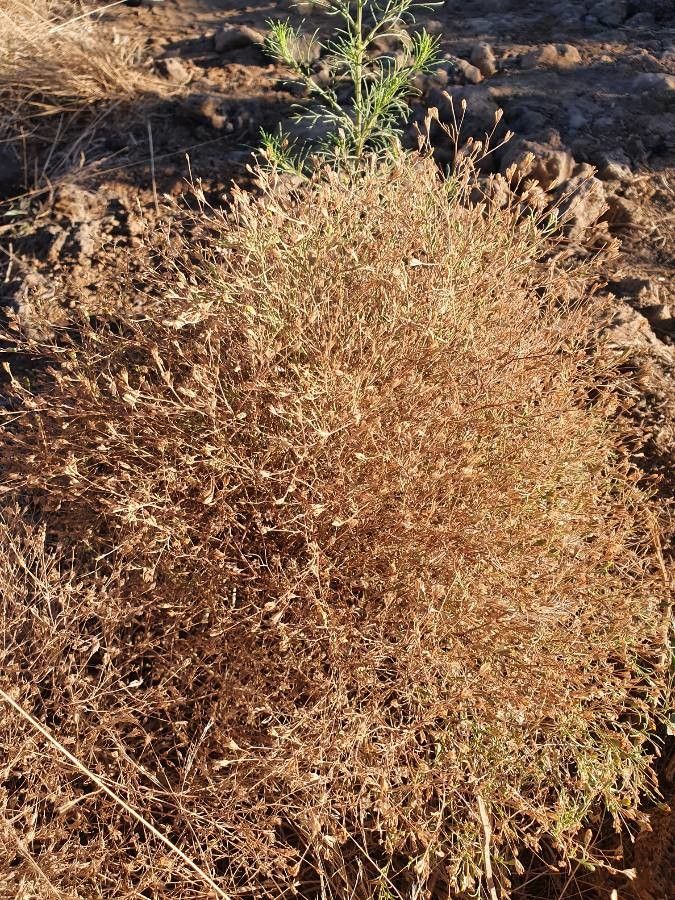
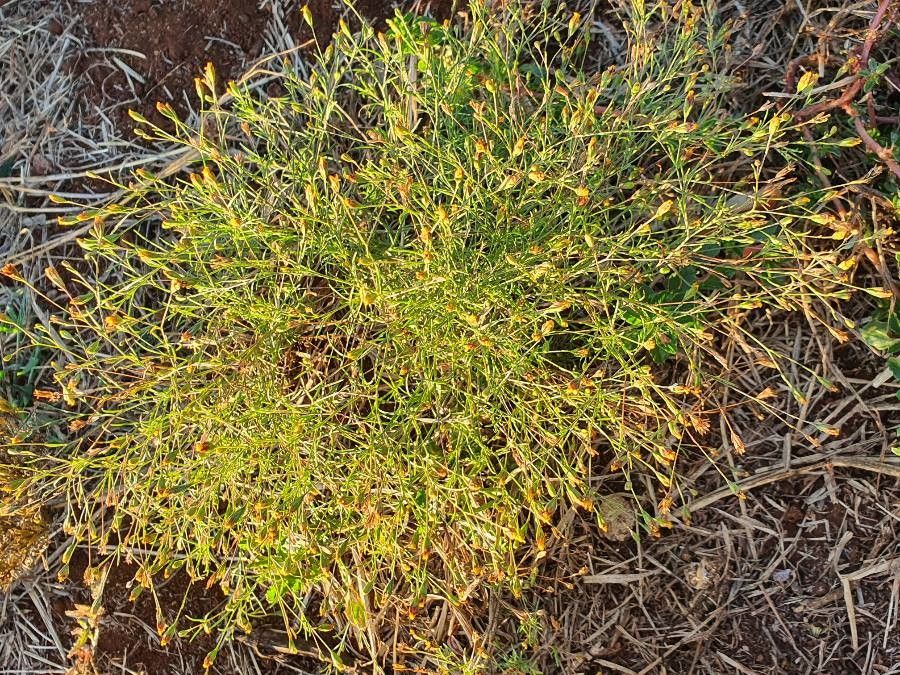
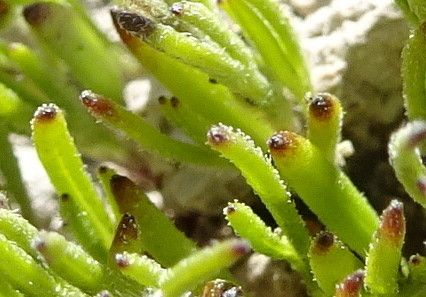
Schkuhria pinnata, the canchalagua or dwarf Mexican marigold, is a small, dainty, pioneer annual herb of the family Asteraceae and widespread in the tropics. It is regarded as a naturalised weed with low ecological impact. Reaching 30–60 cm in height, this species is found as a pioneer on disturbed ground such as roadsides and ploughed lands. Leaves are mainly pinnatisect, with the upper leaves simple and filiform. The upper leaf surface is narrowly grooved, while both leaf surfaces are pitted with numerous small glands. Its capitula are numerous, terminal and small, with a solitary ray floret, its ligule 1.5–2 mm long and yellow, and 4-6 disc florets. Corollas are yellow to white sometimes with a purple tinge. Bracts are obovate, with a hyaline apex, while margins are minutely ciliate and glandular-punctate. Achenes are narrow-turbinate, 4-angled and some 4 mm long; there are 8 membranous pappus scales, darkly striated at apex.The plant is native to South America, normally found in drier mountainous regions of 2000 – 3000 meters in elevation, and growing abundantly in the inter-Andean valleys. It is currently found in Latin America, Mexico, Africa, and in the southern United States.
Dwarf marigold is largely disease-resistant and generally not prone to illnesses. However, it can be affected by pests and diseases present nearby. These infections are typically not serious. In terms of care, this plant requires a moderate level of maintenance. It should be pruned regularly to preserve a good appearance and support healthy growth. Fertilizing can also help encourage flowering. Dwarf marigold is appropriate for anyone with outdoor space, such as a garden or patio, and does not demand extensive care experience. It may need more attention when grown indoors.
How to keep Schkuhria Pinnata.
Light
Dwarf marigold comes from sunny, open habitats and does best in full sun. It will tolerate partial shade but favors direct sunlight for optimal growth. This plant, which can be annual or biennial, is noted for its sun-loving habits.
Water
To ensure that dwarf marigold plants thrive, keep them in environments with moderate moisture and provide them with evenly moist soil. Water them weekly to maintain proper hydration, though they can recover from slight periods of under-watering. Usually grown outdoors, dwarf marigolds benefit from rainwater during their active growing season.
Temperature
Dwarf marigold shows good temperature adaptability, able to endure higher heat and fairly large temperature swings. In hot weather, pay attention to watering and provide appropriate shading to avoid sunburn. However, dwarf marigold is relatively sensitive to low temperatures; while it can tolerate some cold, excessively low temperatures can cause frost damage.
Fertilizer
When most of the Dwarf marigold's blooms have opened to full size, resume fertilizing. During the period when flowering is at its peak, apply fertilizer every three to four weeks, as the weather allows. Once the Dwarf marigold begins producing fewer new blooms, stop fertilizing — there’s no need to feed the plant when it can no longer produce more flowers.
Pruning
Dwarf marigolds have delicate foliage and bright yellow flowers. For healthy growth and a full, bushy appearance, prune them from early to late spring. During pruning, remove dead stems and spent flowers. Pinch new growth to encourage denser foliage. Make sure to clean your tools to prevent infections. Proper pruning enhances air circulation, reduces the risk of disease, and encourages more blooms.
Botanical profile.
- Plant Type
- Herb
- Life Cycle
- Annual
- Genus
- Schkuhria
- Family
- Asteraceae
- Hardiness Zone
- 9-11
- Mature Height
- 30 cm to 61 cm
- Mature Spread
- 20 cm to 30 cm
- Leaf Color
- Green
- Leaf Type
- Deciduous
- Flower Color
- Yellow
- Flower Size
- 0.51 cm to 0.76 cm
- Bloom Time
- Mid summer, Late summer, Early fall, Mid fall
- Planting Time
- Spring
- Harvest Time
- Fall
- Native Area
- Colombia, Honduras, Mexico, Guatemala, Bolivia, Venezuela, Peru, El Salvador, Nicaragua, Ecuador, Costa Rica
Other names.
Reader questions.
How should I water my Dwarf marigold plant?
When watering Dwarf marigold, there are a few options for tools you can use: a garden hose with a spray nozzle, a watering can, or any other common watering tool. This plant is generally not too particular about the type of water it receives, as it can thrive with rainwater, tap water, or filtered water. However, it is advisable to avoid watering from overhead as it can harm the leaves and flowers and increase the risk of disease. Setting up a drip irrigation system is often the best method for watering Dwarf marigold, as it delivers water evenly and directly to the soil. If you have a container-grown Dwarf marigold, you can follow a similar watering approach but use a cup, watering can, or tap to directly water the soil.
What should I do if I give my Dwarf marigold too much or too little water?
To remedy underwatering of Dwarf marigold, simply increase watering frequency when you notice the plant lacking moisture. Overwatering, on the other hand, can be more serious if not detected early. It can lead to diseases and ultimately the decline and death of the plant. To avoid this, choose a suitable location with ample sunlight for soil drying and sufficient drainage to prevent waterlogging. If your potted Dwarf marigold is overwatered, consider changing to a new pot with better soil drainage and more drainage holes. When repotting, use loose soil and an efficiently draining pot.
How frequently do I need to water my Dwarf marigold?
To keep your Dwarf marigold healthy, make sure to water it regularly throughout the growing season. In the spring, you should aim to water it about once a week. As the weather gets warmer, you may need to increase the frequency to two to three times a week. However, be careful not to overwater, as this can harm your plant. Regardless of how often you water, it's important to keep the soil relatively moist but not soaked. If your Dwarf marigold is in a pot, you'll have to water it more often compared to if it were planted in the ground. This is because the soil in a pot can dry out faster. In most cases, watering a container-grown Dwarf marigold a few times a week should be sufficient, whereas watering an in-ground plant just once a week is usually enough.
How much water should I give my Dwarf marigold?
Determining the right amount of water for your Dwarf marigold can be done in a few ways. One approach is to feel the soil for moisture and water until the top six inches feel moist. Another option is to use a set measurement, such as giving the plant around two gallons of water per week, taking into account the temperature and soil dryness. However, be cautious about overwatering if your plant requires less. When growing Dwarf marigold in a container, a different method is needed. Make sure to moisten all layers of dry soil, either by feeling for moisture with your finger or by allowing excess water to trickle out of the drainage holes.
How can I know if I'm giving enough water to my Dwarf marigold?
Avoiding overwatering your Dwarf marigold can be challenging due to its deep roots that need weekly moisture. However, overwatering can cause root rot and browning. Underwatering is less common, as these plants can survive without supplemental watering for some time. If you wait too long to water, your Dwarf marigold may wilt and develop dry leaves.
How do I water my Dwarf marigold throughout the different seasons?
As the season progresses, the water needs of your Dwarf marigold will increase. During spring, watering once a week should be sufficient. However, as the summer heat sets in, you will likely need to water your Dwarf marigold a bit more often, potentially up to three times per week. This is especially important if your Dwarf marigold is growing in a container, as the soil in containers tends to dry out faster in warm weather. In autumn, when your Dwarf marigold is still blooming, its water needs may decrease slightly due to the lower temperatures and weaker sun compared to summer.
At different stages of growth, how should I water my Dwarf marigold?
Throughout the year, the Dwarf marigold goes through different growth stages, each with different watering needs. When you start with a seed, it requires more water for germination. During this time, you should water often to maintain consistent soil moisture. As the seedling grows, it needs slightly less water. Once the plant is mature, you can water it about once per week. During flower development, you may need to give it slightly more water to help the process.
How is watering Dwarf marigold plants different indoors versus outdoors?
Most Dwarf marigold plants are grown outdoors for a few reasons. Firstly, these plants can grow quite tall, which doesn't work well indoors. Secondly, Dwarf marigold requires more daily sunlight than most indoor settings can offer. However, if you can provide a suitable indoor growing space, you may need to water your Dwarf marigold more frequently compared to outdoor plants. This is because indoor locations tend to be drier, especially due to HVAC units. Additionally, soil in containers can dry out quickly compared to soil in the ground.