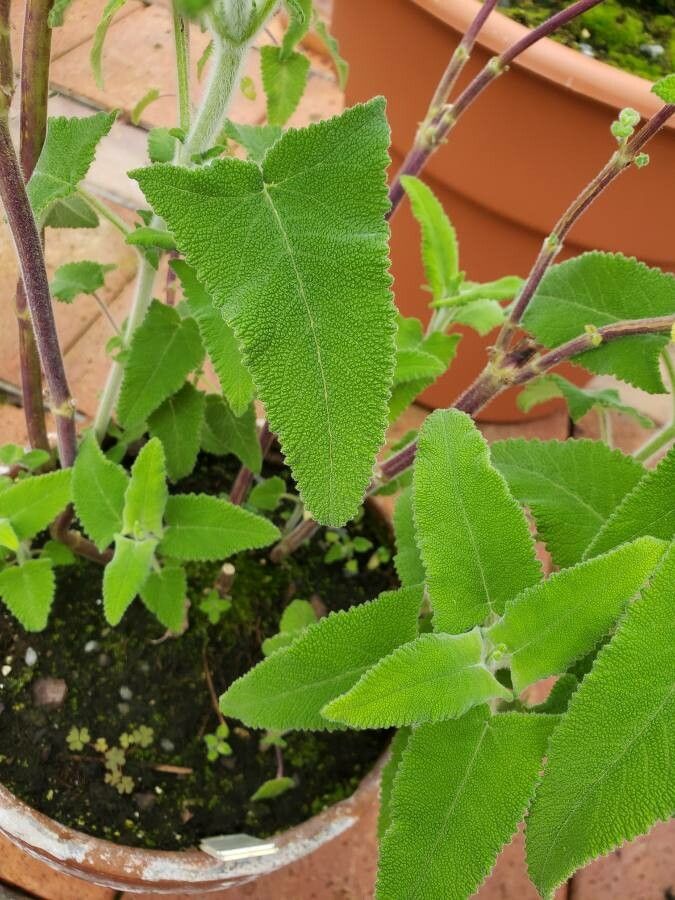
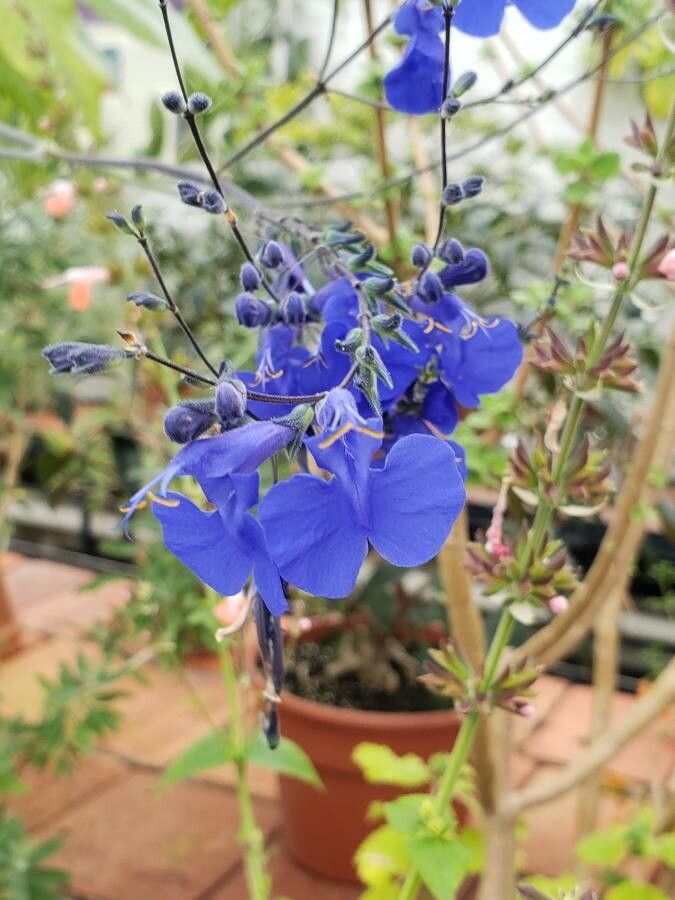
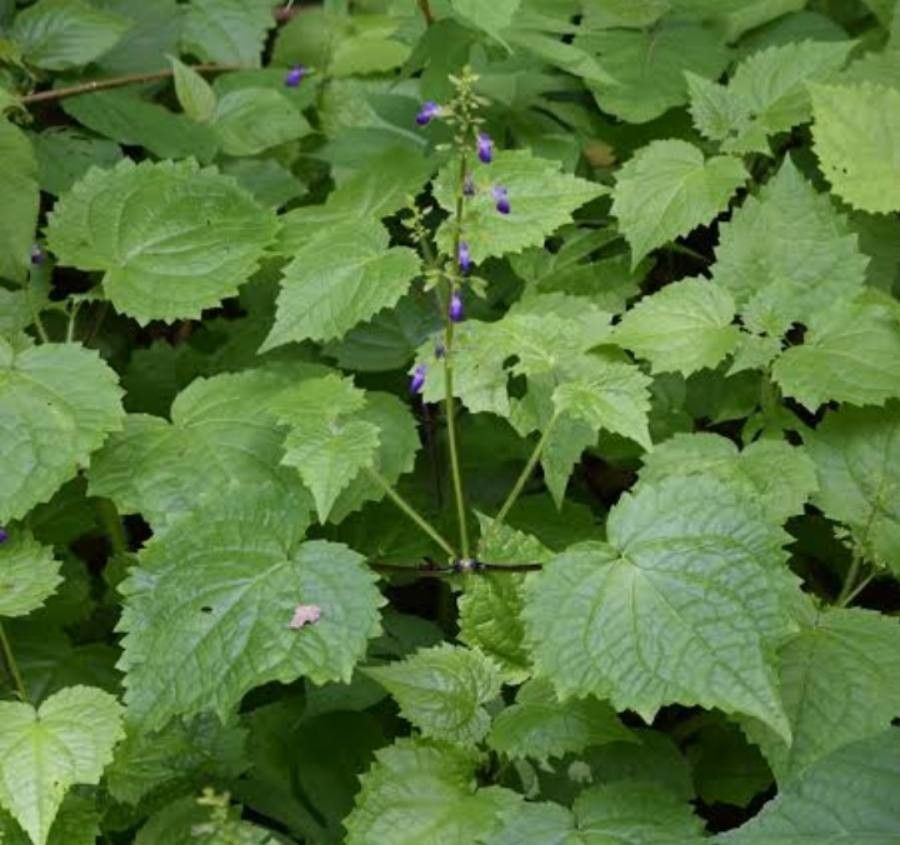
Salvia sagittata is a herbaceous perennial plant that is native to the Andes Mountains, growing at elevations from 9,500 to 10,500 ft (2,900 to 3,200 m). The specific epithet refers to the arrow-shaped leaves. The plant was collected and named in 1798 by Hipólito Ruiz López and José Antonio Pavón Jiménez, two Spanish botanists who spent ten years in Peru and Chile on a commission by the government of Spain to go to the New World in search of new medicinal and agricultural plants.Salvia sagittata reportedly reaches 7.5 ft (2.3 m) tall in the wild and 2.5 ft (0.76 m) in cultivation. It is covered with yellow-green leaves that are rugose on the upper surface—with the underside covered with short white hairs and heavily veined. The inflorescences are very sticky, reaching up to 2 ft (0.61 m) long above the leafy stems. The 1 in (2.5 cm) flowers are a brilliant blue, with a spreading lower lip. A pistil and two yellow stamens show in the upper lip.
Arrowleaf Sage has good disease resistance and is generally not prone to illnesses. Nonetheless, it can be vulnerable to pests and diseases present in its surroundings. These problems are typically not serious. Regarding care, this plant requires a moderate level of maintenance. It should be pruned regularly to keep a neat appearance and encourage healthy growth. Fertilizing can also help boost flowering. Arrowleaf Sage is suitable for anyone with outdoor space, such as a garden or patio, and does not demand extensive care experience. It may need more attention when grown indoors.
How to keep Salvia Sagittata.
Light
Arrowleaf Sage is a perennial herbaceous plant that prefers sunlight and comes from open habitats, commonly growing in meadows and grasslands. It favors full sun but can also tolerate partial sun.
Temperature
Arrowleaf Sage can tolerate a wide range of temperatures, but its distribution may still be restricted by different combinations of water and heat. It performs best in warm summer climates with adequate rainfall or irrigation. Extended periods of cloudy, rainy weather, and prolonged high temperatures can increase the chance of Arrowleaf Sage dying. In winter, proper protection from cold can enhance the plant's survival rate.
Fertilizer
The best time to fertilize an Arrowleaf Sage is in early spring, as it comes out of dormancy and begins active growth. Fertilizing supplies important nutrients needed for healthy development. Although Arrowleaf Sage has fairly low fertilizer requirements, applying fertilizer once a year can improve its survival and encourage better, longer-lasting flowers.
Botanical profile.
- Plant Type
- Herb
- Life Cycle
- Perennial
- Genus
- Salvia
- Family
- Lamiaceae
- Hardiness Zone
- 9-11
- Mature Height
- 0.91 m to 1.52 m
- Mature Spread
- 61 cm to 91 cm
- Leaf Color
- Green, Dark Green
- Leaf Type
- Deciduous
- Flower Color
- Blue
- Flower Size
- 2.03 cm to 3.05 cm
- Bloom Time
- Summer, Early fall, Mid fall
- Planting Time
- Spring, Autumn
- Harvest Time
- Late summer, Fall, Early winter
- Native Area
- Colombia, Ecuador, Peru