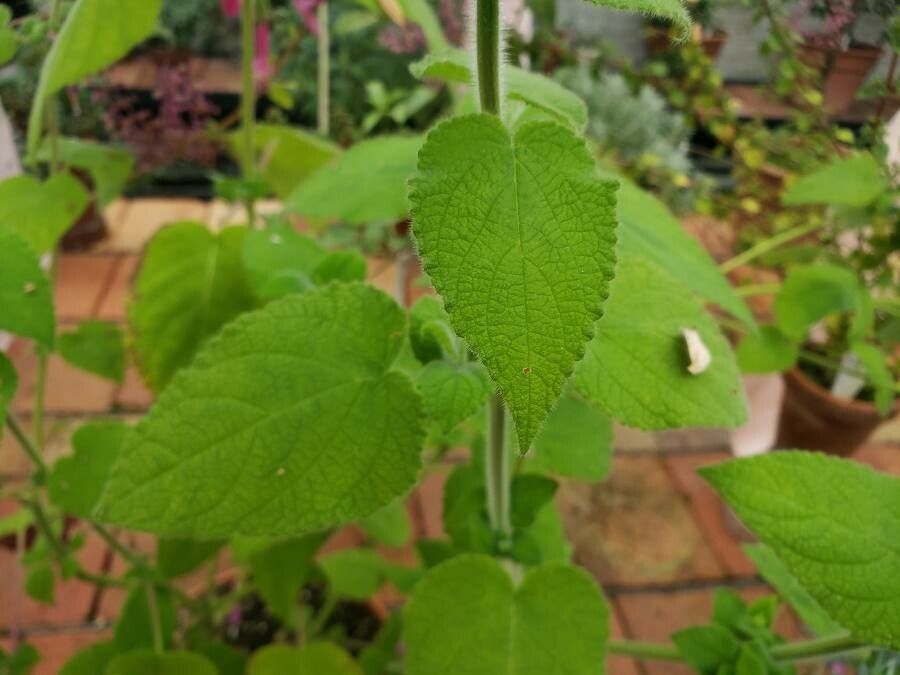
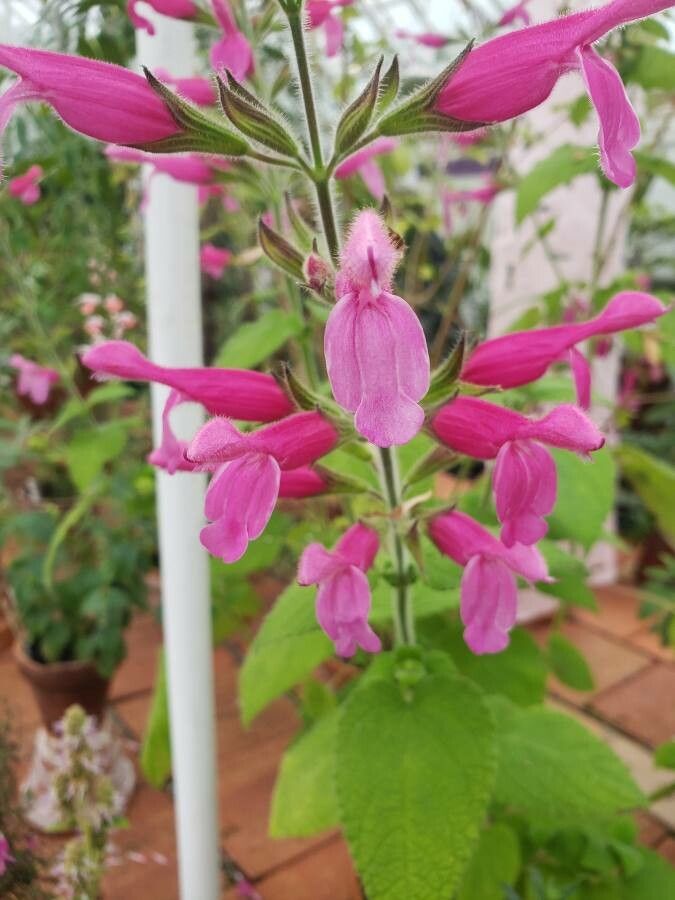
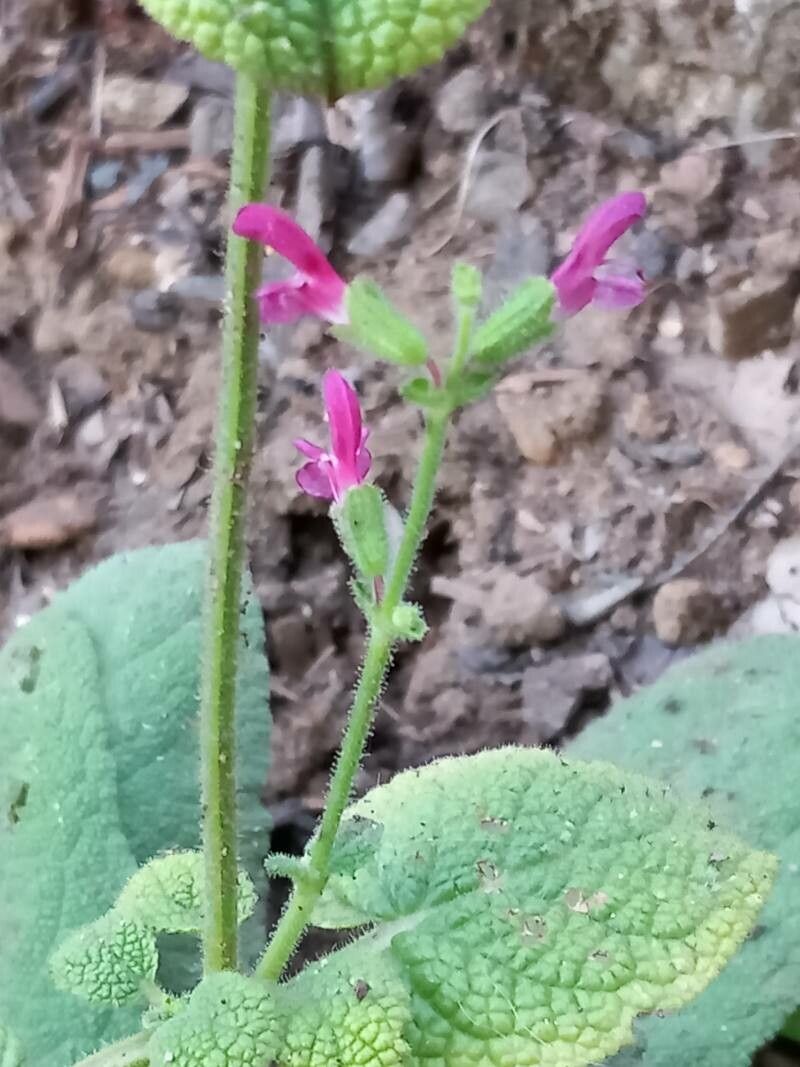
Salvia dorisiana, the fruit-scented sage or peach sage, is a perennial shrub native to Honduras. It grows 1–1.3 m tall, and is heavily branched. The leaves have a fruity scent when brushed, and large magenta-pink flowers that bloom in winter. Salvia dorisiana was first described in 1950, and has become popular as a greenhouse plant. The flowers reach up to 5 cm in length, with a lime-green calyx about the same length. The entire plant is covered in hairs whose glands release a pineapple-grapefruit scent.Salvia dorisiana was named for Doris Zemurray Stone, 1909–1994, archaeologist and ethnographer and director of the national museum of Costa Rica, though many horticulture references apocryphally repeat that it was named after Doris, daughter of Oceanus and Tethys, and the wife of Nereus.
Fruit-scented Sage is fairly disease-resistant and usually not prone to illnesses. Still, it can be affected by pests and diseases present in its environment; such problems are typically not severe. As for care, this plant requires moderate maintenance. It should be trimmed regularly to keep a neat appearance and support healthy growth. Fertilizing can also encourage flowering. Fruit-scented Sage is well suited to anyone with outdoor space, such as a garden or patio, and does not demand extensive gardening experience. It may need more attention when grown indoors.
How to keep Salvia Dorisiana.
Light
Fruit-scented Sage is a sun-loving, perennial herbaceous plant native to open habitats and commonly found in meadows and grasslands. It prefers full sun but can also tolerate partial sun.
Temperature
Fruit-scented Sage comes from tropical areas, where the climate is typically warm and humid. As a result, it is well adapted to high temperatures and humidity. It does not tolerate sudden temperature changes and prefers a stable temperature environment, so avoiding temperature fluctuations indoors is important. It generally cannot withstand cold temperatures and requires warmer conditions to grow. If the environmental temperature falls too low, the plant may stop growing or even die.
Fertilizer
Adequate fertilization is vital for Fruit-scented Sage's health and appearance. Feed Fruit-scented Sage during summer, applying fertilizer once a month throughout the season. The nutrients supply energy for growth and help maintain the plant's parts. Fertilizing improves Fruit-scented Sage's floral display, ensuring the best blooms.
Botanical profile.
- Plant Type
- Herb
- Life Cycle
- Perennial
- Genus
- Salvia
- Family
- Lamiaceae
- Hardiness Zone
- 9-11
- Mature Height
- 91 cm
- Mature Spread
- 91 cm
- Leaf Color
- Green
- Leaf Type
- Evergreen
- Flower Color
- Pink
- Flower Size
- 2.03 cm to 3.05 cm
- Bloom Time
- Winter, Spring
- Planting Time
- Spring, Summer, Autumn
- Harvest Time
- Late winter, Spring, Early summer
- Native Area
- Honduras
Other names.