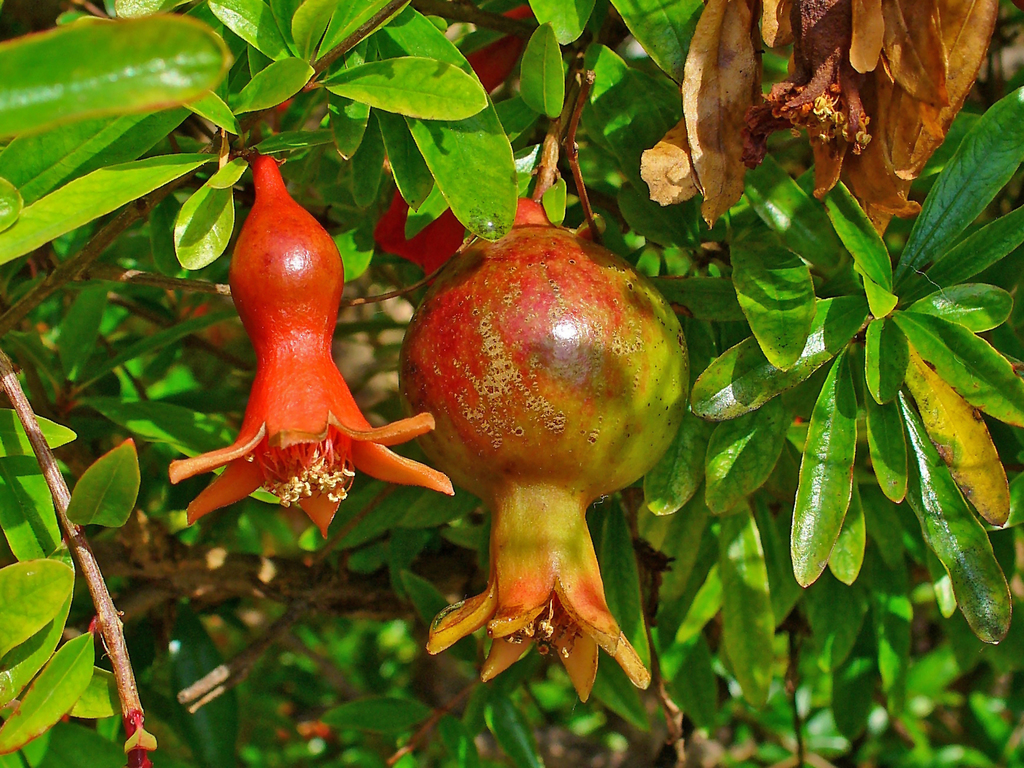
Punica granatum, commonly known as pomegranate, is a fruit-bearing deciduous shrub or small tree belonging to the Lythraceae family. Native to the Middle East and South Asia, it has been widely cultivated around the world for both its edible fruit and ornamental value.
The plant can grow to a height of 5-8 meters, featuring a rounded shape with multiple, often spiny stems. Its leaves are glossy, narrow, and oblong, and they display a bright green color that turns yellow in autumn before they fall off. The flowers are striking, with bright red or orange petals that form cup-shaped blooms.
The fruit of Punica granatum is a large, round berry filled with juicy arils (seed casings) surrounded by bitter white pith. The arils have an intensely sweet-tart flavor and are rich in antioxidants, vitamins C and K, fiber, potassium, and folate.
Pomegranates thrive in full sun exposure but can tolerate partial shade. They are adaptable to various soil types, including sandy loam or clay soils, as long as there is good drainage.
In addition to its culinary uses for juice production or eating fresh, Punica granatum has been used medicinally for centuries. Its anti-inflammatory properties may help reduce inflammation-related diseases such as arthritis and heart disease. The plant also contains compounds that may help prevent cancer growth.
Overall, the Punica granatum plant offers both ornamental beauty through its attractive flowers and foliage and nutritional benefits through its delicious fruits, making it an excellent addition to any garden.
Pomegranate has strong disease resistance and generally does not easily get sick. However, when grown in poor conditions it can become more prone to disease. It also faces few insect pests. Care needs are moderate. It requires plenty of sunlight, because with insufficient light it can become more susceptible to disease and produce thin growth. Since it is often kept indoors, it may need to be moved regularly to a bright spot. It does not need frequent watering. Overall, Pomegranate is suitable for most people, though it is best for those who can provide good light conditions.
How to keep Punica Granatum.
Light
Pomegranate plants do best where they get many hours of sunlight each day, which supports healthy development. They can also tolerate environments with limited sun exposure. At every stage of growth, plentiful light encourages vigorous development. Their native habitat was largely sun-drenched. Too little sunshine can stunt growth, while too much can scorch the leaves.
Water
Pomegranates thrive in seasonal climates and adapt well to both wet and dry conditions, showing moderate drought tolerance. To ensure healthy growth, keep the soil consistently moist by watering every 1-2 weeks, but let the top layer of soil dry out between waterings. During the colder months, when the plants enter dormancy, you can reduce the frequency of watering.
Humidity
This plant will thrive in moderate humidity, which is probably the level in your home. However, misting it a few times a week can be very beneficial. Make sure the room has good ventilation.
Temperature
Pomegranate has a temperate temperature preference. It prefers temperatures between 41 and 100 °F (5 and 38 °C) for best growth. In its native habitat it occurs in areas with hot summers and cool winters. In summer it can benefit from shade or partial shade, while in winter it may need protection from cold and frost.
Fertilizer
The pomegranate plant requires adequate nutrients for optimal fruit production. Fertilize in early spring to promote new growth and bloom development. Regular fertilization helps the plant stay healthy, produce more delicious fruit, and prevents nutrient deficiency problems such as yellowing leaves and poor fruit production.
Pruning
Pomegranates produce stunning red flowers and fruit. To improve airflow and sunlight exposure, prune these plants in late winter. Remove crowded branches to shape the plant and boost fruit yield. Regular light pruning encourages healthy growth, but be cautious with heavy pruning, as it might decrease fruit production.
Pot & Repot
When repotting Pomegranate, select a pot 1-2 inches (2.5–5.1 cm) larger that has good drainage. Use a well-draining potting mix. Repot in spring or fall, making sure the root ball sits slightly below the rim of the flower pot. Water thoroughly after repotting and place it in a warm spot with indirect sunlight.
Botanical profile.
- Plant Type
- Tree, Shrub
- Life Cycle
- Perennial
- Genus
- Punica
- Family
- Lythraceae
- Hardiness Zone
- 5-11
- Mature Height
- 1.83 m to 6.1 m
- Mature Spread
- 1.22 m to 4.57 m
- Leaf Color
- Green, Bronze
- Leaf Type
- Deciduous
- Flower Color
- Red
- Flower Size
- 1.02 cm to 2.03 cm
- Bloom Time
- Late spring, Early summer, Mid summer
- Planting Time
- Spring, Autumn
- Harvest Time
- Mid summer, Late summer, Early fall
- Native Area
- Afghanistan, Iraq, Turkey, India, Iran, Armenia, Pakistan, Turkmenistan
Other names.
Reader questions.
When Should I Water My Pomegranate?
Proper irrigation is crucial for the fruitful growth and overall health of pomegranates. The key indicators to water your pomegranate include the dryness of the top 2 inches of soil, leaves starting to wilt or droop, discolored leaves indicating thirst, and any noticeable slowdown in the plant's growth. However, it's vital to avoid watering too early, as this could lead to waterlogging and root rot, while watering too late might cause the plant to experience drought stress, leading to wilting, leaf discoloration, slowed growth, and potentially plant death.
What kind of fertilizer does my Pomegranate tree require?
Using fertilizer that contains a balance of nitrogen, phosphorus, and potassium can bring many benefits to plants. Nitrogen is important for leaf growth and chlorophyll production. Phosphorus helps support the root system and promotes the development of blossoms, fruits, and seeds. Potassium plays a role in photosynthesis and the movement of water and nutrients throughout the plant. When choosing a fertilizer, you can opt for a commercial one that is specifically designed for a particular type of tree. Alternatively, you can use organic sources of nitrogen such as manure, feather meal, or blood meal. To ensure you apply fertilizer accurately, conducting a soil test can give you a better understanding of the condition of your soil. For commercial fertilizers, if your soil lacks sufficient phosphorus and potassium according to the soil test, you can use a balanced granular fertilizer with a ratio of 10-10-10 or similar. In most cases, nitrogen in the soil is continuously depleted with rainfall. If your soil already has enough phosphorus and potassium, it would be more appropriate to use a high-nitrogen fertilizer with a ratio of 6-2-1 or 10-2-2.
What are the sun requirements for pomegranate plants?
Pomegranate plants thrive in full sun, needing above 6 hours of sunlight a day for vigorous growth and development. They can also grow in partial sun, with around 3-6 hours of sunlight. It's important to observe how sunlight moves through your garden to find spots that offer a perfect balance of light and shade, ensuring the plant's health and happiness.
What is the optimal temperature range for growing pomegranates?
Pomegranates thrive in a temperate climate, prospering best within a temperature range of 41 to 100°F (5 to 38°C). These conditions are typical in its native environment, characterized by hot summers and cool winters. In the hotter months, pomegranates can benefit from being placed in shaded or partially shaded areas. Conversely, during the winter season, they may need protection from the bitter cold and frost. Despite pomegranates' notable resistance to cold, they require special care if winter temperatures are expected to plummet below their tolerance threshold. Providing cold protection by wrapping the trunk and branches with non-woven fabric or cloth, and ensuring the soil is moist before freezing conditions set in, helps in preventing drought stresses throughout the winter and into early spring.
How Should I Water My Pomegranate?
Pomegranates have specific watering needs that include well-draining soil and regular watering, particularly during the growing season. The ideal watering method is deep watering, ensuring a thorough saturation of the root zone to promote deep root growth. Utilizing a watering can with a rose attachment enables an even distribution of water. Employing a moisture meter can inform when the soil is dry and requires watering. It's crucial to avoid overhead watering to reduce the risk of fungal diseases and ensure the water is directed at the base of the plant.
How can I give my Pomegranate plant plant food?
1. Always review the directions specific to the fertilizer you are using and conduct research on how to apply it for your Pomegranate tree. 2. It is crucial to avoid over-fertilizing your Pomegranate, especially for fruit trees. To determine the correct amount to use, you can follow the usual rule of using the age of the tree (if known) or the diameter of the trunk. Estimate one-tenth of a pound of fertilizer per year or per inch of trunk, with a maximum of one pound. 3. Note that Pomegranate trees should not be fertilized during the first few years. 4. Granular fertilizers and organic options like blood meal should be applied by sprinkling them around the base of the tree, extending all the way to the drip line (the area beneath the farthest-reaching branches). Ensure that the fertilizer does not come into direct contact with the trunk. 5. Over time, the granules will break down and filter into the soil, allowing the roots to absorb the nutrients. 6. After applying the fertilizer, spread a one-inch layer of compost around the base of the tree and thoroughly water the area.
How essential is sunlight for the growth of pomegranate plants?
Sunlight is crucial for the healthy growth of pomegranate plants. These plants flourish best in abundant sunlight, which is vital throughout all growth phases. Originating from sun-drenched habitats, pomegranates can tolerate some variations in sun exposure. However, too little sunlight may hinder growth, while too much can cause issues like leaf scorching.
How should you care for pomegranates in low temperatures?
Pomegranates display a commendable tolerance to cold, preferring temperatures to stay above specific minimum thresholds for optimal growth and survival over winter. Despite their hardiness, exposure to temperatures falling below their growth limit can lead to the branches becoming brittle and dry by spring, at which point they would fail to sprout new shoots. The remedy for such damage involves pruning away the dead branches during spring to encourage the growth of new, healthy branches.
How Much Water Does Pomegranate Really Need?
Pomegranates, being native to dry and semi-arid climates, require a thorough soaking about once a week for mature plants, ensuring the water reaches their deep roots. Young plants or seedlings need lesser water until their roots are well established. The right amount of watering is signaled by vibrant green foliage and, during growing seasons, healthy flowering. Over-watering can lead to symptoms such as droopy, yellow leaves, and possibly root rot due to waterlogged soil. Morning watering is recommended, and utilizing a moisture meter can help manage the hydration levels effectively.
Why should I put fertilizer on my Pomegranate plant?
Plants continue to deplete the soil of nutrients as they grow, especially fast-growing plants. Regularly fertilizing Pomegranate trees can provide them with the extra nutrients they need to stay healthy and produce delicious fruit. Not fertilizing plants for a long time can lead to various problems. Nutrient deficiency can result in issues like yellow leaves, reddish discoloration, deformed shapes, withered tips, or parts of the plant dying off. Certain nutrient deficiencies can also affect the bark, causing disorders, slow growth, poor shoot development, and a lack of fruit production.
Can artificial lighting be used for pomegranate plants, and if so, how?
Yes, artificial lighting can be beneficial for pomegranate plants, especially when natural sunlight is insufficient, like during winter or in less sunny spaces. LED lights are recommended for their adaptability to the plant's needs. Full sun plants require 30-50W/sq ft of artificial light, partial sun plants need 20-30W/sq ft, and full shade plants should have 10-20W/sq ft. The light source should be placed 12-36 inches above the plant, mimicking natural sunlight for 8-12 hours per day.
What are the effects of high temperatures on pomegranates, and how can they be mitigated?
During the summer, it's crucial for the well-being of a pomegranate plant to be kept below a certain maximum temperature. Surpassing this temperature threshold can lead to the leaves lightening in color and the tips becoming dry and withered. Additionally, the plant may become more susceptible to sunburn under these conditions. To alleviate these issues, it's advisable to trim away any parts of the plant that are sunburned or dried up, relocate the plant to a shaded area, especially during the midday and afternoon sun, or use a shade cloth for protection. Regular watering of the plant in the morning and evening is also recommended to maintain soil moisture and mitigate the effects of high temperatures.