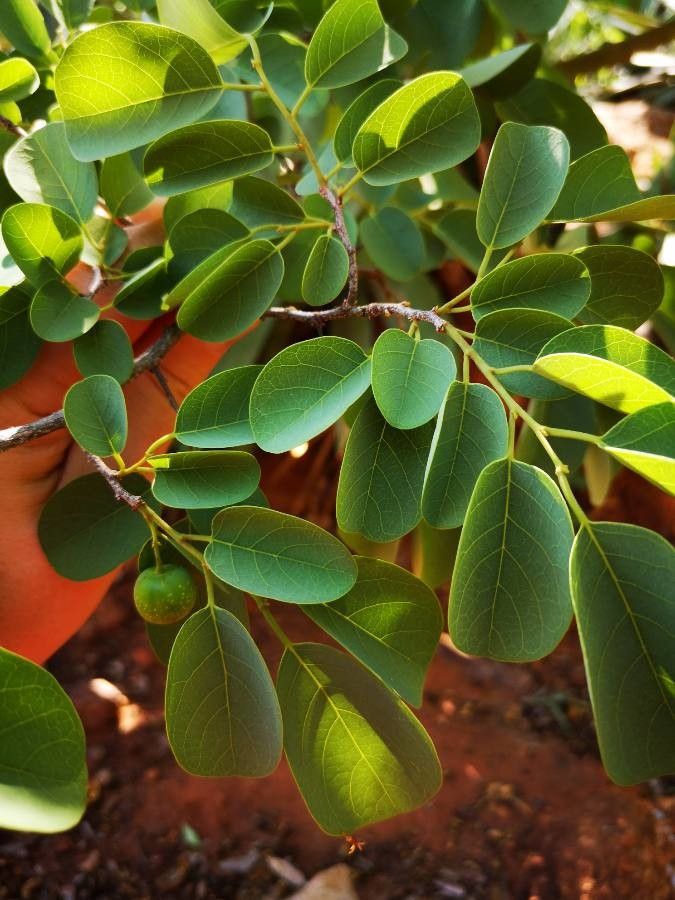
Pseudolachnostylis maprouneifolia, commonly known as the African wild pear or umqokolo, is a tree species native to southern Africa. It belongs to the Rosaceae family and can grow up to 20 meters tall. The tree features a dense crown of glossy, leathery, dark green leaves. Its bark is smooth and greyish-brown.
The African wild pear produces small white flowers that bloom from September to November, followed by small edible fruits that ripen from December through February. The fruit has a sweet taste and is often used for making jams or eaten fresh.
This tree has various uses in traditional medicine, as its bark, leaves, roots, and fruits are employed to treat ailments such as diarrhea, dysentery, and fever.
Pseudolachnostylis maprouneifolia is also valued for its hard wood, making it an important source of timber for furniture and construction materials, such as poles.
Despite its various uses and contributions to southern Africa's ecosystem services, such as carbon sequestration, Pseudolachnostylis maprouneifolia faces threats from habitat loss due to deforestation caused by human activities, including logging. Consequently, it is classified under the IUCN Red List category "Least Concern."
Kudu berry is fairly disease-resistant and typically not prone to illness. In terms of care, the plant is relatively low-maintenance. When grown outdoors it needs minimal watering, and larger plants generally don't require pruning. Smaller plants, however, should be pruned after they have finished blooming. Kudu berry is suitable for anyone with an outdoor area, such as a garden or deck, and does not demand a lot of care experience.
How to keep Pseudolachnostylis Maprouneifolia.
Light
Kudu berry comes from open habitats, like sunny meadows and forest margins, that receive plenty of light. It performs best in Full Sun but can withstand Partial Sun, showing good adaptability to different light conditions.
Temperature
Kudu berry comes from tropical areas, where the climate is usually warm and humid. As a result, it is well adapted to high temperatures and humidity. It does not tolerate sudden temperature changes and prefers a stable temperature environment, so avoiding temperature fluctuations indoors is important. It generally cannot endure cold and requires warmer temperatures to grow. If the environmental temperature falls too low, the plant may stop growing or even die.
Fertilizer
Fertilization is essential to the care of the Kudu berry. Regular feeding during the growing season maintains the energy for its showy leaves and supports overall growth. If fertilization is neglected, leaves can become unhealthy, the plant’s ornamental value can decline, and growth may be stunted or weak and prone to breakage.
Botanical profile.
- Plant Type
- Tree
- Life Cycle
- Perennial
- Genus
- Pseudolachnostylis
- Family
- Phyllanthaceae
- Hardiness Zone
- 9-11
- Mature Height
- 3.96 m to 10.06 m
- Mature Spread
- 3.05 m to 6.1 m
- Leaf Color
- Dark Green, Olive Drab
- Leaf Type
- Deciduous
- Flower Size
- 0.51 cm to 0.76 cm
- Bloom Time
- Mid spring, Late spring, Early summer
- Planting Time
- Spring, Summer, Autumn
- Harvest Time
- Mid summer, Late summer, Early fall
- Native Area
- Malawi, Angola, Burundi, Mozambique, Tanzania, South Africa, Zambia, Namibia, Congo (DRC), Botswana, Zimbabwe