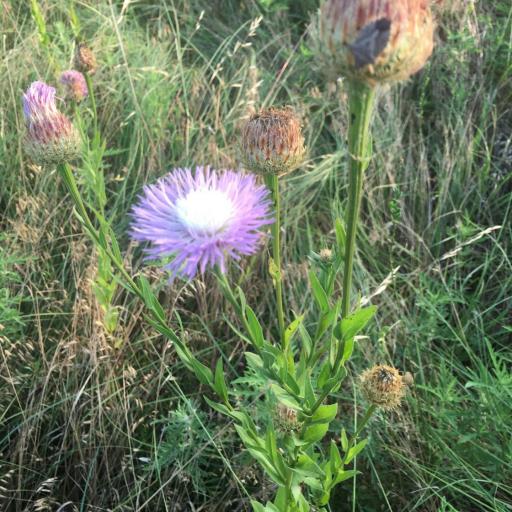
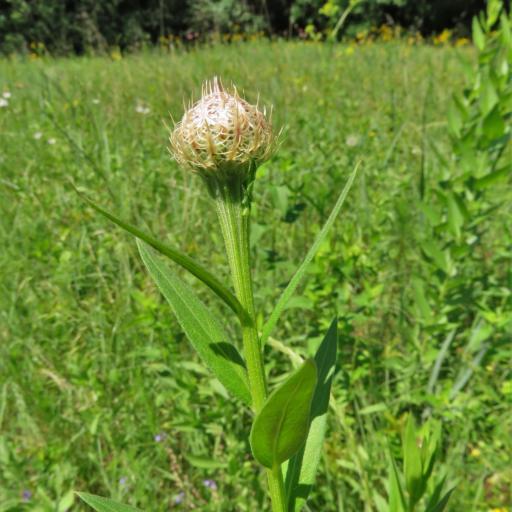
Centaurea americana, commonly called American starthistle or American basketflower, is an annual native to the southern central United States and northeastern Mexico. Its common name comes from the underside of the inflorescence, which has a basket weave pattern on it and on the flowerbuds. The pink petals look somewhat like a thistle with a cream colored center. Blooms are 4" in diameter and are held from May until June. The plant can reach 5-6' tall and has rough 4" long lance-shaped leaves. The plant is often cultivated for its showy flowers, and can sometimes be found outside its native range as an escape from cultivation.
American basket-flower has good disease resistance and is generally not prone to diseases. However, it can be affected by pests and diseases present in its surroundings. Such infections are usually not severe. In terms of care, this plant requires a moderate level of maintenance. It should be pruned regularly to preserve a tidy appearance and support healthy growth. Fertilization can also help encourage flowering. American basket-flower is suitable for anyone with outdoor space, such as a garden or patio, and does not require much care experience. It may need more attention when grown indoors.
How to keep Plectocephalus Americanus.
Light
The american basket-flower does best when given ample light for most of the day, which encourages stronger growth and more blooms. It can, however, tolerate a position with some dappled shade. Too little or too much light may cause decreased flowering and reduced vigor.
Water
The American basket-flower thrives in grassland environments where it receives moderate moisture and regular weekly watering. Although it can endure brief periods of drought, it benefits significantly from seasonal rainfall, which influences its water requirements and flowering cycles.
Temperature
American basket-flower can tolerate a wide range of temperatures, but its distribution may still be restricted by different combinations of moisture and heat. It performs best in warm summer climates with sufficient rainfall or irrigation. Extended periods of cloudy, rainy weather or prolonged high temperatures increase the chance of the American basket-flower dying. In winter, adequate protection from cold can boost the plant's survival chances.
Fertilizer
When the American basket-flower has opened most of its blooms to full size, resume fertilizing. During the period of peak bloom production, feed it every three to four weeks as the weather allows. Once the American basket-flower begins producing fewer new blooms, stop fertilizing; there’s no need to feed it when it can no longer produce more flowers.
Pruning
To promote healthy blooms and vitality, American basket-flowers benefit from annual pruning in early to late spring. Trim away spent flowers and dead stems, cutting back to the base if the plant becomes leggy. Regular pruning not only enhances the plant's density and flowering season but also maintains its aesthetic appeal.
Botanical profile.
- Plant Type
- Herb
- Life Cycle
- Annual
- Genus
- Plectocephalus
- Family
- Asteraceae
- Hardiness Zone
- 7-10
- Mature Height
- 0.61 m to 1.52 m
- Mature Spread
- 30 cm to 46 cm
- Leaf Color
- Green, Light Green
- Leaf Type
- Semi-evergreen
- Flower Color
- Purple, Lavender
- Flower Size
- 7.62 cm to 10.16 cm
- Bloom Time
- Early summer, Mid summer
- Planting Time
- Spring, Summer, Autumn
- Harvest Time
- Late summer, Early fall
- Native Area
- Mexico
Other names.