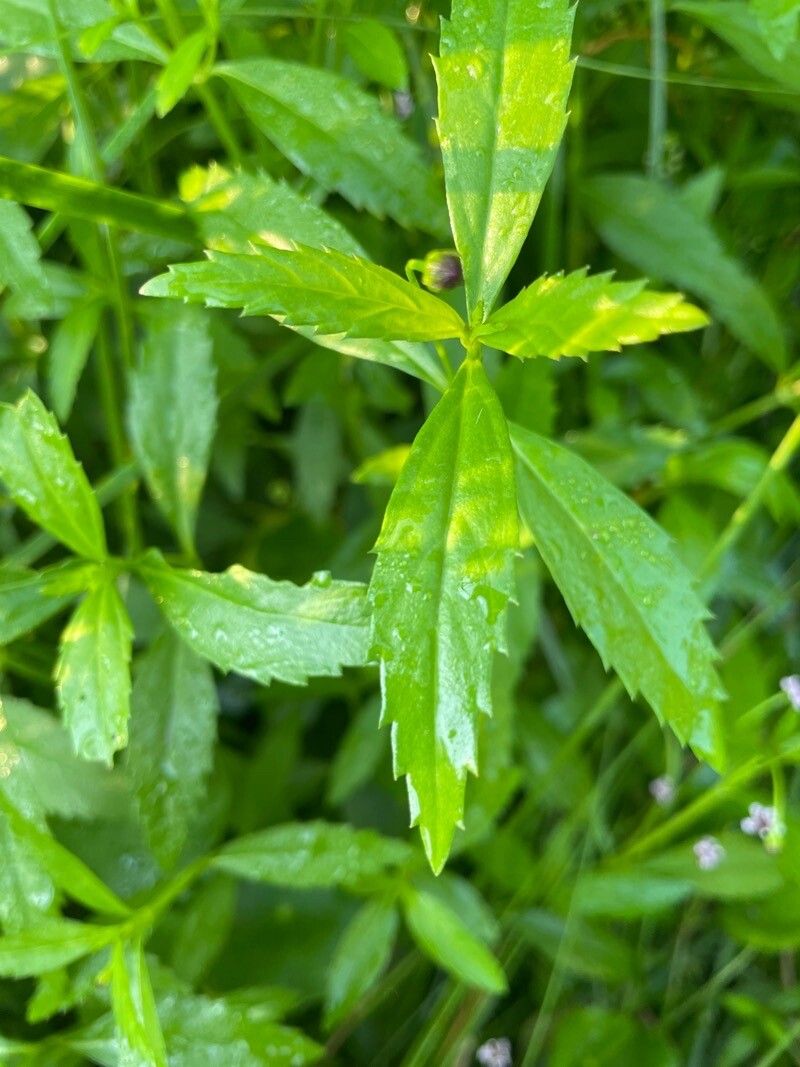
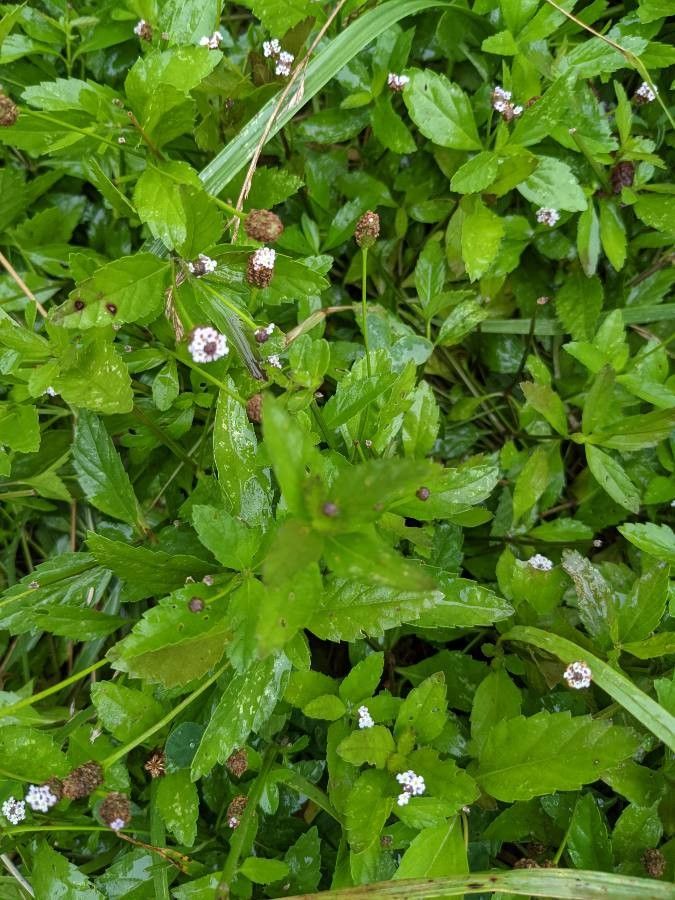
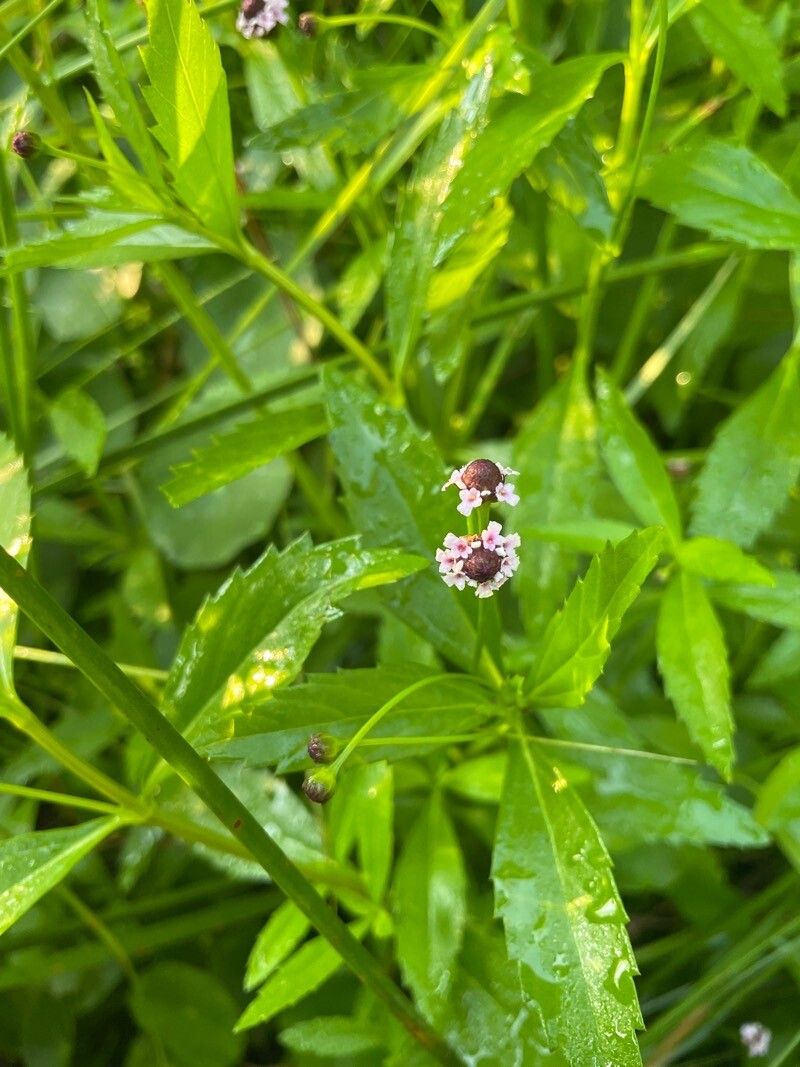
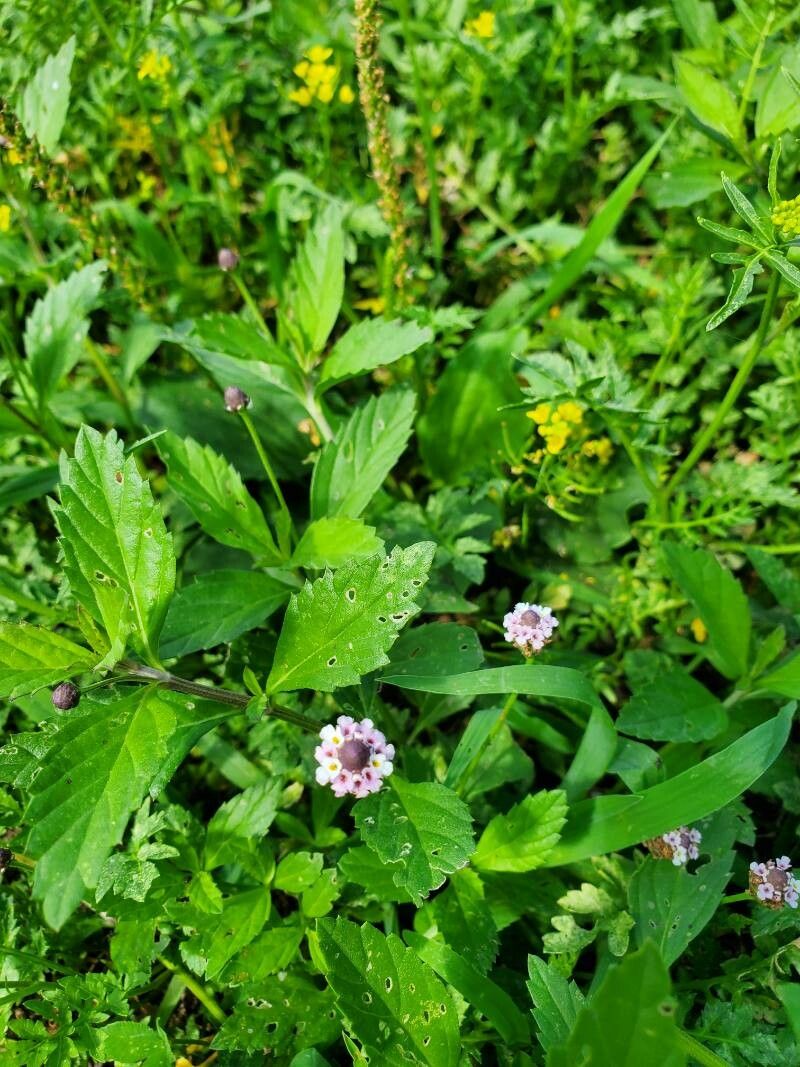
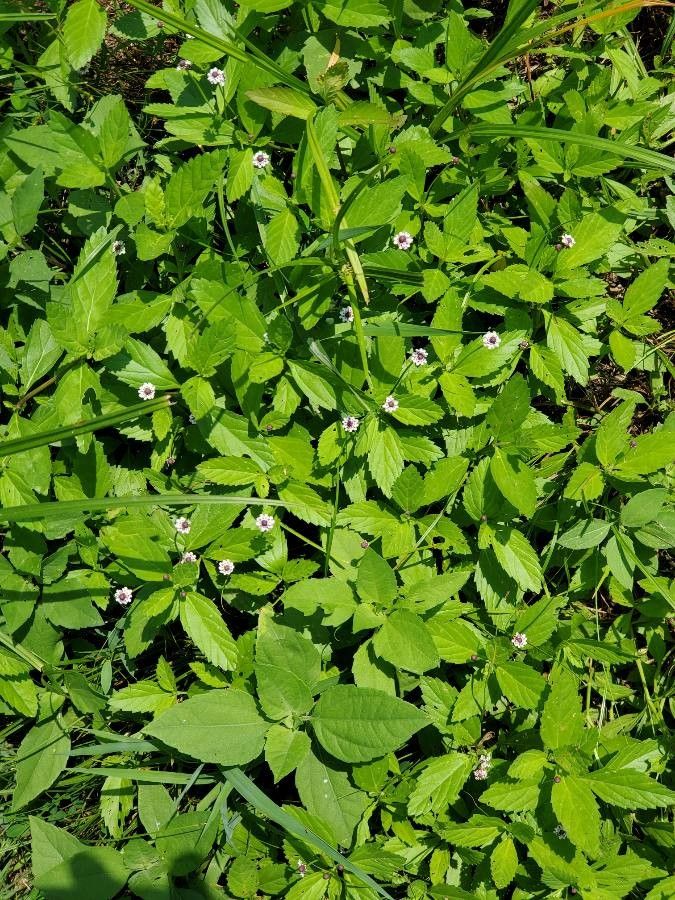
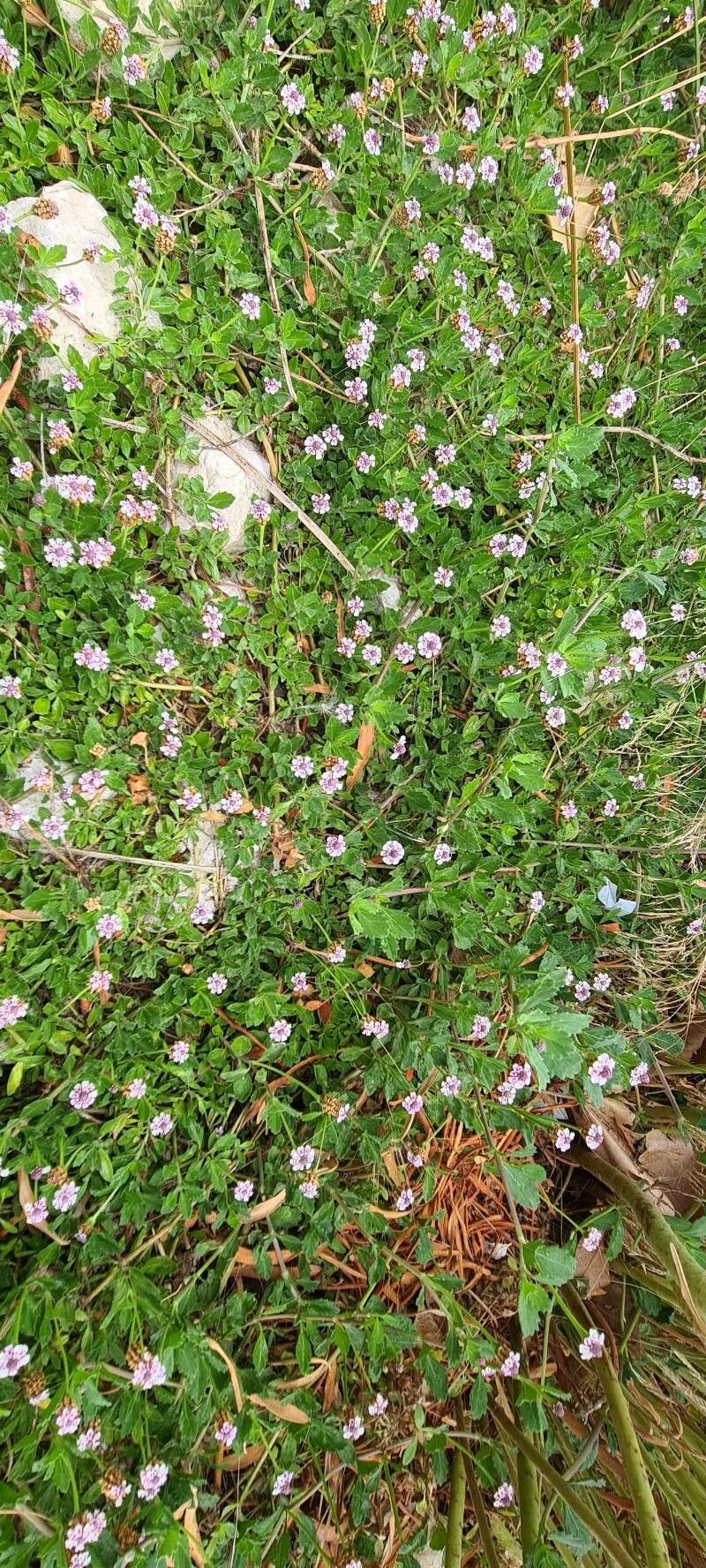
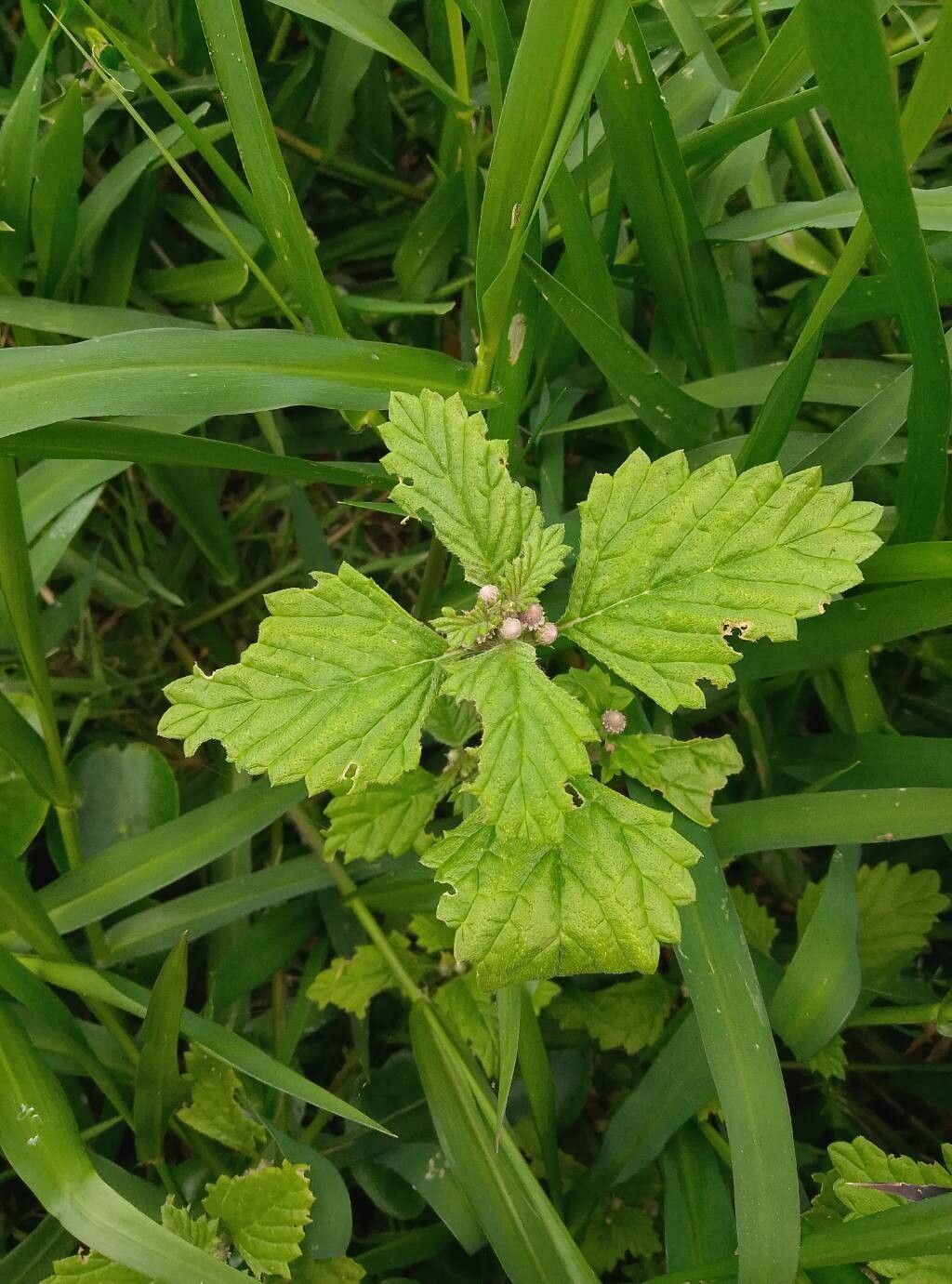
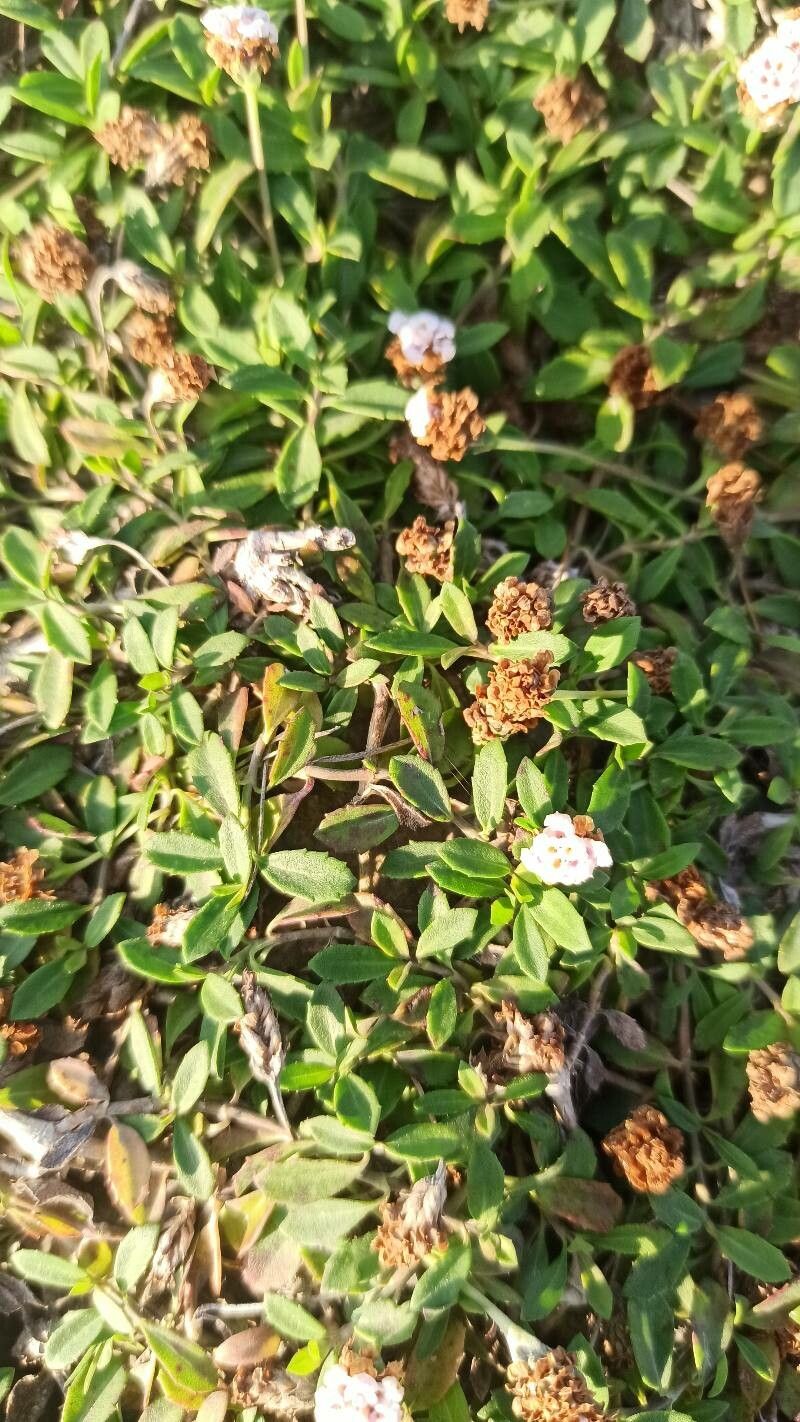
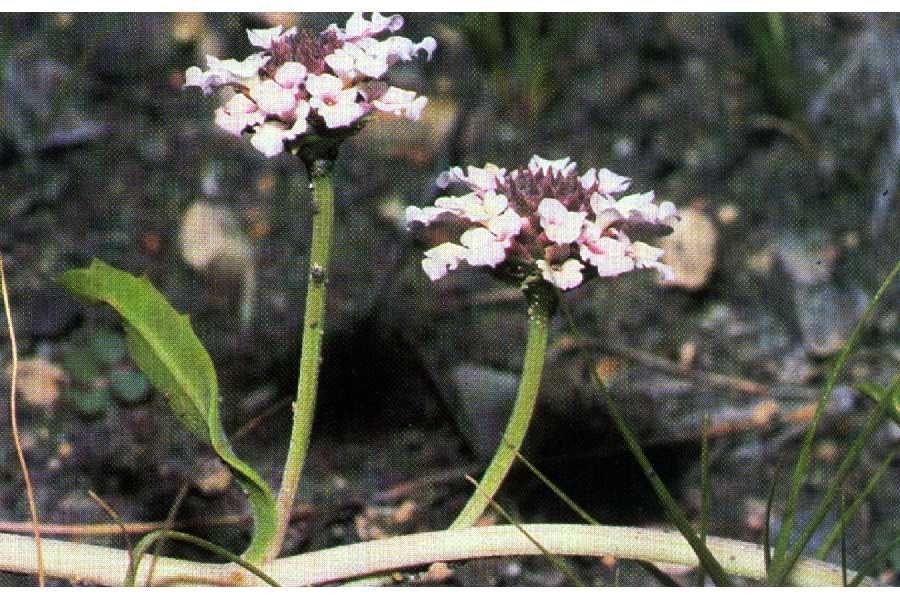
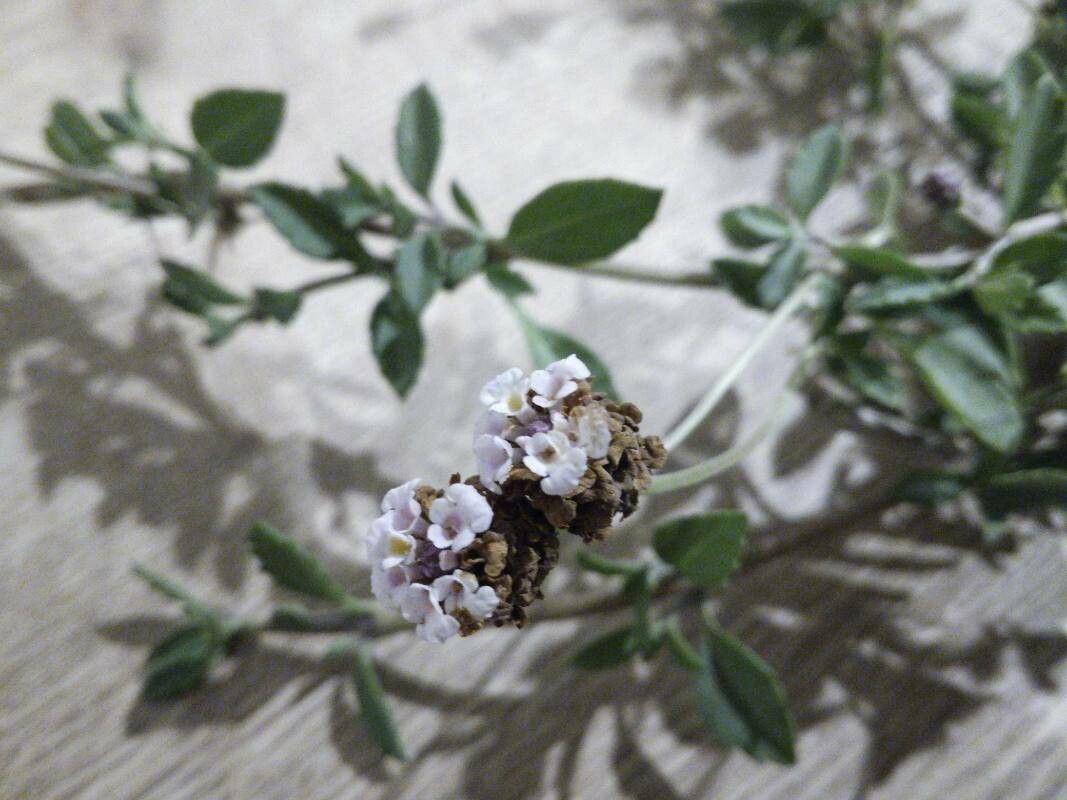
Phyla lanceolata is a species of flowering plant in the verbena family known by the common names lanceleaf fogfruit, fogfruit, or frogfruit. It is native to the southern half of North America, including much of the United States except for the northwestern quadrant, and much of Mexico. It is resident in many types of moist and wet habitat, including disturbed areas, such as irrigation ditches. It is a perennial herb growing decumbent in a matlike form with spreading, trailing stems up to half a meter long, sometimes rooting at nodes. The lance-shaped or nearly oval leaves are up to 6 centimeters long and have toothed or partially toothed edges. The inflorescence, arising on a peduncle several centimeters tall, is a spherical spike of flowers which elongates into a cylindrical form as the fruits develop. The tiny, densely packed flowers are white, sometimes tinged with blue or purple. It is similar to the related species Phyla nodiflora, but differs in having much longer and more pointed leaves. Both species are common as weeds and in the ornamental environment. An older scientific name for this species is Lippia lanceolata, and in some older references 'frogfruit' is provided as a common name.The Acadian French name for the plant is "caille eau," stemming from the superstition that it can curdle water.
Lanceleaf Fogfruit shows strong resistance to diseases and is typically not vulnerable to them. Still, it can be affected by pests and diseases present in its environment. Such infections tend to be mild. Regarding maintenance, this plant requires moderate care. It should be pruned regularly to preserve a neat appearance and support healthy growth. Applying fertilizer can also encourage flowering. Lanceleaf Fogfruit is appropriate for anyone who has an outdoor area, like a garden or patio, and does not demand extensive plant-care experience. It may need extra attention when cultivated indoors.
How to keep Phyla Lanceolata.
Light
Lanceleaf Fogfruit does best in settings with moderate sun exposure, which promotes healthy growth. Its original habitat accounts for this preference, since comparable light levels occur there naturally. Excessive sunlight can stress and damage the plant, while too little light can impair its development, disrupting its growth and life cycle.
Water
Lanceleaf Fogfruit thrives in moisture-rich environments, needing consistent hydration with evenly moist soil. While it has moderate drought tolerance, it benefits from weekly watering to support its growth. As a herbaceous perennial, Lanceleaf Fogfruit adjusts its water intake based on rainfall patterns during the growing season.
Temperature
Lanceleaf Fogfruit comes from temperate regions and grows well in temperatures between 41 and 100 °F (5 to 38 ℃). It favors mild conditions, so you should change indoor temperatures with the seasons. Keep the environment warmer in winter and cooler in summer.
Fertilizer
Usually one application of fertilizer in spring is enough for Lanceleaf Fogfruit, although several feedings can enhance growth. Fertilize every one to one-and-a-half months. Fertilization improves the leaves' appearance and function, helping maintain even color and a healthy texture. It also promotes root development and nutrient uptake for long-term plant health.
Pruning
Lanceleaf Fogfruit has small, lance-shaped leaves and grows low to the ground. To encourage denser growth and more flowers, prune it from early to late spring. Be sure to trim away any dead or diseased stems to improve its health and appearance. Regular pruning helps maintain strong growth throughout the season.
Pot & Repot
Repot your lanceleaf fogfruit every two to three years during the spring. Use a shallow, wide container for the best results. After repotting, place the plant in indirect light and maintain moist soil without overwatering. This will help the plant recover and encourage its foliage and blooms to spread.
Botanical profile.
- Plant Type
- Herb
- Life Cycle
- Perennial
- Genus
- Phyla
- Family
- Verbenaceae
- Hardiness Zone
- 5-11
- Mature Height
- 15 cm to 52 cm
- Mature Spread
- 1.22 m
- Leaf Color
- Green
- Leaf Type
- Semi-evergreen
- Flower Color
- White
- Flower Size
- 1.27 cm
- Bloom Time
- Late spring, Summer, Early fall, Mid fall
- Planting Time
- Spring, Summer, Autumn
- Harvest Time
- Mid summer, Late summer, Fall
- Native Area
- Honduras, Mexico
Other names.
Reader questions.
How should I water my Lanceleaf Fogfruit plant to make sure it grows well?
To properly care for the Lanceleaf Fogfruit, it is best to use filtered water at room temperature. Tap water may have particles that are harmful to this plant's health. It is important to use water that is at room temperature or slightly warmer because the Lanceleaf Fogfruit comes from a warm environment and cold water can be a shock to its system. Avoid overhead watering as it can cause issues with the foliage. Instead, thoroughly soak the soil with your filtered, room temperature water. This helps to moisten the roots and allows them to spread and collect essential nutrients from the soil.
Why should I put fertilizer on my Lanceleaf Fogfruit plant?
The Lanceleaf Fogfruit's leaves are essential to its structure, and fertilization is a powerful way to improve their appearance and function. By properly fertilizing, you can maintain consistent color and a healthy texture in the leaves. Fertilization also benefits the plant below the surface, promoting the growth of new roots and the maintenance of existing ones. This not only supports the plant's current health but also enhances its ability to absorb nutrients from the soil in the future.
How much sunlight does Lanceleaf Fogfruit need to grow?
To help Lanceleaf Fogfruit thrive, it needs both sunlight and shade. Ideally, it should receive about 3-6 hours of direct sunlight each day, preferably in the morning when the sun is not too intense. However, during the hottest parts of the day, it's important to protect it from sun damage by providing some shade. If the temperature is not too hot, it can tolerate some afternoon sun as well. To achieve the optimal balance, consider planting Lanceleaf Fogfruit in a spot that gets partial sun, such as under a tree or on the east side of a building.
What is the native climate for Lanceleaf Fogfruit?
Lanceleaf Fogfruit, known botanically as Phyla lanceolata, is native to temperate environments. It thrives best within a temperature range of 41 to 100 °F (5 to 38 °C), favoring mild climates. It's important for growers to adjust the indoor settings according to seasonal temperatures to mimic its native climate as closely as possible, ensuring a warmer environment in winter and a cooler one during summer months.
What should I do if I give my Lanceleaf Fogfruit too much water or too little water?
Overwatering can severely damage your Lanceleaf Fogfruit, and it is a more frequent issue. When this plant gets excessive water, its stems and leaves may wilt and turn yellow. Extended overwatering can also cause diseases like root rot, mold, and mildew, which can be fatal for the plant. Underwatering is less common for the Lanceleaf Fogfruit due to its ability to tolerate drought. However, it is still possible, and in this case, the leaves will become brittle and brown. It is important to recognize the signs of overwatering early when caring for your Lanceleaf Fogfruit. Some diseases caused by overwatering, like root rot, can't be reversed if you wait too long. If you notice early signs of overwatering, reduce your watering schedule immediately. Also, check the quality of the soil in which your Lanceleaf Fogfruit is growing. If the soil drains poorly, replace it with a loose, well-draining potting mix. On the other hand, if you observe signs of underwatering, simply increase your watering frequency until the signs disappear.
When should I give my Lanceleaf Fogfruit plant fertilizer?
When you grow your Lanceleaf Fogfruit outdoors, you can expect new growth in early spring. This is the signal that it's time to start fertilizing for the year. Usually, one application of fertilizer in the spring is sufficient for the plant to thrive. However, if you want to maximize its growth, you can fertilize multiple times during the spring and early summer. In this case, you can feed your Lanceleaf Fogfruit once every month to a month and a half.
What will happen if Lanceleaf Fogfruit doesn't get enough sunlight?
Lanceleaf Fogfruit can experience yellowing, drying, or burning of its leaves when exposed to excessive direct sunlight. In addition, you may observe wilting or stunted growth of the plant. To avoid sun damage, it is important to provide some shade for Lanceleaf Fogfruit during the hottest times of the day. This can be achieved by using a shade cloth or planting it near taller plants that offer natural shade.
Does Lanceleaf Fogfruit need frost protection in winter?
Lanceleaf Fogfruit has strong cold resistance, making it generally unnecessary to take special frost protection measures during the winter season. However, in regions where winter temperatures are expected to drop below -25°C, it becomes crucial to provide cold protection to prevent damage. This can be done by covering the plant with materials such as soil or straw. Additionally, watering the plant abundantly before the first freeze in autumn ensures the soil remains moist and enters a frozen state, which helps prevent drought and water scarcity for the plant during winter and early spring.
How often should I give water to my Lanceleaf Fogfruit?
If your Lanceleaf Fogfruit plant is in a pot, the best way to determine if it needs water is to check the soil. Simply stick your finger into the soil and if the top two to three inches are dry, it's time to water. The same method can be used if you have the plant outdoors in the ground. When the top few inches of soil have dried out, it's time to water. In the spring and early fall, you'll typically need to water about once a week using this method. However, in extremely hot weather, you may need to water twice or more per week. It's worth noting that mature Lanceleaf Fogfruit plants that are well-established have a remarkable ability to tolerate drought.
When is it not a good idea to add fertilizer to my Lanceleaf Fogfruit?
During the late fall and winter, your Lanceleaf Fogfruit will go into a dormant phase and stop producing new growth. It's important to refrain from fertilizing your Lanceleaf Fogfruit during this time. If you decide to fertilize it multiple times in the spring and summer, start reducing the amount of fertilizer as summer approaches because the growth rate of your Lanceleaf Fogfruit will also slow down. In general, it's not a good idea to fertilize your Lanceleaf Fogfruit during excessively hot weather or when the soil is extremely dry. Fertilizing under these conditions can cause stress to your Lanceleaf Fogfruit and lead to premature death.
What will happen if Lanceleaf Fogfruit gets too much sunlight?
If Lanceleaf Fogfruit doesn't receive sufficient sunlight, it can become tall and thin with not many leaves. The leaves may also appear yellow or pale green, indicating a lack of chlorophyll due to lack of sun. To fix this, try relocating the Lanceleaf Fogfruit to a sunnier area or trim nearby foliage to allow more light to reach the plant.
How does Lanceleaf Fogfruit respond to low temperatures?
Lanceleaf Fogfruit is cold-tolerant and prefers temperatures to stay above 5°C. Throughout winter, maintaining the temperature above -20°C is crucial for its survival. If temperatures fall below -25°C, the plant may not show noticeable changes during the winter but could have decreased sprouting or fail to sprout at all in the spring. In response to these conditions, the suggested solution is to remove any parts of the plant that have failed to sprout in spring.