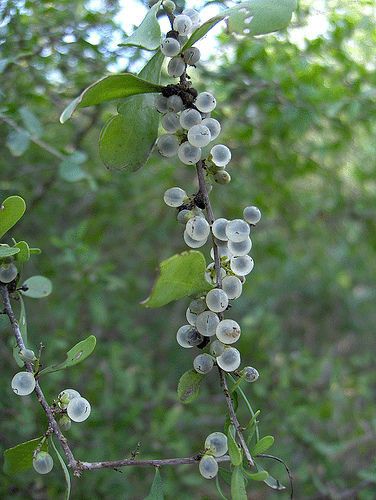
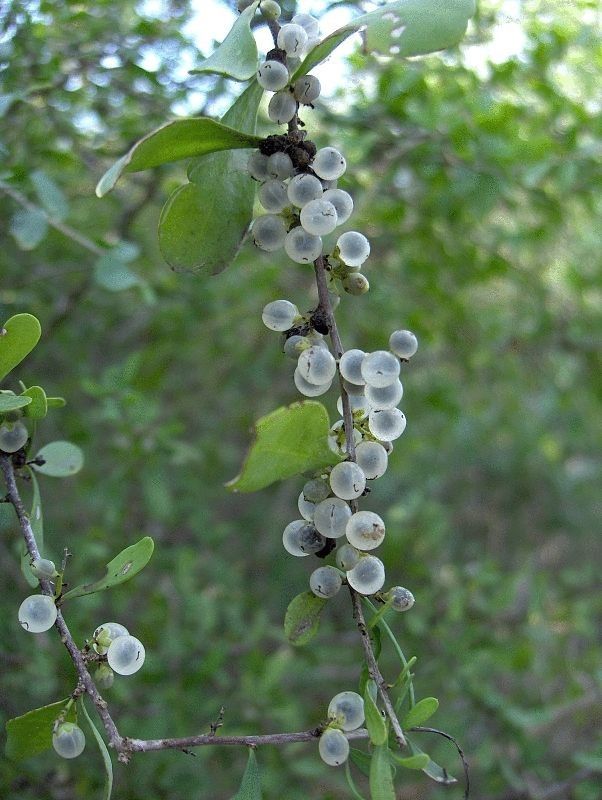
Phaulothamnus is a genus of plants formerly included in the family Phytolaccaceae but now considered a part of the Achatocarpaceae.Only one species is recognized: Phaulothamnus spinescens A. Gray, native to Texas, Tamaulipas, Nuevo León, Sonora and Baja California. This is a branching shrub with juicy berries. Common names includes devilqueen, snake-eyes or putia. Phaulothamnus spinescens is a branching shrub up to 250 cm tall, with spines along the branches. Leaves are broader than wide, up to 35 mm wide but rarely more than 12 mm long. Flowers are borne one at a time or in racemes. Fruits are spherical, juicy, white to greenish with the black seeds visible through the thin fruit wall.
Devilqueen has strong resistance to disease and is usually not prone to illnesses. In terms of care, this plant is fairly low-maintenance. When grown outdoors it needs minimal watering, and larger plants generally do not require pruning. Smaller plants, however, should be pruned after they have bloomed. Devilqueent is suitable for anyone with an outdoor area, such as a garden or deck, and does not require much care experience.
How to keep Phaulothamnus Spinescens.
Light
Devilqueen comes from open habitats, such as sunny meadows and forest edges, that offer abundant light. It thrives in Full Sun but can also tolerate Partial Sun, adapting well to different sunlight conditions.
Water
Originating from arid regions, the devilqueen is drought-tolerant and thrives in dry conditions. Watering it once a week is enough to keep it healthy. Although it's typically grown outdoors, it excels in low-maintenance, water-efficient settings, making it an ideal choice for xeriscaping or dry gardens.
Temperature
Devilqueen comes from tropical areas, where the weather is generally warm and humid. Therefore, it is adapted to high temperatures and humidity. It is sensitive to sudden temperature changes and prefers a steady thermal environment, so indoor temperature fluctuations should be avoided. It usually cannot tolerate cold conditions and needs warmer temperatures to grow. If the surrounding temperature falls too low, the plant may stop growing or even die.
Fertilizer
Fertilization is essential to Devilqueen care. Regular feeding during the growing season provides energy for its showy leaves and supports overall growth. Neglecting fertilization can lead to unhealthy leaves, reduced ornamental appeal, and stunted or weak growth that is prone to breaking.
Pruning
The Devilqueen plant has a spiky appearance and needs regular pruning to maintain its shape and promote healthy growth. It's best to prune it from early to late winter, removing any dead branches and thinning out crowded areas to improve air circulation. Using clean, sharp tools helps prevent disease, strengthen the plant's structure, and reduce the risk of pests.
Botanical profile.
- Plant Type
- Shrub
- Life Cycle
- Perennial
- Genus
- Phaulothamnus
- Family
- Achatocarpaceae
- Hardiness Zone
- 8-11
- Mature Height
- 1.83 m to 3.66 m
- Mature Spread
- 0.91 m to 2.13 m
- Leaf Color
- Green
- Leaf Type
- Evergreen
- Flower Size
- 0.20 cm to 0.25 cm
- Bloom Time
- Early summer, Mid summer
- Planting Time
- Spring, Summer, Autumn
- Harvest Time
- Late summer, Early fall
- Native Area
- Mexico
Other names.