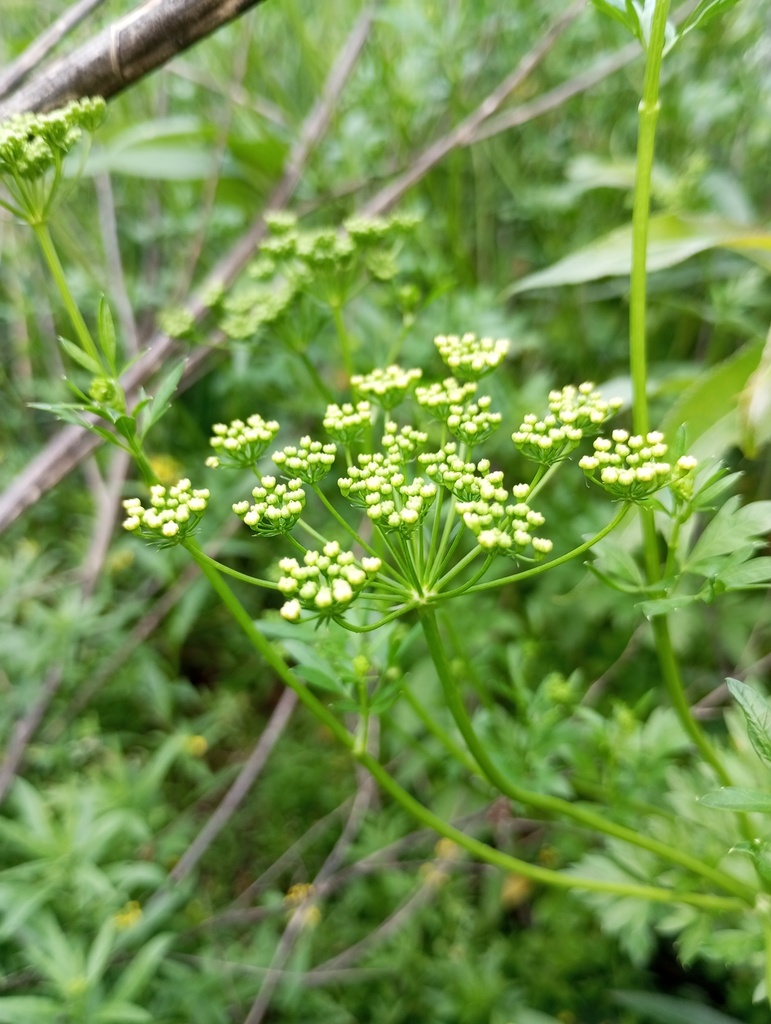
Parsley, or garden parsley (Petroselinum crispum) is a species of flowering plant in the family Apiaceae that is native to the central and eastern Mediterranean region (Sardinia, Lebanon, Israel, Cyprus, Turkey, southern Italy, Greece, Portugal, Spain, Malta, Morocco, Algeria, and Tunisia), but has been naturalized elsewhere in Europe, and is widely cultivated as a herb, and a vegetable. Parsley is widely used in European, Middle Eastern, and American cuisine. Curly leaf parsley is often used as a garnish. In central Europe, eastern Europe, and southern Europe, as well as in western Asia, many dishes are served with fresh green chopped parsley sprinkled on top. Flat leaf parsley is similar, but it is easier to cultivate, some say it has a stronger flavor. Root parsley is very common in central, eastern, and southern European cuisines, where it is used as a snack or a vegetable in many soups, stews, and casseroles. It is believed to have been originally grown in Sardinia (Mediterranean area) and was cultivated in around the 3rd century BC. Linnaeus stated its wild habitat to be Sardinia, whence it was brought to England and apparently first cultivated in Britain in 1548, though literary evidence suggests parsley was used in England in the Middle Ages, as early as the Anglo-Saxon period.
Parsley has moderate resistance to disease but can be prone to ailments like leaf spot. Its sensitivity to insect pests varies with the variety, though most types are relatively less resistant to pests. For care, parsley needs consistent watering and fertilizing, along with frequent removal of yellow leaves. It is important to address pests and diseases when they appear and to harvest the plant promptly. Parsley is appropriate for people who can devote some time and energy to regular maintenance.
How to keep Petroselinum Crispum.
Light
Parsley grows best with constant sunlight, particularly during its growth stage. Native to habitats with abundant sun, it can tolerate periods of weaker light, though this may affect its health and growth. Excessive or insufficient sunlight can cause pale leaves and stunted development.
Water
Parsley, which originates from the Mediterranean, prefers consistently moist soil and thrives when watered twice a week. It is sensitive to both drought and waterlogging, so maintaining the right moisture level is crucial. During its growing season, parsley requires careful watering to ensure optimal leaf production and to prevent stress from either overwatering or underwatering.
Humidity
This plant will thrive in moderate humidity, which is probably the level in your home. However, misting it a few times a week can be very beneficial. Make sure the room has good ventilation.
Temperature
Parsley originates from regions with cool to moderately warm temperatures, typically between 68 and 100 °F (20 to 38 ℃). It prefers those conditions and may need slight adjustments to its surroundings in the extreme cold of winter or the extreme heat of summer.
Fertilizer
To maximize the yield and flavor of Parsley, provide adequate nitrogen throughout the entire growth cycle, including the pre-planting stage and at harvest. Well-watered, properly fertilized plants develop abundant, healthy leaves and have reduced bitterness. Prior to planting, amend the soil with organic matter such as compost or manure, ideally 2 to 8 weeks in advance.
Pruning
Parsley has fragrant leaves that are perfect for cooking. To promote dense growth and prevent a leggy appearance, it's best to use pruning techniques like harvesting and pinching back between early and late spring. Regular pruning also boosts air circulation, lowers the risk of disease, and improves overall plant health.
Pot & Repot
When repotting Parsley, choose a pot about 1–2 inches (2.5–5.1 cm) larger in diameter that has good drainage. Use a well-draining potting mix and consider adding perlite for extra drainage. Repot in spring or early summer, water thoroughly afterward, and place it in a shady spot at first.
Botanical profile.
- Plant Type
- Herb
- Life Cycle
- Biennial, Annual, Perennial
- Genus
- Petroselinum
- Family
- Apiaceae
- Hardiness Zone
- 2-11
- Mature Height
- 25 cm to 30 cm
- Mature Spread
- 25 cm to 30 cm
- Leaf Color
- Green
- Leaf Type
- Deciduous, Evergreen
- Flower Color
- Yellow, Green
- Flower Size
- 0.20 cm
- Bloom Time
- Late spring, Early summer, Mid summer
- Planting Time
- Spring, Summer, Autumn
- Harvest Time
- Mid summer
- Native Area
- Europe
Other names.
Reader questions.
How should I water my Parsley plant?
Parsley has specific water preferences and is particular about how it is watered. If you don't water it correctly, you could harm your tomatoes. The best way to water Parsley is to slowly and gently apply the water directly to the soil. Avoid pouring all the water at once and avoid overhead watering. It is important to water slowly and deeply to ensure that the soil where your Parsley is growing is adequately moist.
Why should I put fertilizer on my Parsley plant?
Parsley, being cultivated for its edible leaves, has specific nutrient requirements. All plants need essential nutrients, such as nitrogen, phosphorus, and potassium, to grow properly. However, when it comes to foliage, nitrogen is the most important nutrient for supporting growth. Parsley often struggles to obtain enough nitrogen from the soil to produce a satisfying harvest. As a result, many gardeners choose to supplement by providing extra nitrogen through heavy feeding.
What are the sunlight requirements for parsley?
Parsley requires a significant amount of sunlight to thrive, ideally flourishing under conditions that offer continuous exposure. For optimal growth, parsley should be exposed to full sun, receiving more than 6 hours of sunlight daily. However, it can also manage in partial sun, where it gets about 3-6 hours of sunlight. Adjusting to the movement of sunlight through your garden is crucial, as finding the right balance of light and shade is important for the health of your plants. Despite its resilience, inadequate or excessive sunlight exposure can lead to pale leaves and stunted growth, impacting the plant's overall well-being.
What is the origin and preferred climate for parsley?
Parsley, scientifically known as Petroselinum crispum, originates from regions with cool to moderately warm climates, favoring temperatures between 68°F (20°C) and 100°F (38°C). It thrives in these conditions and may require adjustments in extreme cold winter or hot summer weather. To support its growth, especially during winter, it's important to maintain temperatures above the plant's minimum tolerance level and ensure they do not fall to freezing points to prevent damage.
What should I do if I give my Parsley too much water or too little water?
If you've overwatered your Parsley and are worried about disease risks, take immediate action. The best approach is usually to remove the plant from its current location and let its roots dry a little before replanting it somewhere with good soil drainage. If you're growing in pots, you can also consider moving the plant to a pot with better drainage. On the other hand, if you've underwatered your Parsley, simply increase the frequency of watering.
What time should I fertilize my Parsley?
To ensure your Parsley grows successfully, it is important to apply fertilizer at different points during the growing season. The first application should be made when preparing the ground for planting, ideally 2 to 8 weeks before planting. This involves thoroughly amending the soil with nutrient-rich organic materials like compost or manure. At the time of planting, it is necessary to amend the soil again using the same method. Once the seedlings emerge and reach a height of around 2 inches, the next dose of fertilizer can be applied. From there, it is recommended to regularly feed the Parsley with either rich organic matter or a commercial fertilizer until it is ready to be harvested. This can be done every two to three weeks, following a typical schedule. Additionally, it is beneficial to add a layer of compost or manure around the plant. This will provide a continuous supply of nutrients for the Parsley.
How does artificial lighting support parsley growth indoors?
Parsley plants growing indoors require sufficient lighting to ensure optimal growth, especially in environments where natural sunlight is scarce, such as during winter or in less sunny spaces. Artificial lighting, such as LED lights, can be a vital solution, providing the necessary wavelengths of light that plants need. For full sun plants, 30-50 Watts per square foot of artificial light is recommended, while partial sun plants need about 20-30 Watts per square foot, and full shade plants require 10-20 Watts per square foot. The artificial light source should be placed 12-36 inches above the plant, mimicking natural sunlight as closely as possible. Most plants will need 8-12 hours of light per day, mirroring the natural daylight hours for your specific plant species.
How does low temperature affect parsley and what are the remedies?
Parsley possesses a moderate tolerance to low temperatures but flourishes optimally within its suitable temperature range. When the mercury dips below its tolerable growth minimum during winter, its leaves may darken. In extreme cold, symptoms like water-soaked necrosis, wilting, and browning of the leaves can occur. In such cases, frost-damaged foliage should be trimmed away, and the plant should be moved to a warmer indoor setting or safeguarded with a temporary greenhouse. Ensuring enough sunlight through placement near a south-facing window or using artificial lighting is crucial for recovery and continued growth.
How often should I give water to my Parsley?
Parsley needs a lot of water during its growing season. To ensure it receives enough water, it is recommended to water it frequently in the spring and summer. At the beginning of the season, watering once or twice a week should be sufficient. As the season goes on and the weather gets warmer, it may be necessary to water the parsley twice a day or even more. Once the parsley has completed its main growth phases, the watering frequency can be reduced to about once a week until the end of the growing season.
When is it not a good time to put fertilizer on my Parsley plant?
When using nitrogen-rich fertilizers, be cautious about using them near vegetable plants that should be focused on fruiting instead of growing foliage. If you apply it too close, your vegetable plants may produce an abundance of leaves but few vegetables. To avoid harming your Parsley, make sure the fertilizer doesn't come into contact with the leaves and apply it a few inches away from the base of the plant. If your Parsley is already unhealthy due to disease, pests, drought, or other issues, hold off on fertilizing until those problems are resolved. Fertilizer can benefit healthy plants, but it can cause damage when applied to unhealthy ones.
What are the common light deficiency symptoms in parsley?
When parsley is grown indoors or under limited light conditions, it can exhibit several symptoms indicative of light deficiency. These symptoms might include smaller new leaves, leggy or sparse growth with longer spaces between leaves or stems, accelerated leaf drop as the plant sheds older leaves to conserve resources, slower or halted growth due to the plant entering survival mode, pale or irregularly colored new leaves indicating a lack of chlorophyll, chlorosis or the yellowing of leaves, sunscald from excessive light exposure leading to damaged leaves or stems, curled or twisted leaves as a defense mechanism against extreme sunlight, wilting from increased water loss and reduced hydration, and leaf scorching characterized by brown, dry, crispy leaf edges from too much sunlight.
What effect does high temperature have on parsley, and how can it be managed?
Parsley should be kept under its maximum temperature threshold during summer to avoid slowing its growth. Exceeding this limit makes its leaves prone to lightening in color and increases the risk of sunburn. To combat these issues, sunburned or dried portions of the plant should be pruned away. Relocating the plant to a shaded area, particularly protected from the harsh afternoon sun, along with watering it during cooler parts of the day, helps in keeping the soil adequately moist and the plant healthy.