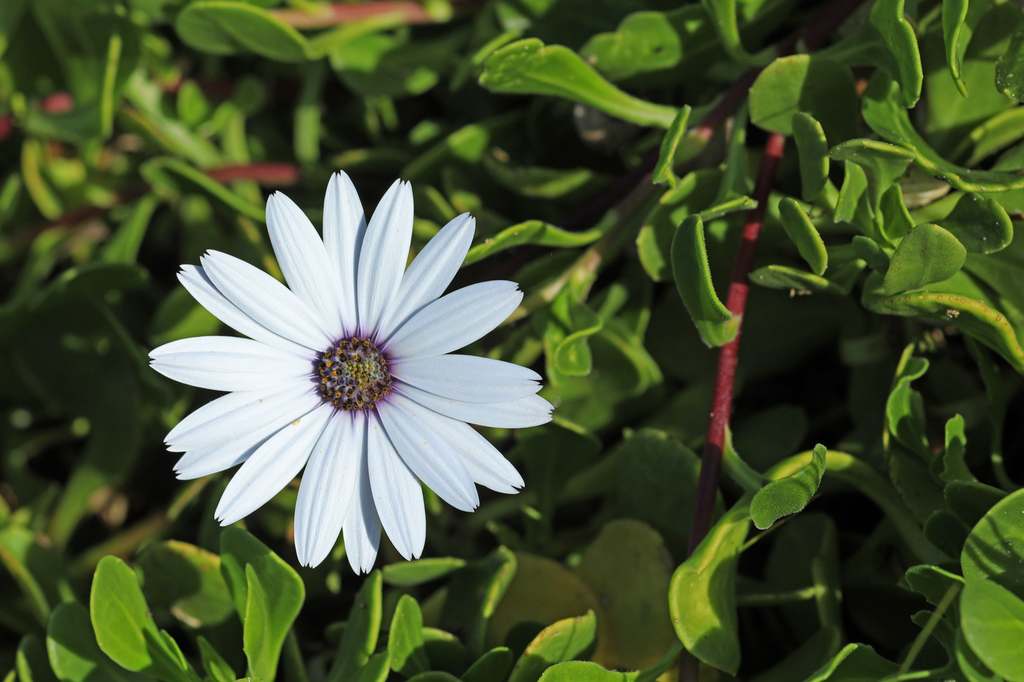
Osteospermum fruticosum, commonly known as the trailing African daisy or trailing Cape daisy, is a perennial plant native to South Africa. Belonging to the Asteraceae family, it is a popular ornamental plant due to its attractive flowers and foliage. It exhibits a trailing growth habit and can reach up to 1 meter in length.
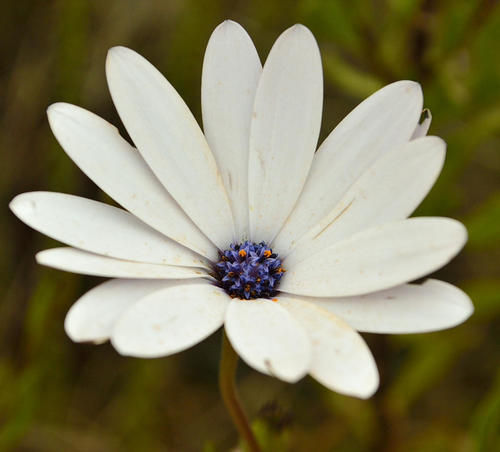
The leaves of Osteospermum fruticosum are small, narrow, and green. The daisy-like flowers feature white or pink petals surrounding a yellow central disk and bloom from spring through fall in warm climates.
This plant thrives in full sun but can also tolerate partial shade. It prefers well-draining soil with moderate moisture levels but can withstand drought conditions once established.
The daisy represents true love, both in its symbolism and in the way its flowers are structured. What appears to be a single flower head is actually a cluster of many florets. The daisy's flower head contains both male and female flowers. In the shrubby daisybush, the ray petals are female, while the disc flowers in the center are individual, pseudo-bisexual flowers. FUN FACT · FROM THE LIBRARY
Osteospermum fruticosum is often used as ground cover or in hanging baskets due to its trailing habit and extended blooming period. Additionally, it attracts pollinators such as bees and butterflies, making it an excellent choice for gardens or landscape designs that promote biodiversity.
Overall, Osteospermum fruticosum is an easy-to-grow perennial that adds color and texture to any planting area while providing ecological benefits by attracting pollinators.
Botanical profile.
- Plant Type
- Herb
- Life Cycle
- Perennial, Annual
- Genus
- Osteospermum
- Family
- Compositae
- Hardiness Zone
- 10
- Mature Height
- 15 cm to 30 cm
- Mature Spread
- 1.22 m to 1.83 m
- Leaf Color
- Green
- Leaf Type
- Evergreen
- Flower Color
- White, Yellow
- Flower Size
- 5.08 cm to 7.62 cm
- Bloom Time
- Mid spring, Late spring, Summer
- Planting Time
- Spring
- Harvest Time
- Late spring, Summer, Early fall
- Native Area
- South Africa