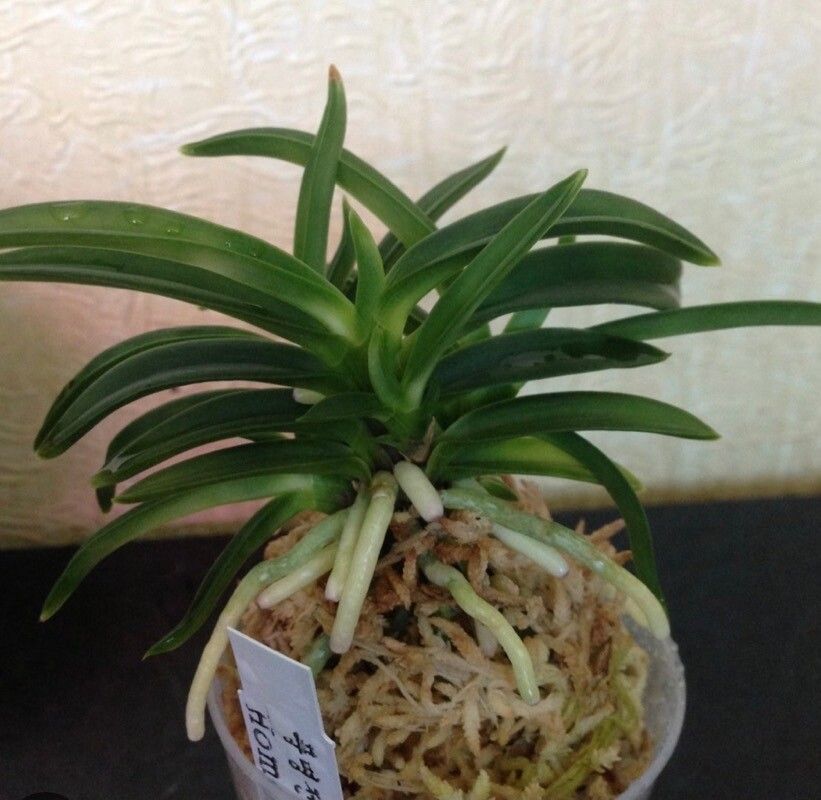
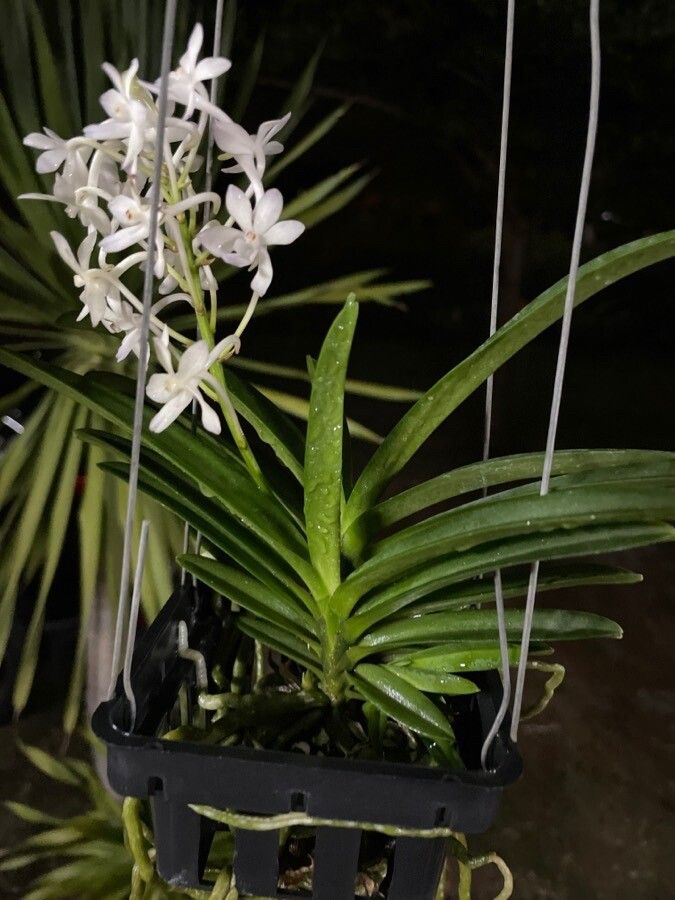
Vanda falcata, the wind orchid, is a species of orchid found in China, Korea, and Japan. It was formerly classified in the genus Neofinetia.
风兰 (feng lan) China (N Fujian, S Gansu, SW Hubei, W Jiangxi, Sichuan, Zhejiang) 풍란 (pungnan) Korea 風蘭 (fūran) Japan (Honshu from the Kantō region westwards; Shikoku; Kyushu; and Ryukyu Islands.)Named cultivars selected for characteristics including variegation, flower color or form, and vegetative form are often referred to as 富貴蘭 (fūkiran) in Japan. Due to these highly variable mutant forms this species has been proposed as a model organism for floral development in orchids.
Samurai orchid is generally resistant to disease and suffers from relatively few insect pests. Its care is considered difficult because it needs high humidity yet good ventilation and an environment with few harmful pathogens. Overwatering can cause root rot. While anyone can grow Samurai orchid, keeping it healthy and getting it to flower again requires more growing experience.
How to keep Neofinetia Falcata.
Light
The samurai orchid thrives best with plenty of sunlight, its natural environment, which supports healthy growth. However, it can also tolerate moderate amounts of sun. Too little or too much sunlight can stress the plant and reduce its vigor and flowering.
Temperature
The Samurai orchid is native to regions with temperatures of 68 to 100 °F (20 to 38 ℃). It does best in those conditions, but can tolerate somewhat cooler climates in winter by reducing watering.
Fertilizer
Proper fertilization is essential for the Samurai orchid's health and appearance. Fertilize the Samurai orchid in summer, repeating the treatment monthly throughout that season. Nutrients support growth and help maintain the plant's parts. Feeding the plant improves its flower display and ensures the best blooms.
Pruning
The Samurai Orchid has no trimming requirements. However, while repotting, you may clip away any dead or extra roots so that the plant will fit in the new container.
Pot & Repot
When repotting a Samurai orchid, pick a pot that is only a bit bigger and has good drainage, ideally a clear orchid pot. Use an orchid-specific, well-draining medium that includes bark or moss. Carefully clean the roots and cut away any that are dead or rotting. Repot after the plant has finished flowering, typically in spring or fall, water well, and set it in bright, indirect light. Do not disturb the roots after repotting.
Toxicity
The vast majority of orchids are safe for both people and animals. However, it poses a possible choking danger. It is essential to use care near children and animals.
Further reading →
The toxicity and danger assessments provided are for reference only. We do not assure their accuracy, so it's crucial not to depend on them. Seek professional advice when necessary for accurate guidance.
Botanical profile.
- Plant Type
- Herb
- Life Cycle
- Perennial
- Genus
- Neofinetia
- Family
- Orchidaceae
- Hardiness Zone
- 9-12
- Mature Height
- 1.22 m
- Mature Spread
- 15 cm
- Leaf Color
- Green, Blue
- Leaf Type
- Evergreen
- Flower Color
- White
- Flower Size
- 5.08 cm to 7.62 cm
- Bloom Time
- Summer, Early fall, Mid fall
- Planting Time
- Spring, Summer, Autumn
- Harvest Time
- Fall, Early winter, Mid winter
- Native Area
- South Korea, Japan, China
Other names.