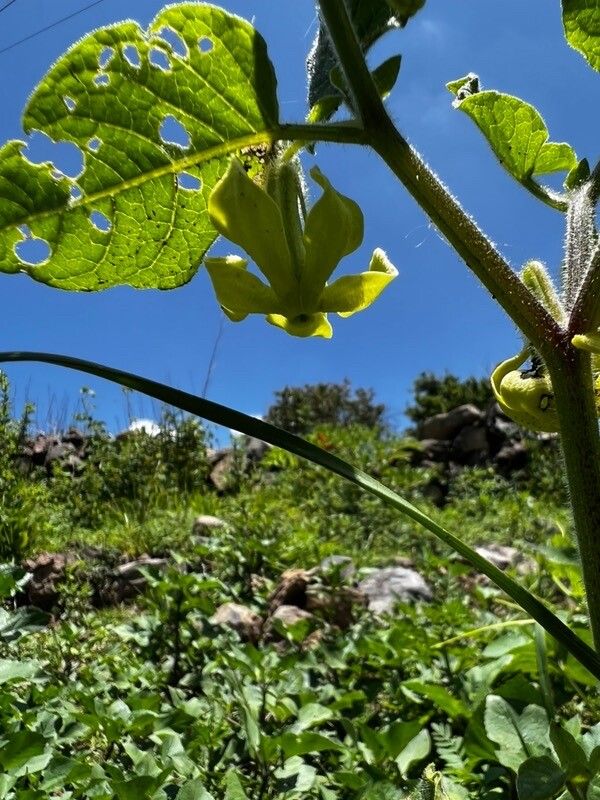
Nectouxia is a monotypic genus of flowering plants belonging to the family Solanaceae. The only species is Nectouxia formosa. It is in the Solanoideae subfamily and in Subtribe Salpichroinae, which is a subtribe of Physaleae. Its native range is from Texas, USA and Mexico.The genus name of Nectouxia is in honour of Hippolyte Nectoux (1759–1836), a French botanist, botanical garden director in Santo Domingo. He was also head gardener in Fontainebleau and founded a botanical garden in Rome. The Latin specific epithet of formosa is derived from formosus meaning (well-)formed and/or beautiful. Both the genus and species were first described and published in F.W.H.von Humboldt, A.J.A.Bonpland & C.S.Kunth, Nov. Gen. Sp. Vol.3 on page 10 in 1818.
Trans-pecos stinkleaf has strong disease resistance and is generally not prone to illnesses. However, it can be susceptible to pests and diseases present in its surroundings. These infections are typically not serious. For care, this plant requires a moderate amount of maintenance. It should be pruned regularly to maintain a neat appearance and healthy growth. Fertilizing can also help encourage flowering. Trans-pecos stinkleaf is suitable for anyone with outdoor space, such as a garden or patio, and does not need extensive care experience. It may require more care when grown indoors.
How to keep Nectouxia Formosa.
Light
Trans-pecos stinkleaf comes from habitats with dappled sunlight, like forest understories or rocky spots that provide natural shade. It performs best in partial sun but can also tolerate full sun.
Temperature
Trans-pecos stinkleaf comes from tropical areas where the climate is generally warm and humid. As a result, it is adapted to high temperatures and humidity. It does not tolerate sudden temperature changes and prefers a steady temperature, so avoiding indoor temperature fluctuations is important. It typically cannot endure cold and needs higher temperatures to grow. If the environmental temperature falls too low, the plant may stop growing or even die.
Fertilizer
Trans-pecos stinkleaf responds well to regular, light applications of fertilizer to encourage healthy leaf development. You should fertilize Trans-pecos stinkleaf about once a month during the summer. Nitrogen is important for foliage, and adding nitrogen-rich sources helps Trans-pecos stinkleaf thrive.
Botanical profile.
- Plant Type
- Herb
- Life Cycle
- Annual
- Genus
- Nectouxia
- Family
- Solanaceae
- Hardiness Zone
- 8-11
- Mature Height
- 30 cm to 61 cm
- Mature Spread
- 20 cm to 40 cm
- Leaf Color
- Green
- Leaf Type
- Deciduous
- Flower Color
- Yellow
- Flower Size
- 2.03 cm to 3.05 cm
- Bloom Time
- Late spring, Early summer, Mid summer
- Planting Time
- Spring, Summer
- Harvest Time
- Late summer, Early fall, Mid fall
- Native Area
- Mexico