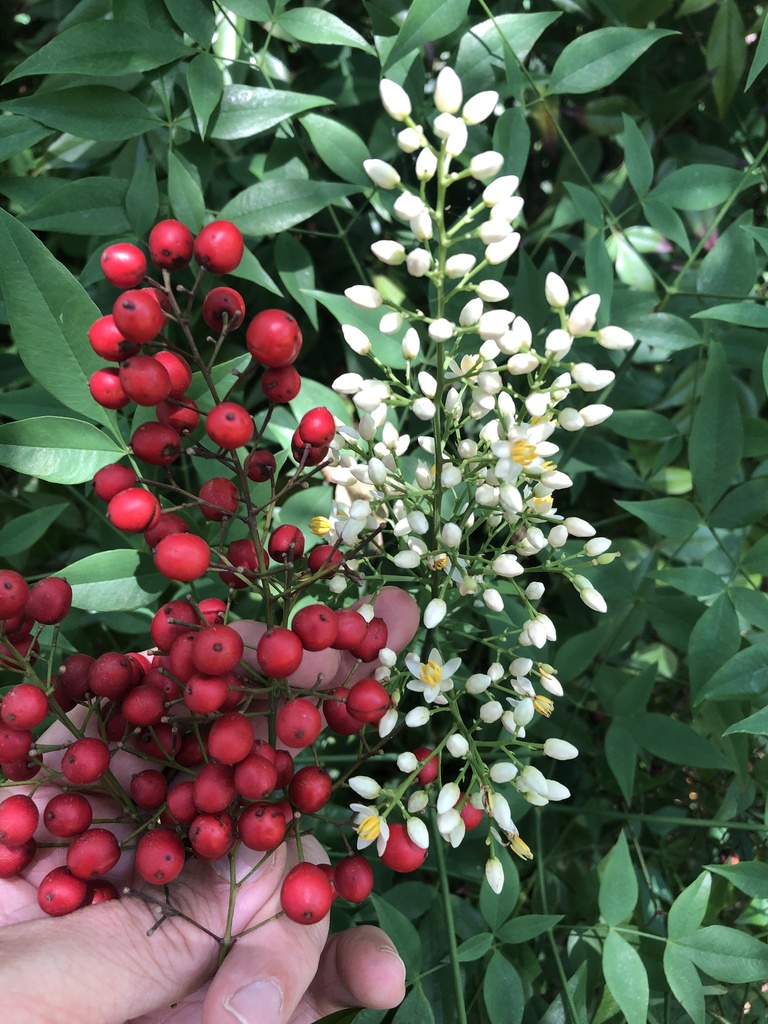
Nandina domestica, commonly known as heavenly bamboo, is a shrub native to eastern Asia. It is a popular ornamental plant thanks to its attractive foliage and bright red berries. Growing up to 8 feet tall, this plant has slender, bamboo-like stems and compound leaves that turn red in the fall. Small white flowers bloom in late spring or early summer, followed by bright red berries that persist through the winter months.
Nandina domestica is easy to grow and requires minimal maintenance once established. It prefers well-drained soil in full sun or partial shade but can tolerate a wide range of soil types and drought conditions once well-rooted.
While it is commonly called heavenly bamboo due to its resemblance to bamboo plants, it should not be confused with true bamboos, which belong to the grass family (Poaceae). Nandina domestica is not related to true bamboos at all.
Heavenly bamboo grows in clumps, and during autumn and winter, its leaves gradually turn red while its branches become laden with vibrant red fruits. This creates a stunning scene in gardens during the cooler seasons. FUN FACT · FROM THE LIBRARY
The plant's berries are toxic if ingested by humans or pets but can be used for ornamental purposes such as in wreaths or holiday decorations.
Overall, Nandina domestica makes an excellent addition to any garden due to its attractive foliage year-round and low maintenance requirements, making it an ideal choice for gardeners of all experience levels!
Heavenly bamboo resembles true bamboo due to its leaves and vine-like stems, which are similar to those of plants in the Poaceae family. When it was first introduced to the United States, it was highly valued and believed to be suitable only for sacred locations, earning it the name "heavenly bamboo."
Heavenly bamboo is fairly disease-resistant and generally does not get sick. However, if grown in poor conditions it can become more prone to disease. It also experiences relatively few insect pests. Regarding care, its requirements are moderate. Providing ample sunlight is important, because insufficient light can make it more susceptible to disease and result in thin growth. It is often kept indoors, so it may need to be moved regularly to a bright spot. It does not need frequent watering. Overall, Heavenly bamboo is suitable for most people, though it is best for those who can provide good light conditions.
How to keep Nandina Domestica.
Light
Heavenly bamboo is a highly sun-loving plant that performs best with full sun but can also survive and grow adequately in moderate light. Although it originates from habitats with plentiful sunlight, too much exposure can scorch its leaves, while too little light may stunt its growth.
Water
Heavenly bamboo grows well with moderate moisture and can tolerate some drought. It should be watered every 1 to 2 weeks, allowing the soil to dry slightly between waterings. Ideal as an ornamental shrub, heavenly bamboo prefers well-draining soil, which supports its hydration needs and enhances its resilience.
Humidity
This plant will thrive in moderate humidity, which is probably the level in your home. However, misting it a few times a week can be very beneficial. Make sure the room has good ventilation.
Temperature
Heavenly bamboo thrives in temperatures from 59 to 100 ℉ (15 to 38 ℃). The plant can grow in both warm and cool climates and adapts to seasonal temperature fluctuations. In summer, providing some shade or misting is advised to prevent heat stress. In winter, it can withstand temperatures as low as 5 ℉ (-15 ℃) and will go dormant.
Fertilizer
Fertilize your Heavenly bamboo in early spring to encourage healthy growth. Consistent feeding improves overall health, producing vigorous growth, increased tolerance of harsh conditions, and enhanced resistance to diseases and pests. Follow a regular fertilizing routine for your Heavenly bamboo to maintain foliage that is richly colored and lush in appearance.
Pruning
To maintain the optimal shape of heavenly bamboo, careful pruning is essential. In the spring, remove any lower sprouts and consider trimming up to one-third of the longer branches. This helps improve light access and conserve nutrients. During the plant's winter dormancy, prune away any dead, diseased, or overly dense branches to promote health and encourage new growth.
Pot & Repot
When repotting Heavenly bamboo, choose a container 1–2 inches (2.5–5.1 cm) larger with good drainage. Use a well-draining potting mix. Repot in spring or fall, making sure the root ball sits slightly below the rim of the flower pot. Water thoroughly after repotting and place it in a warm spot with indirect sunlight.
Botanical profile.
- Plant Type
- Shrub
- Life Cycle
- Perennial
- Genus
- Nandina
- Family
- Berberidaceae
- Hardiness Zone
- 7-11
- Mature Height
- 0.91 m to 3.05 m
- Mature Spread
- 1.52 m
- Leaf Color
- Green, Red, Purple, Yellow, White, Variegated, Orange
- Leaf Type
- Evergreen
- Flower Color
- White
- Flower Size
- 0.51 cm to 0.76 cm
- Bloom Time
- Late spring, Early summer, Mid summer
- Planting Time
- Spring, Autumn
- Harvest Time
- Early spring, Mid summer, Late summer, Fall, Winter
- Native Area
- Japan, China
Other names.
Reader questions.
When should I water my Heavenly Bamboo?
Watering your heavenly bamboo is crucial for its growth and should be timed properly to maintain optimal moisture levels. To determine when your heavenly bamboo needs water, check the soil’s moisture by inserting your finger about an inch deep into the soil; if it feels dry, it's time to water. Watch for signs such as soil dryness, wilting or discoloration of leaves, and slow growth, as these can indicate the need for water. However, be cautious of overwatering, as it can lead to root rot, while under-watering can stress the plant, potentially leading to its death. A regular inspection will help you assess the right watering schedule to keep your heavenly bamboo healthy.
Why should I put fertilizer on my Heavenly bamboo?
No matter what type of Heavenly bamboo you have, regularly fertilizing it will promote overall health. Providing the proper nutrients will result in stronger growth and increased resilience to difficult growing conditions, as well as better defense against diseases and pests. Maintaining the foliage of your Heavenly bamboo is important for its attractiveness, so it's crucial to establish and stick to a fertilization schedule tailored to your specific plant. This will encourage the development of deeply colored leaves and an overall lush appearance.
How many hours of sunlight should Heavenly bamboo get each day for it to grow healthy?
To ensure healthy growth, Heavenly bamboo needs at least 3–6 hours of daily sunlight. This is the minimum requirement for most plants that can tolerate partial sun. However, since Heavenly bamboo requires less light for photosynthesis, it can also thrive in full sun, making it more adaptable compared to plants that need either full sun or partial shade.
What are the ideal temperature conditions for Heavenly bamboo?
Heavenly bamboo, or Nandina domestica, flourishes in a wide range of temperatures, ideally between 59°F to 100°F (15°C to 38°C). This versatility allows it to adapt to both hot and cold environments throughout the year. To prevent heat stress during summer's peak temperatures, providing shade or misting is beneficial. Despite its strong cold resistance, it can endure winter cold down to 5°F (-15°C), entering a dormant state. While it generally does not require special frost protection, in exceptionally cold winters where temperatures fall below expected lows, wrapping the plant in materials like non-woven fabric can offer additional safeguarding. Ensuring the soil is moist before the onset of the first freeze can also help the plant through winter and early spring by preventing drought.
How should I water my Heavenly Bamboo?
Watering heavenly bamboo effectively requires a deep and thorough technique, allowing the water to reach the root zone. Although overhead watering is an option, bottom-watering is generally recommended as it prevents excess moisture on the foliage, promoting deep root growth. This can be achieved by placing the pot in a tray with water for the roots to absorb moisture from the bottom up. Utilizing tools like a moisture meter can help monitor the soil's moisture, ensuring you water the plant only when necessary. Aim to water the base of the plant, avoiding the foliage, to reduce the risk of fungal diseases. Ensuring the plant sits in well-draining soil and checking the moisture level before watering will help maintain the right moisture balance.
When should I fertilize my Heavenly bamboo plant?
To ensure healthy growth, it is recommended to fertilize your Heavenly bamboo during late winter or early spring. This provides the necessary nutrients for the plant to thrive once the weather warms up. In warm climate regions, an additional fertilizer feeding in early fall can be beneficial. This not only supplements the soil with nutrients for the upcoming growing season, but also helps the plant withstand the winter cold without foliage damage. It is advisable to fertilize earlier to allow new branches enough time to grow and withstand the winter conditions.
What kind of sunlight does Heavenly bamboo require?
Heavenly bamboo thrives in full or part sun, but it does particularly well with direct morning light. During summer, it is important to shield them from the intense afternoon sun. In temperate areas, excessive exposure to hot afternoon sun can harm the leaves and negatively affect the plant's overall look and well-being.
How does Heavenly bamboo react to low temperatures?
Heavenly bamboo is known for its cold tolerance, thriving best in temperatures above its minimal growth threshold. Although it can withstand cold winters, falling below specific low-temperature limits might not immediately show effects; however, by spring, the plant could exhibit signs of stress. This includes brittleness and drying of branches, along with a failure to produce new shoots. To manage these symptoms, it's advisable to prune away any dead branches to encourage new growth and vitality in the spring.
How much water does Heavenly Bamboo really need?
The amount of water your heavenly bamboo needs depends on several factors like pot size and the plant's size. For a small pot, about 500ml of water is sufficient to keep the soil moist but not soggy. Larger pots and plants will require more water to ensure thorough soil saturation. It's important to ensure that the water reaches the root depth, which is typically between 20-30cm. After watering, the soil should feel moist, without waterlogging. Proper watering is indicated by turgid, well-colored leaves. Incorrect water quantities can lead to symptoms like yellowing leaves from over-watering or wilting from under-watering, both of which can harm the plant.
When should I not put fertilizer on my Heavenly bamboo?
There are specific times of the year when you should avoid fertilizing your Heavenly bamboo. The first instance is during the early and mid-winter months when the plant is dormant and doesn't require any feeding. It's also not recommended to fertilize during late spring and throughout summer, as the weather tends to be hotter and drier. These conditions make it more likely for the plant to have a negative reaction to fertilization. To prevent any issues, it's best to stick to a fertilization schedule that involves feeding only in early spring and early fall.
Can the sun harm Heavenly bamboo? How can I shield Heavenly bamboo from the sun and heat damage?
When moving Heavenly bamboo from indoors to outdoors, it can be easily damaged by direct sunlight. To prevent sunburns, it's best to gradually move the pots from a shaded area to a brighter spot. However, even if the plants are used to the sun, extreme heat can still harm them. During a heatwave, it's crucial to keep the soil consistently moist to help the plants handle excessive heat levels. If there is extreme weather, moving container plants to areas with afternoon shade or using a shade cloth can protect the sensitive Heavenly bamboo.
What should be done if Heavenly bamboo experiences high temperatures?
During the height of summer, Heavenly bamboo should ideally be kept below its maximum tolerable temperature to avoid heat-related stress. Signs of excessive heat include leaves lightening in color, tips becoming dry and withered, and an increased risk of sunburn. To mitigate these issues, you can trim away the affected parts and move the plant to a shaded area, particularly away from the harsh midday and afternoon sun. Providing shade through a cloth and ensuring the soil remains moist with watering sessions in the morning and evening will help the plant remain healthy despite high temperatures.