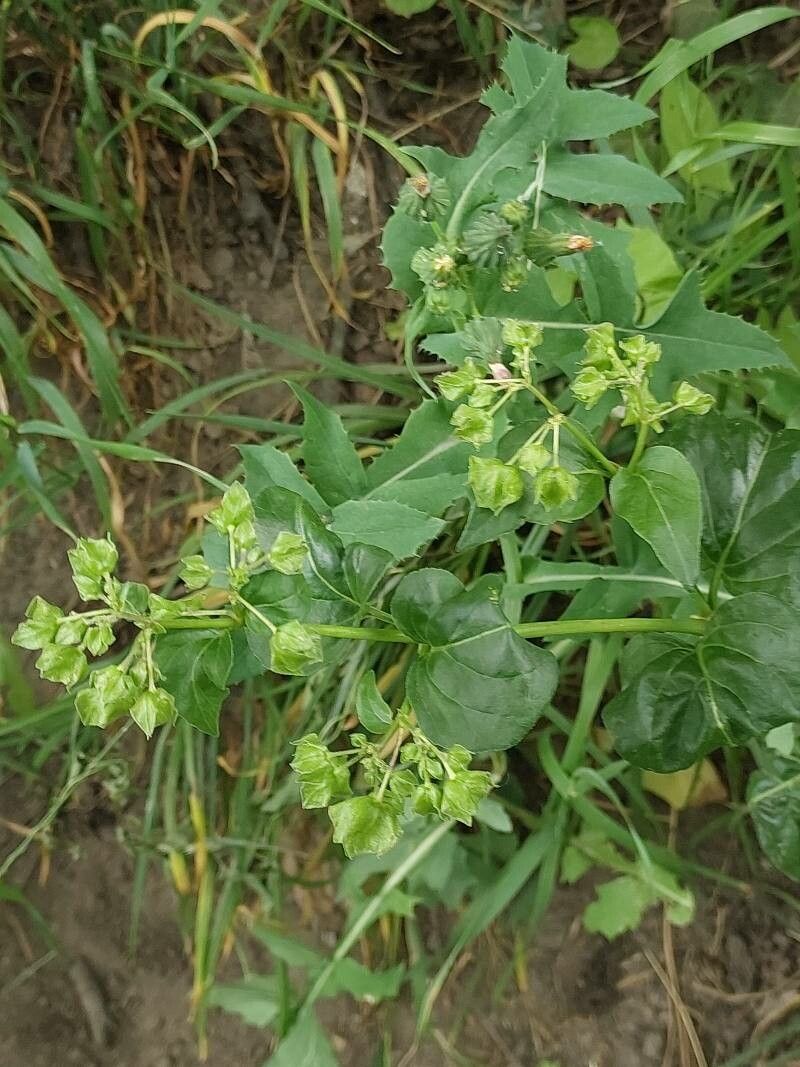
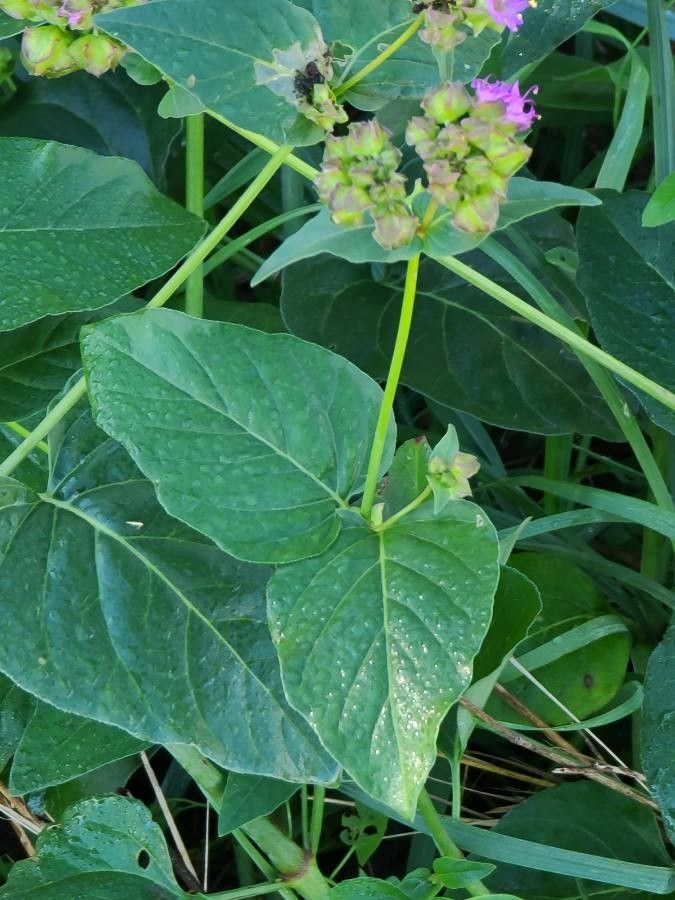
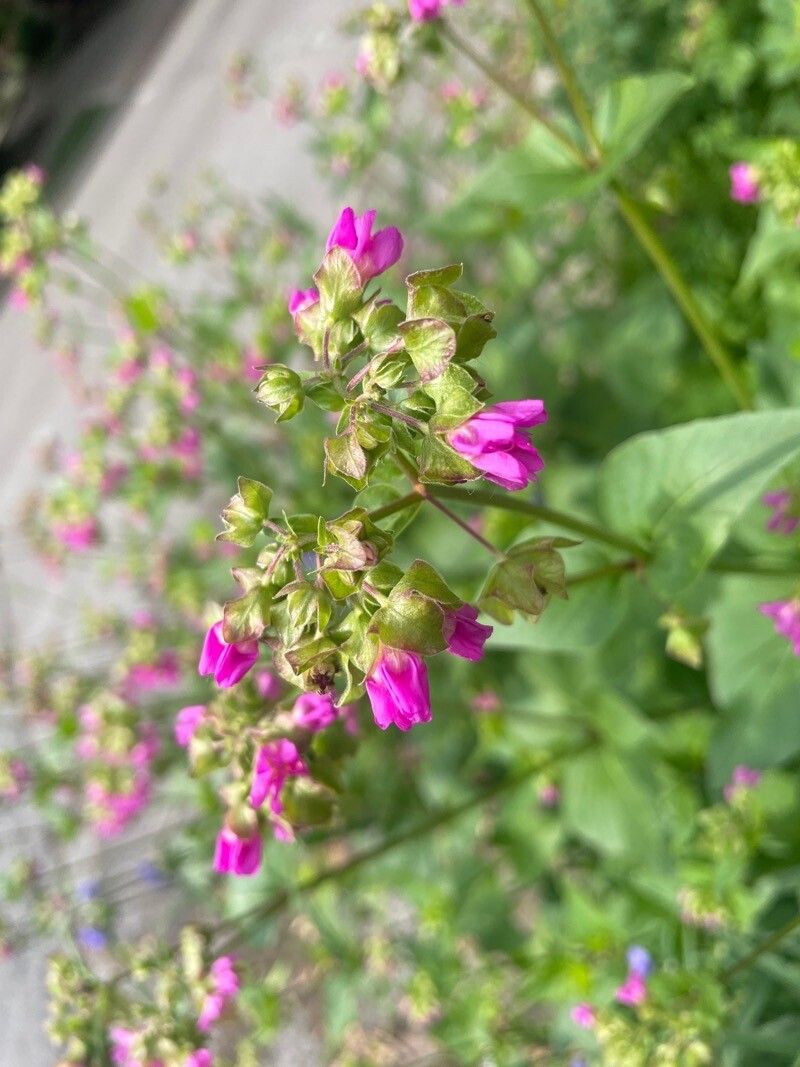
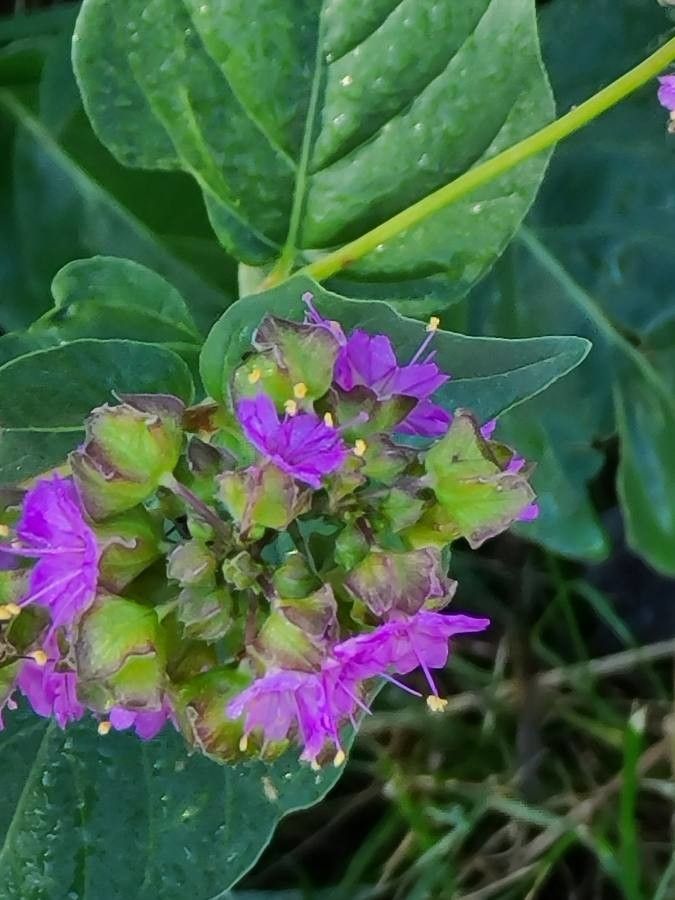
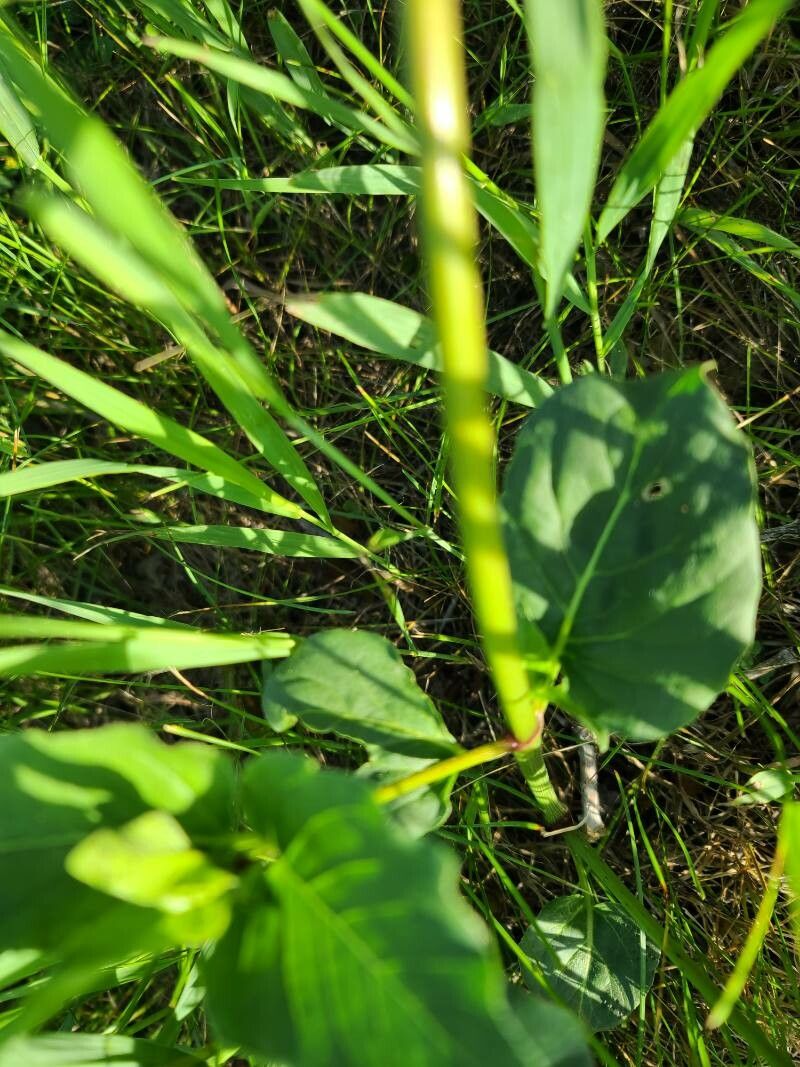
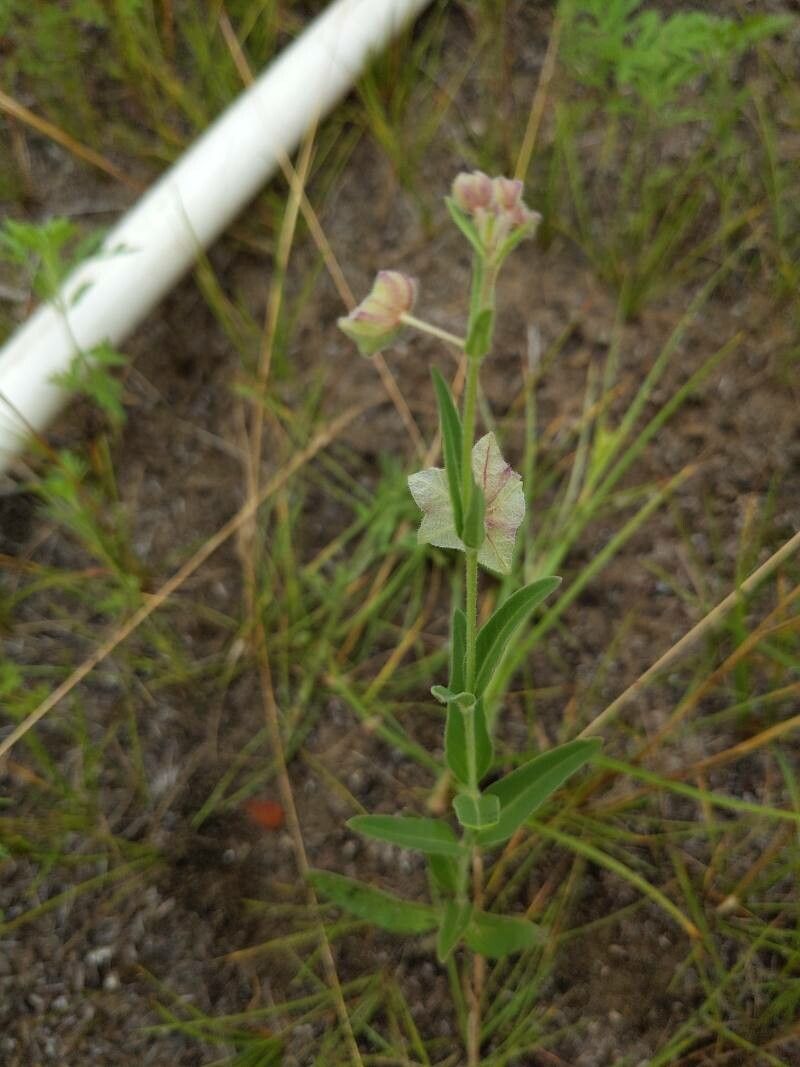
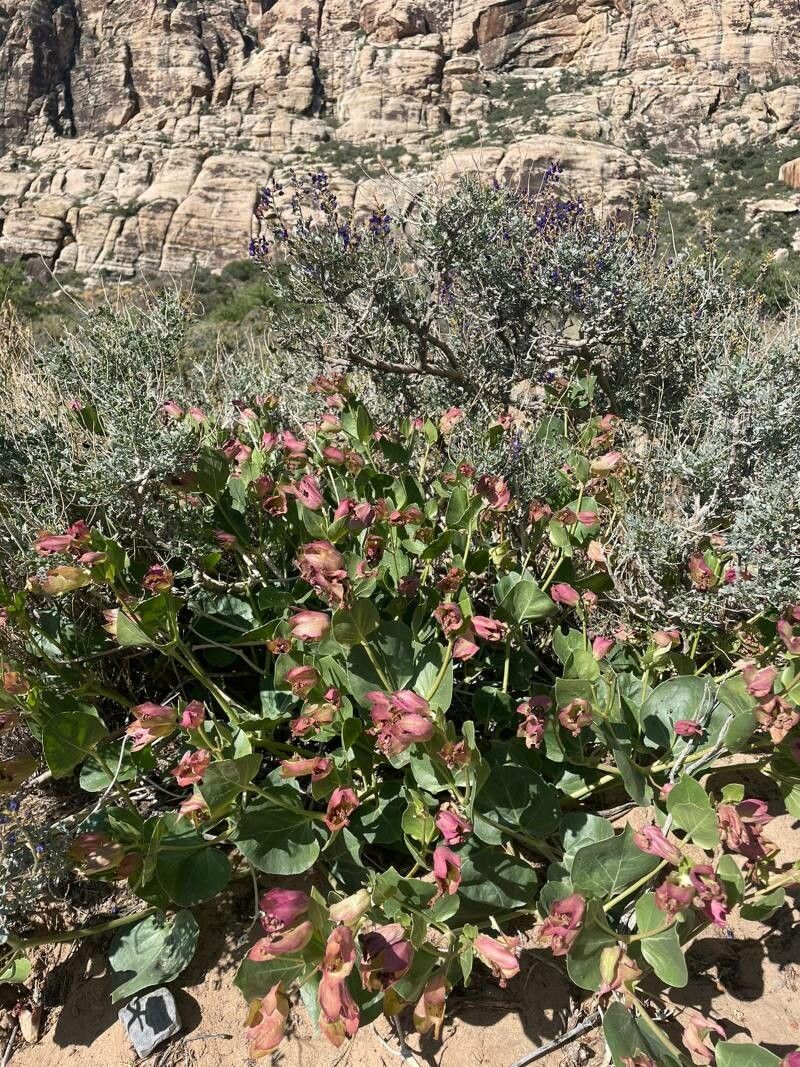
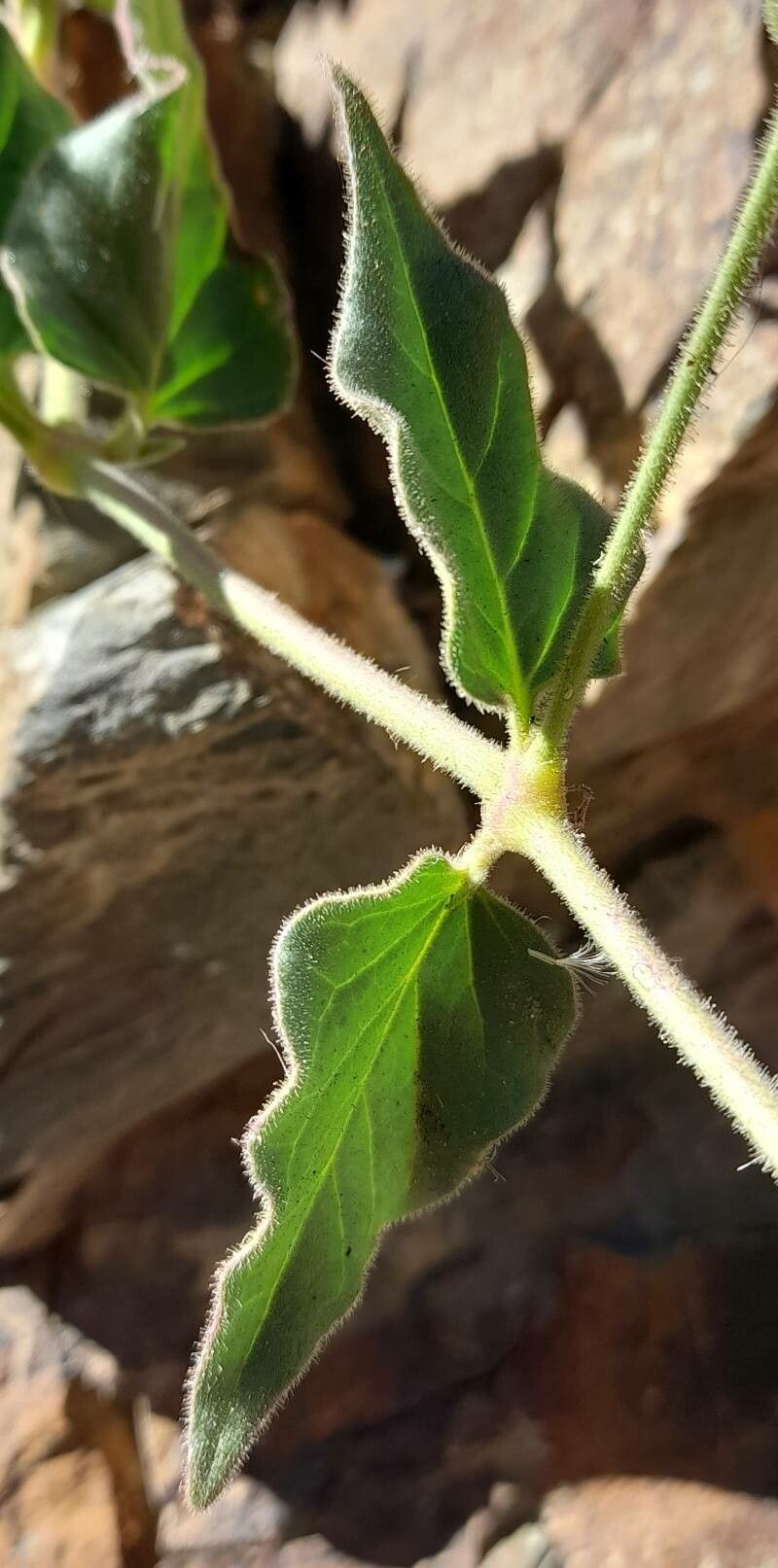
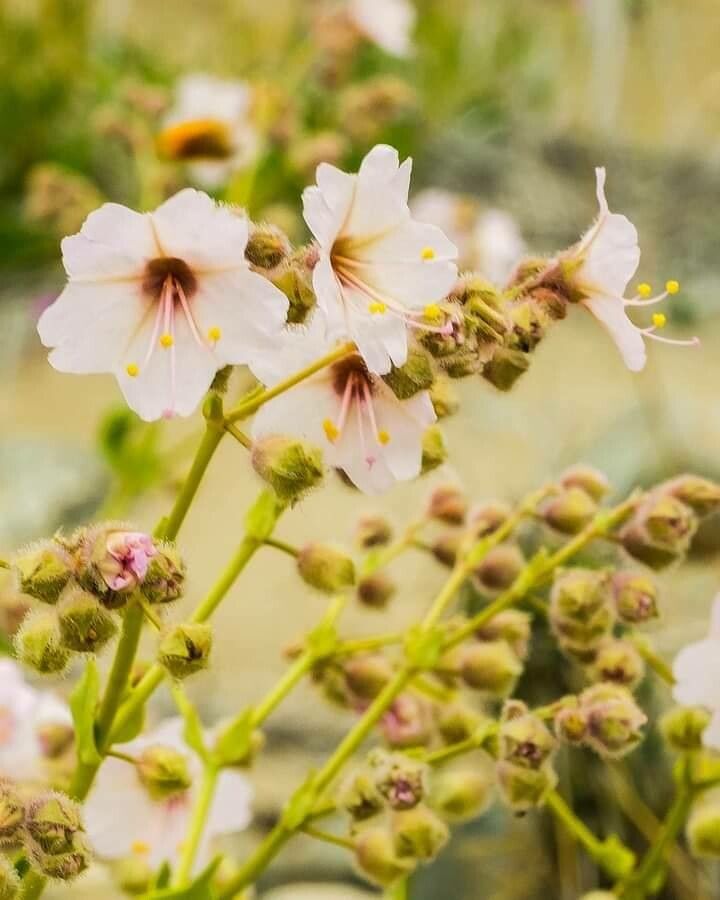
Mirabilis nyctaginea is a species of flowering plant in the four o'clock family known by several common names, including wild four o'clock, heartleaf four o'clock, and heartleaf umbrella wort. Four-o'-clock is native to the central section of North America, and it occurs elsewhere as an introduced species, including parts of Europe. Its exact native range is obscure, and it is often weedy throughout its range, spreading into disturbed habitat easily. Four-o'-clock is a hairy to hairless perennial herb growing erect to over a meter in maximum height. The leaves are oppositely arranged mainly on the lower two thirds of the plant below the upper forkings of the stem. Each thin green leaf has an oval or heart-shaped blade up to 10 centimeters long. The flowers occur in leaf axils on the upper branches. A cluster of 3 to 5 flowers blooms in a bell-shaped involucre of five partly fused bracts. Each five-lobed, funnel-shaped flower is about a centimeter wide and magenta or pink to nearly white in color. The flowers open for only a few hours and drop, leaving the shaggy-haired developing fruits in the drying, papery cup of bracts. The root is a thick, fleshy taproot. Four-o'-clock is host to the larvae (caterpillars) of several micromoths: Embola ionis is a stem borer, Neoheliodines cliffordi and N. nyctaginella are leaf skeletonizers, and Aetole tripunctella is a leaf miner.
Wild four o'clock is fairly resistant to disease and generally does not suffer from many illnesses. Still, it can be vulnerable to pests and diseases found in its surroundings. Such infections are generally mild. Regarding care, this plant needs moderate maintenance. It should be pruned on a regular basis to preserve an attractive appearance and support healthy growth. Fertilizing can also encourage more flowering. Wild four o'clock is well suited for anyone who has an outdoor area, like a garden or patio, and does not require a great deal of care experience. It may demand more attention if cultivated indoors.
How to keep Mirabilis Nyctaginea.
Light
Wild four o'clock prefers being in areas with plentiful sunlight throughout the day. In its native habitat it performs best where it gets the sun for most of the day. Still, it can tolerate locations with somewhat reduced sunlight. Excessive shade can cause the plant to perform poorly, while too much sun can result in leaf scorching.
Water
Wild four o'clock plants thrive in temperate regions where there is moderate moisture. They prefer soil that is consistently moist but not waterlogged, which can be achieved with weekly watering. These plants are adaptable to different rainfall patterns, making them well-suited for gardens in climates with predictable seasonal rains.
Temperature
The wild four o'clock is native to North America and occurs in a temperature range of 0 to 38 ℃ (32 to 100 ℉). It prefers warm daytime temperatures and cooler nighttime temperatures. In the summer it may benefit from partial shade to prevent heat stress.
Fertilizer
Generally, a single fertilizer application in spring is adequate for Wild four o'clock, though repeated feedings can enhance growth. Fertilize every month to every six weeks. Feeding improves the leaves' appearance and function, helping maintain uniform color and a healthy texture. It also promotes root development and nutrient uptake, supporting the plant's long-term health.
Pruning
The wild four o'clock plant features heart-shaped leaves and vibrant flowers. To encourage strong growth and abundant blooming, it is important to prune it regularly from early to late spring. This involves trimming dead stems, maintaining the plant's shape, and improving air circulation to reduce the risk of disease. For more detailed pruning techniques and advice, consult horticultural resources.
Pot & Repot
When repotting Wild four o'clock, choose a pot 1-2 inches (2.5–5.1 cm) larger with ample drainage. Use a well-draining potting mix. Repot in spring or fall, making sure the root ball sits slightly lower than the rim of the flower pot. Water thoroughly after repotting and place it in a warm spot with indirect sunlight.
Botanical profile.
- Plant Type
- Herb
- Life Cycle
- Perennial
- Genus
- Mirabilis
- Family
- Nyctaginaceae
- Hardiness Zone
- 3-11
- Mature Height
- 91 cm
- Mature Spread
- 49 cm
- Leaf Color
- Green
- Leaf Type
- Deciduous
- Flower Color
- Pink, White
- Flower Size
- 1.02 cm
- Bloom Time
- Late spring, Early summer, Mid summer
- Planting Time
- Spring, Summer
- Harvest Time
- Summer
- Native Area
- Mexico
Other names.
Reader questions.
How should I water my Wild four o'clock plant?
To ensure the well-being of the Wild four o'clock plant, it's best to water it using filtered water. This is important because tap water may contain harmful particles that can affect its health. Moreover, it's necessary to use water at room temperature or slightly warmer. This is because the Wild four o'clock plant is accustomed to warm environments, and cold water may shock its system. Additionally, overhead watering should be avoided as it can cause issues with the foliage. Instead, a better approach is to apply the filtered room temperature water directly to the soil until it is completely soaked. Doing so benefits the plant by providing moisture to its roots, aiding in their spread through the soil and enabling nutrient collection.
Why should I put plant food on my Wild four o'clock plant?
The Wild four o'clock relies on its leaves for structure, and fertilization is key to keeping these leaves looking great and functioning properly. Proper fertilization promotes consistent leaf color and a healthy texture. Additionally, fertilization benefits the plant below the surface by encouraging new root growth and maintaining existing roots. This not only improves the plant's current health but also enhances its ability to absorb nutrients from the soil in the long run.
What are the sunlight requirements for Wild four o'clock?
Wild four o'clock (Mirabilis nyctaginea) thrives best with ample sunlight exposure throughout the day. It requires full sun, which means it needs to be in a spot that receives more than 6 hours of direct sunlight daily. However, it can also grow in partial sun locations, where it receives about 3-6 hours of sunlight daily. Being adaptable, it manages slight variations in light but perfoms poorly in excessive shade, resulting in underperformance, or in too much direct light, which might cause leaf scorching.
What is the native region and optimal temperature range for the wild four o'clock?
The wild four o'clock, known botanically as Mirabilis nyctaginea, is native to North America. It thrives in a variety of temperatures ranging from 0 to 38 °C (32 to 100 °F). This plant prefers warm daytime temperatures with cooler temperatures at night. During summer months, partial shade can be beneficial to prevent heat stress. Its strong cold resistance typically obviates the need for special frost protection measures in winter, though protection is advised if temperatures drop below its growth limit.
What should I do if I give my Wild four o'clock plant too much water or too little water?
Overwatering is a common issue that can harm your Wild four o'clock plant. It causes wilting and yellowing of the stems and leaves, and can lead to diseases like root rot, mold, and mildew. Underwatering is less common because this plant can tolerate drought, but it can still happen. In this case, the leaves become brittle and brown. It's important to notice the signs of overwatering early on. Diseases like root rot can't be fixed if you wait too long. If you see these signs, reduce your watering schedule and check the quality of the soil. If it doesn't drain well, replace it with a loose, well-draining potting mix. If you notice signs of underwatering, simply water more regularly until the signs disappear.
When should I fertilize my Wild four o'clock?
If you grow your Wild four o'clock outdoors, it will send new growth in early spring. This signals the time to fertilize it. Generally, a single application of fertilizer in spring is sufficient. However, if you want to maximize growth, you can fertilize it multiple times during spring and early summer, about once every month to a month and a half.
How can artificial lighting be used for indoor plants?
Indoor plants, including Wild four o'clock, may require artificial lighting to achieve optimal growth, especially in conditions where natural sunlight is insufficient. LED lights are recommended as they can provide specific wavelengths needed for plant growth. For plants needing full sun, 30-50 watts per square foot of artificial light is needed; partial sun plants require 20-30 watts per square foot; and full shade plants need 10-20 watts per square foot. The light source should be placed 12-36 inches above the plant and kept on for 8-12 hours a day to mimic natural daylight hours.
How should the wild four o'clock be cared for in winter?
Despite its strong cold resistance, if winter temperatures are expected to fall below the plant's growth limit, it's important to protect the wild four o'clock from the cold. This can be done by covering the plant with soil or straw. Additionally, before the first freeze of the autumn, it's recommended to water the plant abundantly so the soil remains moist going into its frozen state, helping prevent drought and water scarcity during winter and early spring.
How often should I give water to my Wild four o'clock plant?
If you have a potted Wild four o'clock plant, you can check if it needs water by inserting your finger into the soil. If the top two to three inches of soil feel dry, it's time to water it. For outdoor Wild four o'clock plants, the same method applies. If the top few inches of soil are dry, it needs watering. Normally, watering once a week is sufficient during spring and early fall. However, during extremely hot weather, you may need to water twice or more per week. It's worth noting that mature and well-established Wild four o'clock plants can tolerate drought well.
When should I not put fertilizer on my Wild four o'clock plant?
During the late fall and winter, your Wild four o'clock will go into a dormant phase and stop growing. Therefore, it is important to avoid fertilizing it during this time. If you do choose to fertilize in the spring and summer, start reducing the amount of fertilizer as summer approaches and the growth rate slows down. It is always best to avoid fertilizing your Wild four o'clock during excessively hot weather or when the soil is unusually dry, as doing so can stress the plant and cause it to die prematurely.
What are some common symptoms of inadequate lighting for Wild four o'clock?
Symptoms of inadequate light in Wild four o'clock include smaller new leaves, leggy or sparse growth, premature leaf drop, delayed or halted new growth, lighter-colored new leaves, and various signs of distress like chlorosis, sunscald, leaf curling, wilting, and leaf scorching. These signs reflect the plant's stress due to either insufficient or excessive sunlight exposure, affecting its health and growth.
What are the symptoms of low temperature exposure and solutions for the wild four o'clock?
The wild four o'clock is cold-tolerant and performs best when the temperature remains above its minimum suitable growth temperature. During winter, maintaining a temperature above its minimum tolerable growth level is ideal. Exposure to temperatures below its growth limit may not show immediate changes but can lead to decreased or absent sprouting in spring. If sprouting is affected, removing the non-sprouting parts in spring is recommended.