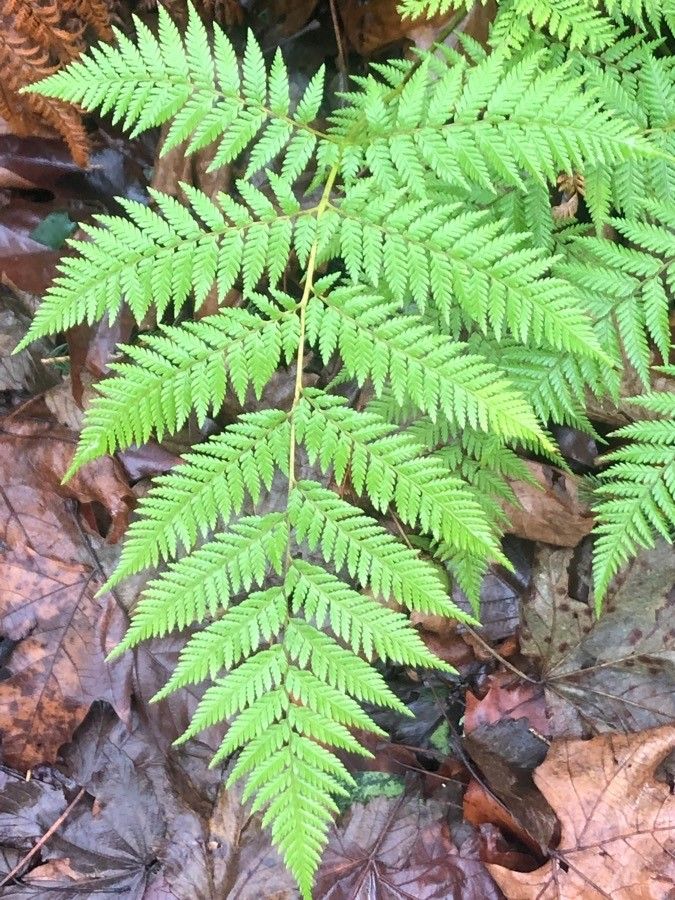
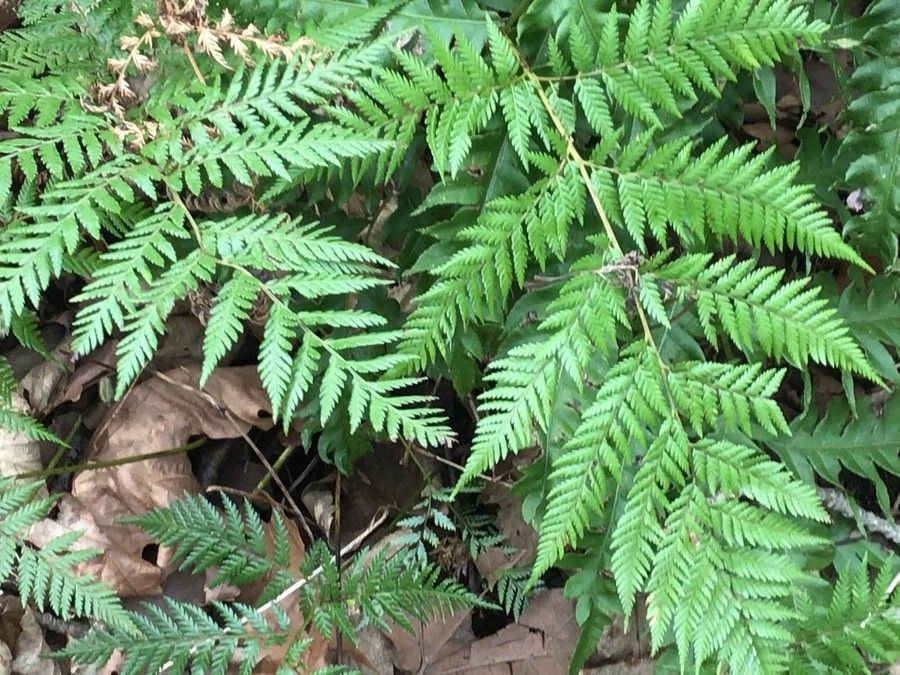
Lophosoria quadripinnata (J.F.Gmel.) C.Chr. is a species of fern that, according to DNA molecular analysis, belongs to the family Dicksoniaceae, where it is placed in the genus Lophosoria. It is found in the Americas spanning from Cuba and Mexico to Chile. In Chile it is present in the area between Talca and Aysén including Juan Fernández Islands. In Argentina it grows only in the humid valleys of western Neuquén and Río Negro Province. Diamondleaf fern is a common name. In Spanish it is known as 'ampe' (from the Mapudungun añpe) or palmilla, but one has to remember that there are several species of ferns called "palmillas" that have larger or smaller fronds, and which grow in colder climates. It is a medium-sized plant, growing to about 4–5 feet (though 10–12 feet in a sheltered place at Arduaine Garden in Argyll, Scotland) and even though the rhizome does not grow a trunk, it is clearly related to the other tree ferns due to features that were apparently already present in their common ancestor, like 'pneumathodes', and the rhizome which changed from the dorsiventral symmetry typical of the other ferns, to a radial symmetry typical of tree ferns. Their large and multiple pinnate fronds, with the petiole raised adaxially, and the hairs on the rhizome and lower part of the petioles, also resemble those of tree ferns. To identify the species, use the position and characteristics of the spores found on the fertile fronds. The genus already existed in the Cretaceous Period in southern Gondwana according to fossil remains found in Antarctica. The species is well known as an ornamental plant.
Diamondleaf fern typically has strong resistance to disease and faces relatively few insect pests. Its care is considered difficult because it needs a consistently moist environment and frequent watering. However, the roots are susceptible to rot if the plant is overwatered and the air is not well ventilated. Diamondleaf fern is better suited to people with some growing experience, since most people can keep it alive for a period of time. Still, the fern may struggle to thrive and its leaves can dry out and become less healthy over time.
How to keep Lophosoria Quadripinnata.
Light
Diamondleaf fern comes from habitats such as forest understories or rocky sites that provide natural shade. It prefers Full Shade but can tolerate Partial Sun.
Humidity
This plant needs special care because it loves high humidity levels of 60-80% or more. The best way to achieve this is by placing a humidifier near the plant. Daily misting is also essential! Make sure the room has good ventilation.
Temperature
The Diamondleaf fern adapts well to heat and wide temperature swings. In hot weather, care should be taken with watering and providing adequate shade to prevent sunburn. Conversely, the Diamondleaf fern is less resistant to cold. While it tolerates some chill, very low temperatures can cause frost damage.
Pruning
The Diamondleaf fern is known for its distinctive diamond-shaped fronds. To keep your fern healthy, it's best to prune it in early spring. Use sterilized shears to remove any damaged fronds, which will encourage new growth. This practice also improves air circulation and reduces the risk of disease. Additionally, thin out dense areas of the plant to ensure even light exposure. For the best results, refer to season-specific pruning techniques found in horticultural guides.
Pot & Repot
When repotting a Diamondleaf fern, select a pot 1–2 inches (2.5–5.1 cm) larger that has good drainage. Use a well-draining potting mix. Repot in spring or fall, making sure the root ball sits slightly below the rim of the flower pot. Water well after repotting and place the plant in a warm location with indirect sunlight.
Botanical profile.
- Plant Type
- Fern
- Life Cycle
- Perennial
- Genus
- Lophosoria
- Family
- Cyatheaceae
- Hardiness Zone
- 9-11
- Mature Height
- 3.05 m
- Mature Spread
- 2.13 m
- Leaf Color
- Dark Green, Forest Green
- Leaf Type
- Evergreen
- Planting Time
- Spring, Summer, Autumn
- Native Area
- Belize, Honduras, Mexico, Guatemala, Peru, Panama, Jamaica, Colombia, Cuba, Bolivia, Venezuela, Brazil, El Salvador, Nicaragua, Ecuador, Costa Rica
Other names.