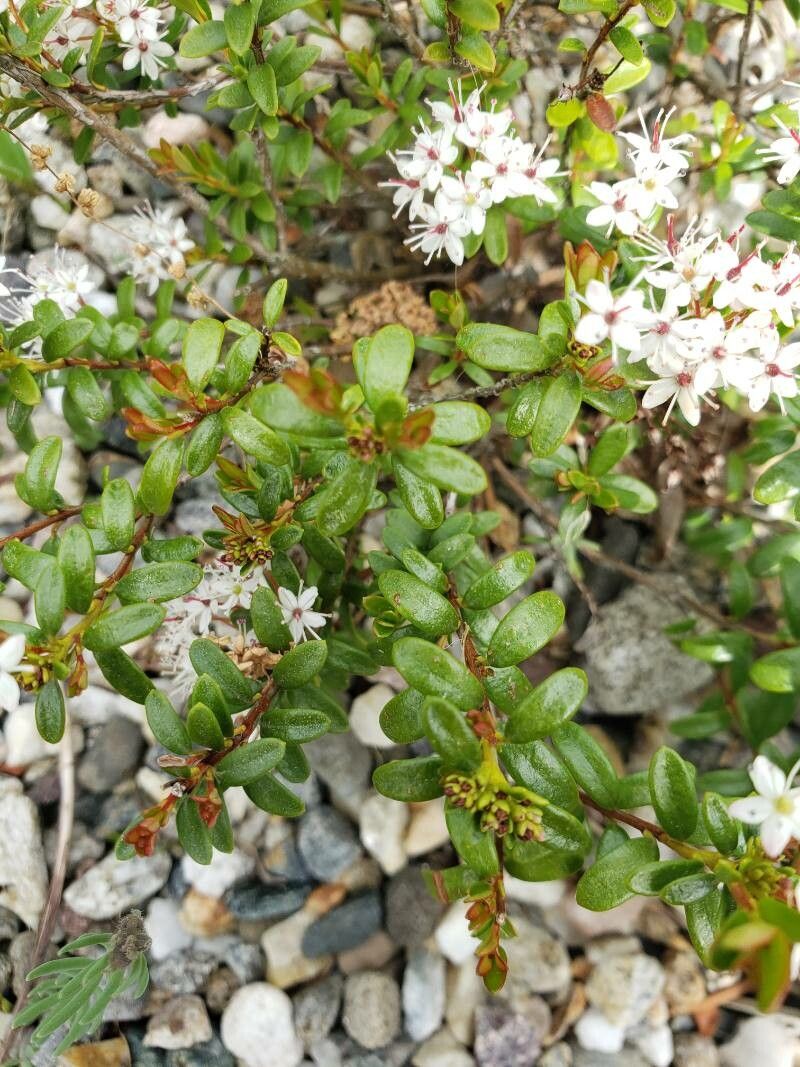
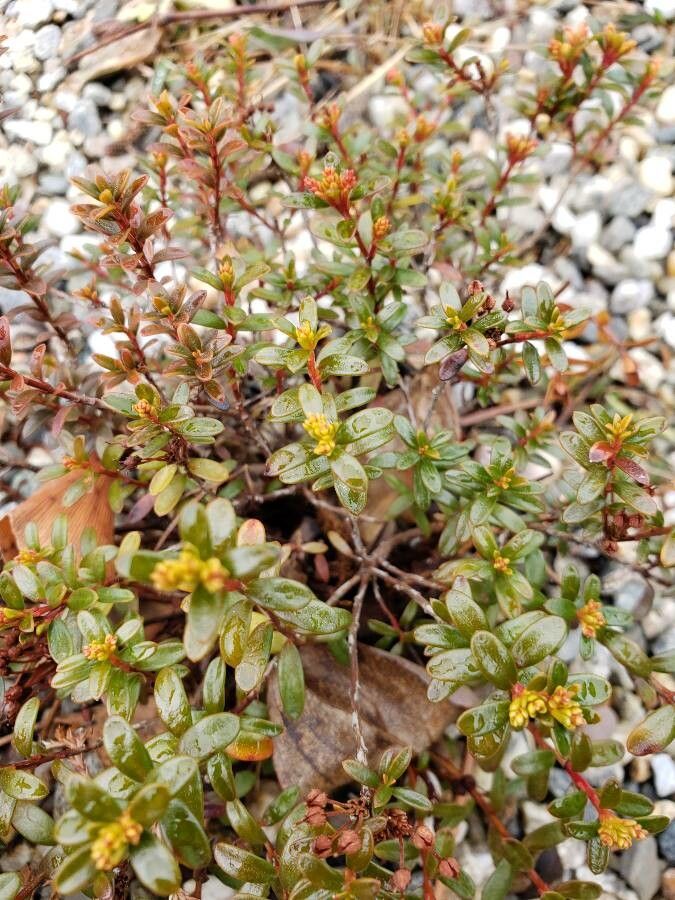
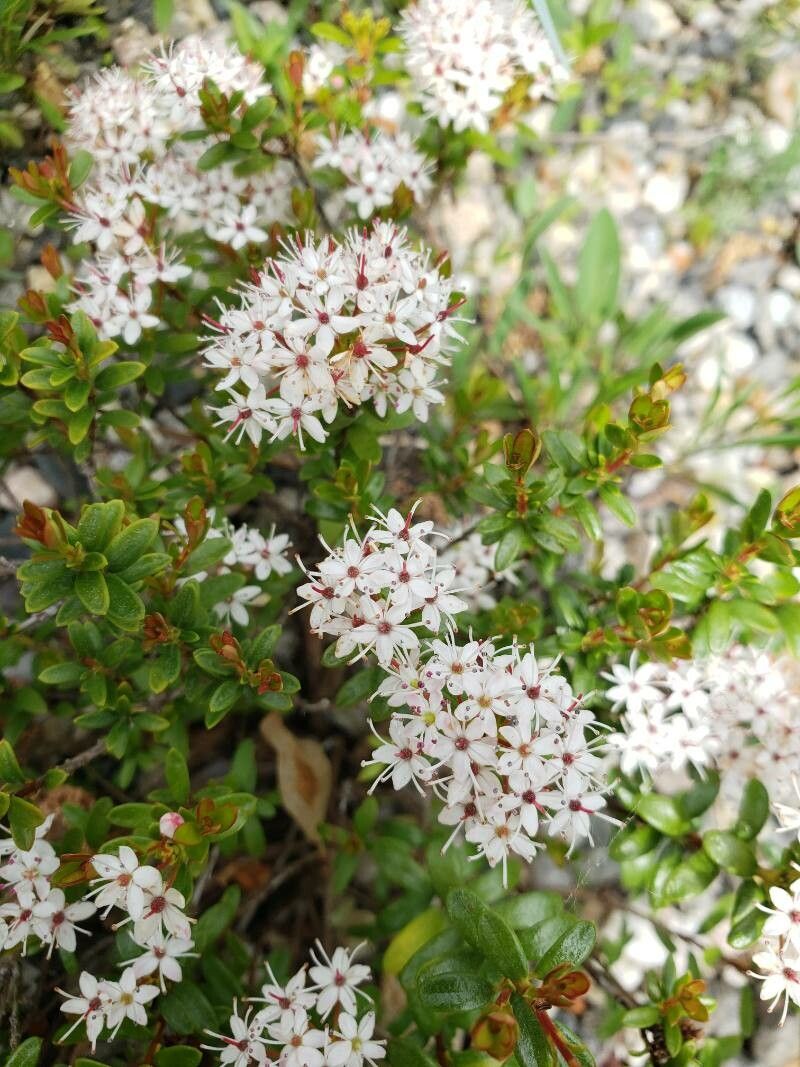
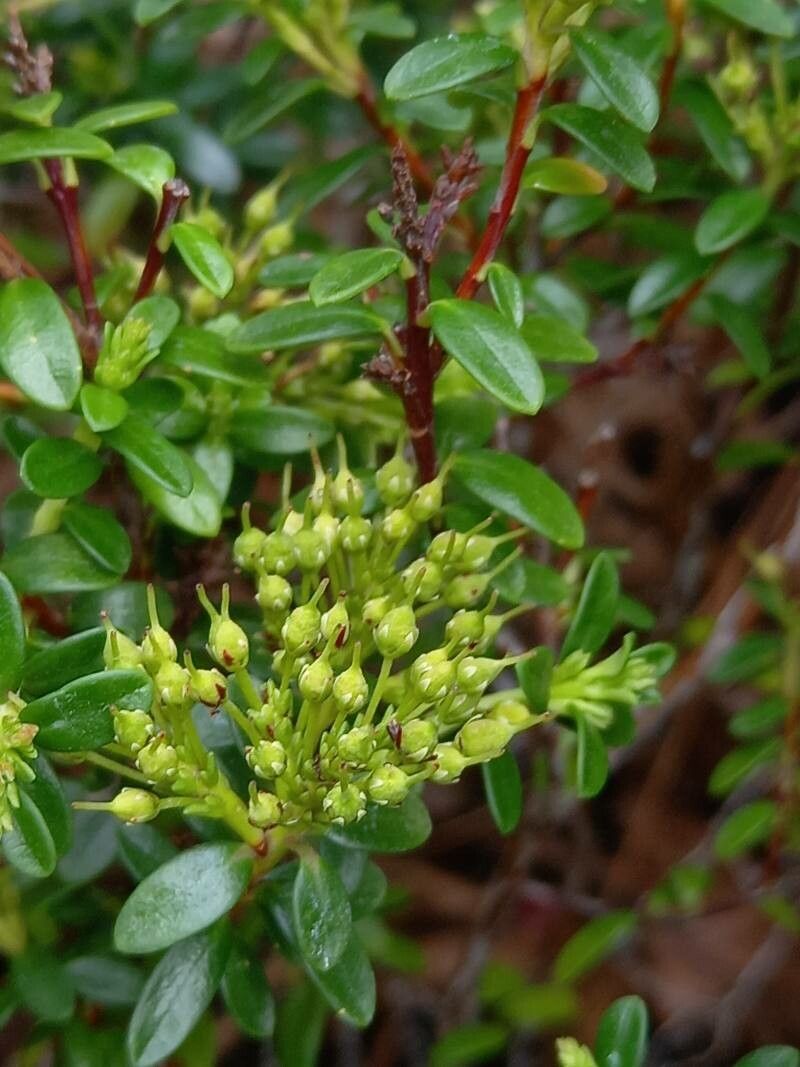
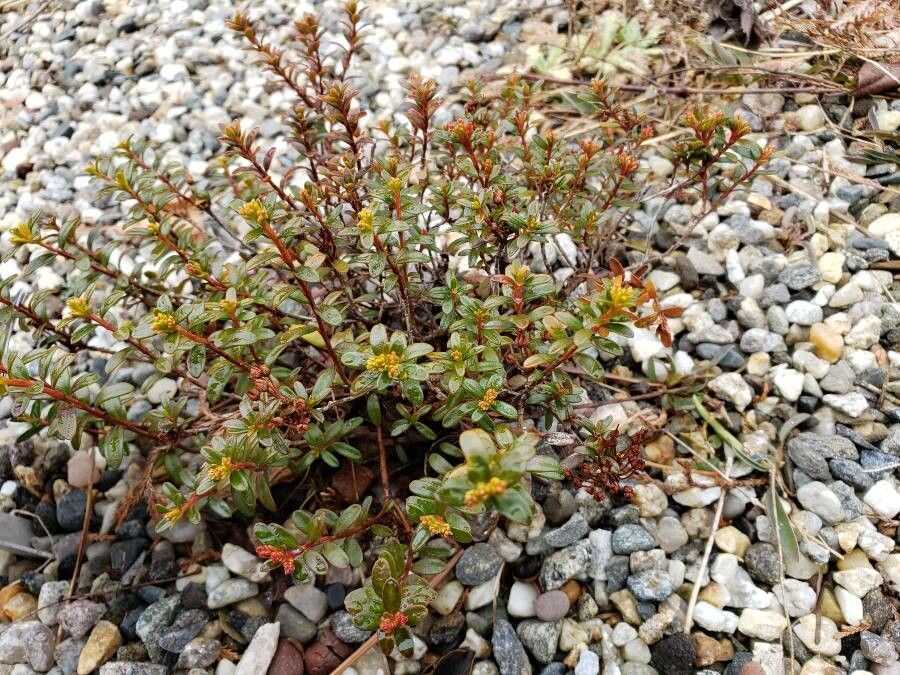
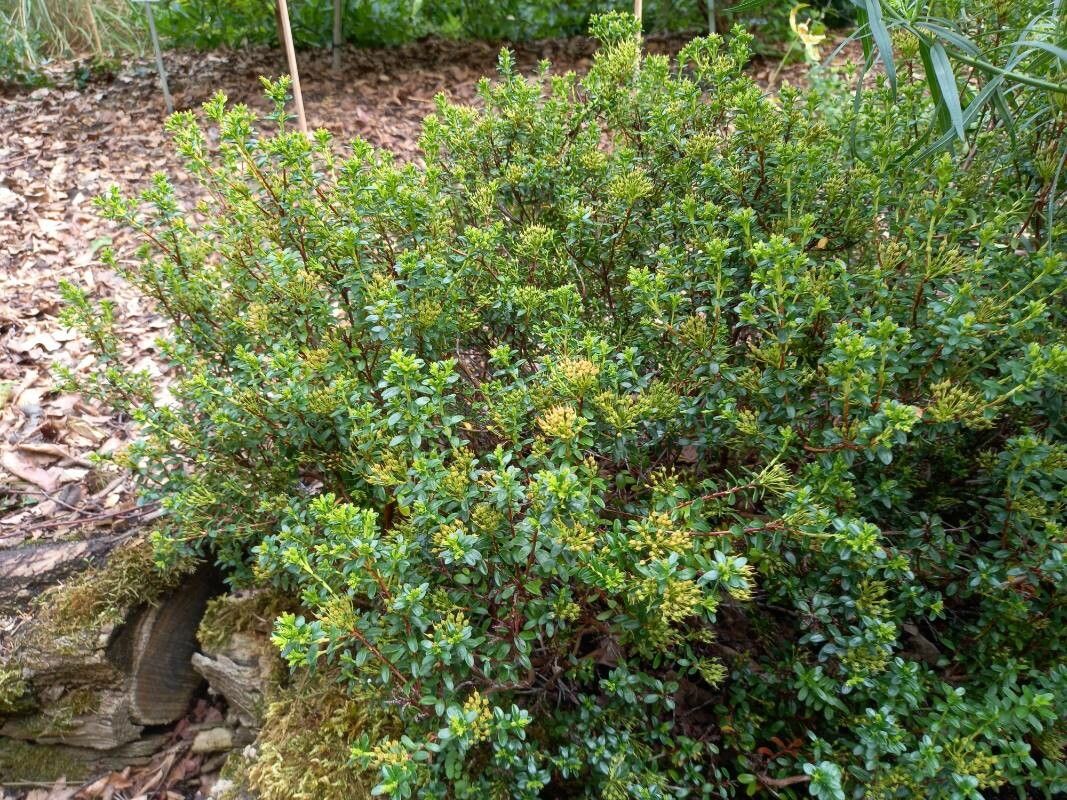
Kalmia buxifolia is a species of flowering plant in the family Ericaceae known by the common name sandmyrtle, or sand-myrtle. It is native to the mid-Atlantic and southeastern United States, where it has a disjunct distribution, occurring in three separate areas. It is known from the Pine Barrens of New Jersey, the Coastal Plain of the Carolinas, and the southeastern Blue Ridge Mountains.This species is sometimes called Leiophyllum buxifolium, the only member of the monotypic genus Leiophyllum. Genetic analysis supports its inclusion in genus Kalmia.This species is quite variable in appearance. It is a shrub growing 10 centimeters to one meter in height. The leaves may be alternately or oppositely arranged on the stems. They are oval to lance-shaped and up to 1.4 centimeters long. The inflorescence is a raceme or umbel of up to 18 flowers with white or light pink petals. The fruit is a capsule a few millimeters long.This species grows in a variety of habitat types in its fragmented range, including sandy plains in the Carolinas and rocky mountain woods.The Latin specific epithet buxifolia means "box-leaved", referring to species in the genus Buxus.The species and the cultivar 'Maryfield' have received the Royal Horticultural Society's Award of Garden Merit.
Sand-Myrtle is fairly disease-resistant and generally not susceptible to illnesses. Regarding care, this plant is fairly low-maintenance. When grown outdoors it needs little watering, and larger specimens usually do not require pruning. Smaller specimens, however, should be pruned after they finish blooming. Sand-Myrtlet is appropriate for anyone with an outdoor area, like a garden or deck, and does not demand much plant care experience.
How to keep Leiophyllum Buxifolium.
Light
The Sand-Myrtle prefers a location where gentle sunlight filters through and can flourish even in completely shaded areas. A surplus of solar exposure can hinder its growth, and on the other hand, insufficient sunlight may result in the decline of the plant's overall health. Hailing from a habitat with diverse light exposure, it is adaptable to different sunlight conditions.
Temperature
The Sand-Myrtle is indigenous to climates with temperatures between 50 and 90°F (10 and 32°C). It flourishes in such thermal conditions, though significant seasonal variations may necessitate adaptation. In the chillier months, measures to safeguard the plant or growing it indoors might be essential for its survival.
Fertilizer
For the Sand-Myrtle, the timing of fertilization is critical. Begin fertilizing in the early spring, and continue on a monthly basis until the early summer. The fertilizer contributes to the production of beautiful flowers and supplies energy during both the dormant and active growth stages.
Botanical profile.
- Plant Type
- Shrub
- Life Cycle
- Perennial
- Genus
- Leiophyllum
- Family
- Ericaceae
- Hardiness Zone
- 6-8
- Mature Height
- 10 cm to 91 cm
- Mature Spread
- 10 cm to 49 cm
- Leaf Color
- Green
- Leaf Type
- Evergreen
- Flower Color
- Pink, White
- Flower Size
- 0.51 cm
- Bloom Time
- Mid spring, Late spring
- Planting Time
- Spring, Summer, Autumn
- Harvest Time
- Mid summer, Late summer, Early fall
Other names.