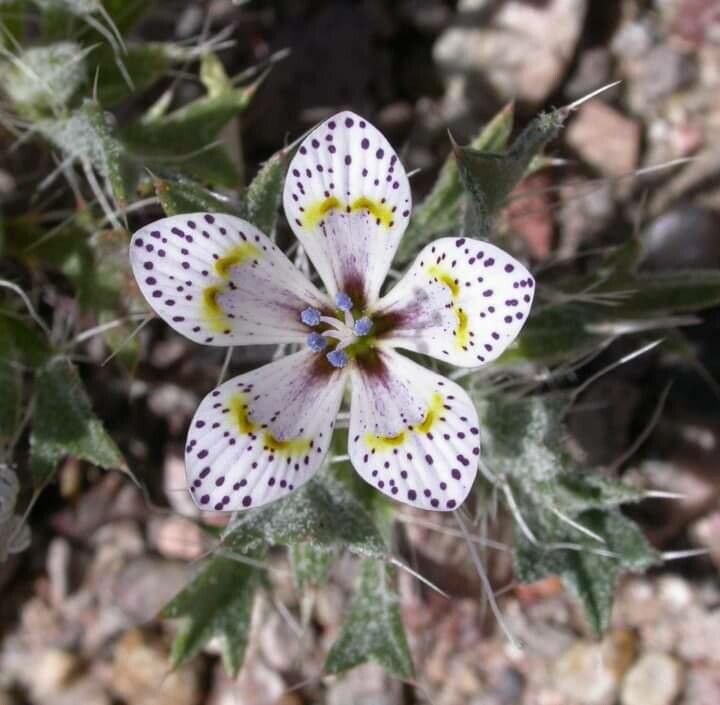
Langloisia setosissima, the bristly langloisia, bristly-calico, Great Basin langloisia or lilac sunbonnets, is a flowering plant, the sole species in the genus Langloisia in the family Polemoniaceae. It is native to the western United States and north western Mexico, where it is found in desert washes and on rocky slopes and plains from eastern Oregon and Idaho, south via Nevada and Utah to eastern California and Arizona. The genus name of Langloisia is in honour of Auguste Berthélemy Langlois (1832–1900), who was a French-born American clergyman and botanist.It is an annual plant, growing to 4–20 cm tall. The leaves are spirally arranged, linear, 2–3 cm long, densely bristly and with a toothed margin. The flowers are white to light blue or pale purple in color, 1.5–2 cm diameter, with a deeply five-lobed corolla. There are two subspecies:
Langloisia setosissima subsp. setosissima. Flowers with a uniformly colored corolla, possibly showing faint patterns of dots and stripes. Langloisia setosissima subsp. punctata (syn. Langloisia lanata, Langloisia punctata). Flowers with a corolla spotted with darker purple and yellow.The genus Loeseliastrum was previously included in Langloisia, formed from two former Langloisia species: Loeseliastrum matthewsii, formerly Langloisia matthewsii Loeseliastrum schottii, formerly Langloisia schottii
Great basin langloisia has strong disease resistance and is generally not susceptible to illnesses. Still, it can be affected by pests and diseases present in its environment. Such infections are typically mild. Regarding care, this plant demands moderate maintenance. It should be pruned regularly to preserve a neat appearance and encourage healthy growth. Applying fertilizer can also aid in enhancing flowering. Great basin langloisia is appropriate for anyone with outdoor space, like a garden or patio, and does not require extensive gardening experience. It may need increased care when cultivated indoors.
How to keep Langloisia Setosissima.
Light
Great basin langloisia is native to bright, open sites and thrives in full sun. It tolerates partial sun but prefers direct sunlight for optimal growth. This plant, which can be annual or biennial, is known for its sun-loving nature.
Water
Great Basin langloisia flourishes in arid environments due to its high tolerance for drought and preference for dry conditions. For optimal growth, it should be watered weekly and planted in well-draining soil that mimics its natural habitat. This plant is well-adapted to harsh sunlight and rare rainfall.
Temperature
Great basin langloisia naturally prefers environments with temperatures of 68 to 100 °F (20 to 38 ℃). It is advisable to seasonally adjust the surroundings to these preferred temperatures for optimal growth.
Fertilizer
Great basin langloisia responds well to regular, light applications of fertilizer to encourage healthy leaf growth. You should fertilize Great basin langloisia about once a month during the summer. Nitrogen is essential for foliage, and adding nitrogen-rich sources helps Great basin langloisia thrive.
Pruning
The Great Basin langloisia is known for its vibrant foliage and flowers and requires minimal pruning. To promote air circulation, remove any dead stems, generally from early to late spring. Regular pruning encourages dense growth and enhances flowering. Always use clean, sharp tools to prevent disease, ensuring the plant remains healthy and visually appealing.
Botanical profile.
- Plant Type
- Herb
- Life Cycle
- Annual
- Genus
- Langloisia
- Family
- Polemoniaceae
- Hardiness Zone
- 1-11
- Mature Height
- 4 cm to 20 cm
- Mature Spread
- 20 cm
- Leaf Color
- Green
- Leaf Type
- Semi-evergreen
- Flower Color
- Lavender
- Flower Size
- 1.02 cm to 1.52 cm
- Bloom Time
- Early spring, Mid spring
- Planting Time
- Spring
- Harvest Time
- Late spring, Early summer
- Native Area
- Mexico
Other names.
Reader questions.
How should I water my Great basin langloisia?
To water Great basin langloisia, you have several options. You can use a garden hose with a spray nozzle, a watering can, or any other common watering tool. The good news is that this plant isn't too particular about its water source. It can survive with rainwater, tap water, or filtered water. However, it's important to avoid watering from above as it may harm the leaves and flowers and lead to diseases. Instead, a drip irrigation system is often the best choice for watering this plant. It applies water evenly and directly to the soil. If you have a container-grown Great basin langloisia, the same approach applies, just change the tools. You can use a cup, watering can, or tap to water the soil directly.
How many hours of sunlight does Great basin langloisia need each day to grow well?
To ensure optimal growth and survival of the plants, it is important to provide them with a minimum of 6 to 8 hours of sunlight each day. Particularly during the summer, it is beneficial to expose them to more morning light. The Great basin langloisia, in particular, thrives in full sun and benefits significantly from increased sunlight. Providing ample light enables these species to produce food, display stunning blooms, and thrive in their environment.
What is the best temperature for Great basin langloisia?
The best temperature for Great basin langloisia depends on the time of year. There are two primary seasons to consider: the growing season and the dormancy season. During the growing season, it is ideal for the temperature to be between 65~80℉ (18~27℃) once the plant has started sprouting. If the temperature drops below 15℉ (-10℃), the plant will suffer, with its leaves potentially browning and wilting. However, with some assistance, it may survive a short cold snap. In the warmer parts of the year, Great basin langloisia should also be shielded from excessively high temperatures. The plant can tolerate temperatures up to 95-105℉ (35-40℃). Anything higher can harm the plant's leaves and blooms, leading to wilting, drooping, and even sunburn. Recovering from this damage can be challenging for the Great basin langloisia. Fortunately, there are several quick and easy ways to address this issue.
What should I do if I give too much or too little water to my Great basin langloisia?
To care for underwatered Great basin langloisia, simply water it more regularly when you notice it lacks moisture. Overwatering, on the other hand, can be a serious problem that may lead to diseases and even death. To prevent this, choose a growing location with plenty of sunlight and good drainage to avoid waterlogged soils. If you're overwatering a potted plant, consider repotting it with soil that drains well and a pot with sufficient drainage holes.
What kind of sunlight does Great Basin langloisia require?
The Great Basin langloisia thrives in full sunlight, so it's important to give them enough space to receive even sun exposure. To avoid depriving the leaves of sunlight, it's recommended not to overcrowd them. If planting in pots, place the herbaceous flowers in windows with direct sun, ensuring they receive full sunlight throughout the year. It's important to note that partial or filtered light is not ideal for these plants, as it results in weak stems and unhealthy flowers. For optimal growth, it's best to always expose the Great Basin langloisia to the sun.
The temperature needed for the first year or young Great Basin langloisia plants.
If this is the first year of your Great basin langloisia plant outside, it may require extra care during the coldest months. Frost can cause severe damage to a first-year Great basin langloisia and prevent it from growing back healthy in the spring. To prevent this, the plant should be kept at a temperature of 40℉(5℃) or above. This can be achieved by either bringing the plant indoors for a month or two or using mulch or fabric barriers to protect it from frost damage. During the first year or two, it is recommended to plant Great basin langloisia in a shadier area. Smaller and weaker plants have difficulty maintaining their own temperatures in hot weather. Therefore, it is best to limit the plant's exposure to direct sunlight to no more than five hours per day, especially when the temperature exceeds 80℉(27℃). To control the summer heat, use shadecloth and ensure regular watering or misting.
How much water does my Great basin langloisia need?
Great basin langloisia requires regular watering throughout its growing season. In spring, it's recommended to water this plant once a week. As the season progresses and temperatures rise, you may need to increase watering to two or three times per week. However, exceeding this rate can harm the plant. It's important to keep the soil relatively moist, but not wet, regardless of the watering frequency. Watering Great basin langloisia in a pot is slightly different. Potted plants tend to heat up and dry out faster than those planted in the ground. Therefore, you should water container-grown Great basin langloisia a few times per week, compared to just once per week for plants in the ground.
Does sunlight harm plants? How can we keep Great basin langloisia safe from sun and heat damage?
When the temperature goes above 90℉(32℃), the Great basin langloisia can be damaged by extreme heat, especially if they are exposed to many hours of sun. It is a good idea to provide some shade in the afternoon during the summer. Remember that the sun's rays are stronger in the summer and exposure is 50% longer than in the winter. If the Great basin langloisia is stressed from too much sunlight, make sure to keep them well-hydrated. Water the plants when the top of the soil is about 2 inches dry and consider moving them indoors if it is too hot outside, particularly if they are in containers. It is normal for the plant leaves to wilt during the day, as they can recover at night. However, if you notice that the Great basin langloisia is still drooping, it means the plant is losing water quickly and it is time to water them.
How can I keep Great basin langloisia safe from very hot or very cold temperatures?
If cold temperatures (below 15℉(-10℃)) occur during the growing season for your Great basin langloisia, there are a few steps you can take to protect it from frost or cold damage. - If you're growing it in a container, simply bring the container inside in bright, indirect light until temperatures rise above the lower threshold again. - For ground-planted Great basin langloisia, you can use mulch or horticultural fabric to create an insulated barrier around the plant, shielding it from frost and cold wind. In hot temperatures (above 80℉(27℃) in the shade) during the day, take care to only expose your Great basin langloisia to six hours or less of sunlight per day, ideally in the morning. Setting up shade cloth or fine plastic mesh can reduce direct sunlight exposure during the hottest parts of the day. Additionally, consider installing a misting system to release cooling mist around the plant's base during the day, lowering ground temperatures.
How much water does my Great basin langloisia plant need?
Determining the appropriate amount of water for your Great basin langloisia can be done in a few different ways. Some gardeners prefer to gauge the moisture in the soil by touch, ensuring that the first six inches are moist before ceasing watering. Another approach is to use a specific measurement, such as approximately two gallons per week, depending on factors like temperature and soil dryness. However, strictly adhering to these guidelines may lead to overwatering if your plant requires less. When growing your Great basin langloisia in a container, a different method is necessary. In this case, ensure that all layers of dry soil are moistened by testing with your finger or watering until a slight trickle of excess water escapes the drainage holes.
Should I keep Great basin langloisia out of the sun?
The Great basin langloisia thrives in sunny conditions and can be planted in south-facing gardens to maximize sun exposure. However, care should be taken to protect them from the intense afternoon and midday sun, as they may experience sunburn. Providing shade from a tree or wall during these times can be beneficial. It is not recommended to grow the Great basin langloisia in shady areas, as their larger flowers require ample energy from sunlight to grow and produce. For optimal results, always provide them with full sun by setting them in a well-lit area.
Temperature recommendations for the dormant season of Great Basin langloisia.
During the cold winter months, Great basin langloisia needs a certain amount of coldness to stay dormant until it is time to sprout. Sprouting too early, before the last frost has passed, can be deadly for Great basin langloisia, especially if it has already started growing before the frost arrives. Winter temperatures should ideally be below 32℉ (0℃), but if they reach up to 40℉ (5℃), it is not a problem. In more temperate climates like woodland rainforests, there can be unexpected warm periods during the cold months, which can cause Great basin langloisia to sprout prematurely. In such cases, if there is still a risk of frost, you can protect it by covering it with clear plastic on stakes to reduce the chance of damage from the cold. This covering can be removed once the danger of frost has passed. Sometimes, Great basin langloisia can sprout at the right time without any assistance, but using this method increases the likelihood of successful second sprouting.