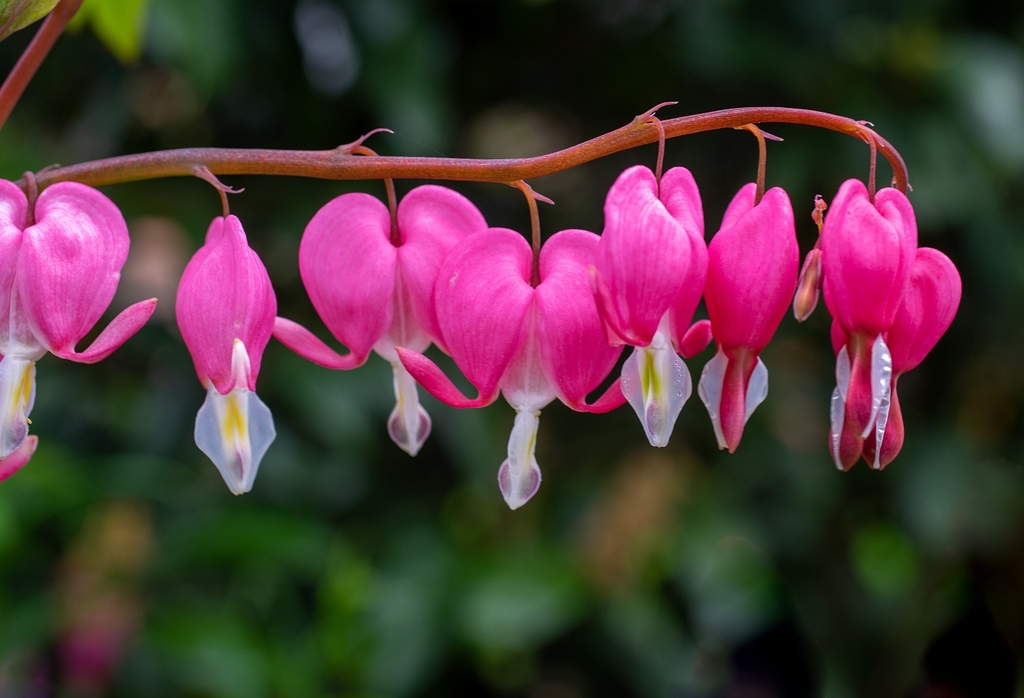
Lamprocapnos spectabilis, bleeding heart, fallopian buds or Asian bleeding-heart, is a species of flowering plant belonging to the fumitory subfamily (fumarioideae) of the poppy family Papaveraceae, and is native to Siberia, northern China, Korea, and Japan. It is the sole species in the monotypic genus Lamprocapnos, but is still widely referenced under its old name Dicentra spectabilis (now listed as a synonym), not to be confused with the North American native bleeding heart plants also classified under Dicentra. It is valued in gardens and in floristry for its heart-shaped pink and white flowers, borne in spring.Other common names include lyre flower, heart flower, and lady-in-a-bath.
The Asian bleeding heart is a highly valued plant in gardens. It features long branches adorned with numerous small, lantern-like flowers. Upon closer inspection, you'll notice that these pink flowers are heart-shaped, with white petals that resemble water droplets. Native to Asia, this plant is appropriately named the Asian bleeding heart.
Bleeding heart is fairly resistant to disease and is generally not prone to illness. However, it can be affected by pests and diseases present in its environment; these problems are usually mild. In terms of care, the plant requires moderate maintenance. It should be pruned regularly to maintain an attractive appearance and support healthy growth. Fertilizing can also help encourage flowering. Bleeding heart is suitable for anyone with an outdoor area, such as a garden or patio, and does not require extensive care experience. It may need more attention when grown indoors.
How to keep Lamprocapnos Spectabilis.
Light
Bleeding heart does best with moderate light, such as locations where strong daytime sun is shielded by nearby objects, encouraging steady growth. Although it can live in lower-light spots, that often results in weak flowering. Conversely, too much sun can damage the plant, causing leaves to brown or wilt.
Water
The Bleeding Heart plant is native to the moist woodlands of Asia, where it thrives in consistently damp soil. It prefers soil that remains evenly moist and requires weekly watering to flourish. As an herbaceous perennial, it benefits from natural rainfall, which helps produce its lush, heart-shaped flowers during the growing season.
Humidity
This plant will thrive in moderate humidity, which is probably the level in your home. However, misting it a few times a week can be very beneficial. Make sure the room has good ventilation.
Temperature
Bleeding heart grows best at temperatures from 41 to 90 ℉ (5 to 32 ℃). It comes from regions with mild climates and prefers cool summers. In winter it can tolerate temperatures as low as -30 ℉ (-34 ℃).
Fertilizer
The best time to fertilize a Bleeding heart is in early spring, as it comes out of dormancy and starts active growth. Fertilization supplies essential nutrients for healthy development. Although a Bleeding heart has relatively low fertilizer requirements, yearly fertilization can improve its survival and encourage better, longer-lasting flowers.
Pruning
The Bleeding Heart plant features heart-shaped flowers and should be pruned from early to late spring, after it has flowered. This helps promote growth and maintain its shape. Remove any damaged stems to improve air circulation. For older plants, cut mature stems down to ground level. Proper pruning enhances the plant's vigor and bloom fullness.
Pot & Repot
When repotting Bleeding heart, select a container 1-2 inches (2.5–5.1 cm) larger that provides good drainage. Use a well-draining potting mix. Repot in spring or fall, making sure the root ball sits slightly lower than the rim of the flower pot. Water thoroughly after repotting and place it in a warm spot with indirect sunlight.
Botanical profile.
- Plant Type
- Herb
- Life Cycle
- Perennial
- Genus
- Lamprocapnos
- Family
- Papaveraceae
- Hardiness Zone
- 5-8
- Mature Height
- 30 cm to 61 cm
- Mature Spread
- 46 cm
- Leaf Color
- Green
- Leaf Type
- Deciduous
- Flower Color
- Pink, White
- Flower Size
- 2.03 cm
- Bloom Time
- Mid spring, Late spring, Early summer
- Planting Time
- Spring
- Harvest Time
- Early summer, Mid summer
- Native Area
- Russia, Koppen, South Korea, China
Other names.
Reader questions.
When Should I Water My Bleeding Heart?
Knowing when to water your bleeding heart is essential for its health and to encourage the blossoming of its unique heart-shaped flowers. The primary indicator that your bleeding heart needs water is soil dryness; when the top inch of soil feels dry to the touch, it's time to water the plant. Additionally, signs such as wilting leaves, browning at the leaf edges, and stunted growth can also indicate a need for watering. However, be wary of overwatering, as this can lead to root rot and make the plant susceptible to pests.
Why should I add fertilizer to my Bleeding heart plant?
Fertilization plays an important role for the Bleeding heart and other plants due to its ability to provide essential nutrients for growth. While the fertilization needs of a Bleeding heart are generally low, it can still benefit from annual fertilization. In some cases, the plant may survive without fertilization, but regular fertilization can help it thrive and produce longer-lasting flowers. Those who want their Bleeding heart to look its best should consider implementing annual fertilization.
What are the sunlight requirements for a Bleeding Heart plant?
Bleeding Heart plants require moderate levels of light exposure, ideally in areas that avoid the intense rays of the sun for the entire day but still receive sufficient light. The plant thrives under conditions of partial sun, which is about 3-6 hours of sunlight. In full shade, or areas receiving less than 3 hours of sunlight, the plant may survive but with less optimal flowering. It's important to observe how sunlight moves through your garden to choose the best spots that offer a balance of light and shade, ensuring the plants remain happy and healthy.
What is the optimal temperature range for a Bleeding Heart to grow?
The optimal temperature range for a Bleeding Heart (Lamprocapnos spectabilis) to grow is between 41 to 90°F (5 to 32°C). This plant is native to environments that enjoy moderate temperatures and thrives in areas with cool summers. During the winter months, it has the ability to withstand low temperatures down to -30°F (-34°C), showcasing its strong resistance to cold. Despite this cold resistance, if temperatures are forecasted to fall below the plant's growth limit, it's crucial to take steps for frost protection, such as covering the plant with soil or straw. Additionally, ensuring the soil is moist going into the freeze can help prevent drought stress throughout the winter and early spring.
How Should I Water My Bleeding Heart?
Bleeding heart requires a unique watering approach due to its preference for moist, well-drained soil. The optimal technique includes bottom-watering, which allows the plant to absorb moisture through the drainage holes without oversaturating the soil surface. Utilizing a moisture meter can help determine the perfect watering schedule by accurately measuring soil dryness. When watering from the top, aim towards the soil around the root zone and avoid wetting the foliage to prevent fungal diseases. The goal is gradual, deep watering that moistens the soil adequately without waterlogging it.
When should I fertilize my Bleeding heart plant to get the best results?
The best time to fertilize a Bleeding heart is late winter to early spring, as this is when the plant is coming out of dormancy and starting to grow actively. Fertilizing during this time promotes healthy growth and sets the plant up for a successful season. While it is generally recommended to fertilize in early spring, it is also acceptable to fertilize in the fall. However, it is not advisable to fertilize in summer or winter.
How does artificial lighting affect Bleeding Heart plants?
Bleeding Heart plants can benefit from artificial lighting, especially when natural sunlight is not sufficient, like during winter or in less sunny indoor spaces. For optimal growth under artificial lights, consider the following: LED lights are recommended because they can provide the specific wavelengths of light that plants need. Full sun plants require 30-50W/sq ft of artificial light, partial sun plants need 20-30W/sq ft, and full shade plants need 10-20W/sq ft. The artificial light source should be placed 12-36 inches above the plant to mimic natural sunlight and should be left on for 8-12 hours per day to replicate natural daylight hours.
How should you care for a Bleeding Heart during low temperatures?
Bleeding Heart plants are notably cold-tolerant, and for optimal growth, it's important to keep them above their minimum tolerable growing temperatures. Even though they can survive winter conditions without visible damage, temperatures falling below their growth limit might lead to a decrease in sprouting or no sprouting at all come springtime. To manage this, it's recommended to remove any parts of the plant that fail to sprout as the weather warms up in spring, ensuring the plant can focus its energy on new growth.
How Much Water Does Bleeding Heart Really Need?
Bleeding heart, with its shallow root system, requires a moderate amount of water to thrive. It's best to water whenever the top inch of the soil dries out, focusing on keeping the root depth of 6-8 inches moist but not oversaturated. Proper hydration is indicated by glossy, green leaves and slightly moist soil. Both overwatering and underwatering can have adverse effects, such as root rot or stunted growth, so maintaining a balance is crucial, especially by avoiding standing water and watering in the early morning or late afternoon.
When is the best time to not put fertilizer on my Bleeding heart plant?
To avoid overfertilization and complications, it is best to only fertilize your Bleeding heart in late winter or early spring. A single annual feeding will suffice for this plant's low fertilization needs. However, if you did not fertilize in spring, it is acceptable to feed it in the fall. It is important to refrain from fertilizing during the rest of the growing season and winter. During these times, the Bleeding heart is either dormant or does not put forth new growth, making fertilization unnecessary and unadvisable.
What are the signs of poor lighting conditions in Bleeding Heart plants?
Bleeding Heart plants show several symptoms when exposed to insufficient light, including small new leaves, leggy or sparse growth, faster leaf drop, slower or ceased new growth, lighter-colored new leaves, and conditions like chlorosis, sunscald, leaf curling, wilting, and leaf scorching. These symptoms indicate the plant is struggling with the current light conditions, affecting its overall health and growth. Adjusting light exposure, either by moving the plant to a sunnier spot or by providing artificial lighting, can help address these issues.
What should you do if a Bleeding Heart is exposed to high temperatures?
During the hotter summer months, it's essential to keep your Bleeding Heart plant below its maximum suitable growth temperature to avoid heat stress. Exceeding this temperature threshold can cause the leaves to lighten in color, curl, become susceptible to sunburn, and in severe cases, lead to wilting and drying out of the entire plant. To mitigate these issues, you should trim away sunburned and dried parts of the plant, relocate it to a shaded area, or use shade cloth for protection against the intense midday and afternoon sun. Ensuring the soil stays moist with regular watering sessions in the morning and evening can also help the plant manage better in high temperatures.