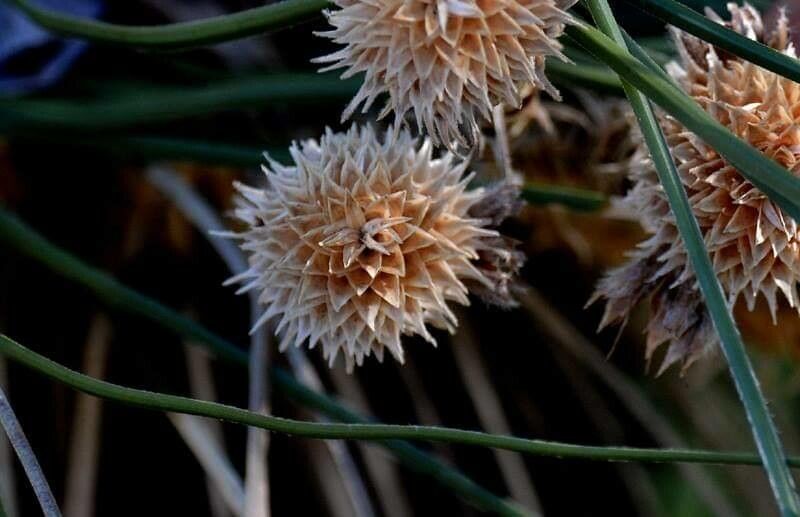
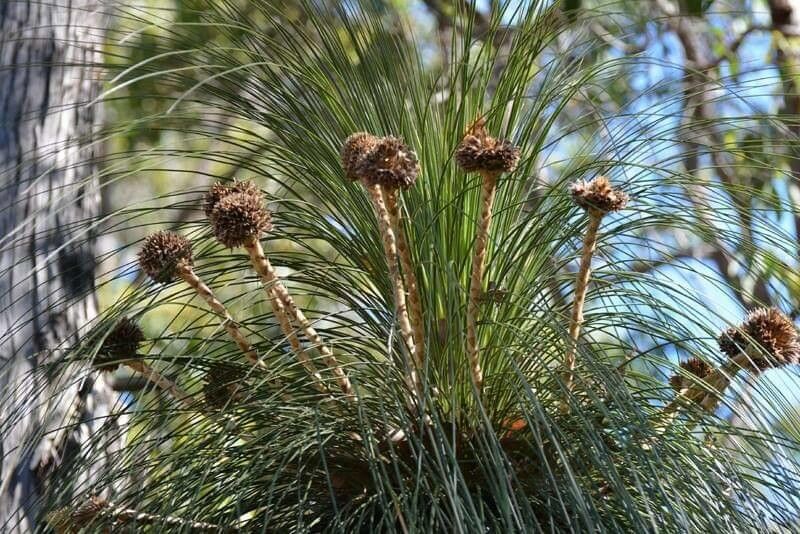
Kingia is a genus consisting of a single species, Kingia australis, and belongs to the plant family Dasypogonaceae. It has a thick pseudo-trunk consisting of accumulated leaf-bases, with a cluster of long, slender leaves on top. The trunk is usually unbranched, but can branch if the growing tip is damaged. Flowers occur in egg-shaped clusters on the ends of up to 100 long curved stems. Kingia grows extremely slowly, the trunk increasing in height by about 1½ centimetres per year. It can live for centuries, however, so can attain a substantial height; 400-year-old plants with a height of six metres are not unusual.
Black gin is resistant to disease and is generally unlikely to develop illnesses. In terms of care, this plant is fairly low maintenance. When grown outdoors it needs only minimal watering, and larger specimens typically do not require pruning. Smaller plants, however, should be pruned after they finish blooming. Black gint is appropriate for anyone with outdoor space, such as a garden or a deck, and does not demand extensive experience in plant care.
How to keep Kingia Australis.
Light
Black gin is found in open habitats, like sunny meadows and forest edges, that offer abundant light. It performs best in Full Sun but can tolerate Partial Sun, adapting well to different sunlight conditions.
Temperature
Black gin shows strong adaptability to a wide variety of climatic conditions, from blazing summers to freezing winters. It does, however, have an ideal temperature range for growth. If temperatures become excessively high, the plant is vulnerable to heat and humidity stress, which can cause it to die. In areas where temperatures approach the lower limit of its cold tolerance, providing insulation is important to protect the plant.
Fertilizer
Apply fertilizer to your Black gin in early spring to encourage healthy growth. Regular feeding improves its overall condition, producing strong growth, greater tolerance of harsh conditions, and better resistance to pests and diseases. Keep a consistent fertilization routine for your Black gin to maintain vibrant, deeply colored foliage and a lush look.
Pruning
Black gin, which resembles a grass tree, benefits from pruning in early spring. To maintain its health and appearance, use clean tools and avoid heavy pruning. Focus on removing dead foliage and shaping the plant, and be sure to trim old flower spikes. This practice encourages new growth, enhances the plant's appearance, and helps prevent diseases.
Botanical profile.
- Plant Type
- Tree
- Life Cycle
- Perennial
- Genus
- Kingia
- Family
- Dasypogonaceae
- Hardiness Zone
- 9-11
- Mature Height
- 3.05 m to 7.92 m
- Mature Spread
- 2.13 m to 3.96 m
- Leaf Color
- Dark Green
- Leaf Type
- Evergreen
- Flower Color
- White
- Flower Size
- 1.02 cm to 2.03 cm
- Bloom Time
- Mid fall, Late fall
- Planting Time
- Spring, Summer, Autumn
- Harvest Time
- Winter
Other names.