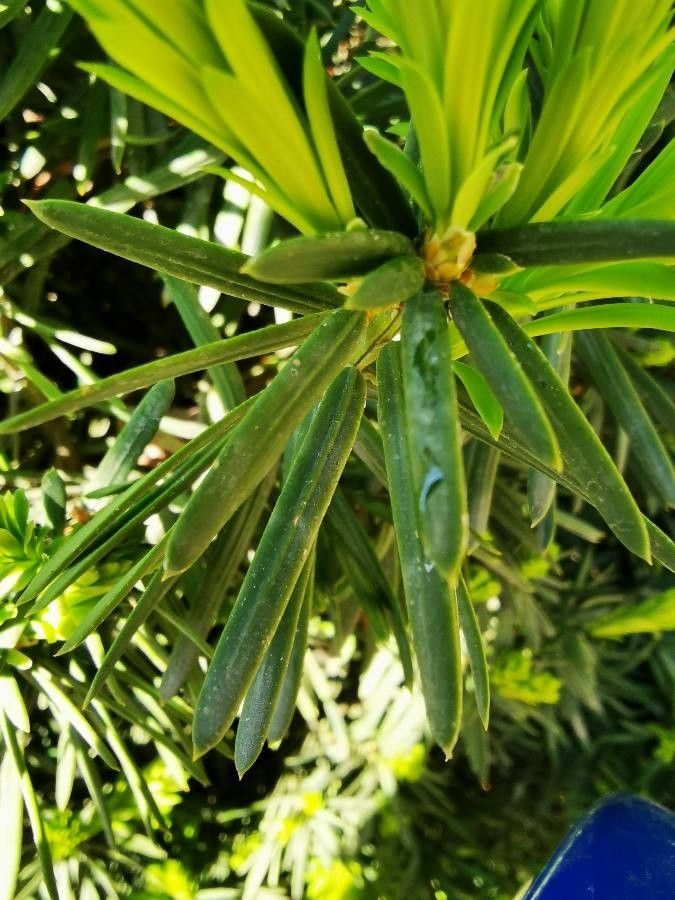
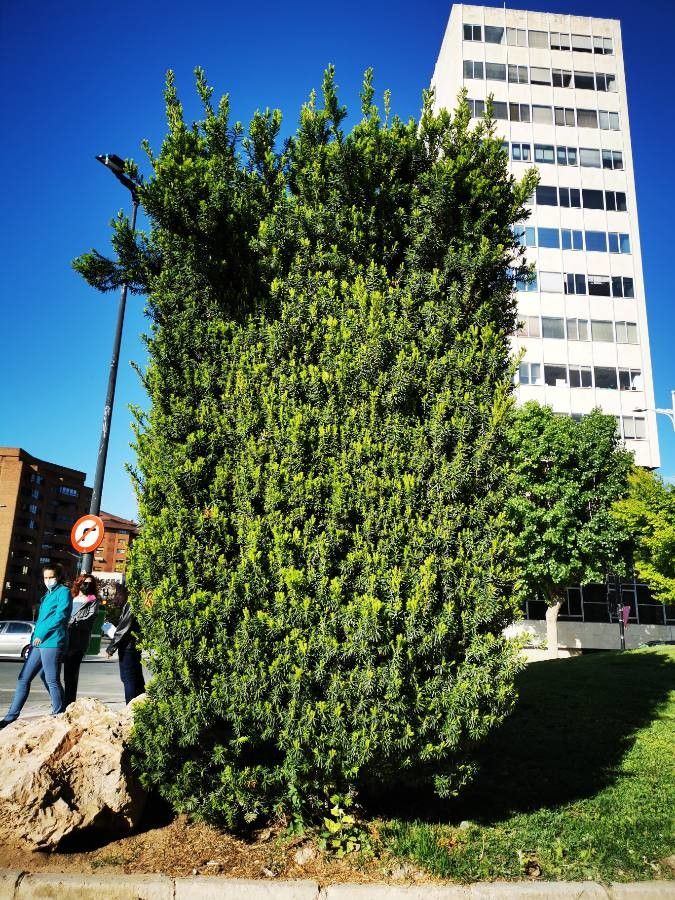
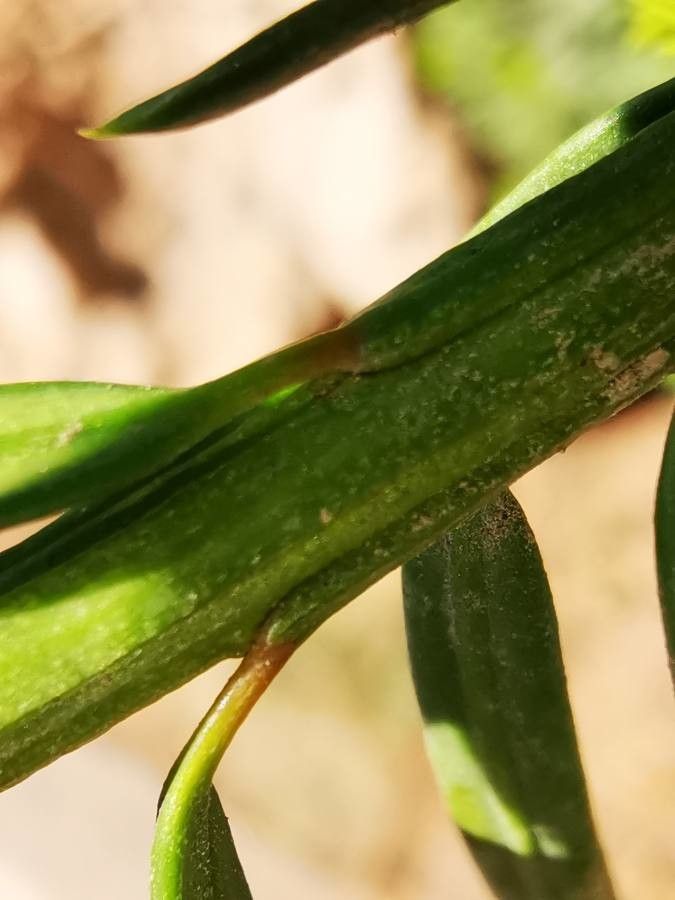
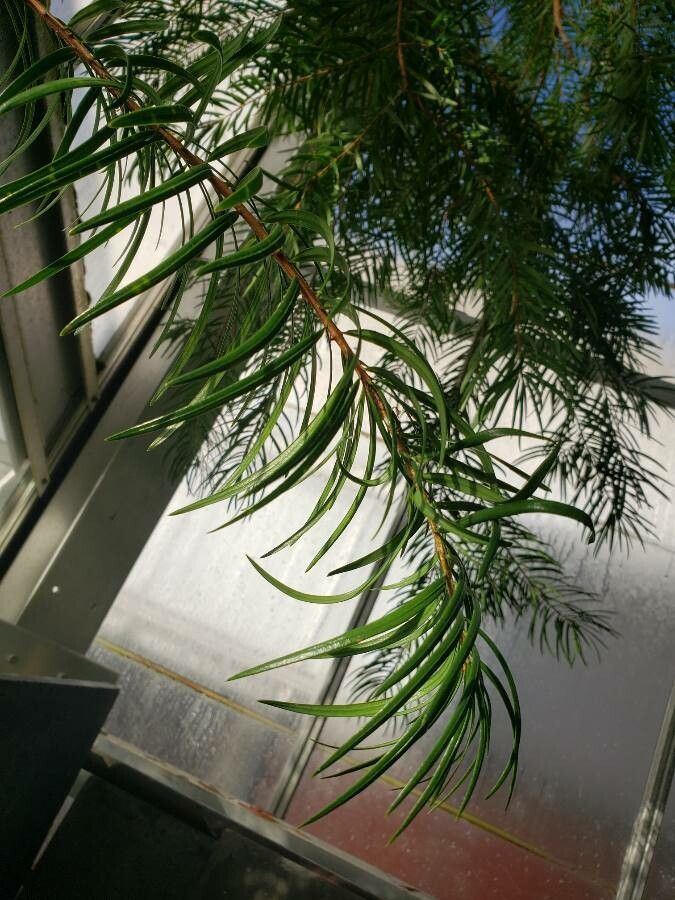
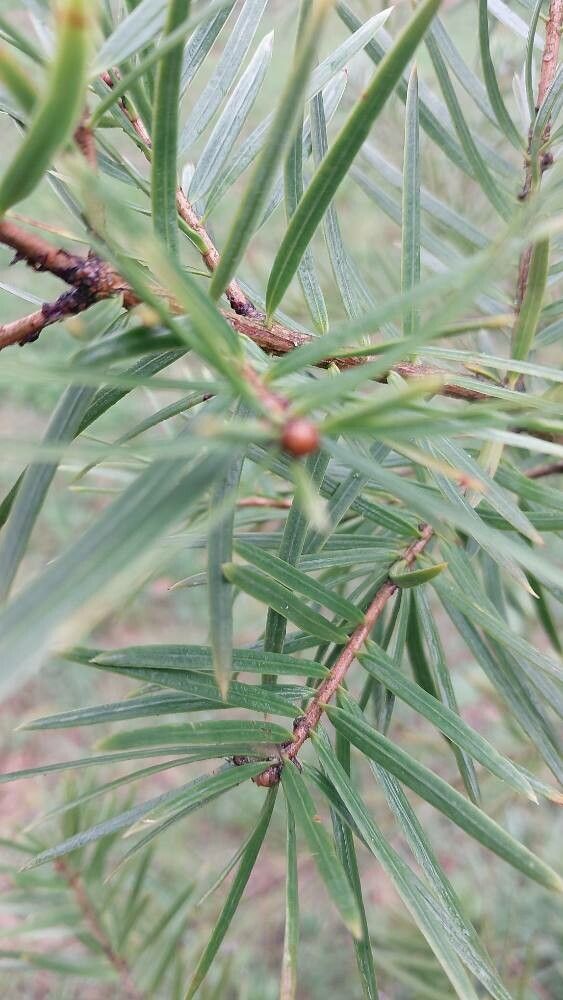
Keteleeria davidiana (zh: 铁坚油杉) is a coniferous evergreen tree native to Taiwan and southeast China, in the provinces of Gansu, Guangxi, Guizhou, Hubei, Hunan, Shaanxi, Sichuan, and Yunnan. It also occurs in the very northern part of Vietnam. The tree is restricted to hills, mountains, and valleys at elevations of 200–1500 m. Generally, it grows in regions with a more continental climate than the other two Keteleeria species. The tree reaches 40–50 m in height, developing an irregular oblate crown with large branches. The branchlets have a dense covering of stiff hairs. The bark is dull brown to dark gray-black, and is scaly or flaky. The leaves are needle-like, 2-6.4 cm long by 3.6-4.2 mm broad. They are flat, stiff, and dark shiny green. The cones are light brown, cylindrical, and stand erect on the branches. They are 8–20 cm long and 4–5 cm broad with a stalk 2.5-3.2 cm long. The winged oblong seeds, which mature in October or November, are 13 mm long with a glossy brown wing 12–19 mm long. Three varieties of the species exist:
Keteleeria davidiana var. calcarea. Guangxi and Guizhou on calcareous mountains. First-year branchlets yellow. Apices of seed scales blunt and rounded. Winter buds globular. Keteleeria davidiana var. davidiana. First-year branchlets yellow-gray or light-gray. Apices of seed scales narrowed. Winter buds ovoid. Keteleeria davidiana var. formosana. Endemic on Taiwan, at 300–900 m. Dark leaf scars protruding noticeably on branches. Leaves 2–4 cm long.The wood is soft and white yellow, and is used for construction, bridges, furniture, and wood fiber.
David's keteleeria has good resistance to disease and is generally not susceptible to illnesses. Regarding care, this plant is fairly low-maintenance. When grown outdoors it needs minimal watering, and larger specimens typically do not require pruning. Smaller plants, however, should be pruned after they have bloomed. David's keteleeriat is suitable for anyone with an outdoor area, such as a garden or deck, and does not demand much prior care experience.
How to keep Keteleeria Davidiana.
Light
David's keteleeria comes from open habitats, such as sunny meadows and forest edges, which supply abundant light. It performs best in Full Sun but can also tolerate Partial Sun, adapting well to various sunlight conditions.
Temperature
David's keteleeria shows considerable adaptability to a range of climate conditions, from scorching summers to cold winters. Nevertheless, it has an optimal temperature range for growth. When temperatures become excessively high, the plant is susceptible to heat and humidity stress, which can lead to its death. In areas where temperatures approach the lower limit of its cold tolerance, it is important to use insulation measures to protect the plant.
Fertilizer
David's keteleeria has specific nutrient needs and does not require heavy fertilization. Spring is the best time to apply fertilizer for optimal growth. Providing nutrients improves its health, increases resistance to pests and diseases, and helps sustain its long lifespan.
Botanical profile.
- Plant Type
- Tree
- Life Cycle
- Perennial
- Genus
- Keteleeria
- Family
- Pinaceae
- Hardiness Zone
- 6-9
- Mature Height
- 20.12 m to 39.93 m
- Mature Spread
- 10.06 m to 14.94 m
- Leaf Color
- Dark Green
- Leaf Type
- Evergreen
- Bloom Time
- Mid spring, Late spring
- Planting Time
- Spring, Summer, Autumn
- Harvest Time
- Late summer, Early fall, Mid fall
- Native Area
- Vietnam, China
Other names.