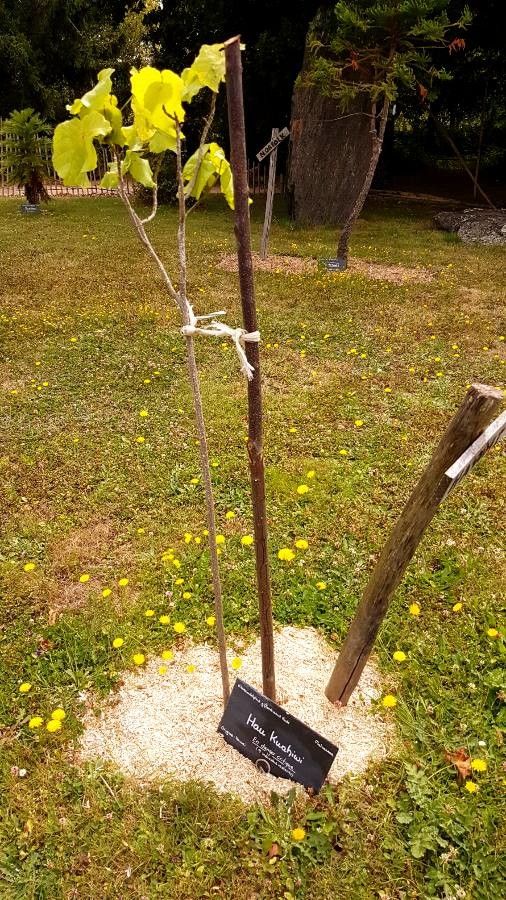
Hibiscadelphus giffardianus (Kilauea hau kuahiwi) is a species of flowering plant in the mallow family, Malvaceae, that is endemic to the Big Island of Hawaii. It is believed to be extinct in the wild; any remaining plants are threatened by habitat loss. Cultivated plants exist in Hawaii Volcanoes National Park. It inhabits mixed mesic forests on the slopes of Mauna Loa at elevations of 1,200–1,310 m (3,940–4,300 ft). Associated plants include ʻōhiʻa lehua (Metrosideros polymorpha), koa (Acacia koa), mānele (Sapindus saponaria), hoio (Diplazium sandwicianum), pilo (Coprosma spp.), māmaki (Pipturus albidus), kōpiko (Psychotria spp.), olopua (Nestegis sandwicensis), alani (Melicope spp.), ʻaʻaliʻi (Dodonaea viscosa), and naio (Myoporum sandwicense). H. giffardianus is a small tree, reaching a height of 7 m (23 ft) and trunk diameter of 30 cm (12 in).
How to keep Hibiscadelphus Giffardianus.
Pruning
The Kilauea hau kuahiwi is a rare shrub known for its bell-shaped flowers, and it thrives when pruned in early spring. To care for this plant, focus on a few key practices: remove any dead branches and thin out dense areas to improve air circulation. Regular pruning encourages vigorous growth and abundant blooming, but be careful not to over-prune, as this shrub is sensitive and can be adversely affected.
Botanical profile.
- Plant Type
- Tree
- Life Cycle
- Perennial
- Genus
- Hibiscadelphus
- Family
- Malvaceae