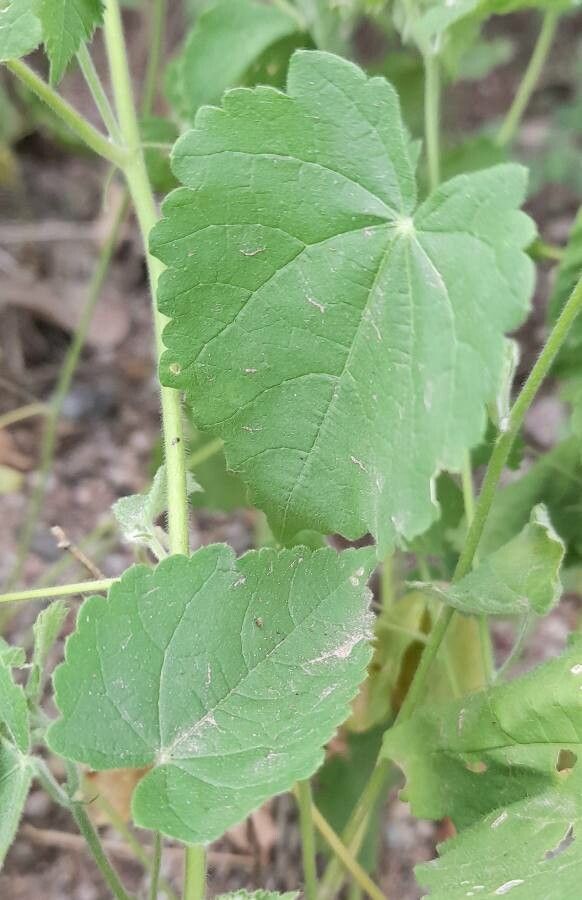
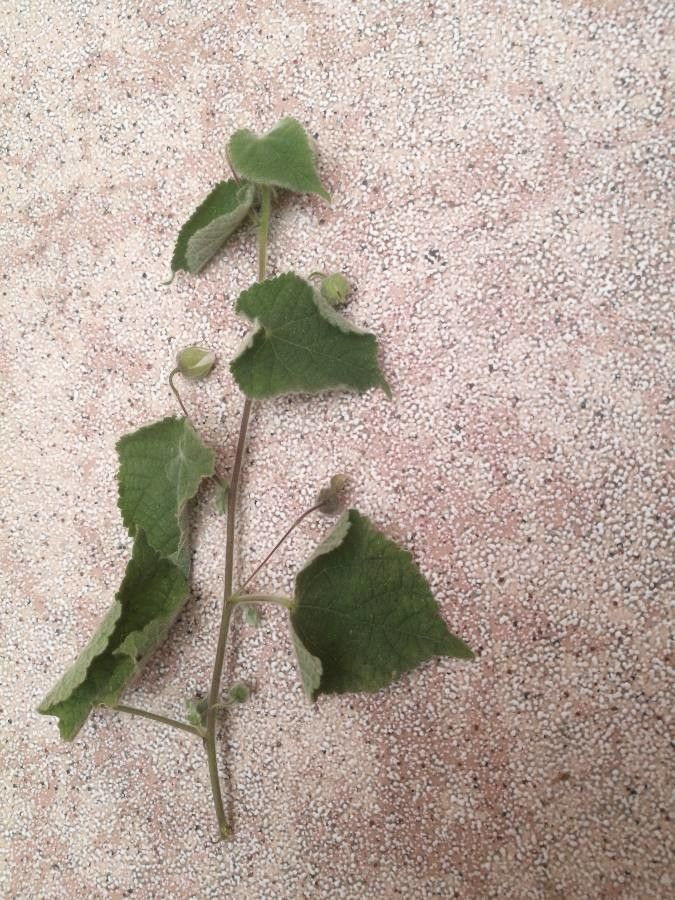
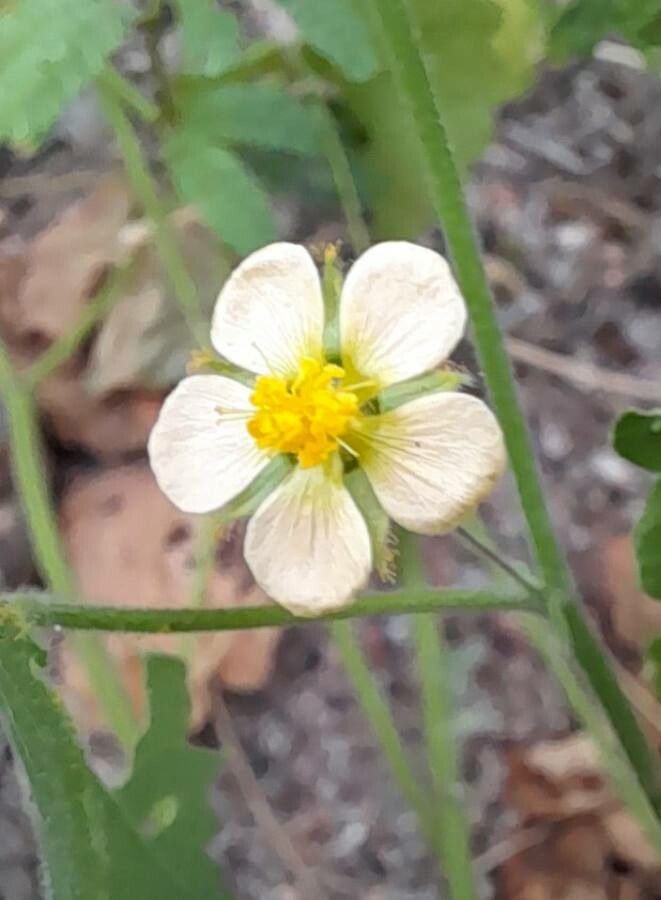
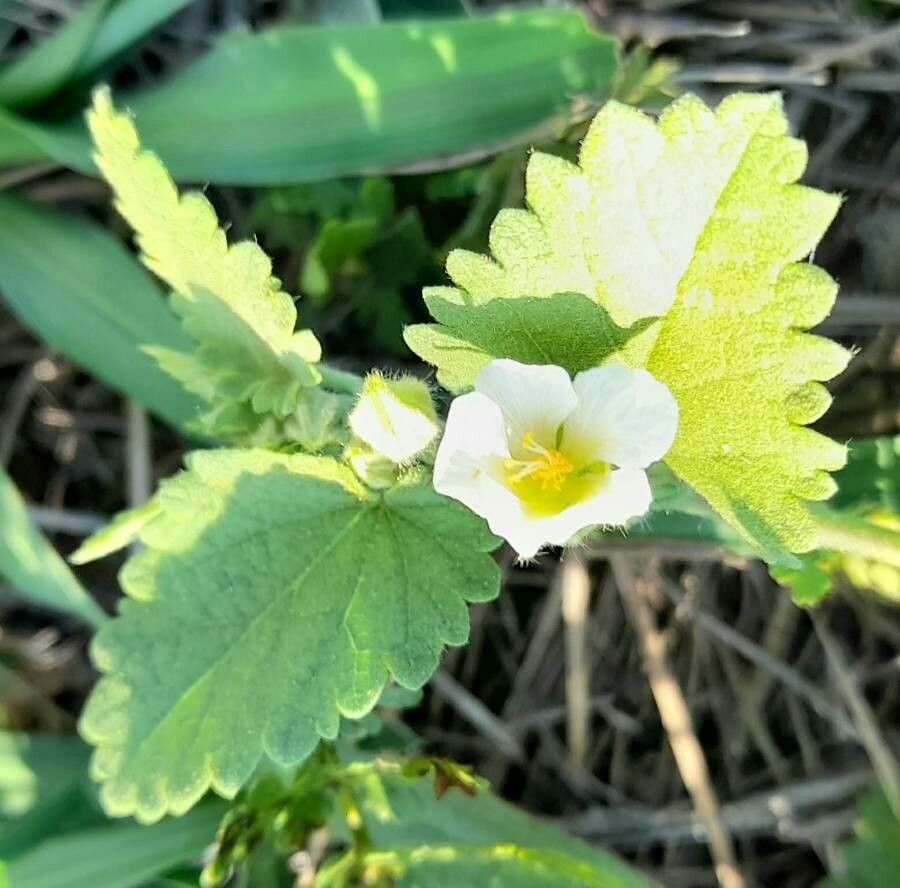
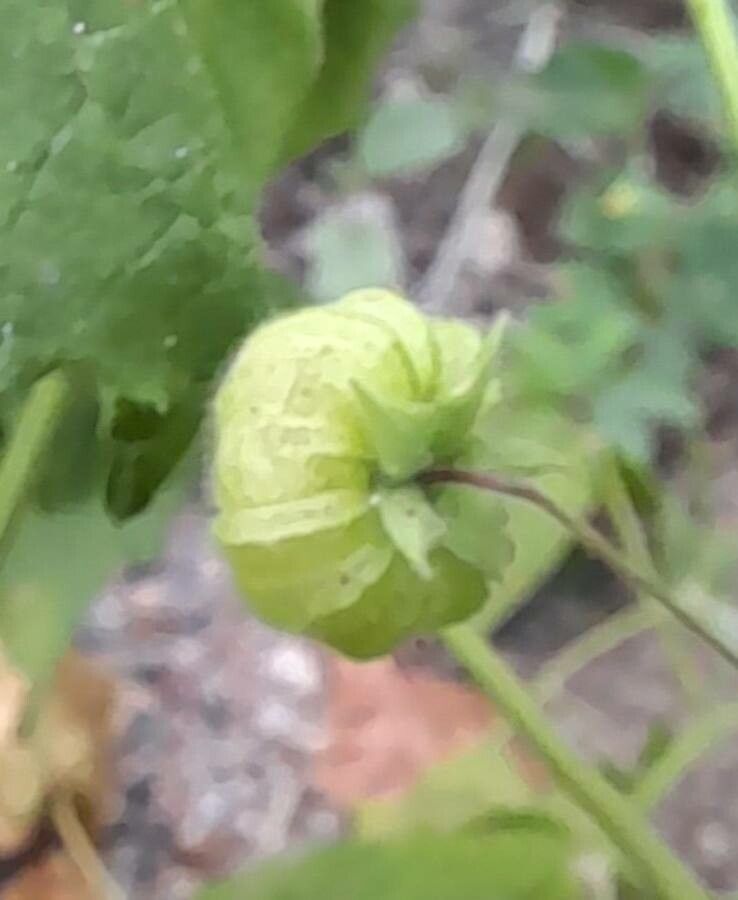
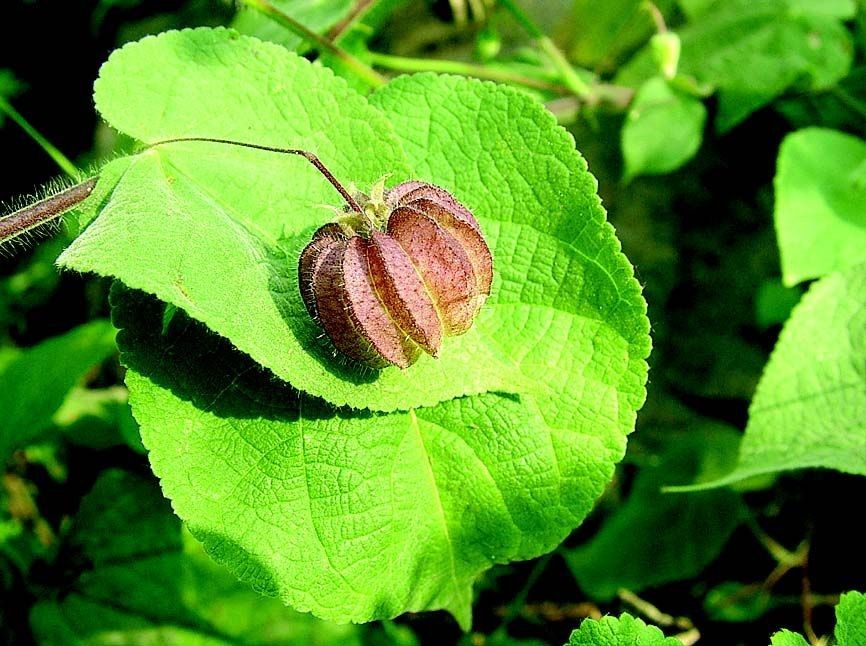
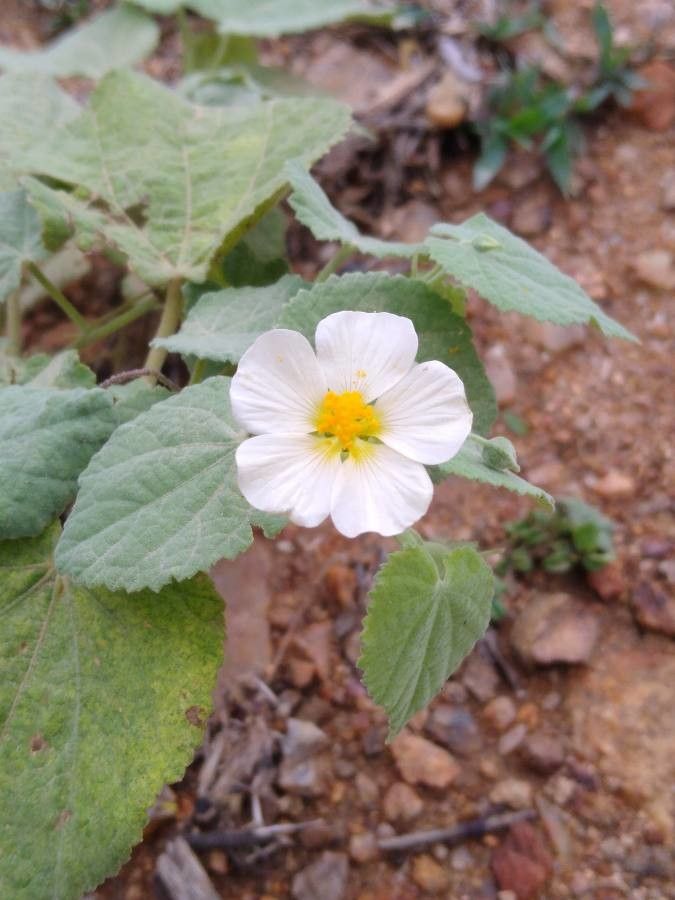
Herissantia crispa is a species of flowering plant in the mallow family known by the common names bladdermallow and curly abutilon. It is native to the tropical Americas but it can be found throughout the tropical and warmer temperate world as an introduced species and sometimes a weed. This is a perennial or sometimes annual herb growing up to about 1.5 meters in maximum stem length, usually taking a trailing or creeping form. It is coated in whitish hairs. The oval or heart-shaped leaves are up to 7 centimeters long with rippled edges. The inflorescence is a solitary flower emerging from a leaf axil, borne on a long-haired pedicel which is half erect and then jointed downward. The flower has five pale yellow oval petals each up to a centimeter long. The fruit is a lantern-like inflated sphere ribbed into segments. It is up to 2 centimeters wide, coated in long hairs, and dehiscent, each segment containing 2 or 3 black kidney-shaped seeds.
Bladdermallow is relatively resistant to disease and generally does not develop illnesses. That said, it can be vulnerable to pests and diseases present in its environment. These problems are typically mild. For care, this plant needs moderate maintenance. It should be pruned regularly to keep a neat appearance and support healthy growth. Fertilizing can also encourage flowering. Bladdermallow is suitable for people with outdoor spaces like a garden or patio and does not require extensive care experience. It may need extra attention when grown indoors.
How to keep Herissantia Crispa.
Light
Bladdermallow grows best with abundant sunlight for most of the day. It is fairly adaptable and can tolerate locations with reduced light exposure. However, prolonged periods of low light can hinder growth and harm its health, reflecting its origins in sun-drenched environments.
Water
Bladdermallow thrives in high humidity and requires consistent moisture, preferring well-drained soil that remains evenly moist. To encourage lush growth, especially during the growing season, water the plant weekly. It is best to cultivate bladdermallow outdoors to replicate its natural habitat. As an evergreen, it maintains continuous foliage production.
Temperature
Bladdermallow is native to areas with a temperature range of 68 to 100°F (20 to 38℃). The plant thrives in warm conditions and grows best within that optimal range. For seasonal adjustments, keep the environment warmer during colder periods to meet its preference for heat.
Fertilizer
Correct fertilization is essential for Bladdermallow's health and appearance. Fertilize Bladdermallow during the summer, repeating monthly throughout that season. Nutrients supply the energy for growth and help maintain the plant's tissues. Fertilization improves Bladdermallow's flower display, ensuring the best blooms.
Pruning
Bladdermallow benefits greatly from being pruned in early spring. During this time, removing dead stems encourages new growth. Thinning out crowded branches also improves airflow, which aligns with the plant's growth cycle and ensures abundant flowering. Regular pruning not only enhances the plant's appearance but also boosts its vitality, making it a recommended practice for maintaining optimal health.
Botanical profile.
- Plant Type
- Herb
- Life Cycle
- Perennial, Annual
- Genus
- Herissantia
- Family
- Malvaceae
- Hardiness Zone
- 9-11
- Mature Height
- 91 cm
- Mature Spread
- 30 cm to 49 cm
- Leaf Color
- Green
- Leaf Type
- Semi-evergreen
- Flower Color
- White
- Flower Size
- 2.54 cm
- Bloom Time
- All year round
- Planting Time
- Spring, Summer
- Harvest Time
- All year round
- Native Area
- Belize, Honduras, Mexico, Guatemala, Peru, Panama, Jamaica, Colombia, Cuba, Bolivia, Venezuela, Guyana, El Salvador, Nicaragua, Brazil, Ecuador, Costa Rica
Other names.
Reader questions.
How much water does my Bladdermallow need?
If your Bladdermallow is in a pot, check the soil moisture by sticking your finger into it. If the top two to three inches of soil are dry, it's time to water. The same method can be used for Bladdermallow grown outdoors in the ground. In spring and early fall, watering once a week is usually sufficient. During extremely hot weather, you may need to increase watering to twice or more per week. However, mature, well-established Bladdermallow plants can tolerate drought well.
How much sunlight does Bladdermallow need to grow?
Bladdermallow requires six to eight hours of direct sunlight daily. When growing outdoors, choose a location that receives full sunlight all day. If growing indoors, place the plant near a south-facing window or area with ample sunlight. However, ensure that Bladdermallow is not exposed to direct sunlight during high temperatures over 35°C (95℉) or hot summer afternoons to prevent leaf scorching or wilting. Consider using sheer curtains or blinds to filter intense sunlight or relocate the plant to a shadier spot.
What temperature is best for Bladdermallow?
To help your tropical plants thrive, it's best to maintain a temperature range of 75℉ to 90℉ (25-32℃). While different species can tolerate temperatures outside this range, sticking within a few degrees of these limits will ensure optimal growth. However, there are extreme temperature limits to be aware of. Anything below 50℉ (10℃) or above 95℉ (35℃) can hinder growth and cause issues with the leaves and stems. Low temperatures are particularly damaging, as even a light frost can lead to the death of your tropical plants. In fact, cellular death can occur rapidly, with some species dying within 12 to 24 hours.
How should I water my Bladdermallow plant?
To properly water the Bladdermallow plant, follow these steps: 1. Use filtered water at room temperature. Tap water may contain harmful particles that can negatively affect the plant's health. 2. The Bladdermallow prefers warmer conditions, so avoid using cold water as it can shock the plant's system. 3. Instead of overhead watering, apply filtered room temperature water directly to the soil. 4. Water the soil until it is completely saturated. This helps to moisten the roots and facilitate nutrient absorption. 5. By soaking the soil, the plant's roots can continue to spread and gather the necessary nutrients for optimal growth.
What will happen if Bladdermallow doesn't get enough sunlight?
Insufficient sunlight can cause problems for your Bladdermallow. Without enough sun exposure, the plant may have difficulty growing properly, resulting in weak and leggy growth. Additionally, the leaves may turn yellow as a sign of inadequate sunlight for chlorophyll production. In severe cases, lack of sunlight can even lead to the death of the plant.
Does Bladdermallow need different temperatures for different stages of growth?
Bladdermallow doesn't need temperature changes to grow, but it's important to maintain consistency. Fluctuations in temperature can slow down its growth, so it's best to keep it in a controlled environment. The ideal temperature range is between 75℉ and 90℉ (25-32℃), with the lower limit being particularly important to stay above. While temperatures above 90℉ (32℃) aren't ideal, this tropical plant can tolerate them. However, temperatures below 50℉ (10℃), especially 40℉/5℃, will directly damage this heat-loving plant species.
What should I do if I give too much or too little water to my Bladdermallow?
Overwatering and underwatering can harm your Bladdermallow, but overwatering is more common. When the plant gets too much water, its stems and leaves may wilt and turn yellow. Overwatering for too long can also cause root rot, mold, and mildew, which can be fatal for the plant. Underwatering is less likely because the Bladdermallow can handle drought well, but it can still happen. In this case, the leaves may become brittle and brown. It's important to recognize the signs of overwatering early and take action. Some diseases caused by overwatering, like root rot, cannot be fixed if detected too late. Reduce your watering schedule immediately if you see early signs of overwatering. Also, check if the soil drains properly. If it doesn't, replace it with a loose, well-draining potting mix. If your Bladdermallow shows signs of not getting enough water, simply water it regularly until those signs go away.
What happens if Bladdermallow gets too much sunlight?
Bladdermallow thrives in full sunlight, but too much direct sunlight can be harmful. Extended exposure to intense sunlight can cause the plant to develop signs of sunburn, like brown or scorched leaves. To prevent this, carefully observe the plant and relocate it to a more shaded area if needed.
Does Bladdermallow require different temperatures for each season?
Bladdermallow is a plant that does not require different temperatures for different seasons. To ensure its healthy growth, it is important to maintain the environment within the optimal temperature range. Therefore, it is recommended to keep this plant indoors where you have control over the temperature, regardless of the outside climate. In addition to temperature, light is also crucial for tropical species like Bladdermallow. These plants prefer a partial sun exposure, specifically dappled or filtered light. When growing your plants indoors, it is best to provide bright yet indirect light. Excessive direct sunlight can harm the leaves and hinder the plant's growth potential.
How much water does my Bladdermallow plant need?
When watering your Bladdermallow, it's important to be generous with the amount of water you provide. If the top layer of soil is dry, give the plant a thorough watering so that the entire soil is soaked. Make sure to add enough water that it drains through the bottom holes of the pot. If you notice that no excess water is coming out of the pot, you may not have given enough water. However, you should also avoid letting water accumulate inside the soil, as this can harm the plant. On the other hand, if water doesn't drain properly, it could indicate that the soil is poorly draining, which is not good for the plant's health. If the plant is outdoors, receiving 1 inch of rain per week is enough.
What temperatures are best for keeping your Bladdermallow plant healthy?
Here are three tips to help you take care of your plants: 1. Keep your plants away from windows during colder months: Cold air can leak into your home through cracks in the windows, and any plants placed near them will be affected. Move tropical plants to an area with bright but indirect light, while avoiding potential drafts. 2. Watch out for dry patches, which may indicate too much sunlight or heat: If you notice white or scorched leaves, your plant may be getting too much heat or sunlight. This can lead to dehydration and hinder growth. Dry spots can spread and eventually cause your plants to die if left unaddressed. 3. Be cautious of frost: Colder temperatures and frost can damage plants by disrupting their water circulation. This can lead to a lack of moisture in the stems and leaves. Look out for signs of hydrosis (a water-soaked appearance) and if the issue persists, the plant may shrivel and turn dark brown or black, eventually leading to death.
How do I water my Bladdermallow when it's growing at different stages?
The water requirements of the Bladdermallow can vary depending on its growth stages. In the early years or after transplanting, it will need more water to support the development of new roots. These roots require extra moisture for optimal growth. As the Bladdermallow matures, it will eventually require less water. Another stage that may require additional watering is the bloom period, as flower development consumes a considerable amount of moisture.