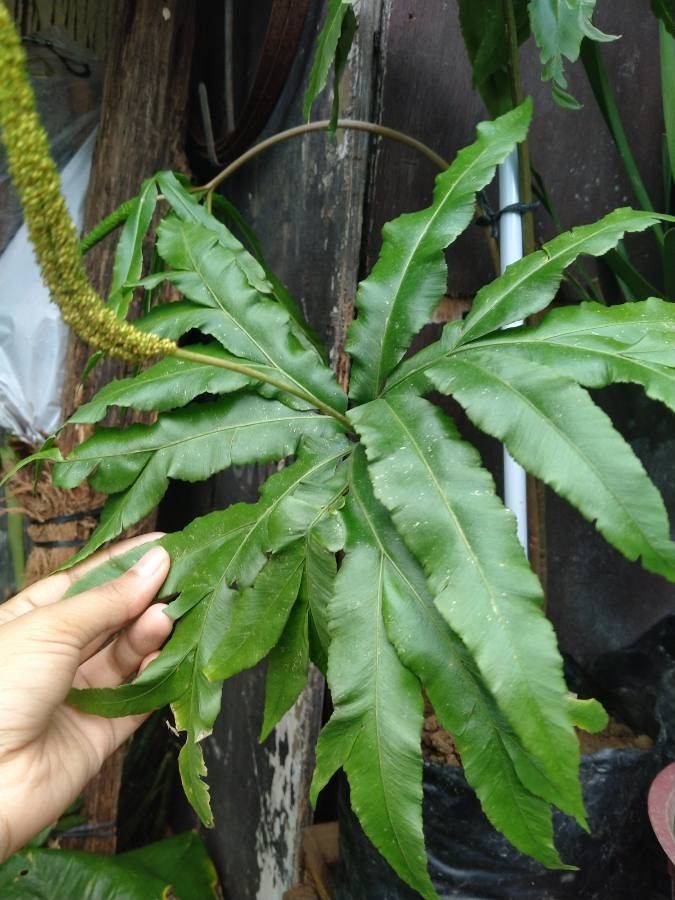
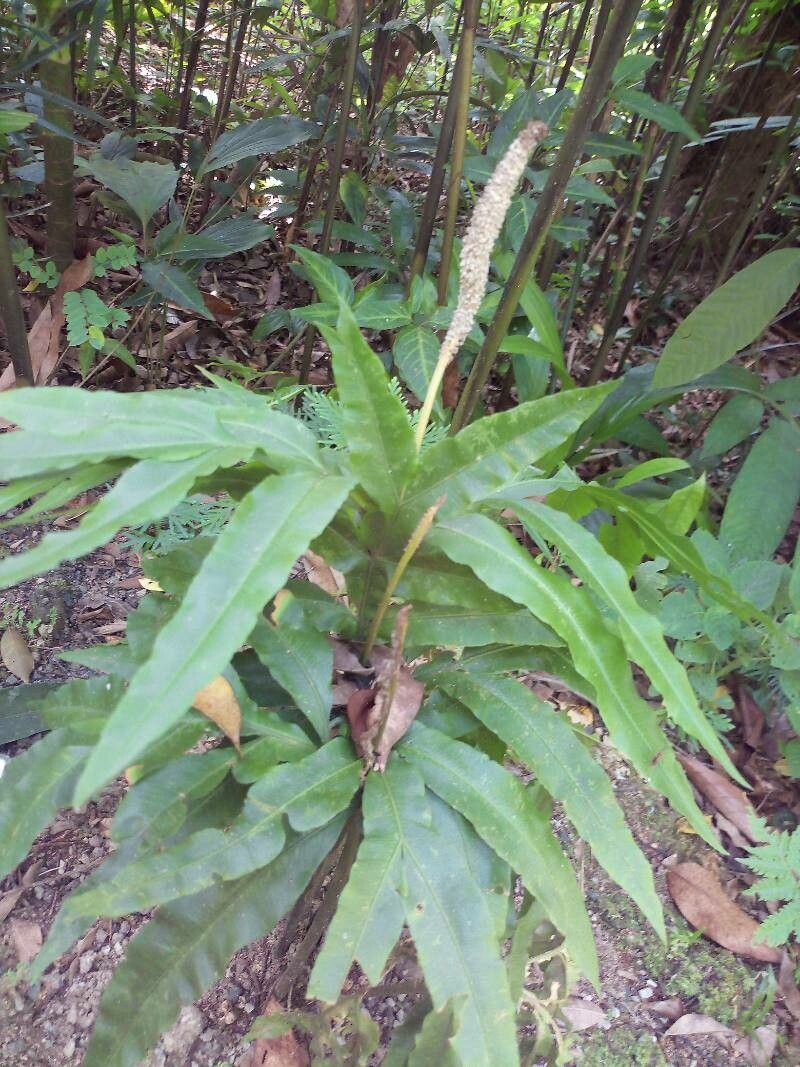
Helminthostachys zeylanica is a terrestrial, herbaceous fern of southeastern Asia and Australia, commonly known as kamraj and tunjuk-langit. The species is like the other members of its family, it has clusters of sporangia on stems of fertile, spike-like fronds. The rhizome of this annual plant is short, creeping, underground, and stout. They can bear either a solitary frond or several fronds. Leaves are lanceolate with the margins entire or irregularly serrate. The frond spike arises from the base of the leaves with its own stipe. Below the spike is a sterile leafy segment (the trophophore). Both it and the sporophore arise from a common petiole.
The Indian flowering fern has good resistance to disease and is generally not susceptible to illnesses. However, it can be affected by pests and diseases present in its surroundings. These infections are usually mild. Regarding care, this plant needs moderate maintenance. It requires regular pruning to keep a neat appearance and encourage healthy growth. Fertilizing can also help stimulate flowering. The Indian flowering fern is suitable for people who have outdoor space, such as a garden or patio, and does not demand extensive care experience. It may need more attention when grown indoors.
How to keep Helminthostachys Zeylanica.
Light
The Indian flowering fern comes from habitats with dappled sunlight, such as forest understories or rocky locations that provide natural shade. It thrives in partial sun yet can also adjust to full-sun conditions.
Water
Native to tropical rainforests, the Indian flowering fern thrives in high humidity with consistently damp but well-drained soil. To maintain its lush growth, it needs to be watered weekly. As an understory plant, it does well in shaded areas, benefiting from the humid microclimate provided by the canopy above.
Temperature
The Indian flowering fern comes from tropical areas, where the climate is usually warm and humid. As a result, it is adapted to high heat and humidity. It is sensitive to sudden temperature changes and prefers a steady temperature, so avoiding indoor temperature swings is important. It generally does not tolerate cold and needs higher temperatures to grow. If the surrounding temperature becomes too low, the plant may stop growing or even die.
Fertilizer
When most of an Indian flowering fern's blooms have opened to full size, it's time to resume fertilizing. Around the period of peak bloom production, begin fertilizing again every three to four weeks, as weather allows. Then, once the fern starts producing fewer new blooms, stop fertilizing; there's no reason to fertilize when the plant can no longer produce more blooms.
Pruning
The Indian flowering fern is characterized by its unique flowering structure and fern-like leaves. To maintain its health and appearance, it is best to prune this fern from early to late spring. During pruning, remove any dead fronds and thin out crowded areas to improve airflow. Be cautious not to prune too heavily, as this can cause stress to the plant. Proper pruning encourages better light penetration and reduces the risk of disease, promoting optimal growth.
Botanical profile.
- Plant Type
- Herb
- Life Cycle
- Annual
- Genus
- Helminthostachys
- Family
- Ophioglossaceae
- Hardiness Zone
- 10-12
- Mature Height
- 15 cm to 40 cm
- Mature Spread
- 20 cm to 40 cm
- Leaf Color
- Dark Green
- Leaf Type
- Evergreen
- Flower Color
- Yellow, Green
- Planting Time
- Spring, Summer, Autumn
- Native Area
- Nepal, Sri Lanka, India, Malaysia, Philippines, Bangladesh, Laos, China, Indonesia, Cambodia, Vietnam, Myanmar, Japan, Bhutan, Thailand
Other names.
Reader questions.
What are the sunlight requirements for Indian flowering fern?
Indian flowering fern benefits from dappled sunlight, mimicking its natural environment such as forest understories or rocky areas that offer natural shade. It prefers partial sun, which amounts to about 3-6 hours of sunlight daily, but it can also tolerate full sun conditions, meaning it can thrive in areas receiving more than 6 hours of sunlight a day. It's essential to watch how sunlight moves through your garden to find spots that offer a balance of light and shade to ensure the plants' wellbeing.
How can artificial lighting support Indian flowering fern growth indoors?
When natural sunlight is insufficient, especially during winter or in less sunny indoor areas, artificial lighting is key for the growth of Indian flowering fern. LED lights are popular for indoor plant lighting as they can provide specific wavelengths needed by plants. Full sun plants should receive 30-50W/sq ft of artificial light, partial sun plants need 20-30W/sq ft, and full shade plants require 10-20W/sq ft. The artificial light source should be placed 12-36 inches above the plant, simulating the natural sunlight's distance, and plants generally need 8-12 hours of light per day to mimic natural daylight hours effectively.
What are common symptoms of inadequate light in Indian flowering fern?
Inadequate lighting can lead to a variety of issues for Indian flowering ferns. Symptoms include the development of smaller leaves compared to older, mature ones, leggy or sparse growth with longer spaces between leaves or stems, faster leaf drop as the plant tries to conserve resources, slower or halted new growth as the plant enters survival mode, paler new leaves indicating a lack of chlorophyll, chlorosis leading to yellowing leaves from excessive sunlight, sunscald causing pale or necrotic spots from intense sunlight, leaf curling as a defense mechanism against too much sunlight, wilting from excessive water loss due to high sunlight exposure, and leaf scorching characterized by brown, dry edges on leaves from too much light.
What solutions can help Indian flowering fern with light-related issues?
To counteract light-related issues in Indian flowering fern, gradual adaptation to increased sunlight is essential. For indoor plants, progressively move them to sunnier spots weekly until they get 3-6 hours of direct sunlight daily. If moving the plant isn't feasible, consider using artificial lighting such as desk, ceiling lamps, or professional grow lights for at least 8 hours daily. For outdoor plants, also move them gradually to sunnier spots to prevent sunburn. Reducing obstructions by pruning trees or relocating plants to sunnier locations during their dormant period can greatly benefit their exposure to sunlight, enhancing their overall health and growth. Note that parts of the plant that have suffered from insufficient sunlight might not recover, but new growth should be healthy with improved light conditions.